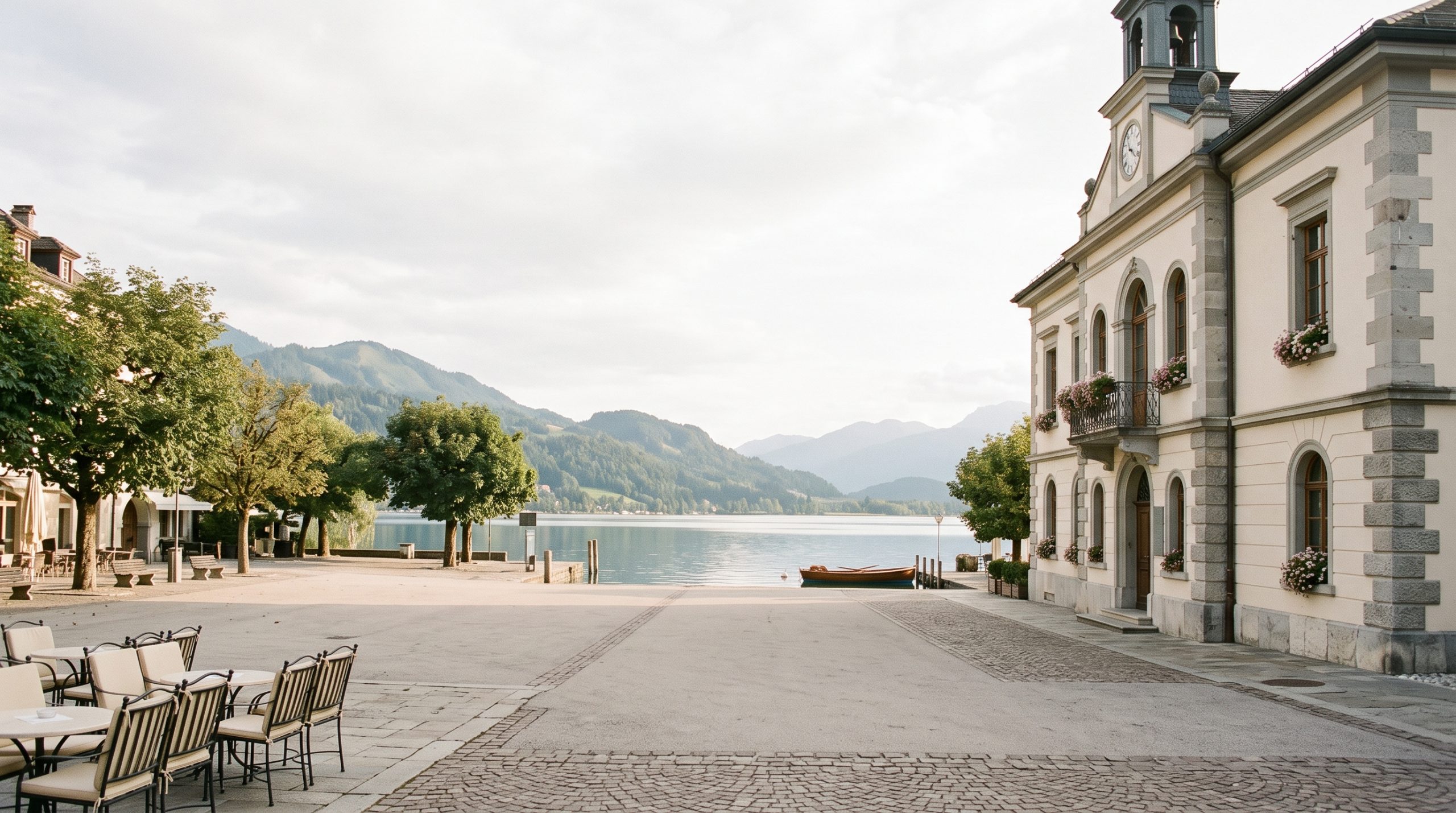
The Swiss civil register office is not the wall couples imagine. It is not closed to visitors and it is not unfriendly. It is an office with a counter you have to stand at in person, a file in German, French or Italian, and a window that opens ten days after it says yes and closes three months later.
That window is the whole story. It is why couples who want their ceremony on a meadow in the Lauterbrunnen valley or on the slopes above Zermatt start reading about Italy and Denmark somewhere around week three of planning, and it is why the answer, for most of them, turns out to be simpler than all three.
We photograph and film in the Alps every summer. Most of the couples we meet on a ridge at six in the morning are already legally married when they land, and not one of them was turned away by Switzerland. They simply wanted their vows at an hour when no register office in Europe is open.
Where the marriage is registered, and where the day happens
Switzerland does marry visiting couples, but the legal act belongs to a civil register office: in person, in an official language, inside a fixed window. Italy and Denmark run files that are friendlier to non-residents. Most couples we work with register the marriage at home and hold the ceremony in the mountains, which costs them nothing in meaning.
What Switzerland asks before it will book you a date
Everything begins with a preparatory procedure, and it is mandatory. It is normally run by the civil register office of the commune where the ceremony will take place, and if you live abroad it can instead be run through a Swiss representation in your own country, which is the part almost no vendor guide mentions. Your presence in person is required, although the two of you are allowed to deal with the administrative side separately, in different places.
The conditions themselves are short:
- Both of you at least 18 years old.
- Both of you with legal capacity.
- Neither already married or in a registered partnership with someone else.
- No marriage between sibling, child, parent or grandparent.
Same-sex couples have married in Switzerland under exactly the same rules since 1 July 2022, and no new registered partnerships are created. Non-Swiss partners have one extra condition to satisfy during the preparatory procedure: they must show that their stay in Switzerland is lawful, which for most American couples means holding the correct entry status through to the wedding day rather than arriving on hope.
Then the document work, which is where the calendar really goes. The office sets its own list, and it is entitled to ask for an apostille on foreign documents and for an official translation into German, French or Italian. For an American birth certificate, the apostille comes from the state that holds the record, and it belongs on a certified copy ordered for this purpose, not on the decorative one in a family album. The office can also ask for foreign papers to be verified through a Swiss embassy and request an advance payment for that work, so this is a stage to start early rather than one to leave until spring.
The ceremony itself is conducted in the local official language, with an interpreter if either of you does not follow it, in the presence of two witnesses of legal age. Documents and the civil ceremony together run between 300 and 400 francs, rising for special requests, a Saturday among them, or a venue outside the register office’s own rooms. There are no banns to publish: Switzerland dropped compulsory marriage announcements on 1 January 2000.
Our rating on this one is fiddly, not closed. If you want the certificate itself to say Switzerland, it is achievable, and couples do it every year. If what you actually want is vows at first light on a terrace above a valley floor, the register office is a detour rather than a route. Published guidance varies, largely because most of it is written for couples who live in Switzerland; the answer that governs your file is the one from the civil register office of the commune where you intend to marry.
Two neighbors whose offices take non-residents
Both are a short flight from the Alps, and both are used to couples who arrive, marry and leave again. They ask for different things in a different order, and that order matters far more than the distance.
| Route | Which office governs your file | Where you stand in person |
|---|---|---|
| Switzerland | The civil register office of the commune, or a Swiss representation abroad for the preparatory procedure | At the office before the wedding, then at the ceremony |
| Italy | The marriage office of the comune, with your own embassy or consulate inside Italy issuing the nulla osta | A tribunal or consulate for the atto notorio, then the comune |
| Denmark | Familieretshuset, the Agency of Family Law, or the local municipality | At the municipality you chose, on the day |
Italy: your own consulate signs before the comune will
- Valid passports for both of you.
- An atto notorio, a sworn statement that nothing stands in the way of the marriage, signed by you along with four witnesses. Americans can do this at the Italian consulate covering their state at home, or at a tribunal or local court once in Italy.
- The nulla osta, the certificate of no impediment, issued by your own embassy or consulate inside Italy. Italy’s consular service says plainly that an affidavit is not the same document as a nulla osta, and that one line protects more wedding dates than anything else on this page.
- The declaration of intent, made at the marriage office of the comune where you will marry.
Anything not in Italian travels with a certified translation, and the comune is specific about who is permitted to certify it, so ask that in the same message in which you ask for an appointment. Read the list above as a sequence rather than a pile: the atto notorio exists so that the nulla osta can be issued, and the comune wants the nulla osta already in your hand. Our destination guides go into what the Dolomites and the lakes actually give you once that file is closed.
Denmark: one authority, one certificate
Denmark’s file is the shortest of the three, and the authority whose answer governs it is Familieretshuset, the Agency of Family Law.
- Check the basics. Both of you 18 or over, both unmarried, and any previous marriage formally dissolved before you can marry again.
- Apply for a Certificate of Marital Status, the document confirming that you meet the requirements of the Danish Marriage Act. The application goes either to the Agency of Family Law or to the local municipality, and which of the two depends on both of your nationalities and on your basis for residence.
- Photograph your passports for that application. Every page, including the front and back covers and the blank ones.
- Pay by a method the agency accepts. Cash and checks are not among them.
Then you marry in the municipality you chose. It is the least romantic paperwork in Europe and the most dependable, which is why couples heading for Alpine ceremonies keep finding their way to it.
Compare the legal calendars before you choose the office
Two Swiss numbers are fixed, and between them they do most of the planning for you. The ceremony cannot be held sooner than ten days after the office confirms the preparatory procedure, and it cannot be held later than three months after that confirmation. The second number is the one that catches people, because the clock starts at the confirmation rather than at the day you handed the file in. A file confirmed in February for a wedding in July has already run out.
So the legal minimum is short: ten days, plus however long the office needs to review what you sent. The comfortable minimum is a different animal, and it is the one we work to.
| Counting back | What is happening |
|---|---|
| Nine to twelve months | Commune and ceremony ground chosen, the date held with us, and a first honest read on which country’s file suits you |
| Six months | Certified copies ordered, apostilles requested from the state holding each record, translations commissioned |
| Four to three months | The file goes in, timed so the office’s confirmation lands inside your three-month window instead of ahead of it |
| Ten days | The earliest the ceremony can follow that confirmation. Nothing left to arrange, only travel |
| The day | In-person appearances behind you, the ceremony hour set against sunrise, sunset and real travel time on mountain transport |
We hold the date before any of this, because register office availability and the hour good light reaches your particular slope are two separate scarcities and they do not negotiate with each other. Getting them to agree is planning work, not luck, and it is easier nine months out than three.
The details that quietly move a wedding date
None of these are dramatic. Each of them is simply a thing to get right early, and each of them has rearranged somebody’s calendar.
- The three-month clock in Switzerland runs from the office’s confirmation. File so that confirmation arrives inside your window, not comfortably before it.
- Ten days at the near end means the confirmation needs to be in hand before you fly, rather than collected on arrival.
- A Saturday costs more in Switzerland, and so does a ceremony held outside the register office’s own rooms. Both can be worth paying for. Neither is free.
- The ceremony runs in German, French or Italian. If you do not follow the language, an interpreter is part of the plan, and planning for one is cheaper than improvising.
- Two witnesses of legal age stand with you at a Swiss civil ceremony. If you are traveling as a pair, raise that with the commune early in the conversation.
- Denmark’s application wants every passport page, covers and blanks included. Far easier to do in one sitting at your own kitchen table than to redo across time zones.
- The Danish agency does not take cash or checks, so settle how you will pay before it is the last thing standing between you and a certificate.
- In Italy, an affidavit is not a nulla osta. Ask your consulate for the document by its name.
- Apostilles attach to certified copies ordered for the purpose. The keepsake certificate stays home.
Administrative prices and deadlines can shift between seasons. Re-check the current amount and deadline with the issuing office before you lock in flights or appointments for easier than switzerland.
Legal at home, celebration above the valley
Here is the route most of our Alpine couples take, and we want to describe it properly rather than as a fallback. You marry at home, often on a weekday morning, at a courthouse ten minutes from where you live. Then you fly to Switzerland with nothing in your luggage but the rings and the vows.
What changes is enormous, practically. There is no preparatory procedure, no translation, no confirmation window, no counter appointment, no language requirement and no dependence on office hours. Which means the ceremony can begin at ten to six in the morning on the Wengen side of the valley, or in the last twenty minutes of light after the day’s final cable car has gone quiet. A celebrant reads what you wrote. Two friends can stand with you, or nobody can, and the fee does not move with guest count either way.
What does not change is everything you came for. The vows are the vows. The letters get read on a rock with the same shake in your voice. The walk up is still the part you talk about at dinner five years later, and the film still opens on the two of you in the dark at the trailhead. If you want to see how that reads in finished work rather than in a promise, our galleries and films are where the difference between an 11am register office slot and a 5:50am ridge becomes obvious. For the wider shape of planning a day like this, start with our guide to how eloping actually works.
If you already know which country you would rather deal with, or you would rather we told you honestly which of the three fits your dates, Send Us a Message and we will start from your calendar rather than from a template.
What we can coordinate across borders and what stays yours
We are photographers and filmmakers, not lawyers. Rules change and circumstances differ, so confirm the detail with the relevant registry office or your own consulate before you book flights. What we do is everything that sits around the file: destination and location design, a timeline built around light and honest travel time, permit research and logistics guidance, weather alternatives and a backup that is real rather than theoretical. We hold your date against register office and celebrant availability, and we set the ceremony hour where the light is, not where it is convenient.
Permit fees themselves are yours, as is the celebrant, accommodation, vendors and any unusual transport such as a helicopter, a private boat or a mountain guide. We do not file paperwork and we do not sign for you. Team travel is included worldwide, so flights and accommodation for the team assigned to you are not a line item you have to think about, wherever the ceremony ends up.
On a day where the civil act sits at 11am inside a register office room, having a photographer and a filmmaker from the same eight-person team matters more than usual. One of us is inside covering the signing and the witnesses; the other is already reading the light on the slope you will be standing on four hours later. Nobody is introducing themselves in the doorway on the morning. What the two of us cover is set out on our pricing page, and the number does not change with the size of your guest list. Highlights reach you in 5 days, and the full gallery or film in 3 weeks.
Common questions
Can we legally get married in Switzerland if we live in the US?
Yes. The preparatory procedure is mandatory and can be started through a Swiss representation in your own country, then completed with the civil register office of the commune where you will marry. You appear in person, non-Swiss partners must show their stay in Switzerland is lawful, and the ceremony falls between ten days and three months after the office confirms.
How much does a Swiss civil ceremony cost?
Documents and the civil ceremony together run between 300 and 400 francs. Special requests raise that, including a Saturday date or a ceremony held outside the register office’s own rooms. Translation, apostilles, celebrant, permit fees and travel all sit outside that figure and are worth budgeting separately.
Is an outdoor ceremony in the Alps legally binding?
The legal act is the civil one conducted by the register office, and some communes will perform it in an approved venue away from their own rooms for a higher fee. A ceremony on a meadow led by a celebrant is a celebration rather than a registration, and for couples who marry at home first it is the only ceremony there needs to be.
Do our US documents need an apostille and a translation?
Expect both in Switzerland: an apostille from the state that holds the record, plus an official translation into German, French or Italian. Italy wants a certified Italian translation and the comune specifies who may certify it. Ask each office for its list in writing and follow that list exactly rather than a summary.
Is Italy or Denmark easier for the marriage certificate?
Denmark has fewer moving parts: one authority, the Agency of Family Law, and one Certificate of Marital Status. Italy has more steps, since an atto notorio with four witnesses comes first and your own consulate inside Italy issues the nulla osta. Italy does put you within driving distance of the Dolomites.
Can same-sex couples marry in Switzerland?
Yes, since 1 July 2022, under the same rules as everyone else, and no new registered partnerships are being created. An existing registered partnership can be converted into a marriage. On a ceremony-only day none of this arises, because the legal marriage already happened at home before you flew.
Do we need witnesses if we are traveling on our own?
A Swiss civil ceremony is held in the presence of two witnesses of legal age, so arriving as a pair is a question to raise with the commune early rather than the week before. For a celebrant-led ceremony after marrying at home, witnesses are a choice, and plenty of the couples we film have none at all.
How far ahead should we start the paperwork?
We work to the comfortable minimum: location and date first, certified copies and apostilles moving around six months out, then the file timed so the office’s confirmation lands inside the three-month window rather than ahead of it. The legal minimum is far shorter, and far more stressful than a wedding morning should be.
Choose the office, then chase the light
The order that works is unglamorous. Decide where the certificate comes from, then build the day around the hour the light is best on the ground you have chosen, because only one of those two things can be moved. We are booking 2027, 2028 and 2029, and everything between us runs in writing, so you can read it properly and reply from your own time zone with the tabs still open.
Tell us the date you are circling and which country’s paperwork you are willing to deal with, and we will come back with a shape for the day, including the honest version if a different month or a different valley fits you better. Start Your Story.