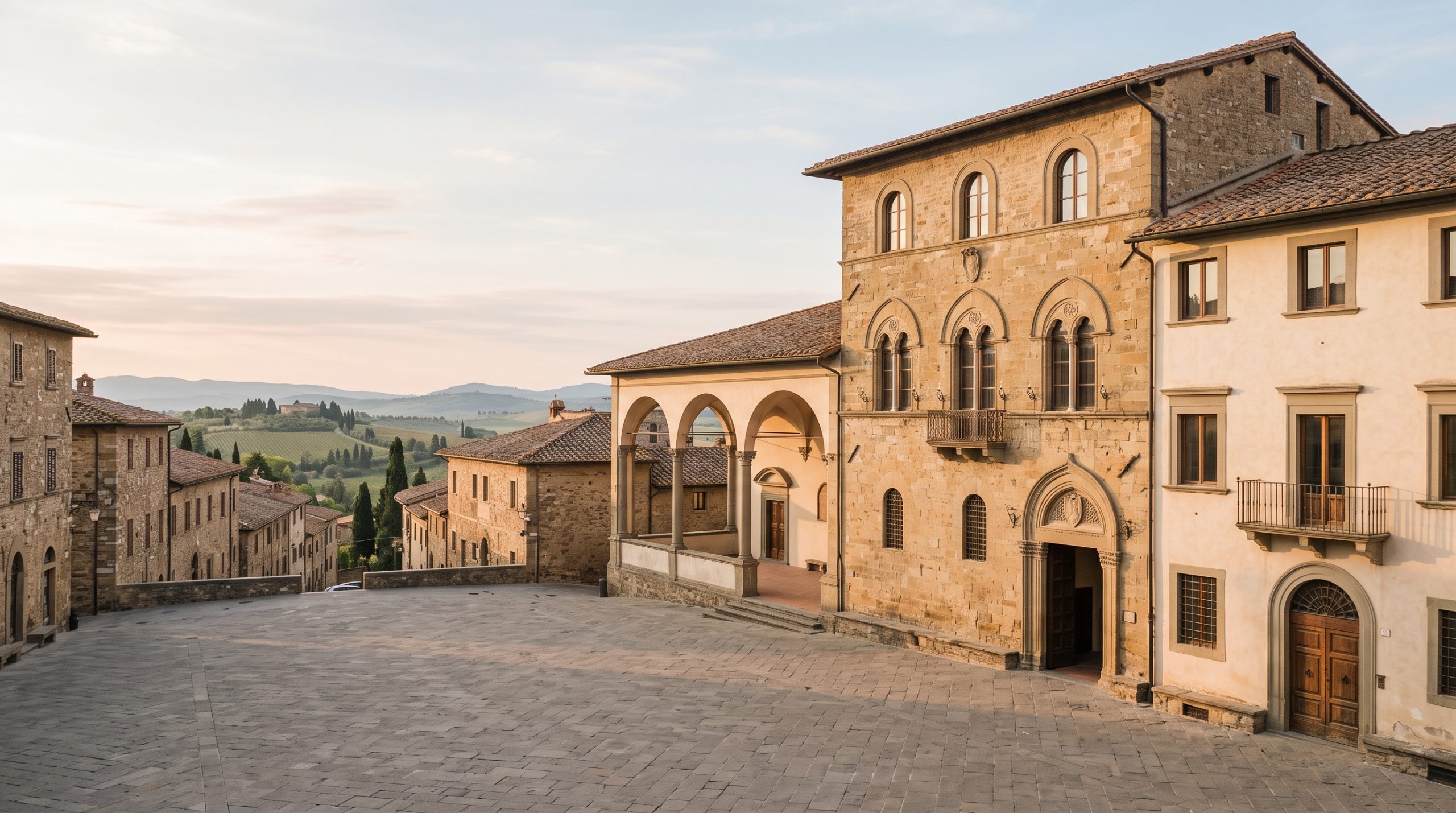
Florence celebrated 1,462 marriages and civil unions in 2027, and 1,345 of those were between people who live there. The gap, a little over a hundred ceremonies, is where visiting couples sit. Those hundred were spread across eight rooms, and the room decides the fee, the day of the week and the hour the registrar can give you.
Couples ask us which Tuscan towns will marry two Americans. All of them will. There is no approved list, no tourist-wedding license, no comune that has opted out. What there is instead is a chain of documents in a fixed order and a set of very local rules about rooms and hours that nobody publishes in English.
Below is that chain in order, the halls four comuni actually license, and the procedural things that catch people out: a nulla osta with no parents’ names on it, an interpreter nobody arranged, a refund line that closes thirty days out. We are photographers and filmmakers, not lawyers. Rules change and circumstances differ, so confirm the detail with the relevant registry office or your own consulate before you book flights.
Any comune can marry you, and none of them sit on a list
Every comune in Italy can marry two foreign nationals, because the procedure sits in Article 116 of the Civil Code rather than in a list of approved towns. What changes from Florence to Calci is the room, the fee, the days the office celebrates, and how early you have to ask for the date.
Our honest rating: fiddly, not hard. Nothing here needs a lawyer or residency. Two sworn statements, one legalization stamp, one hall booking and one visit to the registrar, and they only work in sequence. Couples who start six months out finish comfortably. Couples who start six weeks out spend their first two days in Italy in queues instead of in Chianti, which is a shame rather than a disaster.
If that sequence sounds like the wrong use of a trip you have been saving for, there is a second route we plan just as often: marry at home, then hold the ceremony here. It is a genuinely good option rather than a consolation, and it has its own section below.
The document chain, in the order you collect it
This is the American route, which is the one most of our couples take. Article 116 is the hinge: because your capacity to marry is governed by your own country’s law, the Italian registrar needs something from your side confirming that nothing prevents the marriage. The United States has no federal marriage registry to issue that, so the Italian Consulate General in Houston sets out the requirement as two sworn statements rather than one certificate.
- Atto notorio, signed abroad. A sworn statement made at the Italian consulate covering your state, signed by you and by witnesses who are over eighteen, hold valid photo identification, know you, and are not family or future family. Italian consulates in the United States commonly ask for four, and the issuing office sets the number. The US Embassy’s guidance is to do this before you leave, because in Italy it means the Ufficio Atti Notori of a tribunale, which works to its own diary.
- Dichiarazione giurata, signed in Italy. The declaration made in front of a US consular officer at the consulate covering the comune where you are marrying. You bring proof of citizenship: passport, naturalization certificate, or a birth certificate showing birth in the United States. This is the document the comune will treat as your nulla osta.
- Legalization at the Prefettura. The sworn declaration then goes to the legalization office of the Prefettura. Same city, different building, working hours only. Both the Rome and Milan consular districts list it as its own step, and couples forget it exists.
- Originals of everything, passports included. Comuni want original paper. San Casciano in Val di Pesa, a small Chianti comune with a very clear page, puts it in one line: all documents to be produced in the original.
- A birth certificate, in some cases. Calci’s guidance is the most explicit we have found on this. The nulla osta has to carry your parents’ details, and where it does not, you produce a birth certificate as well, obtainable on the multilingual international form, which is already legible to an Italian registrar.
- Declaration of intent at the comune. Both of you, in front of the ufficiale di stato civile, with an interpreter if you do not speak Italian. For two foreign nationals not resident and not domiciled in Italy, Florence’s guidance states that publications are not carried out under Article 116. This visit does that work instead.
- The ceremony, in the hall you booked, at the hour the office confirmed.
- Apostille on the marriage certificate. After the ceremony the certificate is apostilled. That is the final step the US Embassy lists, and the version to carry home.
Nothing on that list needs a sworn translator if you are American, because both statements are produced inside the system that reads them. Couples on other passports are on a different path: a document issued abroad reaches an Italian registrar with an apostille and an Italian translation attached, which is why Calci points people at the international multilingual birth certificate. Florence also lists nationalities whose registry issues a Certificato di Capacità Matrimoniale instead of a consular nulla osta, among them Austria, Germany, Moldova, Switzerland, Luxembourg, the Netherlands, Portugal, Spain and Turkey.
Counted backwards from the ceremony hour
Two of these steps exist only inside Italy, and both are office-hours work. That single fact sets the shape of your arrival week.
| When | What happens | Whose job |
|---|---|---|
| Twelve to six months out | Comune chosen, room chosen, date held with the stato civile office | You, with our timeline work behind it |
| Well before you fly | Atto notorio at the Italian consulate covering your state, with its witnesses | You |
| Weeks before you fly | A slot booked with the US consulate in Italy for the sworn declaration | You |
| Arrival week, working days | Sworn declaration signed, then legalized at the Prefettura | You |
| Before the ceremony | Documents and declaration of intent at the comune, interpreter present | You and the registrar |
| Ceremony day | The hour agreed with the office, built around the light | All of us |
| Afterwards | Apostille on the marriage certificate | You |
The real minimum is two working days in Italy before the ceremony, and we have planned days that ran on exactly that. The comfortable minimum is four, and four is what we build to: it absorbs a public holiday, a closed counter, or a Saturday arrival that is no use at all for paperwork. If you are still deciding how long the whole trip should be, our guide to planning an elopement from scratch covers the shape of the week rather than the shape of the file.
Florence: eight rooms on one tariff table
Florence publishes a single table covering marriages and civil unions in eight places. In Palazzo Vecchio: the Sala Rossa, the Sala di Lorenzo, the Sala dei Gigli and the Salone dei Cinquecento. Outside it: the former infirmary rooms at the Santa Maria Novella complex, the Giardino delle Rose on Viale Poggi, a room at the Museo Bardini on Via dei Renai, and the council chamber at Villa Vogel on Via delle Torri.
The fee rises by room and by how far away you live, with four residence bands on the table and the top of the published scale sitting just above 5,000 euros. Residents and Florentines registered abroad marry free in the Sala Rossa in the standard weekly slots. Everyone else pays, and the figure covers the registrar’s service only, not the use of a monumental hall for a party afterwards, which sits on a separate tariff altogether.
The capacities matter more than the prices when you are choosing. The Sala Rossa takes about forty people, the Sala di Lorenzo thirty, the Salone dei Cinquecento two hundred and forty. Two people exchanging vows in the Salone dei Cinquecento look like two people in a hall built for a republic, and some couples want exactly that scale. Others find the Sala Rossa kinder: one wall of windows, warm red walls, no walk across an expanse of floor. The Giardino delle Rose is the outdoor option, terraced below Piazzale Michelangelo with the city across the river, and it is a public garden, so quiet is not part of the deal.
Saturday is the day not to assume in Florence. The comune’s page for non-resident foreign couples reserves Saturday celebrations for residents and for Florentines registered with AIRE there. Midweek is where the availability is, and midweek is not the compromise it sounds like, because early-afternoon light through a first-floor Renaissance window is soft, high and consistent. What these rooms and this light give us is in our published galleries and films, a more useful test than any description we could write.
One more Florentine detail: the tariff is refundable only if you release the booking at least thirty days before the date, and payment runs by transfer, postal account or card. Fees and deadlines quoted here were correct at the time of writing and are worth re-checking with the office that issues them.
Siena’s Maestà, San Gimignano’s courtyard, Calci’s piazzale
Siena starts with an email. Foreign couples not resident in Italy write to the stato civile office with both names, current citizenship and the date and hour they want, and the office confirms the booking. Then the room list, and it is the strongest in Tuscany. Inside the Museo Civico in Palazzo Pubblico there is the Sala del Concistoro for fifty, the Loggia dei Nove for eighty with its openings over the Sienese countryside, and the Sala del Mappamondo for fifty, beneath Simone Martini’s Maestà. Beyond the palace: the Fonti di Pescaia, the foyer of the Teatro dei Rinnovati, and the historic hall of the Biblioteca comunale with its walls of old books.
The Mappamondo is the most beautiful ceremony room on this page and the least private. At 5,000 euros it is the top of Siena’s scale, and that figure does not buy exclusive use: the museum stays open, ticket holders keep moving through, and music is not played during the ceremony. The Concistoro and the Loggia dei Nove are the two that are held for you alone. If you want the Maestà above your heads, take the audience with it and let us frame tight. If you want a room that empties for you, say so and we will point you at the other two. Residents pay less than you will; the non-resident line is the one that applies. In a walled city this counts: the tariffs for the Concistoro, the Loggia dei Nove and the Teatro dei Rinnovati include the transit and parking permits you would otherwise buy to get near them.
San Gimignano licenses the Sala di Dante, the courtyard of the Palazzo Comunale, the Conservatorio di S. Chiara museum complex with its Sala Fieschi, exhibition rooms and inner garden, and the municipal offices themselves for couples who want the legal part short and the celebration elsewhere. Its rules come from article 7 of a marriage regulation the council approved in 2011, and two of them shape our planning. From 1 October to 31 March ceremonies run on non-holiday days between 11.00 and 14.00, with anything outside that window agreed with the Ufficio Servizi Demografici. And photographing or filming the celebration itself requires a written request on the comune’s own form, which we would rather have in hand months ahead than discover on the morning. A 14.00 finish in December is better than it reads: the sun is already low over the towers by the time you walk out.
Calci, in the Valgraziosa behind Pisa, is the small-comune example. The council chamber holds ninety and there is a side room that holds ten, and the comune also celebrates on the piazzale in front of the Certosa, the Carthusian monastery that fills the end of the valley. Two Calci rules are worth copying into your notes wherever you marry. Where more than one ceremony falls on the same day, rooms are allocated in the order the requests were registered, so an early file buys the room you actually wanted. And rice and confetti stay out of the hall and out of the building, no hardship, because that moment belongs outside on the gravel with the monastery behind you. For the shape of a day in this part of Tuscany rather than the paperwork behind it, our destination guides are the better place to start.
Where the chain snags, and how we plan around it
None of these are exotic. All of them have moved a real timeline.
- The interpreter is not optional and not provided. Florence states that couples who do not speak Italian must be assisted by an interpreter carrying valid identification, present both at the declaration of intent and at the ceremony, and that the office does not supply one. San Casciano asks for a copy of the interpreter’s identity document with the file. The US Embassy applies the same principle to the atto notorio: if you or even one witness does not speak Italian, an interpreter is required. In practice they stand beside the registrar throughout, so we place them where they belong in the frame.
- Copies are not documents. Originals travel with you, in hand luggage.
- A nulla osta that arrives incomplete. Read it the day it lands. If your parents’ details are missing, Calci’s page shows the fix: a birth certificate on the international form.
- Two offices that only exist on working days. The consulate and the Prefettura both keep counter hours, and Italian public holidays are generous. This is the single reason we ask for four working days rather than two.
- Permission to photograph, where it is a form. San Gimignano requires a written request to photograph and film the celebration. Other comuni handle it in the room regulation or not at all. Working out which applies to your hall is part of the permit research we do before the timeline is written.
Sign at home and keep Tuscany for the celebration
A large share of the couples we photograph in Italy sign at a courthouse at home, quietly, weeks earlier, and treat the Tuscan day as the ceremony. We are not offering that as a fallback. It is the route that produces the day most people describe when they first write to us.
What changes: no atto notorio, no Prefettura, no visit to the registrar, no interpreter requirement, no hall tariff. What you gain is the clock and the map. A comune can only marry you in the venues it has designated, in the hours its regulation allows, which in San Gimignano between October and March means finishing by 14.00. A celebrant will stand with you at 6am on a ridge above the Val d’Orcia or at eight in the evening in an olive grove, anywhere you have permission to be. Vows, rings, the letters you read to each other, a signing if you want the ritual of it, the film, the way the day is built around the light: none of that changes at all.
What we can coordinate with the comune and what stays yours
Our side of this is the day, not the file. We design the destination and the locations, build the timeline around light and real travel time, do the permit research and the logistics guidance, and hold weather alternatives ready. When a comune can only give you 12.30 in July, that decides where you are at 6am and at 8pm, and it is our problem rather than yours. We hold the date against the office’s availability and work outwards from the hour they confirm.
Photography, film and planning come from one team of eight rather than a photographer and a separately hired videographer who introduce themselves on the morning. In a hall with thirty chairs and one aisle, that matters more than it does on a mountain: one of us is on your faces while the other is on the register, the rings and the interpreter’s hands, and where the office allows it, one of us can sign as your witness. Team travel is included worldwide, so Tuscany carries no travel surcharge, and guest count changes the room you can book and the permits you need rather than our fee. Highlights reach you in five days, and the full gallery or film in three weeks. Coverage comes in three shapes, one photographer or one filmmaker for a full day, both working together, or several days across one or more destinations, and the detail sits on our pricing page.
What stays with you: the sworn statements, the legalization, the comune’s forms, the permit fees themselves, your celebrant, your accommodation, and any transport that is out of the ordinary. We research and guide, and we do not file. If you already have a comune in mind, or a hall, or only a week in late September and a preference for hill towns over cities, check your date with us and we will tell you what that comune actually allows.
Common questions
How long do we need to be in Italy before the wedding?
Two working days is the real minimum, because the sworn declaration at the US consulate and the legalization at the Prefettura both happen in Italy and both keep counter hours. We plan four working days where the trip allows it, which absorbs a public holiday or a closed counter without touching your ceremony date.
Which office gives Americans the nulla osta for a Tuscan comune?
The sworn declaration that functions as your nulla osta is signed in front of a US consular officer in Italy, at the consulate covering the comune where you are marrying, and is then legalized by the Prefettura. The atto notorio that supports it is signed earlier, at the Italian consulate covering your state.
Do we need an interpreter at the ceremony if we do not speak Italian?
Yes, and the comune does not provide one. Florence requires an interpreter carrying valid identification to be present both when you make the declaration of intent and at the ceremony itself. San Casciano wants a copy of that person’s identity document in the file. Budget for them as you would a celebrant.
Will our Italian marriage certificate work back home?
The step the US Embassy sets out is to obtain the apostille on the marriage certificate after the ceremony, which is the version to carry home for your own records office. What each state then asks for varies, so have your own state’s requirement confirmed before you travel.
Can we get married outdoors in a Tuscan comune?
Only in a space that comune has designated. Calci celebrates on the piazzale in front of the Certosa, Florence lists the Giardino delle Rose, and San Gimignano licenses the Palazzo Comunale courtyard and the inner garden at S. Chiara. Free choice of a ridge or a vineyard belongs to the ceremony-only route.
How many guests fit in these halls?
Florence runs from thirty in the Sala di Lorenzo to two hundred and forty in the Salone dei Cinquecento. Siena seats fifty in the Concistoro and the Mappamondo and eighty in the Loggia dei Nove. Calci holds ninety in the council chamber, with a side room for ten if it is just the two of you and witnesses.
Can two women or two men marry in a Tuscan comune?
Italian registers record marriage and, for same-sex couples, the unione civile, celebrated in the same halls and priced on the same table. Florence registered forty-four civil unions in 2027. Because a civil union is not a marriage, most American couples in this position marry at home and hold the ceremony in Tuscany, and your own consulate can tell you how the Italian certificate is treated.
Do we need permission to photograph inside the hall?
In San Gimignano, yes, on the comune’s own written request form. Elsewhere it sits in the room regulation, and in Siena the Mappamondo comes with the museum open to the public and no music during the ceremony. We confirm the rule for your specific hall before we write the timeline around it.
Your date, your hall, your hour
We are booking 2027, 2028 and 2029, and Tuscan halls are held further ahead than most couples expect. Everything on our side runs in writing, so nothing has to be squeezed into your working day: send the form, and a reply with our brochure comes back within a day, followed by a proposal built around the comune, the hour and the light. When it is right, a signed contract and a thirty per cent retainer start the planning.
Tell us the town, or tell us the feeling and let us find the town. Tell Us Your Story and we will come back with the halls that fit it, the hours they celebrate, and what your week in Tuscany would actually look like.