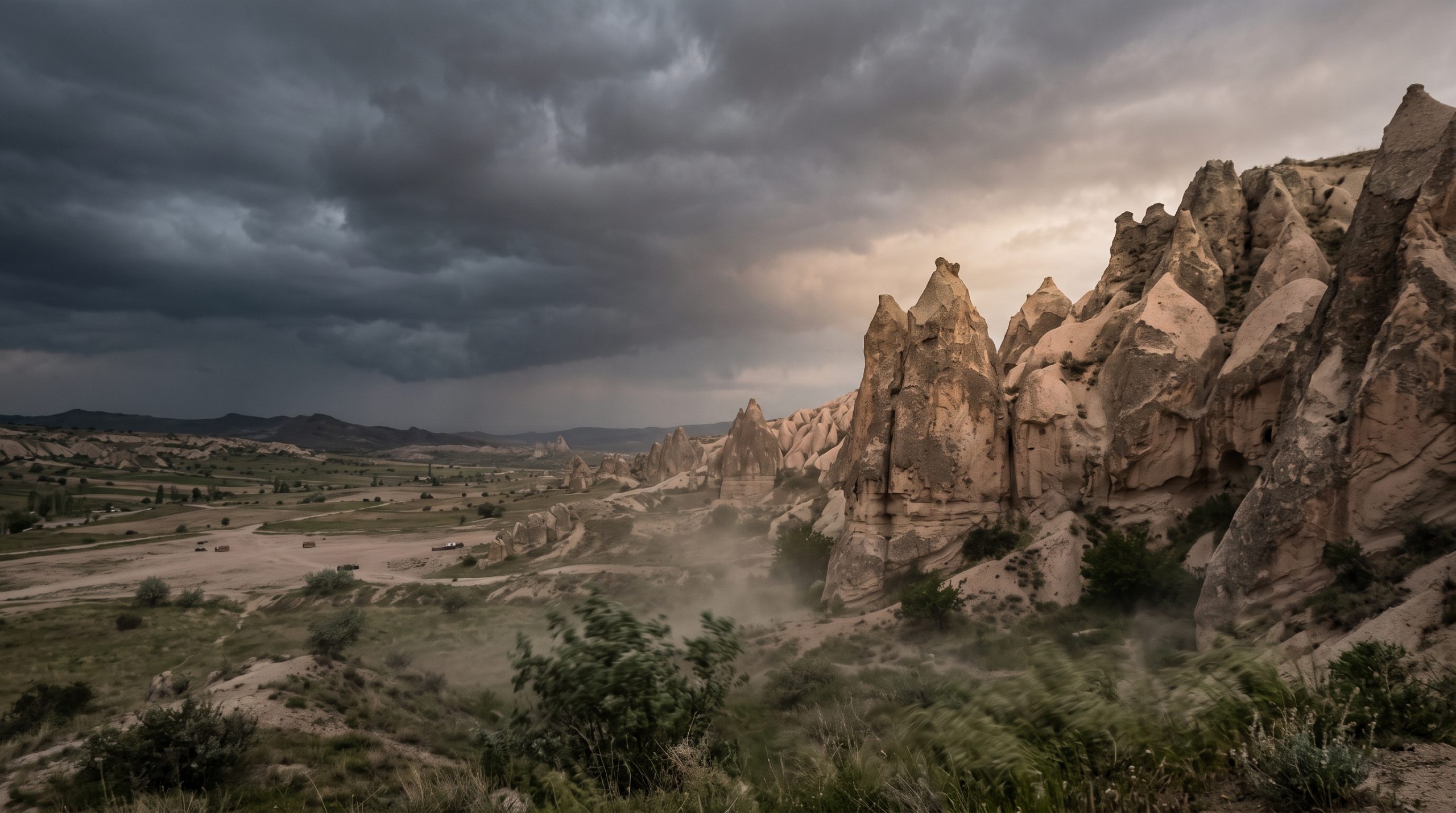
At 4:40am in Göreme the decision has already been made for you. A duty officer looks at surface wind, cloud base and visibility, and a flag is declared over the whole Cappadocia balloon flight zone. Green, and around a hundred balloons start inflating in the dark. Red or yellow, and no company is given takeoff clearance, however clear it looks from the terrace of your cave hotel.
That one call is the only part of a Cappadocia elopement that weather can take off the table outright. Everything else moves. The valleys stay where they are, the rock-cut chapels have no weather at all inside them, and the light along the Uçhisar ridge is better on a broken-cloud morning than on the flat blue ones couples imagine when they book.
So here is the practical version. What each month actually does, what time the sun comes up, what shortens in winter, and what happens on the mornings nobody flies.
Only one thing here can actually be canceled
Weather cancels the balloon flight, and nothing else. Turkey’s civil aviation directorate declares a red, yellow or green flag across the whole Cappadocia flight zone each morning, and no company launches without clearance. Rain, wind and low cloud change where we stand and what hour we start. They do not cancel a wedding day.
Twelve months on the plateau
Nevşehir sits at just over 1,200 meters, which is why a 32°C afternoon in July still arrives after a cold dawn. Sunrise and sunset below are mid-month for Göreme on Turkey’s year-round UTC+3 clock, and they are the numbers your morning is actually built on. If you want one answer rather than twelve, take the first three weeks of October.
| Month | Sunrise / sunset | Conditions | Crowds | Our verdict |
|---|---|---|---|---|
| January | 07:57 / 17:43 | Highs near 6°C, nights around -5°C, snow at some point | Emptiest of the year | Come for snow, not for certainty |
| February | 07:32 / 18:18 | Cold, hard light between fronts | Still very quiet | Our winter pick |
| March | 06:53 / 18:47 | Thaw, soft ground in the valley floors | Building | Unsettled but workable |
| April | 06:05 / 19:17 | Wettest month: 63 mm over about 13 rainy days | Heavy | Green, and damper than you think |
| May | 05:29 / 19:45 | Warm afternoons, cold dawns | Heavy | Strong second choice |
| June | 05:15 / 20:07 | Dry heat building, nearly 15 hours of daylight | Peak | Long evenings, brutal alarms |
| July | 05:28 / 20:05 | Highs near 32°C, almost no rain | Peak | Split the day or move it |
| August | 05:54 / 19:36 | Driest month, under 5 mm across about 5 days | Peak | Hot, dependable, busy |
| September | 06:22 / 18:50 | Heat off, ground still dry | Busy | Excellent from the middle onward |
| October | 06:49 / 18:03 | Cool dawns, poplars going yellow on the valley floors | Thinning through the month | The month we would book |
| November | 07:22 / 17:28 | First cold snaps, sunset before 17:30 | Thin | Underrated, and nearly empty |
| December | 07:51 / 17:20 | Around three hours of sunshine a day on average | Quietest | Short, low, atmospheric |
The whole region takes only about 444 mm of rain and snow in a year. Cappadocia is dry. The issue is never the annual total, it is that a large share of it lands inside a few spring weeks, and that the wind tends to arrive with it.
Three windows only a couple of weeks wide
Late September to the third week of October
This is the only stretch of the year when the dawn call is civilized and the ground is still dry. Sunrise moves from 06:22 in mid-September to 06:49 in mid-October, so a first-light ceremony means leaving your hotel at five rather than four. August has already emptied the sky of rain, and the poplars in the valley bottoms turn while the rock stays warm-toned. Roughly four weeks, and they are the four weeks everyone else has also worked out, so the terraces above Göreme are full by 06:00.
The first snow, whenever it decides to arrive
Nobody can date this one, and anybody who promises you snow is selling weather. What we can tell you is that January runs highs near 6°C and nights around -5°C, cold enough that once snow lands on the chimneys it tends to stay for a few days rather than a few hours. Plan for three days on the ground in a snow month and your odds improve considerably. Plan for one and you are rolling a die. If it does not come, you get bare volcanic ash under a very low sun, which is a harder and more sculptural look, and honestly not a consolation prize.
The first ten days of November
A small, specific window that matters if you want frescoes and last light in the same afternoon. The Göreme Open Air Museum runs its winter schedule from November, closing at 17:00 with last entry an hour before. On 1 November the sun sets at 17:41, so you walk out of the churches with forty minutes of usable light left. By mid-December sunset is 17:20 and that gap has effectively closed. Two weeks decide whether those two things happen on the same day, which is exactly the kind of thing a timeline should already know before anyone books flights. Our guide to planning an elopement goes through how the rest of the day gets built around a fixed point like that.
The two months we try to move couples off
April is the counterintuitive one. It looks like the safe spring choice and it is the wettest month of the Cappadocian year, roughly 63 mm spread across thirteen rainy days, with maximum daytime temperatures around 18°C. The valleys are genuinely green, which they are not in August, and the light between bands of rain is superb. It is simply the month most likely to hand you a gray ceiling at 06:00. If your date is flexible, mid to late May does almost everything April does with a fraction of the rain and a 05:29 sunrise. If April is fixed, we build a wider morning window and put the ceremony where a shower is scenery rather than a problem.
July is the other one, and the reason is heat rather than cancellation. July mornings fly more reliably than any other time of year, but daytime highs sit near 32°C, or 90°F, and the middle six hours of the day are unusable for anything except sitting in shade. The second half of September gives you the same dry mornings without an afternoon you have to hide from. When July is the only month that works, we split the day hard: dawn until about 08:30, a long gap, then everything else from 18:30 to the 20:05 sunset.
What the light does between June and December
Göreme sits at 38.6 degrees north, which gives the year a much bigger swing than most American couples expect. At noon on 21 June the sun stands nearly 75 degrees above the horizon, close to straight down, and the valleys lose all their shadow between about 10:00 and 17:00. On 21 December it barely reaches 28 degrees at its highest, so the entire nine and a half hours of daylight rake sideways across the chimneys. Less light, better light, and a much shorter day to fit everything into.
Practically, that moves the ceremony hour a long way. A June ceremony sits comfortably at 19:00 with the sun still up until 20:09 and civil dusk holding to 20:40. A December ceremony wants to be at 16:20, because sunset is 17:23 and the color goes fast at altitude. June gives you a warm evening two hours deep. December gives you about forty minutes.
That forty minutes is the honest argument for having a photographer and a filmmaker on the ground at the same time rather than one person switching between two jobs. In a June evening there is room to work slowly and repeat things. In a December window there is not, and the difference shows up in whether the vows exist as footage or only as stills. You can see how both look across seasons in our published galleries and films, where the highlights from a day like this reach the couple five days later and the full gallery or film three weeks after that.
What shortens, what closes, and what never shuts
Cappadocia is a year-round region, and very little of it genuinely closes. What changes is how much daylight each thing gets.
- The Göreme Open Air Museum runs to 19:00 from April through October and to 17:00 from November through March, with last entry an hour before closing either way.
- The balloon flight zone is slot-controlled by the civil aviation directorate and divided into three sectors, A, B and C, split by two lines of latitude across the valleys. Operators given clearance have to launch within fifteen minutes either side of their allotted time.
- Aerial filming is planned around that morning wave rather than through it, on a permit and inside a time window we confirm in advance, so the drone work sits either side of the balloons.
- Valley floors, rock-cut interiors and cave hotel courtyards have no season at all. They are where a wet morning goes.
Permit research and the logistics around it are part of what we do before you land, alongside a timeline built on real travel time between Uçhisar, Göreme and Ortahisar rather than optimistic map estimates. Government, site and landowner fees themselves are paid by you. If you are weighing Cappadocia against somewhere else entirely, our destination elopement guides cover the same ground for other regions. When you know roughly which month you are aiming at, tell us your story and we will tell you what that month really gives you.
The morning the flag goes up red
Weather planning is not a hope. It is a document written before anyone gets on a plane, and it names places rather than moods.
A red flag morning still has a sunrise in it. What it does not have is a hundred balloons, so we stop treating the sky as the subject and move to the ground: the deep narrows of Rose Valley and Red Valley, where the walls cut the wind, or the north face below Uçhisar where cloud makes the tuff go silver instead of orange. On a wet morning we go inside, into carved rooms and the chapels, where the only light is what comes through the door and it does not care what the forecast said. On a hot morning we simply start earlier, which in July means being in position by 05:00.
The ceremony hour is the movable part. We build the day so it can slide by two or three hours in either direction without anything downstream breaking, and we agree that in advance so nobody is negotiating at dawn. With eight of us on the team there is always a second camera on the ground and a colleague in reserve, which is what makes a same-morning change of plan a logistics decision rather than a compromise.
One more piece of candor about the place. The famous panorama above Göreme at sunrise, the one every balloon photograph is taken from, is a gravel car park lined with tripods, with the sun sitting directly behind the balloons. It works. It is also crowded, and identical in everyone’s pictures. We will take you there for eight minutes if you want the frame, then move somewhere the light is actually doing something.
Common questions
If the balloons do not fly on our wedding morning, do we lose the day?
No. The flight is the only thing weather cancels outright, and it is one element of a day that runs from before dawn until after sunset. The timeline is built so the ceremony, the valley hours and the evening light all stand on their own without a balloon in the frame.
Which month has the best chance of a clear sunrise in Cappadocia?
Late September and October. August is the driest month of the year with under 5 mm of rain, and that dryness carries into the autumn while the temperature drops off its summer peak. October also gives you a 06:49 sunrise instead of a 05:15 one.
Can we plan an elopement in the snow?
You can plan for the season, not for the day. January and February are the months snow is most likely, with January nights around -5°C, cold enough that a fall holds on the chimneys. Give yourself three days rather than one and treat the snow as a bonus rather than the plan.
How early do we actually have to get up for a sunrise ceremony in Göreme?
In mid-June, sunrise is 05:15 and civil dawn is 04:44, so we are moving by 04:00. In mid-October it is 06:49, which means a 05:30 start. In December sunrise is not until 07:51 and you can have breakfast first.
Is July too hot for a Cappadocia elopement?
Not if the day is shaped for it. Highs near 32°C rule out the middle of the day, so we run dawn to around 08:30, break through the heat, and come back out at 18:30 for the two hours before a 20:05 sunset. Tell us July is fixed and we will build it that way from the start.
Do we need to hold a backup date?
Almost never. What helps far more is a movable ceremony hour inside the day you have chosen, plus named alternative locations for wind and rain. Both are written into the timeline before you travel.
Does the Göreme Open Air Museum close before sunset in winter?
Effectively, yes, from December to February. It closes at 17:00 through the winter schedule while mid-December sunset is 17:20, so the frescoes and the last light are two separate plans. In early November, with sunset at 17:41, you can still have both in one afternoon.
Pick the month, then let us build the morning
Cappadocia rewards couples who choose a season deliberately and then stop trying to control it. October for reliability, February for snow and empty valleys, late May if spring is non-negotiable. Tell us which one you are drawn to and we will tell you honestly what it tends to do, including the parts that do not flatter it.
A Cappadocia day runs as The Expedition, a dedicated photographer and filmmaker working together, with team travel already included and the coverage set out on our pricing page. We currently have elopement dates available through 2027–2029. The planning stays in writing from the first message onward, at whatever hour suits your time zone, starting with a reply and an initial brochure within 24 hours. Check your date and tell us what you want the morning to feel like.