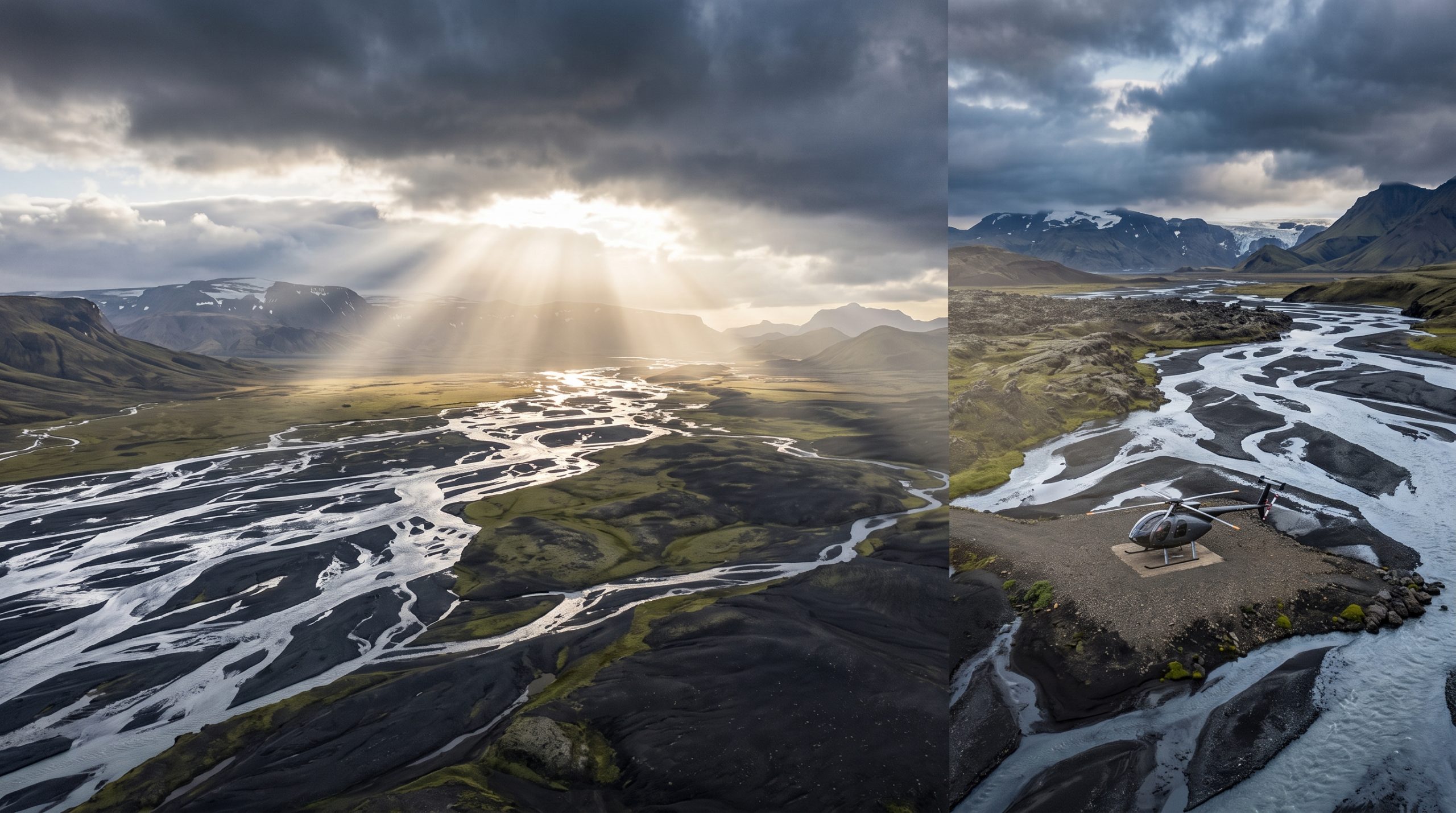
A helicopter elopement in Iceland is not a longer version of a helicopter tour. The tour is a loop with a landing in the middle of it. What you are buying for a wedding day is something else: a private aircraft, a pilot willing to hold that aircraft on a glacier while you say your vows, and the specific hour of light you want to be standing in when it happens.
Most of these flights leave from Reykjavík Domestic Airport, which sits inside the city rather than out at Keflavík. Norðurflug, the oldest and largest helicopter service on the field, keeps its doors open from 9am to 5pm, seven days a week. In late June, the light you crossed an ocean for arrives at eleven at night. Reconciling those two sentences is most of the planning work on a day like this.
So this page covers the three things couples ask us in the first email: what the flight costs, where a helicopter is allowed to set down, and what happens to the day if the weather says no. Photography, film and planning come from one team here, so the flight is never a booking we hear about after the fact.
What the flight costs, where you can land, and who decides
Private helicopter elopement flights leave from Reykjavík Domestic Airport and currently start around ISK 199,000 for a short package with one landing. Landing away from an airfield needs the landowner’s permission, or the managing authority’s inside protected areas. The pilot makes the final weather decision on the morning itself.
Rotor time is the product, not the package
Charter is priced by the aircraft and the hour, not by the head. Glacier Heli publishes private flights for proposals and small ceremonies from around ISK 199,000, which covers the aircraft to yourselves, a pilot, and a landing on a glacier, an active volcano or Mount Esja above Reykjavík, with the timing arranged around sunrise, golden hour or sunset. Prices move, and operators quote in krona, so ask for the number in ISK rather than a converted figure you will have to check again later.
The published sightseeing loops give you a sense of the clock. A glacier landing run out of Reykjavík, over Þingvellir and Skjaldbreiður toward Þórisjökull, is listed at roughly 75 to 95 minutes in total, aircraft and conditions depending. Highland routes that reach Landmannalaugar, Þórsmörk or Hekla are measured in hours instead. Every extra minute you want on the ground is another minute of a machine sitting with its rotors turning, and that is the line couples underestimate.
Helicopters, private boats and 4×4 charters sit on your side of the budget rather than ours, which is deliberate. You pay the operator directly, and we stay free to tell you when a shorter flight would serve the day better than a longer one. Our own coverage is one figure wherever in the world we fly, with team travel included, and it is set out on our pricing page.
Who has to say yes before you land
Two questions decide it: whose land is it, and does that land carry a protection status. Outside protected areas, setting down away from an airfield is the landowner’s decision, and a written yes is worth having before anyone falls in love with a location. Inside reserves and national parks the rules are tighter and specific to each area. Hornstrandir is the clearest published example of the pattern: landing outside the areas defined in the zoning plan requires the conservation authority’s approval, while landowners may land on their own land.
Vatnajökull National Park now sits under the Nature Conservation Agency of Iceland, and permits for film and advertising work there must be applied for at least 30 days in advance, charged against the park’s own price list. In the Fjallabak reserve, highland traffic uses established landing sites, Landmannalaugar being the one everybody knows, and the agency’s 2027 to 2027 action plan looks at adding more of them.
That is why “can we land on that ridge” and “can we land where you normally land” are completely different requests. An operator already holds the arrangements for the sites it uses week in and week out. A new spot on a private farm is a conversation with a farmer, and it takes as long as it takes. Permit research and logistics guidance are part of every booking on our side, and the order the rest of the planning happens in is laid out in our guide to planning an elopement.
| Who approves it | Where it applies | When to start |
|---|---|---|
| The landowner | Farmland, coast and lava outside protected areas | In writing, before the location is fixed |
| Nature Conservation Agency of Iceland | Vatnajökull National Park and other protected areas | Film and advertising permits at least 30 days ahead |
| The operator’s established sites | Highland landings such as Landmannalaugar in Fjallabak | Confirmed when the charter is held |
| The pilot in command | Every landing, without exception | The morning of the flight |
Seats, weight and the fifth person in the cabin
Count the bodies early. Private cabins on the aircraft used here take four to six passengers depending on the type. You are two. A celebrant makes three. A photographer is four. A filmmaker is five. In a four seat cabin that arithmetic does not work, and the answer is either a larger machine or two rotations with someone waiting on the ice. Nobody enjoys discovering this in the week before the wedding.
Because photography and film come from the same eight people here, we know which shape your day needs before the charter is held. On the Expedition, a dedicated photographer and a dedicated filmmaker work the same hours: one rides in and covers the approach while the other is already on the ground as you step out, if the flight runs twice. Two sets of gear also means the day never rests on one battery, one card or one lens in the cold. Cameras count against weight and balance like everything else, so we fly light and leave the rest at the terminal.
Clothing behaves differently near a rotor. Rotor wash flattens anything loose, so a long veil beside a turning aircraft is a choice rather than an oversight, and wool or a heavy crepe holds its shape on ice where tulle simply gives up. Boots stay on for the landing, and the shoes you actually want in photographs live in a bag until you are somewhere they make sense.
Drone and helicopter in the same hour
Aerials in Iceland run under the Icelandic Transport Authority’s rules, currently regulation no. 1360/2024 on remotely piloted aircraft, plus whatever the protected area adds on top. Inside Vatnajökull National Park, permitted zones and daily windows vary from area to area, and filming permission is a production application rather than a recreational one, on the same 30 day timetable. Operationally, we never put a drone up while a helicopter is turning nearby. Aerials get their own slot, before the aircraft arrives or after it lifts away.
Flight time is not day time
A 90 minute flight takes about four hours out of your wedding day. There is the drive to the airport, the check in and the briefing, the wait while the pilot reads the last hour of weather, the changing, and then the flying. Plan the four hours instead of the 90 minutes and the timeline stops fighting you.
Then there is the landing itself. A highland or glacier set down commonly gives you around fifteen minutes on the ground. Vows, rings and a few minutes of the two of you alone with the ice will fill that. A ceremony with readings, a processional and a signing will not. If you want half an hour up there, the aircraft has to wait for you, and that is a decision made when the charter is booked rather than on the ice with the rotors running.
Weather does not behave like one country. Reykjavík can be clear while the plateau above it is in cloud, and we have had mornings where the coast was grey and the highland was wide open above the murk. A pilot needs visibility, a cloud base above the landing site, wind inside limits, and a surface they are content to put weight on. Coastal fog often lifts through the morning. Highland cloud tends to sit.
Light is the other half of the equation. In late June the sun sets a few minutes after midnight and is back up before three, so there is no real darkness and the low, raking light runs for hours at each end of the night. Around the winter solstice, sunrise is close to 11:20 and sunset near 15:30, which leaves a little over four hours of daylight to hold the flight, the ceremony and every drive between them. Ice in low sun does something on film that midday ice never does, and the difference is easiest to see in our films and galleries.
| Season | Light you can fly in | What we do with the slot |
|---|---|---|
| Late May to July | Sunset just after midnight, sunrise before 3am, usable low light for hours | Ask for a late evening or very early charter rather than a midday departure |
| August to mid October | Real darkness returns, golden light lands inside a workable part of the day | Fly early, then work ground locations as the sun drops |
| November to January | Roughly four hours between a late morning sunrise and a mid afternoon sunset | One flight slot, ceremony on the ground, nothing else stacked that day |
| February to April | Daylight climbing fast, deep snow cover, highland cloud still frequent | Flight kept as one movement inside the day, second location held in reserve |
The honest version of the midday problem: at one in the afternoon in July, a glacier under a high sun is a flat white plate. It is bright, it is enormous, and it photographs like a lightbox. The same ice at nine in the evening has shadow, grain and edges. If the only slot available is the middle of the day, take it for the flying and put the frames you will hang on a wall somewhere else in the day, or choose a date where the light and the slot agree with each other.
Three things we would not book. The last flight slot of a December afternoon, because there is no daylight left behind it if the aircraft goes late. Two landings plus a ceremony inside a 75 minute charter. And a flight booked tight against a dinner reservation, because a weather hold then turns two plans into one problem.
How we build a day around one uncertain hour
The flight is a movement inside the day, never the spine of it. That single decision takes most of the pressure off. We put the ceremony where it does not depend on rotor time, or, if you want the vows on the ice, we hold a ground location within reach of the airport for the same hour and decide in the morning which one you are standing in.
The rest is unglamorous and it works. The flight goes in the first workable slot rather than the prettiest one on paper. The timeline is built on real travel time rather than route planner time, and a second location sits in reserve for every outdoor hour. If the cabin is small, the two rotations are planned in advance with the order already agreed. Highlights reach you within 5 days and the full gallery or film within 3 weeks, whichever way the day ended up running.
We are booking 2027, 2028 and 2029, and planning begins once the contract is signed and the 30% retainer is paid. If a helicopter is part of what you are picturing, the earlier we know, the more say you have over the hour you fly. Check Your Date.
Common questions
Can we legally get married on a glacier we fly to?
Your celebrant travels with you, so the ceremony happens where the aircraft lands and where you have permission to be. The legal side is the celebrant’s job and it does not change because you arrived by air. The real constraint is time, which is why many couples handle the formal signing on the ground and keep the vows for the ice.
How much does a private helicopter cost for an Iceland elopement?
Published private packages start around ISK 199,000 for a short flight with one landing, and the number climbs with rotor time rather than with anything else. Ask the operator to quote in krona, and ask separately what waiting time on the ground costs, because that is where two quotes for the same idea stop matching.
What happens if the helicopter cannot fly on our wedding day?
The decision is made on the morning by the pilot, and flights are commonly moved to another slot or another day. On our side the elopement is designed to work without the aircraft: a ceremony location within reach of Reykjavík, a second option held for the same hour, and a timeline that does not collapse if the flying moves.
Do you need a permit to land a helicopter on a glacier in Iceland?
You need permission from whoever controls the ground. Outside protected areas that is the landowner. Inside a national park or reserve it is the managing authority, now the Nature Conservation Agency of Iceland in the case of Vatnajökull, where film related permits are applied for at least 30 days ahead.
Can our photographer and filmmaker both fit in the helicopter?
In a five or six seat cabin, yes, alongside the two of you and a celebrant. In a four seat cabin, no, and the day is then planned as two rotations or around a larger aircraft. We settle that question before the charter is held rather than after.
How long do you actually get on the ground after a landing?
Around fifteen minutes is normal on glacier and highland landings unless you have paid for the aircraft to wait. That is enough for vows and a real set of frames when everyone knows the order in advance, which is exactly what the timeline is for.
Is a helicopter worth it in winter with so little daylight?
It can be, because the sun stays low all day and snow covered ice reads beautifully. The catch is arithmetic. With roughly four hours between sunrise and sunset in December, the flight has to be the only ambitious thing in the day. Our destination guides go through Iceland month by month.
Where to start if the flight is the plan
Send us the month you are considering, whether you want the vows themselves on the ice or somewhere the weather cannot argue with them, and how many people are coming. That is enough for us to tell you which landing sites fit, what the seat count does to your day, and which weeks give you the light you are picturing. Everything on our side happens in writing, and you will have a reply and our first brochure within 24 hours. Tell Us Your Story.