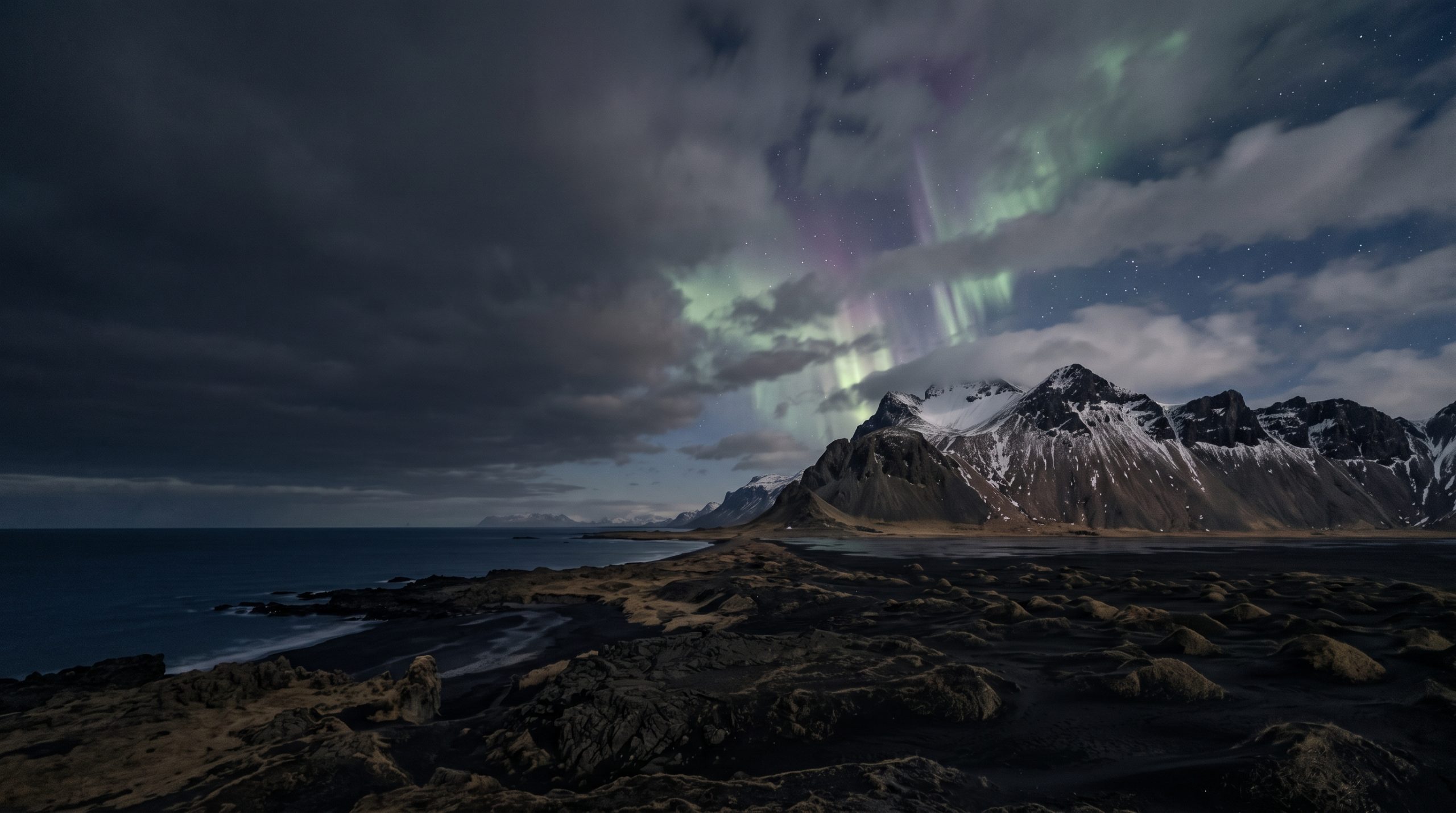
Ask us whether you will see the northern lights on your Iceland elopement night, and you get the same answer every couple gets from us: the season is generous, the sky is not. Iceland’s aurora runs from late August or early September through to roughly mid-April, and that window is set by darkness rather than by luck. Inside it, the sun has been cooperative. The current eleven-year solar cycle began in December 2019 and has spent recent years in its maximum phase, which is the strongest backdrop this decade has to offer.
Cloud is what decides your actual night. The Icelandic Met Office builds its aurora page around that admission. It shows a map of forecast cloud cover across the country, and beside it an auroral activity number for midnight on a scale of 0 to 9, together with the times of sunset, darkness, sunrise and moonrise for Reykjavík. Four things to read, and only one of them is about the sun.
What follows is a month by month read on what Iceland gives you after dark, with the daylight figures that shape the wedding day itself. One thing worth knowing before you stand out there: a quiet aurora looks like a pale gray band to the naked eye long before it looks green. The camera finds the color first. Couples who know that in advance enjoy the night far more than couples who are waiting for the version they saw on a screen.
Your real odds, night by night
Treat any single named night between late August and mid-April as close to a coin toss. The season and the sun are usually working for you, and cloud decides the evening. Across three or four dark nights on the ground, the odds swing strongly in your favor, and September and March are the two strongest months.
Twelve months of darkness, weather and crowds
This is the table we plan from. Daylight figures are for Reykjavík, and the north runs a little longer in summer and a little shorter in December. The crowd column comes from Keflavík traffic, which peaks hard in August and thins out fast once the highland roads shut.
| Month | Darkness and daylight | Conditions | Crowds | Our verdict |
|---|---|---|---|---|
| January | Around 4 to 5 hours of daylight | Cold, dark, plenty of low cloud | Quietest month of the year | Maximum darkness, difficult skies |
| February | Nights still long, daylight climbing | Coldest monthly average, near 0.5°C (33°F) | Still low | Good aurora, cold ceremony hour |
| March | 10 hours of daylight on the 1st, over 13 by the 31st | About 14 days carry precipitation | Rising slowly | Our second pick |
| April | Aurora season closes around mid-month | Milder, changeable, snow inland | Rising | First ten days only |
| May | Midnight sun from mid-month | Driest stretch of the year begins | Busy from mid-month | No aurora, superb daylight |
| June | Peak midnight sun, June 15 to 25 | Driest month in Reykjavík | Very busy | Zero aurora, endless light |
| July | No true darkness at all | Warmest month, average near 12°C (54°F) | About 302,000 foreign departures in July 2027 | Wrong month for the lights |
| August | 18 hours of daylight on the 1st, 14.5 by the 31st | Mild, often settled | Busiest month, about 313,000 departures in 2027 | The last week is the opening |
| September | Sunset slides from about 8:45pm to about 7pm | Changeable and workable | Thinning after the first week | Our first pick |
| October | Real darkness by dinner | Wind and rain arrive, highland roads shut | Low | Strong odds, honest weather |
| November | About 6.5 hours of daylight | Wet, windy, early frost | Low outside the city | Long nights, patient plan |
| December | Just over 4 hours, sunrise about 11:20, sunset about 15:30 | Cold and dark, holiday lights in town | Rises over the holidays | Golden hour that lasts all day |
September and March, and the narrow windows either side
People who study the aurora professionally tend to point at the months around the equinoxes rather than the depths of winter. The Icelandic astronomer Sævar Helgi Bragason names March, April, September and October as the ones to aim for. Midwinter holds more darkness than any of them, so darkness is clearly not the whole story. Weather and access are the rest of it, and those two are what make an elopement work or not work.
September is our first pick for a wedding night. Sunset moves from about 8:45pm at the start of the month to about 7pm at the end, so you can hold a ceremony in evening light, eat somewhere warm, and still be standing in the dark by eleven without anyone having to stay awake until 2am. Daylight drops from roughly 14 hours to roughly 12 across those four weeks, which is a fast change by any standard. A date on September 5 and a date on September 28 are two different plans, and we build them differently.
March is the other one. Daylight climbs from around 10 hours at the start of the month to over 13 by the end, so you get full winter landscape with a workable day wrapped around it. Around 14 days of the month carry some precipitation, which for Iceland is a reasonable deal. Snow is still on the ground at elevation, the coast is walkable, and the nights are long enough that you are not waiting up.
Both edges of the season are narrower than most planning articles admit. The midnight sun peaks between June 15 and 25, and genuine darkness does not return until the middle to the end of August. Reykjavík has about 18 hours of daylight on August 1, and about 14.5 by August 31, with a few properly dark hours in between. An aurora plan for the first three weeks of August is not a plan. The last week of the month is where the season actually opens, and mid-April is where it closes.
The months we would not choose for an aurora-led day
Mid-May to early August. That is the entire list, and the reason has nothing to do with weather. The sun simply does not go far enough below the horizon for the sky to darken, which is why the lights are unavailable in June no matter how active the sun is that week.
That is not a lost trip, it is a different one. If your date sits inside that window because of an anniversary or the way the year falls, we build the day around the midnight sun instead: a ceremony at 10 or 11pm with the sun grazing the horizon, warm light on the north side of a peninsula at an hour when everyone else has gone to bed, and no rush at all because the light never runs out. It is one of the best nights Iceland offers, and it is a completely different film from a September one.
If the date can move, tell us the month you are working around. We will tell you the nearest week that has real darkness in it, and what the trade in weather and daylight looks like. Our destination elopement guides cover the same ground for other places, if Iceland turns out to be the wrong latitude for your calendar.
What the light does before the lights come out
The aurora is one hour of your day. The other hours are governed by a sun that behaves nothing like the one at home. In December, Reykjavík gets just over four hours of daylight, with sunrise around 11:20 and sunset around 15:30, and the sun never climbs high enough to go hard. The entire day reads as one long low golden light. You can sleep, eat breakfast slowly, and still be in position for sunrise. That is a genuinely nice way to get married, and it is why we do not treat December as a compromise.
September gives you the opposite structure: a normal day with a long evening attached. Sunset at 8:45pm early in the month means the warm hour lands after dinner, and the blue hour that follows runs longer at this latitude than most couples expect from home. March sits between the two, with daylight climbing from 10 hours to more than 13 across the month, and a low sun angle that holds side light through the middle of the day.
What that does to the work is simple. In summer, we can shoot the same location twice in one evening and let a ceremony breathe. In December, everything that needs the sun happens inside a four hour block, so the timeline is written to the minute and nothing gets moved casually. You can see how both look finished in our elopement stories and films, where the winter days and the long autumn evenings sit side by side.
Where we drive to find a gap in the cloud
Iceland’s weather is local to a degree that surprises people. A front sitting over the south coast often leaves Reykjanes clear, and a 90 minute drive can change your sky completely. That is the single most useful thing about basing an aurora night here rather than somewhere with one road in.
The practical map in aurora season is coastal and lowland. Þingvellir is under an hour from Reykjavík, the Reykjanes lava fields sit about 45 minutes from Keflavík, Snæfellsnes is roughly two hours out, and Vík is about two and a half down the south coast. Any of those can be reached, checked and swapped inside an evening.
The highlands are a different matter. Vegagerðin, the Icelandic Road and Coastal Administration, opens each mountain road individually once the snow has gone and the ground has dried, which usually falls between mid-June and early July, and those roads close again somewhere between mid-September and mid-October. Live status sits on road.is, and there is a 24 hour road line on 1777. Read those dates against the aurora calendar and the answer is clear: highland nights and aurora nights barely overlap, so we plan aurora around the ring road and the peninsulas, where the driving stays reasonable in the dark.
How the aurora backup works before you arrive
Every Iceland day we build has two locations for each hour, chosen by wind direction rather than by preference, and an aurora hour that is separate from the ceremony hour. The ceremony is anchored to daylight. The aurora is opportunistic, and we say so from the first proposal, because a night sold as a certainty is a night that can only disappoint.
In the days before you fly, we are reading the Met Office cloud map alongside the midnight activity number, and the moonrise and moonset times published next to them. A bright moon does not cancel an aurora night. It lights the landscape underneath it, which can be a gift on a snow covered plain and a nuisance on a coast where we want the sky to carry everything. Either way we know which one we are getting before we choose the spot. Where a trip runs several nights, we hold two evenings open and commit to one of them roughly 24 hours ahead.
This is also where working as one team stops being a talking point. A December ceremony has four hours of usable daylight around it, which is not enough time for a photographer and a filmmaker to take turns. On the Expedition, both are on the ground at once, so the vows are filmed and photographed in the same take rather than in two attempts. At night the split matters even more, since a long exposure for stills and a rolling shot of the same sky are two different jobs happening at the same moment. Team travel to Iceland is included in every experience, and what each one covers is set out on our pricing page. Highlights reach you within 5 days, and the full gallery or film within 3 weeks.
If you already have a date, send it to us with the month you are stuck with and the kind of night you are hoping for, and we will tell you honestly what that date can and cannot deliver. Send Us a Message and we will come back with the specifics for your week.
Common questions
Can we see the northern lights if we elope in June or July?
No, and we would rather say it plainly than hedge. The midnight sun peaks between June 15 and 25 and the sky does not get dark enough for the aurora from mid-May to early August. What those months give you instead is a ceremony at 11pm in warm light, which is its own reason to come.
Which month gives the best northern lights chance for a wedding night?
September, then March. September holds real darkness by late evening while sunset is still around 8:45pm early in the month, so the ceremony and the aurora hour both fit into one civilized evening. March gives you longer nights and a landscape still holding snow, with daylight climbing from 10 hours to over 13 across the month.
How many nights should we plan for if the aurora matters to us?
Three or four dark nights. A single night is a coin toss, and every extra night you spend in Iceland during the season lowers the odds that cloud takes all of them. Couples who build a two or three day shape into the trip almost always get their night somewhere inside it.
What do our photos look like if the aurora is faint?
Better than what you saw standing there. A quiet display reads as a pale gray band to the eye and comes through green in a long exposure, so a night that feels modest at the time often delivers the frames you keep. On a faint night we work closer, use the landscape and the light we can control, and let the sky be the backdrop rather than the subject.
Does a full moon ruin northern lights photos?
It changes them rather than ruins them. Moonlight puts detail into snow, water and mountain faces that would otherwise sit black, which suits a wedding frame where you are the subject. The Met Office publishes moonrise and moonset alongside the darkness times, so we know months out whether your night is a bright one and we choose locations accordingly.
Can the ceremony itself happen under the northern lights?
Vows in full darkness are hard to see and harder to hear over wind, so we almost always set the ceremony in daylight or blue hour and treat the aurora as a second act later that night. In December that is easy, because sunset arrives around 15:30 and the dark hours are underway well before dinner.
Choosing a week you can plan around
Pick the month for the light and the daylight hours first, because those are the only parts of an Iceland night that behave predictably. The aurora is the bonus that shows up on top, and the couples who treat it that way are the ones who end up with both. Dates are currently open across the 2027–2029 seasons, and everything runs in writing from the first message onward: you send the form, we reply within 24 hours with an initial brochure, and the planning starts from there. Tell us your date and what you want the night to feel like, and we will tell you what Iceland does that week. How the planning works covers the rest, or go straight to the form and Start Your Story.