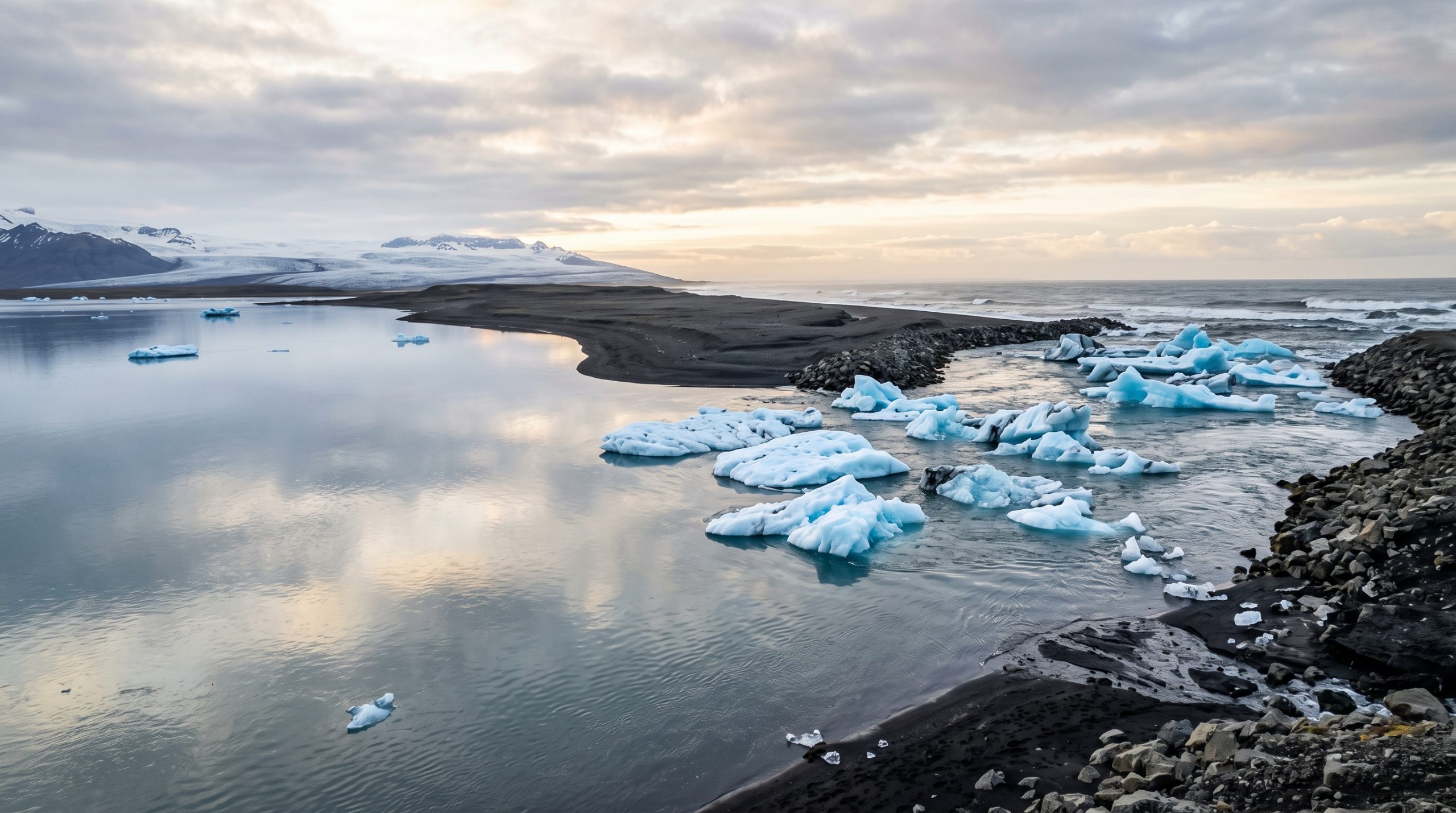
The sand at Fellsfjara is a different beach at six in the morning than it was at midnight, and the reason is not the light. Ice arrives on the rising tide and gets left behind as the water pulls back, so a stretch that held nothing at high water can hold twenty pieces of glacier ice two hours later.
Most pages about Jökulsárlón and Diamond Beach tell you what the place looks like. The useful information is a clock. Route 1 crosses the lagoon outlet on a bridge, still water on one side and open Atlantic on the other, and the two sides are good at different hours of the same day.
Nothing here involves a hike. You are never much more than five hundred metres from a car park. What decides whether the day works is the tide table, the wind direction, and how far you are willing to sit from the middle of the afternoon.
The hour we aim for on the sand
We build the beach hour on a falling tide, an hour or two after high water, when the pieces the sea carried in are sitting on drying sand and the walkable strip is at its widest. The lagoon side barely changes with the tide, so it takes whatever hour is left over.
Why the beach resets twice a day and the lagoon barely moves
Icebergs break off Breiðamerkurjökull at the head of the lagoon, drift for as long as the wind and the current want them to, and eventually find the narrow outlet that runs beneath the Ring Road bridge and out to sea. Seawater pushes the other way through the same channel, which is why the lagoon is a mix of fresh and salt rather than pure meltwater. The tide here is not weather. It is plumbing.
The sea works those pieces down quickly and hands some of them back. Fellsfjara, the black sand strip the world now calls Diamond Beach, is where they land.
Two high waters and two lows every day, roughly six hours apart, each arriving about fifty minutes later than the day before. The same clock hour on Thursday is a different beach from Wednesday. So the order we work in is fixed: read the tide table for your date, place the ceremony, then move everything else around it.
We will not promise you a beach full of ice on a named date, because nobody can. The amount changes daily with calving, wind and current. Ice shows up year round and the sand usually carries more of it between November and March, and on a thin morning the lagoon itself is holding plenty, five hundred metres away. That is the whole reason we plan both sides of the road rather than one.
The pieces on the sand melt and shift through the day, so we compose around them rather than on them. It keeps the film honest too. Nothing in it depends on standing on something that is quietly changing shape.
Route 1 runs between them, which is the good news
Reykjavík is about 370 km away, roughly five hours on Route 1 in ordinary conditions, and five hours back again, which settles most of the planning here.
Three car parks make one payment zone: the main lagoon lot on the north side of the road, and Vestari-Fellsfjara and Eystri-Fellsfjara on the beach side. Vatnajökull National Park collects a regional fee there, currently around 1,000 ISK for a standard car, single digits in US dollars at recent rates. Paid by app, it holds until midnight on the date you pay it, so one payment covers a pre-dawn arrival and a return that evening. If you have already paid a regional fee at another of the park’s service areas earlier the same day, Skaftafell for example, the Jökulsárlón fee is half.
Flush toilets, a café and a shop sit on the lagoon side. Café hours move with the season, and from December to February the doors close at 17:00, so a mid-winter ceremony finishes after the last heated room on site has shut. That is not a problem, just a fact to design around: the warm layer waiting in the car matters more than anything else you pack.
What black sand does to a dress
The sand is fine, volcanic and damp near the water, and it holds onto hems. On ivory it reads as a grey tideline about six inches up. Above the high water mark the surface is soft and slow to walk on; below it, where the sea has just been, it is firm and easy, so the driest route to where you want to stand is usually the strip the tide has only just left. Boots stay on until the last moment and we carry them afterwards. A long train does not enjoy any of this, so we pick the standing spot first and walk one clean line to it. In a real wind a long veil becomes a decision rather than an accessory, and we will tell you plainly what it is going to do out there.
Which car park to start from
Eystri-Fellsfjara, the eastern lot, has the national park’s own photography exhibition beside it and puts you on the sand within a minute of shutting the car door. The western lot sits nearer the outlet channel and the bridge. Either way the beach is about five hundred metres from the lagoon car park, a walk of around five minutes, short enough that we often use both sides inside one hour.
Where the light comes from when the sun never gets high
Iceland keeps one clock all year with no summer time change, and this coast sits about sixteen degrees west of the Greenwich meridian, so the sun reaches its highest point a little after one in the afternoon local time. Every timeline here is offset from that, not from noon, and an hour’s error is the commonest fault we see in other people’s plans.
At sixty-four degrees north the sun stays in the southern half of the sky all year, and the beach faces south into open ocean. No ridge, cliff or headland drops a shadow across it. That is unusual in Iceland, where half the good locations lose the sun an hour before it actually sets. Here the light is decided by cloud, not by terrain.
In December there are only four or five hours of usable daylight and the sun never climbs far off the horizon, so there is no bad hour, only a short supply of them. Midwinter light comes up over the sea to the southeast, tracks low across the southern sky, and goes down over the water to the southwest. June brings the opposite problem. Light almost all night makes a ceremony at half past ten in the evening entirely normal, and hands us the emptiest car park of the day for free.
Clear glacier ice only does its trick when light comes through it from behind. Backlit, a piece the size of a suitcase glows from the inside. Front-lit, it goes grey and reads like wet rock. So we shoot toward the sun and toward the sea, which on this beach are the same direction, and we put you between the two. Our published galleries and films show what that looks like in December light and in June light, so you can see the difference before you pick a month.
There is also room here to work properly. On a sand plain this wide a photographer standing three metres from you and a filmmaker forty metres down the beach both get clean frames with nothing in them but ice, water and you. Space is never the constraint at Fellsfjara. Wind is. A steady onshore breeze sits on top of spoken vows and flattens them, so audio goes on the two of you rather than on a stand out in the open, and the filmmaker holds the long frame from the downwind side while the words are said. Two people who work together every week settle that in half a minute.
The coaches arrive in the middle of the day
In one recent record summer, rangers at Jökulsárlón counted around 100,000 visitors in July alone. Volume like that is not spread evenly across the day, and the reason is the five hour drive from Reykjavík. Day tours leave the city in the morning and turn around in the afternoon, so the buses land here between late morning and mid-afternoon, in a block.
Which is why the standard advice to arrive early is not enough in July, when early is already bright and already busy. The hours that genuinely belong to you are the ones nobody else wants: between ten at night and two in the morning in June, or around nine on a December morning when the first coach of the day is still an hour east of Vík.
Two honest qualifications. Even at the worst hour the wide frames still work, because Breiðamerkursandur is an enormous plain and people cluster tightly. It is the close frames near the outlet that fill up, and no amount of patience clears them at two in the afternoon. Walking also helps more than waiting: most people stay within a couple of hundred metres of a car park, so eight or ten minutes along the sand buys a stretch of beach that is effectively private, ice permitting.
Who has to say yes, and when to ask them
Both sides of the road are inside Vatnajökull National Park, a UNESCO World Heritage site, and the Breiðamerkursandur rangers look after Jökulsárlón, Fellsfjara and Fjallsárlón every day of the year. There is nobody to negotiate with on the morning; it all happens beforehand, in writing.
Two of the park’s application routes matter to a wedding. One covers events, and the park’s own examples include weddings and family gatherings. The other covers filming and advertising, applied for at least 30 days in advance and charged on the park’s published price list. Thirty days is the floor written into the rule, not a working plan, so we open these at booking.
The marriage paperwork is a separate track. The district commissioner examines whether the conditions for marriage are met, and couples whose legal address is outside Iceland submit a certificate of marital status from that country. One detail catches almost everyone: the estimated wedding date on the application is not a booked ceremony slot. You arrange the place and hour directly with the officiant, and that hour is the one thing the tide table has an opinion about, which is why we work on both together. The order these things happen in is laid out in our guide to planning an elopement.
Aerials follow the same logic. Recreational drone flying is broadly allowed inside the park with regional restrictions, and anything commercial runs on a park permit, so we confirm the permission and its window before any part of the film is designed around a drone. Permit fees themselves are yours to pay; the research, the applications and the timeline are inside every experience we run, whether that is one full day with a dedicated photographer or filmmaker from $4,900 or the two of them working together from $7,900, and the detail sits on our pricing page.
When the wind gets up, we go ten minutes west
Wind reshapes a day here far more often than rain does. An onshore blow carries spray and grit up the beach and puts both into every frame and every microphone, so the first decision each morning is which side of the road to stand on. The lagoon, set back behind the bridge and the bank, holds up when the beach has turned loud.
Ten minutes further west on Route 1 is Fjallsárlón, a smaller lagoon with the glacier much closer to the shore, its own car park, toilets and cafeteria. The national park points visitors there when they want fewer people around them, and we hold it as the standing alternative because it is close enough to reach without losing the light.
The lagoon boats are worth understanding before you build them into anything. Amphibian and Zodiac tours usually run from early May into late October, weather and ice allowing, to a fixed timetable with check-in half an hour beforehand. That makes a boat a good piece of a day and a poor place for a ceremony, so the vows stay on land. Our other Iceland elopement guides cover how this stretch of the south east links up with the rest of a week here.
Common questions
Do we need permission to have our ceremony on Diamond Beach?
Both Fellsfjara and Jökulsárlón sit inside Vatnajökull National Park, which has an application route for events and lists weddings among its examples. Filming permits are a separate application, required at least 30 days ahead and charged on the park’s price list. We handle the research; the fees are billed to you.
Will there be ice on the sand on our date?
Some, almost certainly. How much is unpredictable, because it depends on calving, wind and current in the days beforehand. November to March usually leaves the most on the beach. We plan the lagoon side as well, so a thin day on the sand decides nothing, and the two are five hundred metres apart.
Is there anywhere at the lagoon to change out of boots and a parka?
There are flush toilets and a café on the lagoon side, and no changing room. From December to February the café closes at 17:00. In practice you change in the car or at your accommodation, and we build the timeline so the walk in wedding clothes is short and the warm layer is thirty seconds away.
Can we get married on one of the lagoon boats?
The amphibian and Zodiac tours are fixed public departures with other passengers aboard, running from about early May to late October and subject to conditions, with check-in half an hour before. They make a fine part of the day and a difficult place for vows, so we put the ceremony on the shore and book the boat separately.
Can we drive from Reykjavik and still be there for the good light?
Not comfortably. It is roughly 370 km each way, about five hours of driving in each direction, which puts you at the lagoon in the same hours as the coaches. Staying locally the night before buys the early and late hours, and it is the single change that improves this location most.
A February afternoon, and a June night
A February day here is short and simple. You are on the sand by half past ten with the sun low in the southeast and the tide falling, vows said before the light peaks just after one, then the lagoon in the last of the afternoon before the café shuts. A June day runs the other way: dinner, then a ceremony at half past ten in the evening with the sun grazing the water, ice glowing from behind, and a car park with four cars in it.
Tell us your date and we will read the tide against it before we say anything else. the planning stays in one written thread, from the first message to the delivered film, and a reply and our brochure reach you inside a day. Dates are currently open across our 2027, 2028 and 2029 Iceland seasons, and we would like to know which of those two days sounds more like you. Tell Us Your Story.