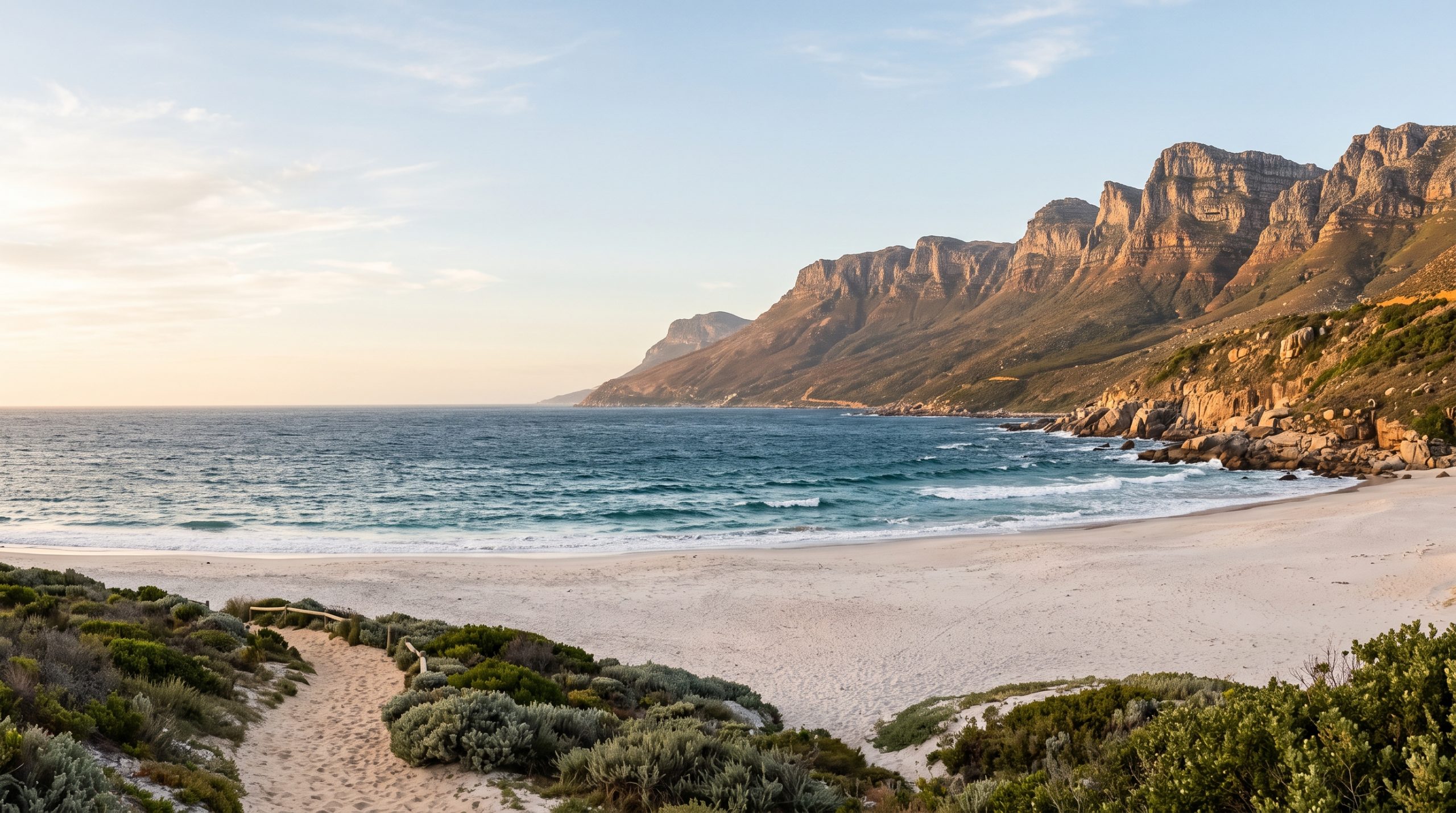
The City of Cape Town’s event application form carries one line that settles most beach ceremonies before anybody reads the rest of it: ground disturbance. Driving pegs, spikes, marquee or stage anchors into the ground. Answer yes and you are staging an event with everything that follows from it. Answer no, and for a ceremony the size most couples actually want, you are two people standing on a public beach.
Camps Bay and Llandudno sit twelve minutes apart on the same coast road, both facing west into the Atlantic, both under the same wall of buttresses. They are not remotely the same place to get married. One has restaurants, a promenade and a bus route directly behind the sand. The other has granite, a flight of steps and no commerce of any kind.
And standing over both of them is the thing that really governs your timeline. The Twelve Apostles take the morning light away and hand the evening back with interest.
What the rules require for a ceremony this size
Camps Bay and Llandudno are public beaches managed by the City of Cape Town. The City sets its event permit line at more than 200 participants, amplified sound, or temporary structures erected on site. A couple, a marriage officer and two witnesses cross none of those three, so a small ceremony on the sand needs no event permit.
The Apostles take the morning and hand back the evening
Both beaches face west. That one fact runs the entire day here, and it runs it in a way that catches out couples who have looked at photographs of this coast and assumed sunrise was on the menu.
The sun rises behind the range, not over the water. Table Mountain’s plateau tops out at 1,086 metres and the Apostles step south from it in a line of buttresses that sits directly between the sand and the eastern sky. Official sunrise in late December is around half past five, but the beach does not see the sun anywhere near then. The sea lights up first. Then the tops of the buttresses go warm. The sand waits underneath in a cool, even, shadowless light with no direction in it at all, and in the winter months that wait is longer again.
None of which is a problem. It is simply a different photograph, and it suits a slow barefoot walk on empty sand better than almost anything else we shoot. It is just not the photograph most people have in their heads when they say Camps Bay.
The evening runs the other way, and there is nothing in front of it. From roughly an hour before sunset the whole beach goes warm and the granite starts holding colour. The last ten minutes are the ones worth planning around: the sun drops into the water in front of you while the Apostles behind you turn orange, and then hold a few minutes of pink after it has gone. Sunset lands close to 8pm at the end of December and a little before 6pm in late June, which changes what a full day on this coast even means.
So we build ceremonies here backwards from sunset rather than forwards from an arrival time. Vows go roughly seventy-five minutes before the sun touches the water, which leaves the whole descent for walking, and the afterglow for the frames nobody expects. You can see what this coastline does with that final half hour in our published films and galleries, where the Atlantic side of the peninsula shows up again and again for exactly this reason.
Twelve minutes apart, and nothing alike
Roughly nine kilometres of Victoria Road separates them, twelve minutes when the road is clear and longer on a January afternoon. Couples routinely assume they are choosing between two versions of the same beach. They are choosing between two entirely different days.
Camps Bay is the easy one. You park along Victoria Road or in the streets above it, cross at the promenade, and you are on the sand inside a minute. The beach is wide and deep and you can walk three hundred metres of it without running out. The catch is what is behind you: palms, a low wall, a road and a row of restaurants, all of which land in any frame pointed inland from the water’s edge.
Llandudno is the opposite trade. There is nothing to buy there, nothing to eat there, and no way to drive down to the sand. Cars stop at the top of the cove and everybody walks in on a short flight of steps and a sloping sandy path that runs between the houses and the rocks. In wedding clothes this is a real, if brief, piece of work. The steps are uneven, the path is loose underfoot near the top, and a long dress needs one hand holding it and one hand free. We tell couples to walk down barefoot or in trainers with the dress gathered, and to change at the last flat boulder rather than at the car. The sand below is coarse and pale, the boulders are the size of small houses, and the shorebreak lands hard and loud onto a short steep beach, so anything that should not be salted stays above the last line of wet sand.
| Practicalities | Camps Bay | Llandudno |
|---|---|---|
| From the city bowl | About 15 minutes over Kloof Nek | About 25 minutes via Victoria Road |
| Car to sand | Under a minute, flat, across the promenade | A few minutes on steps and a sloping path |
| The sand | Wide, deep, soft above the tideline | Coarse, short, steep, backed by granite |
| Behind the ceremony | Palms, restaurants and Victoria Road | Boulders and Little Lion’s Head |
| Facilities | Everything, within a block | None, residential streets only |
| After sunset | Stays busy, the strip lights up | Empties fast, nothing to stay for |
Amplified sound, pegs in the sand and the twenty-one day line
The permit question is not really about weddings. It is about what you bring with you. The City’s own application form asks directly whether you intend to disturb the ground with pegs, spikes or marquee and stage anchors, and that question is a good proxy for the whole rulebook. An arch that has to be anchored, a marquee, a hired sound system or rows of chairs all move a private ceremony across the line into a permitted event.
Once you are across it, the process has a shape. Small event applications go in at least twenty-one days ahead, and the City is explicit that submitting an application is not the same as receiving approval. Nothing proceeds until the Events Permit Office formally approves it. The Events By-law has been amended to scale the requirements to the size and risk of what is proposed, which gives the permit officer room to treat a small low-risk gathering as exactly that rather than running it through the machinery built for festivals.
Above the beach, the authority changes. The Twelve Apostles are part of Table Mountain National Park, so anything staged on park ground goes to SANParks rather than the City, on a separate application with its own lead time. The two are not interchangeable, and a plan that drifts from the sand up onto the contour path needs both looked at.
The legal marriage itself is separate again. South Africa needs a registered marriage officer, the two of you, and at least two competent witnesses, with passports for the paperwork. Worth asking your officiant early where the register actually gets signed, because loose paper and a west wind are not natural allies, and the answer changes the shape of the hour. Permit and licence fees are yours to pay; the research, the applications and the sequencing sit with us, alongside the rest of the planning fundamentals we work through with every couple.
What January actually looks like on the strip
Camps Bay is the busiest beach on the Atlantic seaboard, and between mid-December and mid-January it behaves like it. Parking bays along Victoria Road fill by late morning, the sand in front of the promenade stays dense until dark, and the traffic through the strip moves at walking pace. Arriving early does not solve this, because the hour you want is the hour everybody else wants too. That is worth saying plainly rather than promising you an empty beach in high summer.
What does work is position. The northern end of Camps Bay, where the sand narrows against the rocks towards Glen Beach, thins out noticeably even on a full day. Llandudno empties within twenty minutes of the sun going down, because there is genuinely nothing to stay for. And late February through April is the quiet secret of this coast: the school holidays are over, the wind has eased, the sea is at its warmest, and the light is already lengthening.
When the south-easter runs, and where we move to
The south-easter is a summer wind and it announces itself before it arrives, as cloud pours over Table Mountain and spills down the faces of the Apostles. On this side of the peninsula it does not come in as a steady onshore breeze. It comes off the buttresses in gusty downdrafts that change direction inside a minute, which is a very different thing to plan around.
The plan is two positions, not one. Camps Bay open to the north and Llandudno tucked under Little Lion’s Head do not behave the same way on the same afternoon, and nine kilometres of driving is frequently the entire solution. We watch the forecast through the week, hold both, and choose on the morning rather than committing in advance. Winter is a different rhythm again: north-westerly fronts arrive in bands, and the still, low-sun days that sit between them are some of the best light of the year on this coastline.
There is also the option of going up instead of sideways. The Kasteelspoort path leaves from the top of Theresa Avenue in Camps Bay and climbs into the range itself, which puts you inside the Apostles rather than underneath them, with the whole bay dropping away below. That is park ground and a proper walk, so it belongs in the plan early rather than as a weather substitution. Our destination guides go further into how we pair a high option with a low one in places built like this.
Two cameras on a beach with a road behind it
Camps Bay gives you space along the beach and almost none behind it, so two people working the same ceremony have to move laterally rather than back. One low near the water, one further along the dry sand, both shooting down the beach instead of into the palms. Llandudno does the separating for you, because the boulders give a filmmaker a high line and a photographer a low one without either appearing in the other’s frame. The shorebreak there is loud enough to swallow vows spoken at normal volume, which is why the Expedition carries dedicated audio for the ceremony. One full day here runs from $4,900 with a photographer or a filmmaker, and from $7,900 with both of them working the beach together.
Common questions
Do we need a permit to get married on Camps Bay beach with just two witnesses?
No. The City of Cape Town’s permit threshold is more than 200 participants, amplified sound, or temporary structures. A couple, a marriage officer and two witnesses with nothing erected on the sand meets none of those, so no event permit is required for the ceremony itself.
Can we set up an arch, chairs or a speaker on the sand?
That is the moment it becomes a permitted event. The City’s application form asks specifically about driving pegs, spikes and marquee or stage anchors into the ground, and amplified sound triggers the requirement on its own. Small event applications need at least twenty-one days, and approval is never automatic.
Where do couples get ready for a Llandudno ceremony?
Not at Llandudno. The suburb is residential, with no shops, restaurants or venues at the beach. Most couples dress at a guest house in Camps Bay or Hout Bay, both a short drive away, and walk down the steps ready, changing footwear at the last flat boulder above the sand.
Can we hold the ceremony up in the Twelve Apostles instead of on the beach?
Yes, and it is a genuinely different day. The range is part of Table Mountain National Park, so permission runs through SANParks rather than the City, on a separate application. The Kasteelspoort path from the top of Theresa Avenue is the usual way in, and it needs proper footwear and time in the timeline.
If the wind is up at Camps Bay, is Llandudno any calmer?
Often, yes. Camps Bay sits open beneath the buttresses and takes gusty downdrafts off them, while Llandudno is set into a cove under Little Lion’s Head and can be noticeably steadier on the same afternoon. It is twelve minutes between the two, which is why we hold both and decide on the day.
Building the day around the hour the light arrives
A day here usually starts late and finishes in the dark. Dressing mid-afternoon, the drive out along Victoria Road with the range on your left, vows on whichever beach the wind picked, then the long walk through the last of the sun and the few minutes of pink that follow it on the granite. Highlights reach you within five days and the full gallery or film within three weeks. We are currently taking South Africa elopement bookings for 2027 through 2029, team travel is included wherever in the world we meet you, and We keep the planning in one written thread. Send us the date and what you picture, and we will tell you honestly which of these two beaches, and which hour, fits it. Start Your Story.