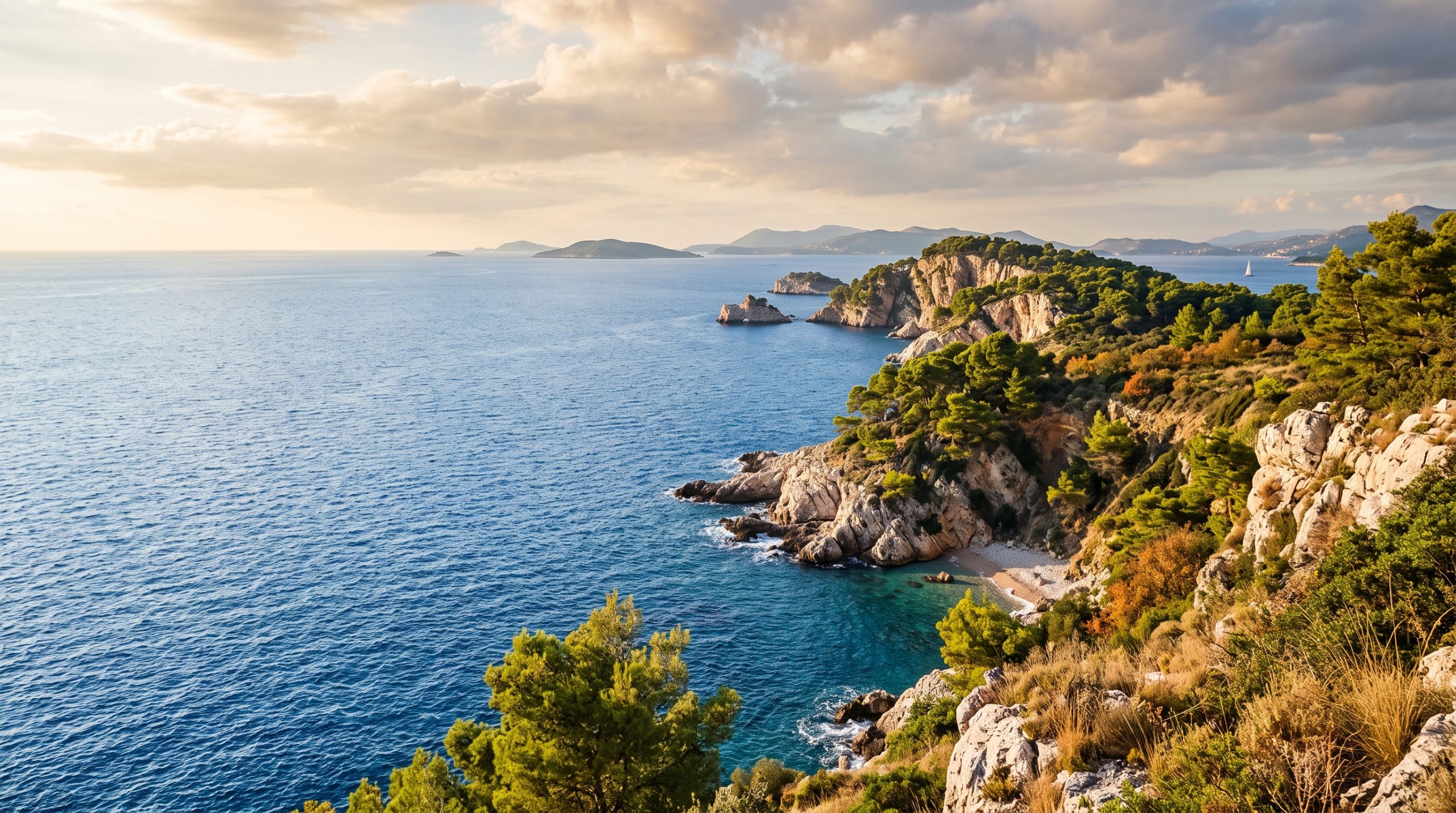
On May 15 the sun comes up behind the hills east of Dubrovnik at 5:26 and does not go down until 20:04. That is fourteen and a half hours of working light, air in the low twenties, water still cool enough that nobody is swimming in it, and a coast road you can actually drive. Six weeks later the same coastline is carrying the busiest travel weeks of the Croatian year.
August is Croatia’s peak month at roughly 4.69 million visitors, with July just behind at about 4.42 million. Those two months hold the warmest sea and the hardest light, and they are the two months we spend the most effort steering around. The three we ask couples to look at first are late May, September and October, in that order.
What follows is the timing detail we use when we build a Croatian day: sunrise and sunset by month, how far the sun moves along the horizon between spring and autumn, when the water is still warm, when the clocks take an hour off your evening, and what we do when the wind turns.
Late May is the fortnight we would take first
The last two weeks of May on the Dalmatian coast. Sunrise sits near 5:14 and sunset near 20:19, giving fifteen hours between them, and the sun drops to the northwest over open water rather than behind a headland. Air is comfortable, the sea is cold, and the coast is working full hours without the peak-month traffic.
Croatia month by month, judged on light and water
Light times below are for Dubrovnik, which sits at 42.65 degrees north. Split runs a few minutes behind on sunset and a few minutes ahead on sunrise, and Istria adds roughly ten minutes to the evening. Water temperatures are Dubrovnik averages, the warmest in the country.
| Month | Weather and water | Light | Crowds | Our verdict |
|---|---|---|---|---|
| January | Sea at its coldest, averaging about 14.1C; bura and jugo at their most frequent | Around 9h 20m of daylight, sunset 16:39 mid-month | Coast towns near empty | Stone, interiors and hard clear air |
| February | Water still under 15C, strong winds common | Days back past ten hours | Very quiet | Short hours, big skies |
| March | Green hillsides, cold sea; clocks go forward on the last Sunday | Sunset 18:09 before the clock change, 19:12 after | Thin | Good light, no swimming |
| April | Spring water anywhere from 13C to 22C depending on the week | 13h 20m mid-month, sunrise 06:07 | Building through Easter | Low ground and coast, not summits |
| May | Warm air, sea still climbing toward 20C | 14h 38m mid-month, sunrise 05:26, sunset 20:04 | Moderate until the final week | Our first choice |
| June | Warm and mostly dry; sea comfortable from the middle of the month | Longest day 15h 22m, sunset 20:30 at the solstice | Rising quickly | Excellent if you like 5am |
| July | Driest month in Dubrovnik at 35 mm over 7 rainy days; sea warmest near 25.5C | Day length drops 44 minutes across the month | About 4.42 million visitors nationally | Heat and volume together |
| August | Highs near 28C on the southern coast | Daylight back under fourteen hours | The year’s peak, about 4.69 million | Workable with an early plan |
| September | Sea still above 20C; equinox falls on the 23rd | 12h 31m mid-month, sunset due west at the equinox | Thinning week by week | Our second choice |
| October | Water holds above 20C into the month; clocks go back on the last Sunday | 11h 05m mid-month, sunrise 07:01, sunset 18:06 | Quiet outside Dubrovnik | Best month for late risers |
| November | Wettest month in Dubrovnik: 262 mm across 13 rainy days | Under ten hours, sunset 16:25 | Gone | Stone towns and shelter |
| December | Shortest day of the year, sea cooling toward its January low | Just over nine hours, sunset 16:18 at the solstice | Gone | Short hours, mostly indoors |
Where the sun actually sets between May and October
This is the part that changes the photographs, and it is not about temperature at all. In late May the sun sets at an azimuth of about 302 degrees, well north of west. On a coast that faces roughly southwest, that means the sun goes down over open water at the far end of most bays, and light stays on faces until the last minute. By the September equinox it sets at 270 degrees, straight down the channels between the islands. By mid-October it is at 259 degrees and by October 31 it is 251, which puts it behind ridges and headlands well before the printed sunset time.
The low-sun band is shorter than most people expect. In mid-May the sun takes 41 minutes to fall from six degrees above the horizon to setting. In mid-September that band is 37 minutes. After the sun goes, civil twilight gives you roughly another 29 to 32 minutes of usable, shadowless light, which is when the sea goes flat blue and the limestone turns pale. So the evening on a Dalmatian elopement is not a vague golden hour. It is a 37-minute band, a hard-edged transition, and half an hour of afterglow, and the ceremony hour gets built backwards from it. Our published galleries and films are mostly made inside those two bands, morning and evening, and you can see the difference between a May evening and an October one without anyone explaining it.
Mornings run the opposite way. In mid-May the sun rises at azimuth 63 degrees, well round to the northeast, so east-facing coves catch it early and cleanly. In mid-October it rises at 101 degrees, south of east and 95 minutes later on the clock. An October first light at 07:01 is a humane start. A late-May sunrise means leaving accommodation at four.
Three windows that move every year
The warm-water tail is the first. Dubrovnik’s sea is comfortable for swimming from June through October, staying above 20C across that span and peaking around 25.5C in July. Where the tail actually ends shifts by a week or two from year to year, so an early-October coastal date is a warm-sea date most years and a bracing one occasionally.
The equinox week is the second, and it barely moves: in 2028 it falls at 2:05am on September 23. For a few days either side, sunrise and sunset sit almost exactly due east and due west, which on an island channel running east to west is the single best alignment of the year.
The third is the hardest edge in the Croatian calendar. Clocks go back on the last Sunday in October, October 25 in 2028. Sunset in Dubrovnik on the Saturday is around 17:52. On the Monday it is 16:49. Same weather, same light, one hour earlier in the working day, and a completely different shape to the afternoon.
Park gates, cruise mornings and island timetables
Plitvice Lakes sells timed entry in one-hour arrival windows through its own webshop, and prices the later part of the day lower than the morning. In high summer that cheaper afternoon band starts at 4pm; in September it starts at 3pm. Those two facts together are why we almost never put a Plitvice hour in the middle of the day. In September, an arrival window late in the afternoon costs less and hands you the boardwalks as the coach groups leave.
Dubrovnik’s Old Town has a cruise arrangement of no more than two ships a day and a cap of 5,000 cruise visitors, which sounds manageable and still concentrates several thousand people into the same few hours. The walls and the Stradun belong to whoever is standing on them before the first ship’s tenders reach the gate.
Island access is the other seasonal variable. Catamaran and ferry patterns are thinner outside the summer season, and a route that runs three times a day in July may not support a return the same evening in late October. We build island days around the sailings that exist on your date rather than the ones in a summer timetable, and we keep high ground for the second half of the season, when mountain roads and ridge tracks above the coast are reliably open. If you are still choosing between regions, our destination elopement guides are organised by what each place does well in which month.
If your date lands in August, or in February
Plenty of couples arrive with a fixed date because of work, family or a visa, and August is the most common one. It is also the month with the most people and air near 28C. We do not treat that as a problem to talk you out of. An August day here gets built at either end: a 05:55 sunrise start on high or remote ground, a long empty middle where you eat and swim, and an evening that only needs to work for the last 40 minutes. Islands with a car ferry rather than a foot-passenger catamaran stay noticeably calmer, and inland Konavle and the Zagora behind Split are quiet in every month of the year.
Late November through February is the one span where we will actively suggest a different date if yours is flexible. November alone brings 262 mm of rain to Dubrovnik across 13 rainy days, and daylight in December runs a little over nine hours, so a full day of coverage is a genuinely short day. If your reason for winter is the empty coast and the clear bura air, October gives you most of that with four extra hours of light. If your reason is a fixed anniversary in January, tell us and we will build the day around stone towns, interiors and one short outdoor window rather than pretend the afternoon is longer than it is.
The month you have chosen is rarely the wrong month. It just changes what the day should be. Check Your Date with us and we will tell you plainly what that date does in that region, including which two weeks nearby would do it better.
How we plan around Croatia’s two shoulder seasons
Croatia’s meteorological service is clear that the two strong Adriatic winds, bura and jugo, are more frequent and stronger in the cold part of the year, though a summer bura can still be strong enough to affect coastal traffic. That gives us two named scenarios rather than a vague hope for good weather.
Bura comes from the northeastern quadrant, gusty and fast, and it scrubs the air clean. It is a gift for long views and a nuisance for veils and audio, so our bura plan moves to coves and channels that face southwest, where the water is calm and the light is the sharpest of the year. Jugo comes up from the south with swell, haze and warm damp air. Our jugo plan moves off the exposed southern coast, into the lee of an island or inland where the hills break the fetch. Both plans are written into your timeline with locations named and drive times measured, before anyone gets on a plane, and the ceremony hour can move within the day without unpicking anything else.
Season is also why the two-person question matters here. In late May you have fifteen hours to play with, and one photographer or one filmmaker can work slowly through it. In mid-October the whole evening is that 37-minute band plus half an hour of twilight, and a single person covering both stills and film has to choose one or the other inside it. The Expedition puts a dedicated photographer and a dedicated filmmaker on the ground at the same time for exactly that reason, and the difference between our two full-day experiences is set out on the experiences and pricing page.
Common questions
We can only travel in August. Can you still make a Croatian elopement work?
Yes, by moving the hours rather than the plan. Mid-August sunrise on the southern coast is around 05:55, and the first two hours belong to almost nobody. We put the ceremony and the walking at the ends of the day, keep the hot middle for swimming and eating, and choose islands and inland ground where 28C air is bearable in shade.
Is the sea still warm enough to swim in late September or October?
Usually, yes. Dubrovnik’s water is comfortable for swimming from June through October and stays above 20C through that run, having peaked near 25.5C in July. Early October is warm-sea weather most years. The tail end moves by a week or two annually, so we plan a swim as a likely bonus rather than a fixed item.
How much rain should we expect for an October elopement in Dalmatia?
Less than the month after it. November is Dubrovnik’s wettest month at 262 mm across 13 rainy days, and October sits well below that, with rain arriving as short heavy systems rather than all-day drizzle. We build October days with a wet-weather alternative that is a real location, not a hotel lobby, and a ceremony hour that can shift by two hours.
How do we get the Dubrovnik walls without cruise crowds?
By being there first. The city works to a limit of two cruise ships and 5,000 cruise visitors a day, and those arrivals cluster into a few mid-morning hours. From late September the calendar thins out anyway. We put walls and Old Town lanes in the first ninety minutes after opening, then leave the peninsula entirely for the rest of the day.
How early do we need to start the legal paperwork to marry in Croatia?
Earlier than most couples expect, and the timing is tied to your date. Croatia’s foreign ministry asks couples to contact the local registry office, the maticni ured, in the district where the marriage will take place at least three months ahead. For US citizens, the birth certificate has to carry an Apostille and be a copy issued within the past 90 days, then be translated into Croatian by a sworn court interpreter, so those documents get ordered on a schedule, not in advance.
What time would we actually be getting up for a May sunrise?
Around 3:45. Mid-May sunrise in Dubrovnik is 05:26, and the light worth having starts before that, so a headland forty minutes’ drive away means leaving in the dark. In mid-October the same first-light start is 07:01. If early mornings are not your idea of a good time, say so and we will weight the day toward the evening instead.
Choosing your date before the paperwork starts
Pick the fortnight before you pick the venue. Once we know if you are working with fifteen hours of May daylight or eleven hours in October, the rest of the plan follows: which coast faces the sunset that week, which islands still have an evening sailing, which hour the ceremony sits in. We currently have dates open across 2027, 2028 and 2029, and our guide to planning an elopement covers the sequence in order. Everything on our side happens in writing, by email, so you can read, think and reply on your own schedule. Send us the dates you are weighing up and the kind of morning you actually enjoy, and we will tell you which one we would book.