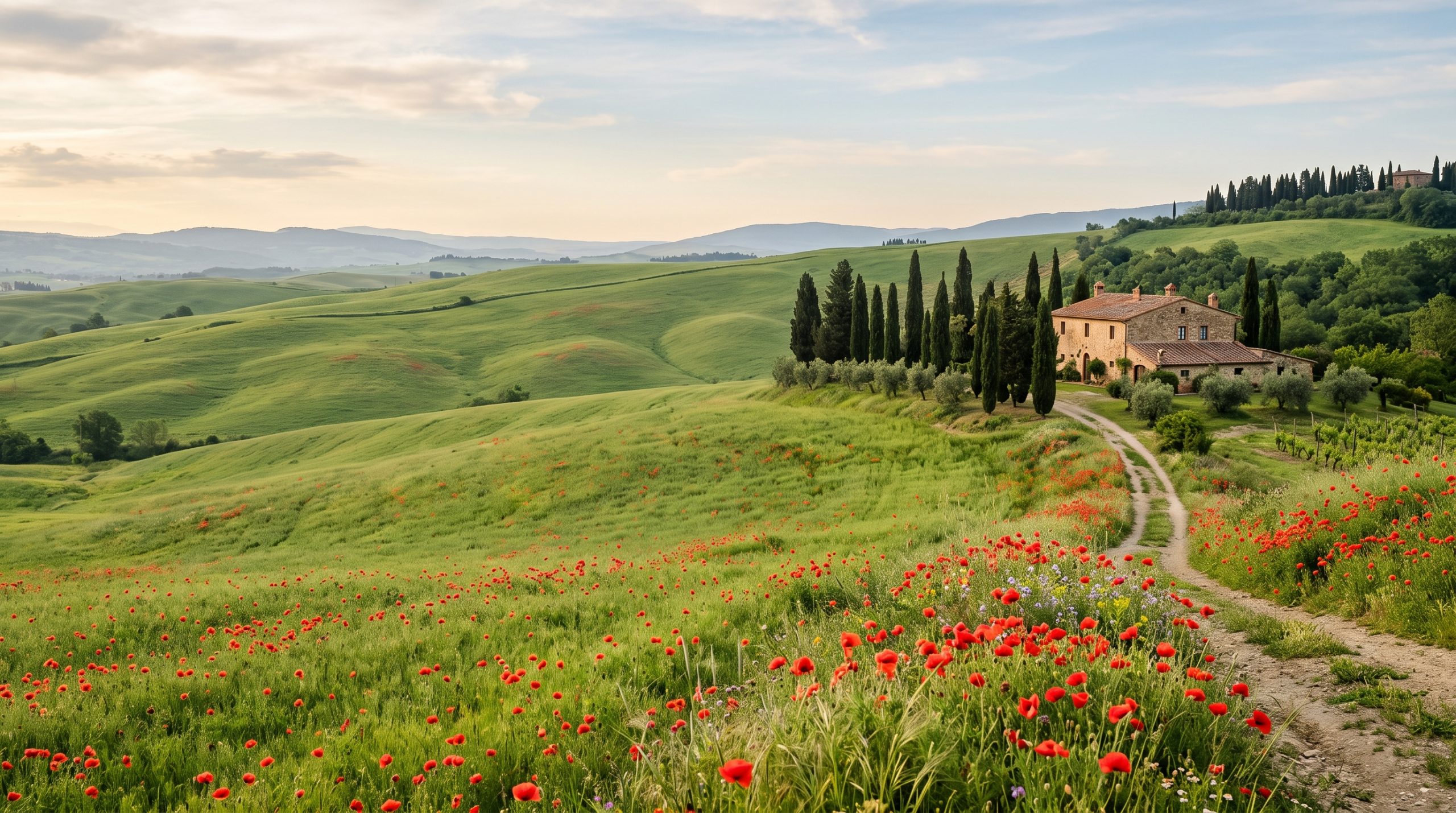
In the second week of May the sun clears the ridgeline south of Pienza at 5:51 in the morning. It comes up well north of east, so the green flanks of the hills light before the road below them does, and you have roughly forty minutes of that low warm angle before the light goes white and flat. Sleep through it and you are photographing the same fields at noon with the sun 66 degrees overhead.
The poppies, when they have come, are rarely the solid red carpet of the postcards. They run in seams along the edges of the wheat, thick in some field margins and absent from the next one, and they photograph best from low down looking along the row rather than across it. They are also a by-product of a wet spring in working farmland, which is why their dates move.
This is what April and May actually do in southern Tuscany, in hours of daylight, millimeters of rain and degrees of sun angle, and how we build a day out of it.
The window we book: the first two weeks of May
The first two weeks of May. Hills are still green, poppies are usually up from the last week of April, mid-month days run 14 hours 40 minutes with sunrise at 5:51, highs sit around 21°C, and Tuscany’s crowds do not peak until mid-June. Late April is the close second if you want cooler air.
Month by month in the Val d’Orcia, with the numbers
Southern Tuscany has no bad-looking month, which is why the choice is hard. What changes is the color of the ground, the length of the usable light and how many people are standing at the same gate. Siena gives the climate baseline: around 903 mm of rain a year, spread unevenly.
| Month | Ground and weather | Light | Crowds | Our verdict |
|---|---|---|---|---|
| January | Cold and clear spells, winter wheat already green | 9h20 of daylight, sunrise 7:44 | Almost nobody | Underrated, very short days |
| February | Cold, changeable, bare oaks | 10h30 of daylight | Almost nobody | Green hills without the traffic |
| March | Warming, wet spells | 11h50, sunrise 6:27 | Quiet | Green arrives, no poppies yet |
| April | Mild and showery, first poppies in the last week | 13h25 by mid-month | Building from mid-April | Strong second choice |
| May | Highs 20°C rising to 23°C, poppies to mid-month | 14h08 on the 1st, 15h09 on the 31st | Busy in towns, empty in fields at dawn | Our pick |
| June | Wheat turning gold, harvest from mid-month, 54 mm rain | Longest day 21 June, 15h24, sunset 20:58 | Peak season from mid-June | Excellent early, crowded late |
| July | Driest month, 33 mm across 6 days, 20 to 30°C, sunflowers | Sunrise 5:48, hard light by 9am | Peak, and the Palio on 2 July | Dawn and last light only |
| August | Hottest, stubble and dust after harvest | Sunrise 6:20, sunset 20:19 | Peak, and the Palio on 16 August | We would move the date |
| September | Warm, grape harvest under way | 12h32 at mid-month | Peak to mid-September, then easing | Best of the second half |
| October | 110 mm of rain, vine leaves turning from week one | 11h05, midday sun only 38 degrees up | Thinning fast after the middle | Low raking light all day |
| November | Wettest month, 121 mm across 14 rainy days | 9h43 at mid-month | Almost nobody | Only with a movable hour |
| December | Cold, the new wheat green again | Shortest day, 8h58 | Almost nobody | Two clean light windows, close together |
How narrow the poppy window really is
Corn poppies come up after the spring rain, generally from the last days of April, and hold into the middle of May. That is about two weeks of overlap with the green hills, and the leading edge of it shifts by a week or more from one year to the next depending on when the rain fell in March and April. Nobody in Tuscany can give you a date in advance, and anyone who does is guessing.
The second thing worth knowing is that poppies are a farmland species. They thrive on ground worked to the annual rhythm of grain, which means the red you saw in a photograph from two years ago was in a field that has since been plowed, planted differently or sprayed. We scout the week of your date rather than promising a location a year out, and we build the day around a landscape that is reliably beautiful, with the flowers as the thing we go hunting at 5am.
Two other narrow windows get confused with this one. The wheat that is green in May turns gold through June and is cut from roughly mid-June, so green hills and golden fields are about five weeks apart and cannot be had on the same trip. Sunflowers are later still: the fields green up in June and reach full bloom in July into early August, and because they are a rotation crop their location changes every single year, so no one can point you at the same field twice.
Why we would move a July or August date
By July the wheat is cut and the hills are stubble and dust, handsome in a hard-edged way but no longer green. July is also the driest month of the year in Siena, with about 33 mm of rain across six days, and midsummer afternoons sitting between 20 and 30°C with the lowest humidity of the year. The region’s own tourism board is blunt about the rest of it: mid-June, July, August and mid-September are peak season, which means queues in the squares and waiting lists at the restaurants you were hoping to walk into.
Two dates make it sharper. The Palio runs in Siena’s Piazza del Campo on 2 July and 16 August every year, ten horses and three laps, and for the days around each race the city and much of the province are effectively full. If your heart is set on Siena’s streets at first light, those two weeks are the ones to avoid.
The better trade is late September and October. The grape harvest runs through September and into October, the vine leaves turn from the first week of October, and by mid-October the midday sun never climbs higher than 38 degrees, so the light stays raking and directional all day instead of collapsing at 10am. The cost is water: October averages 110 mm of rain against June’s 54 mm, so an autumn day needs a written alternative rather than optimism.
And if the date is fixed in August because of school terms, family or the vacation days you have, say so and we will build the day for August rather than apologize for it. Sunrise on 15 August is 6:20 and sunset is 20:19, which gives two long usable windows, and we spend the hours between them in shaded stone towns and high-walled gardens instead of open fields. Send Us a Message with the date you actually have, and we will tell you honestly what that week looks like in the valley.
What the sun does between April and October
This is the part that changes the photographs more than the weather does. In late April the sun rises around 72 degrees on the compass and climbs to 60 degrees at noon. By mid-May it rises at 64 degrees, sets at 296 and stands 66 degrees high at midday, which is close enough to overhead that shadows fall straight down and the terraces lose their shape from ten in the morning until five in the afternoon. Mid-October is a different instrument entirely: sunrise swings round to 102 degrees, noon tops out at 38 degrees, and the hills keep their shape and shadow right through lunch.
In spring the warm low-sun window is about forty minutes at each end of the day. Add civil twilight and you get a workable stretch from 5:18 to roughly 6:30 in the morning, and 19:50 to 21:04 in the evening. That evening window is why we put vows in the last hour of light in May rather than the middle of the afternoon, and it is why a 15-hour day is such a gift: there is room for a long walk, a slow drive between two valleys and a second location without anyone rushing.
Forty minutes is also the reason we send two people. A photographer working alone in that window has to choose between the wide frame and the close one, and a filmmaker arriving separately has to ask you to repeat a moment that only looked like that once. On The Expedition, a photographer and a filmmaker who work together every month cover the same forty minutes from different distances, one on the vow, one on the landscape swallowing you both. Our coverage options and what each includes are set out in full on one page. If you want to see what the valley’s light does in finished work rather than in description, our galleries and films are the place to look.
Whose field is it: private land and the crop calendar
Access in the Val d’Orcia is not governed by gates and opening hours. It is governed by ownership and by what is growing. The chapel most couples arrive with in their reference folder, the Madonna di Vitaleta between San Quirico d’Orcia and Pienza, is privately owned and keeps no fixed public hours. It is reached on foot from the road, it was first recorded in 1590 and redesigned by the architect Giuseppe Partini in 1884, and it stands inside a UNESCO landscape. As a shape on a hill at sunrise it is one of the great frames in Italy. As a ceremony venue it is somebody’s property, and anything beyond looking at it from the path is a conversation with an owner.
The same logic applies to every field of poppies you have pinned. Someone farms it. Permit research, landowner contact and the paperwork that goes with a legal or symbolic ceremony are our job and are included; the government, venue or landowner fees themselves are paid by you, and they vary by comune. If you are still working out the difference between a civil ceremony at a town hall and a symbolic one on a ridge, the planning fundamentals are worth twenty minutes before you write to us.
How the early-May rain version is already mapped
Siena takes around 903 mm of rain a year and May sits in the pleasant middle of it, well below November’s 121 mm across fourteen rainy days. A wet April is good news for a May date, because that rain is what puts the poppies in the margins. What it also means is that some part of your day will probably be under cloud, and the plan has to be written for that before anyone gets on a plane.
In practice that means three things we do rather than hope. The ceremony hour is a decision we make on the day, not six months out, because the difference between 19:00 and 20:15 in May can be the difference between gray and gold. Every open-country location gets a paired alternative within about twenty minutes’ drive, chosen for shelter and for how the cloud sits on the ridges rather than for convenience. And the wet-weather ground is chosen properly in advance, because the arcades and stone streets of Pienza and Siena in rain are genuinely better material than the same hills in flat overcast.
Weather is the one thing nobody can sell you. What we can do is arrive with a timeline that already has two shapes in it, and the local knowledge to know which one the sky is asking for. Our destination guides go deeper on the ground itself, valley by valley.
Common questions
When exactly do the poppies bloom in the Val d’Orcia?
Generally from the last days of April into the middle of May, with the strongest ten days usually falling in early May. The start moves by a week or more year to year, because it follows the March and April rain. Nobody can promise you a specific week twelve months out, ourselves included.
Is late April too early, or is mid-May safer?
Late April is greener and cooler, with 13 hours 25 minutes of daylight by the middle of the month and a genuine chance of the first poppies in the final week. Mid-May is the safer bet for flowers and gives you 14 hours 40 minutes to work with. We book the first two weeks of May when the choice is ours.
Can we get poppies and the golden wheat fields on the same trip?
No. The wheat is green in May, turns gold through June and is cut from around mid-June, by which time the poppies are long gone. They are roughly five weeks apart. If the gold fields are what you came for, book the first ten days of June and accept a busier valley.
What time does a May morning actually start?
Sunrise is 5:51 in mid-May and the good light begins before it, so we usually leave accommodation around 4:45 and are standing on the chosen hill in the dark. If that is not your idea of a good morning, tell us. There is a version of this day built around the evening instead, and in May the evening runs to 21:00.
What happens to our plan if it rains?
The ceremony hour moves within the day, and every outdoor location already has a paired alternative about twenty minutes away chosen for shelter and cloud direction. That plan is written during planning, not improvised at breakfast, and it is one of the reasons we ask for your location wish list early.
Can we have our ceremony at the Chapel of Vitaleta?
The chapel is privately owned and keeps no fixed public opening hours, so we treat it as a landscape element reached on foot rather than as a venue you can assume. Anything more than that starts with a request to the owner, which is part of the permit research we handle.
How far ahead should we book an early May date?
Dates are currently open across the 2027–2029 seasons. The sequence is simple: the inquiry form, then a reply and first brochure within 24 hours, then a tailored proposal, then a signed contract with a 30% retainer before planning begins.
What to send us if May is the plan
Tell us the year. Tell us if you are locked to one date or have a two-week span to work inside, how early you are willing to be awake, and the one frame you cannot leave Tuscany without. From that we can say which week of May suits you better, and where to base you so the drive to first light is twenty minutes rather than an hour. Everything runs in writing, at whatever pace you want to read it.
Eight of us cover these dates between us, photographers and filmmakers who work as one team, which means there is always a second camera on the ground and a colleague in reserve. Start Your Story and we will come back with the honest version of your week in the valley.