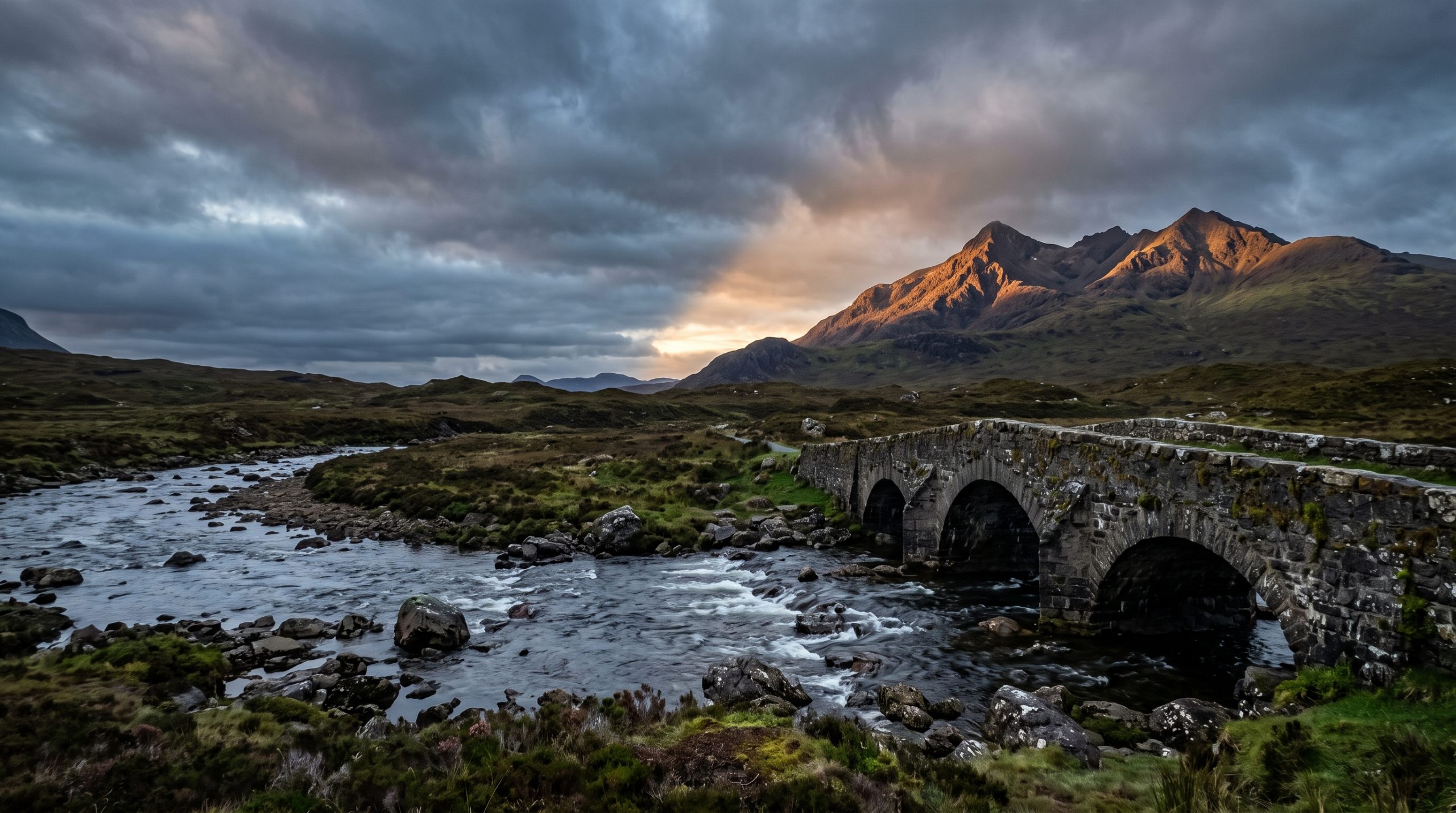
The old bridge at Sligachan carries nobody’s car. Thomas Telford’s three-span rubble crossing went up between 1810 and 1818, and once a single concrete arch was built a few metres to the north, the A87 moved onto it and left the old one to walkers and cyclists. The most photographed frame on Skye now sits on a road to nowhere, which is the first piece of good news for a couple who want to stand in the middle of it.
The second piece is geometry. Sgùrr nan Gillean sits 5.9 kilometres from the bridge on a bearing of 178 degrees, which is as close to due south as makes no difference. Almost everything worth knowing about when to be here follows from that one number, and almost nothing written about Sligachan mentions it.
So: the access, the light, the paperwork, and the two hours a day that are actually worth having.
The legal position at Sligachan, in one paragraph
You can marry on the old bridge. Scotland does not license outdoor ground for weddings, so there is no venue to book and no permit for the bridge itself. You need two marriage notice forms lodged with Highland Council at least 29 days ahead, and a celebrant authorised to marry you outdoors.
A minute from the car, in whatever you are wearing
Sligachan is the crossroads of Skye. The A87 comes down from Portree, 9.5 miles and about fifteen minutes to the north, then carries on south toward Broadford, while the A863 peels away west for Dunvegan. Whatever you are driving on this island, sooner or later you pass through here.
The car park sits on the Portree side of the river, immediately beside the old bridge. It is small, roughly twenty spaces, and it costs nothing to use, which on Skye is worth saying out loud. There is an information board and there are no toilets. When it is full there are laybys on the Dunvegan road a few hundred metres west, and another about 400 metres beyond that where the Bealach a’ Mhàim path starts.
From car door to bridge deck is under a minute on level ground. Sligachan is one of the very few places on Skye where the landscape asks nothing of your legs, which changes what the day can be: you can be dressed, on the deck and married before the walk to the Quiraing would have got you to the first gate.
In wedding clothes, the surface is the detail that matters. The deck is rough rubble with a pronounced hump, and the crown is steeper underfoot than it looks in any photograph ever taken of it. The stone is wet most mornings. A long train will drag and it will pick up grit, and a narrow heel finds the gaps between stones on the first step. The bank below, where the classic frame is actually made, is heather, boulder and wet gravel down to the water. Walk over in boots, change at the tailgate, keep good shoes for the deck rather than the riverbank.
Why the mountain is in shadow when you arrive at noon
Stand where everyone stands, on the downstream bank looking up the river, and you are pointed at 178 degrees. Sgùrr nan Gillean fills the gap 5.9 kilometres away, Am Basteir sits just behind it at 185 degrees, and the Black Cuillin runs off to the right. The wall of rock in your frame is a north face. It spends most of its life in its own shade, and that single fact should decide your ceremony hour.
In the last week of June the sun clears the horizon here at about half past four in the morning, well round in the north-east, and stays up until after ten at night. Those are the only conditions under which that face takes direct light at all. The window is sharper than most people expect: the sun is north of due east until roughly 8.30am, and it comes back north of due west from about 6.20pm. In between, on the longest day of the year, the ridge goes grey while the grass, the water and the stonework are bright.
By mid-August the morning window has already tightened to about eight o’clock, and the evening one does not open again until nearly seven. Between the equinox in late September and the equinox in March, the sun never swings north of due east or due west at any point, so the side of the ridge that faces the bridge stays in shadow from one end of the day to the other.
That is not an argument against a winter wedding at Sligachan. Winter here is genuinely good. It is simply a different photograph: a dark ridge against a luminous sky, the arches reading as silhouette, snow on tops that the sun never quite reaches. Book it knowing which of the two you are getting, and tell us which one you want, because it decides the month before it decides anything else.
The other half of the geometry is kinder to you. If the camera faces south, you face north, and your faces are lit by open northern sky for the whole of the day. No squinting, no hard shadow under the brow, no turning you into the sun for the vows. At six in the morning in June the sun sits about nine degrees up in the east-north-east, over the photographer’s left shoulder, raking along the parapet and putting an edge on one side of you. By nine at night it has swung to the west-north-west and comes down the Dunvegan side of the glen instead, over the right shoulder. Those are the hours. The rest of the day is a car park with a view.
The coach hour, and the windows either side of it
Honesty first. At two in the afternoon in August, Sligachan Old Bridge is a lay-by. The car park is full, something large is usually parked on the verge, people are crossing the deck in both directions, and the light is flat on the one face you came for. Visitors who call it underwhelming came at that hour, and they are not wrong.
What makes this place unusual is that arriving early genuinely works, which is not true of the Quiraing or the Fairy Pools. Most people stop for ten minutes, take the photograph and drive on, so the car park turns over rather than filling for the day. At five in the morning in July you will have the bridge, the pools and the whole glen to yourselves, with three hours of the light window still ahead of you. The late option is nearly as good. From nine at night in June the island is at dinner and the sun is still working.
Two forms, one celebrant, and no venue to book
Scotland is the reason any of this is straightforward. There is no approved-venue list to satisfy, because the authority to marry you travels with the person conducting the ceremony rather than with the ground you are standing on. Humanist Society Scotland celebrants are permanently authorised to conduct legal weddings anywhere in Scotland, which is precisely why so many island ceremonies happen on a riverbank instead of in a room.
The paperwork is two M10 marriage notice forms, one completed by each of you, lodged with the registrar for the district where the ceremony takes place. For Sligachan that is Highland Council. The earliest you can give notice is three months before the date, the legal minimum is 29 days, and Highland’s own guidance asks for 10 to 12 weeks. If you are flying in from the United States, work to the 10 to 12 weeks and not to the 29 days. Notices go by post to the district registrar or in person by appointment, and the fee is charged per person, currently in the region of £45 each.
If you would rather be married by a registrar than by a celebrant, Highland Council will send one out to an agreed outdoor location, described in their own terms as a hill or a lochside rather than a hotel garden, subject to the registrar approving the spot, with travel charged by the mile from the nearest registration office. Either route, nobody is renting you the bridge. It is a listed structure in public use and a public footpath, and the only real obligation is leaving room for someone to walk across it. We sequence the whole thing into your timeline, and the ground rules behind it are laid out in our guide to planning an elopement properly.
Standing room on a three-arch bridge
The deck is narrow. Two people cannot work the same angle from up there without one of them landing in the other’s frame, which is the problem a photographer and a separately hired videographer spend their first hour discovering. Ours settle it the night before: one takes the downstream bank with the long lens and the reflection in the pools, the other works the arch from water level, and they trade positions at an agreed point in the ceremony. Vows are recorded close in, on the sheltered face of the crown, because the glen funnels air down toward the loch and a river dropping through three arches is a great deal louder underneath you than it sounds from the road.
As for how the place actually renders: the river runs into a chain of pools directly below the arches and goes glassy in a calm hour, so the bridge doubles and the ridge doubles with it. A few hundred metres downstream the water reaches the head of Loch Sligachan and turns tidal, which means mountain water and salt water are a five-minute walk apart from the same car park. Drone work suits the glen because there is so much open ground and so little to fly near, and we schedule aerials into the same early window as everything else, where they are legal and sensible. Our published galleries and films will tell you more about what Skye light does to stone and water than another paragraph here will.
One full day at the bridge with a dedicated photographer or a dedicated filmmaker starts at $4,900, and a photographer and filmmaker working it together starts at $7,900, with the multi-day shape and everything included set out on our pricing page. Highlights reach you five days after the date, and the full gallery or film within three weeks.
When the ridge is in cloud and the river is up
The Cuillin makes its own weather, and Sgùrr nan Gillean is often packed in while the glen at the bridge is clear and dry. That is not a lost morning. The arches, the triangular cutwaters and the moving water carry the frame perfectly well without the mountain, and a soft ceiling suits Telford’s stonework better than hard blue sky ever does.
After a wet week the pools run brown and fast and the reflection disappears, so we lift the ceremony position off the low bank and onto the crown, where the picture changes and the sound improves. Wind is the other variable worth planning around. Air moves down Glen Sligachan toward the loch, which is exactly what keeps a summer evening on the riverbank pleasant while the still air further inland belongs to the midges, and it is also what will take a veil sideways at the least helpful moment. We put the veil on the sheltered side of the hump, and we put it there early.
The alternatives are close enough to be genuinely useful. Glen Sligachan runs south from the same car park along the right of way toward Loch Coruisk, and ten minutes on foot takes you deep enough that the road disappears behind you. The shore of Loch Sligachan is just below. Portree is 9.5 miles north if the day needs rebuilding altogether. All of it goes into the timeline before you land rather than being invented on the morning, and if you want to compare the bridge against the rest of the island, our destination elopement guides lay the options side by side.
Common questions
Is there anywhere at Sligachan to change out of hiking boots?
There are no toilets at the old bridge car park. In practice you change at the car, and there is a hotel directly across the road on the Portree side. Because the deck is under a minute from the parking space on level ground, most couples arrive dressed and only swap footwear.
Can we hold the ceremony on the bridge deck itself?
Yes. The old bridge has carried no traffic since the concrete arch was built alongside it, so only walkers and cyclists use it. The crown takes a couple, a celebrant and a witness or two without crowding. It is still a public footpath, so we build a natural pause into the ceremony for anyone crossing.
How early do we need to be there in July to have the bridge to ourselves?
Five in the morning is comfortably enough. The sun is up around half past four in early July, the first campervans rarely appear before eight, and the north-facing ridge holds direct light until roughly half past eight. That gives you a clear three hours with nobody else in the frame.
Is Sgùrr nan Gillean lit at sunrise in October?
Not on the side you see from the bridge. By mid-October sunrise is around eight o’clock and well south of east, so the face toward Sligachan stays in shadow all day. What you get instead is a hard-edged ridge against a bright sky, colour on the cloud above it, and a frame that often works better in black and white.
What do you do if the Cuillin is under cloud on the morning?
We hold the position and change the frame, working the arches, the cutwaters and the pools instead of the skyline, then walk ten minutes into Glen Sligachan where the low ground reads well under a grey ceiling. Where your trip allows it, we also keep a second window later in the week and watch the forecast for it.
The morning we would book
If it were ours: the back half of June, an alarm at half past three, on the bank by half past four with the sun still in the north-east, vows on the crown of the bridge at half past five, and breakfast in Portree before most of the island has found its car keys. Nine hours later the car park is full again and nobody will ever know you were there.
Our current Scotland availability runs across 2027–2029, and all of it happens in writing. Send us the date and a sentence about what you want the morning to feel like, and you will have a reply and our brochure back within 24 hours, then a proposal built around the light window rather than around a template. A signed contract and a 30 per cent retainer start the planning. Check Your Date