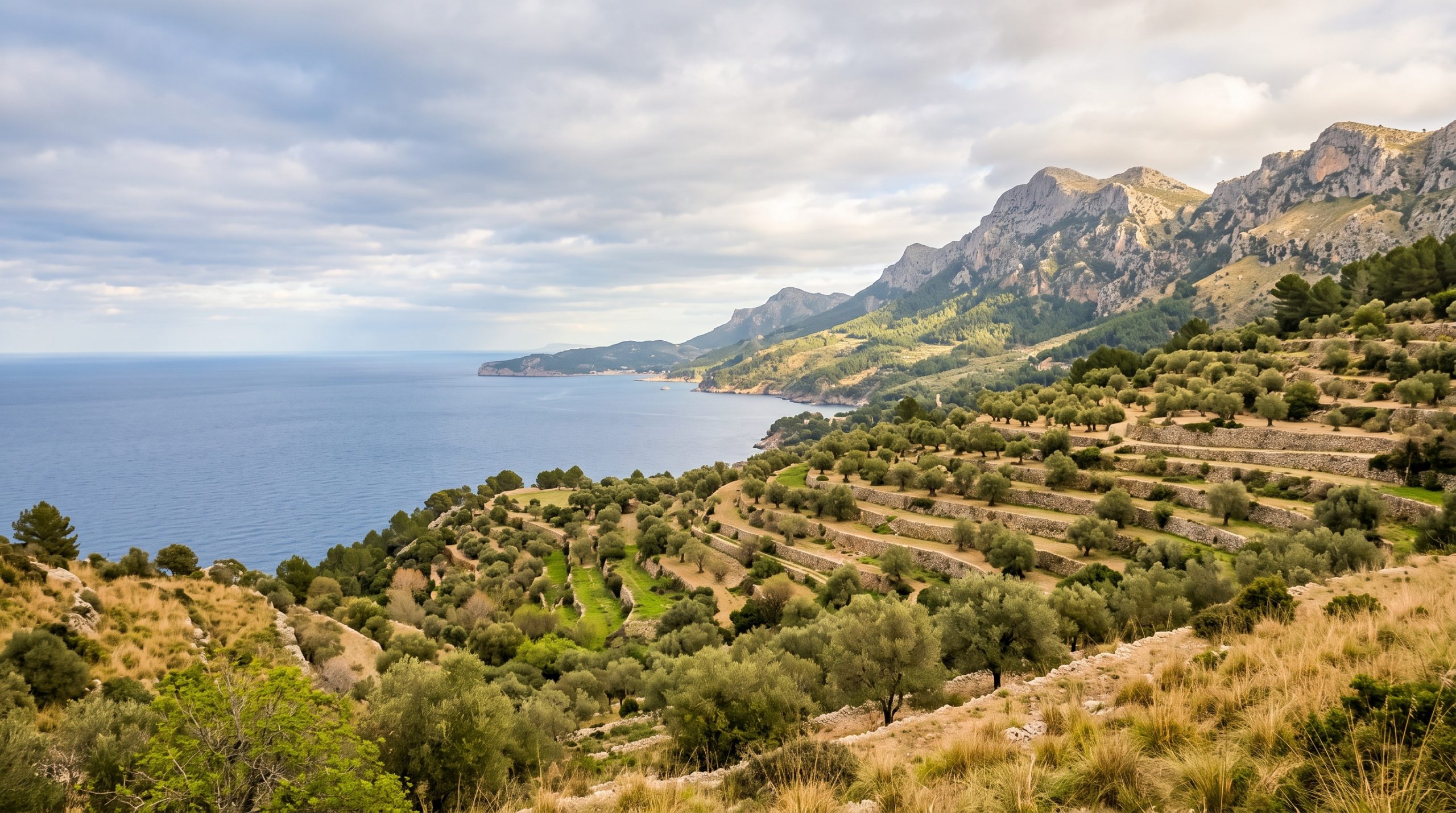
The first thing to know about Mallorca is that the weather is rarely the problem. The driest month at the Palma airport station averages 7 mm of rain, sunshine peaks in July at around 11.1 hours a day, and no month of the year shuts the island down. What actually changes across the calendar is the hour you can stand alone on a cliff, and whether the road to that cliff is open to your car.
Two gates decide most of it. From mid-May to mid-October, private vehicles are kept off the Formentor road between 10am and 10pm. The boat from Port de Sóller round to Sa Calobra thins to two or three sailing days a week once the season turns, with a single late-morning departure. Neither fact causes any trouble if you know it in January. Both rewrite a timeline if you learn it in the car park.
So this is a calendar built around light, sea temperature and access rather than a vague hope for good weather. Sunset times below are for Palma, mid-month. Rain and sea figures are long-term averages for the Palma airport station.
Why we book the second half of September
The second half of September. The sea still carries August warmth, the sun sets around 19:58 mid-month, the school-holiday crowds have thinned, and average rainfall sits at 51 mm against October’s 67 mm. That combination buys a ceremony at seven in the evening and a coastline where you are genuinely alone.
Month by month: sunset, sea and how busy it gets
Sunset is the number that reshapes a whole day, so it leads every row. The Serra de Tramuntana runs about 90 km along the northwest coast with eleven peaks above 1,000 m, which means a valley can lose the sun forty minutes before the sea does.
| Month | Sunset, mid-month | Conditions | Crowds | Our verdict |
|---|---|---|---|---|
| January | 17:49 | Mid-teens Celsius by day, sea around 14.5 °C, blossom starting late in the month | Emptiest weeks of the year | Almond trees, mountains, no swimming |
| February | 18:25 | Sea at its coldest, 13.7 °C, blossom at its peak, temperatures near 15 °C inland by late month | Very quiet | The month most people overlook |
| March | 18:55 | Green Tramuntana, torrents running, clocks jump forward late in the month | Building slowly | Strong for high ground |
| April | 20:26 | Wildflowers, warm afternoons, cool water | Cyclists on every Tramuntana pass | Excellent, with an early start |
| May | 20:56 | Long evenings, dry ground, sea still cool | Over two million visitors arrive in the month | Beautiful light, crowded roads |
| June | 21:18 | Longest evenings of the year, reliably dry | Heavy from the first week | Late ceremony, early alarm |
| July | 21:16 | Driest month at 7 mm, 30 °C and above on the coast | Peak month for arrivals | Sunrise work, then shade |
| August | 20:45 | Warmest month at a 24.6 °C mean, sea at 26.2 °C | As busy as it gets | Our least favourite for a full day |
| September | 19:58 | 51 mm of rain, sea still warm, softer light | Falls away after the first week | The month we book first |
| October | 19:10 | Wettest month at 67 mm, warm water, Formentor gate lifts mid-month | Quiet by the last week | Superb, with a real second plan |
| November | 17:34 | 51 mm, cool clear air, Sa Calobra boat down to two days a week | Almost nobody | Interior, olive groves, high passes |
| December | 17:26 | Shortest day of 9 hours 22 minutes, bright dry spells between fronts | Empty outside Palma | Short, sharp, all yours |
The almond blossom window, and how far it moves
Around seven million almond trees flower across Mallorca between late January and early March, and the fullest colour sits in the fortnight from late January to mid-February. The centre of the island carries it best, through Sencelles, Santa Maria, Selva and Bunyola, with a second belt out towards Manacor and Son Servera.
The window moves, and it moves by weeks rather than days. A mild winter pulls the peak earlier; a cold snap holds the buds back. We plan blossom days with a target date and a working radius instead of a single field, because the difference between bare branches and full white is often a forty-minute drive inland rather than a different week. Late January also gives you a 07:58 sunrise and an 18:07 sunset, which is a civilised ten hours to work with.
August, and the fix if your date is already in August
August is the month we would move if the date is still open. The monthly mean hits 24.6 °C, inland afternoons run far hotter, the sea is at 26.2 °C, and the island is carrying its heaviest visitor load of the year. The coves that photograph best are the coves everyone else has also found, and the middle of the day is flat and hot.
If August is fixed for you, the day still works, and it works well. We build it at both ends. Sunrise sits at 07:01 mid-month, so we are on the ground by six with the light coming over the Tramuntana and nobody else parked yet. The middle of the day goes to shade, water and somewhere with a roof. Then the second half of the day comes back around 19:00 and runs to a 20:45 sunset, with dusk holding until about 21:14. Two working blocks of low sun, one long lunch, and a location list chosen for where the coaches are not.
The same logic works for a fixed July date: 7 mm of rain all month means you can plan an outdoor day with real confidence, as long as you accept that the good hours are the ones before breakfast.
Sunset travels 60 degrees along the horizon
Between the solstices, Mallorca’s day length swings by 5 hours and 36 minutes, from 14 hours 58 minutes in late June down to 9 hours 22 minutes in late December. The bigger effect on photographs is where the sun goes down rather than when.
In late June the sun sets at roughly 302 degrees, well north of west, which lines it up perfectly with the northwest coast between Banyalbufar and Sa Foradada. It drops into open water there, and the cliffs stay lit until the last minute. By December it sets around 240 degrees, deep in the southwest. The same Tramuntana cliffs now have the sun going down behind the land, and the sunset over water moves south to Cap de ses Salines and the low limestone of the far south. Couples who book a west-coast December sunset off a summer photograph are often surprised. We match the coast to the month instead.
Winter gives back something summer does not. The sun sets at a shallower angle in December, so the last ten degrees of altitude take about 69 minutes to burn down to the horizon, against roughly 56 minutes in late September. A December ceremony at four in the afternoon has warm light on it the whole way through. You can see what both ends of the year look like in our published galleries and films, which is a faster way to choose a month than any table. Highlights reach you within five days of the day itself, and the full gallery or film within three weeks.
That short September window is also the honest argument for two people working at once. Under an hour of warm light does not stretch to vows performed once for stills and again for sound. With a dedicated photographer and a dedicated filmmaker on the same timeline, the vows happen once and both records are real. One day of coverage starts at $4,900 with a photographer or a filmmaker, and at $7,900 with both, and the rest of the detail sits on our pricing page.
The Formentor gate at 10am, and a boat that runs twice a week
The Ma-2210 out to the Formentor lighthouse is restricted from mid-May to mid-October, every day from 10:00 to 22:00. Between Port de Pollença and Formentor beach you can still drive in those hours, but only while the official beach car park has space among its 300 places, controlled by barriers and live signage. From the beach out to the lighthouse, private cars are held back entirely during the window, with exceptions for residents, permit holders and reduced-mobility vehicles. Public buses, taxis and coaches keep running, and cyclists and walkers are never stopped.
Read that as an opportunity rather than an obstacle. In July the gate closes at 10:00 and sunrise is at 06:34, so leaving Port de Pollença at half past five puts you at the lighthouse in first light with the road to yourselves, and off it long before the barrier drops. If what you want is that headland at sunset with your own car in the picture, that is a late-October-to-mid-May proposition, and we will say so early enough to matter.
Sa Calobra has its own rhythm. The Ma-2141 is a dead end, built in 1932 by the engineer Antonio Paretti, and the 10 km climb back out holds 26 hairpins and the full 360-degree loop of the Nus de sa Corbata before it tops out at the Coll dels Reis at 682 m. The paid car park down at the port fills early in high season. The boat from Port de Sóller takes about an hour each way and is lovely, but it runs on a season-dependent timetable that drops to two days a week by November, with an 11:20 departure and a 13:40 return, and every sailing depends on the sea state. So in the shoulder months we drive it and treat the crossing as a bonus, never as the spine of a timeline. Our destination guides go deeper on individual locations.
Costs move with the season too. The Balearic sustainable tourism tax charges its higher rate from 1 May to 31 October, currently up to around 4.40 euros per person per night at the top accommodation category, and a small fraction of that in the low season, with a reduction after the eighth night.
Check Your Date and we will tell you what the light and the gates are doing that week.
How the weather backup changes coast without changing the day
It says which coast to be on, by wind direction, with drive times attached. When the wind is out of the north, the north-facing coast at Sa Calobra and Cala Tuent takes the swell and the spray, and the far south sits in the lee: Es Trenc, Cap de ses Salines and the flat Migjorn coast are 45 to 60 minutes away by car and can be a different day entirely. When it swings round to the south, the logic reverses and the Tramuntana coves go glassy.
October is the wettest month on the island at 67 mm, and that rain usually arrives as a few decisive hours rather than a grey week. So the October plan carries a movable ceremony hour. Most couples we work with complete their paperwork at home and hold the ceremony here with a celebrant, which means the hour belongs to us rather than to an office appointment. We can push it three hours and lose nothing.
The written version reaches you before anyone flies: a primary location for each block of the day, a lee-side alternative chosen by wind direction, and a version of the day that works under cloud, which in the Tramuntana is often the better film. Permit research and the logistics behind it are ours to do. Our guide to planning an elopement covers the rest of the groundwork.
Common questions
When is the almond blossom actually out in Mallorca?
Trees flower from late January into early March, with the strongest fortnight running from the last week of January to mid-February. The peak shifts by weeks, not days, so a mild winter brings it forward. We plan a target date with a driving radius through the island’s centre rather than one fixed field.
Is February too cold for a coastal elopement in Mallorca?
Not for standing on a cliff, no. It is too cold for water, since the sea bottoms out around 13.7 °C in February. Days run to the mid-teens Celsius inland, sunset is at 18:25 mid-month, and the blossom is out. We build February around the Tramuntana, the interior and the almond belt, and keep swimwear out of it.
Can we drive to the Formentor lighthouse for sunset?
From roughly mid-October to mid-May, yes. Between mid-May and mid-October the Ma-2210 is closed to private vehicles from 10:00 to 22:00, which covers every summer sunset. In those months we take the headland at sunrise instead, on the road by 05:30 in July, and it is emptier and better light than the evening anyway.
How much does rain move an October elopement in Mallorca?
October averages 67 mm, the highest of any month, and it tends to fall in short heavy spells rather than all day. Our October timelines carry a ceremony hour that can slide by a few hours and a lee-coast alternative around Es Trenc and Cap de ses Salines, so a wet morning becomes a bright late afternoon.
What time would our ceremony be in June compared with December?
In mid-June the sun sets at 21:18, so vows land around 19:45 and portraits run to nearly ten at night. In mid-December sunset is 17:26 and a four o’clock ceremony holds warm light throughout, because the last ten degrees of sun take about 69 minutes in winter against 56 in September.
Are the coves quiet enough for a ceremony in July?
Before nine in the morning, yes. Sunrise in mid-July is 07:01, and the small coves of the north and east are genuinely calm for the first two hours of the day. From late morning onwards we move you to high ground, water, or somewhere with a gate on it, and bring the day back for the 20:45 sunset.
Start with the month you have; we build the best version inside it
If your date is open, we would put you in the second half of September and give you the option of stretching it across two days. If it is fixed, tell us the month and we will show you what it does well, because every month here does something well. We keep the full Mallorca plan in one written thread, so you have the plan on paper and can read it twice. Send us the date and we reply within 24 hours with an initial brochure, and we are currently booking 2027, 2028 and 2029.
Tell Us Your Story and we will start with the light.