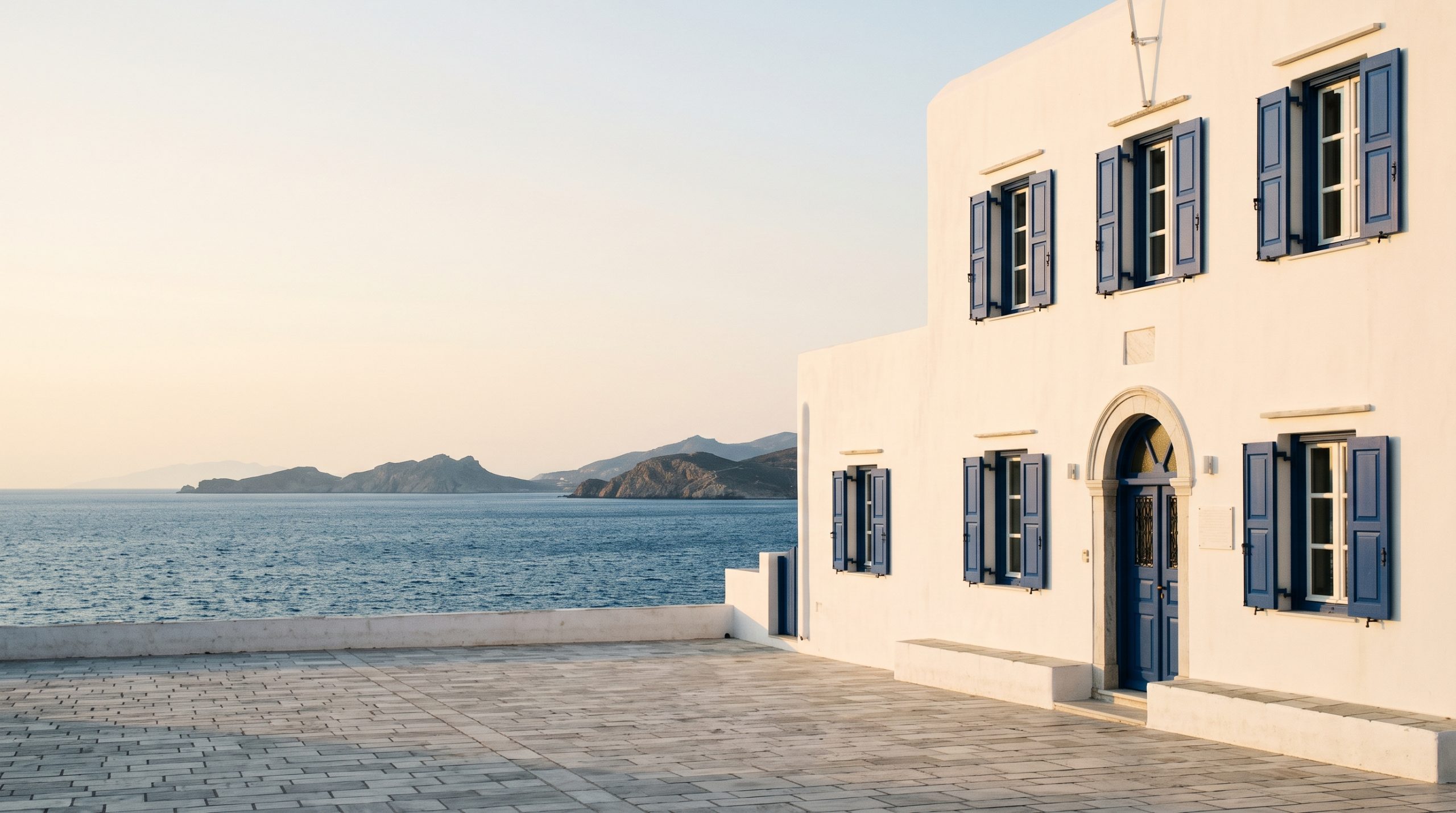
The difficult part of a Cyclades wedding is almost never the island. It is an envelope from a state office in Ohio or Oregon, an official Greek translation of what is inside it, and a municipal counter on Santorini or Paros that stops serving the public in the early afternoon. Start those three things early and the rest of the week is a ferry timetable and a sunrise.
We plan, photograph and film elopements across the Cyclades: Santorini, Milos, Paros, Naxos, Mykonos, Folegandros. The couples who have the calmest week are always the ones who opened the paperwork before they opened the mood board. What follows is the chain as it actually runs, what each piece is valid for, and the two or three places where days quietly disappear.
We are photographers and filmmakers, so the legal decision is not ours to make. Confirm the final the Cyclades requirements with the relevant official office before you rely on them.
Two licenses, one municipality, six months of validity
Two Americans can marry legally in the Cyclades. Each partner needs a Greek marriage license from the municipality where the ceremony will happen, lodged in person with an apostilled birth certificate and an official Greek translation. The license follows roughly a week later and stays valid for six months, for a ceremony anywhere in Greece.
Where the Cyclades legal file takes the most work
Nothing in the Greek process is discretionary or mysterious. It is a checklist with validity windows attached, and municipalities on the islands process foreign files every summer. What makes it fiddly is that the chain crosses an ocean and two governments: the apostille on your birth certificate is issued in the United States by the state that holds the record, while the document proving you are free to marry is usually sworn in front of a consular officer in Greece and then authenticated in Athens.
So the honest rating is fiddly, not hard. If you want the legal act itself at 6am on a caldera path, or at the Portara on Naxos as the light goes, that is a different question, and the answer is further down this page. Our planning fundamentals for eloping cover the sequence that sits underneath all of this.
Apostille, translation, no impediment: the chain in order
Collect it in this order. Each partner assembles a complete set of their own, and both sets go to the same municipal office.
- A certified birth certificate each. Order it from the US state that holds the record. No validity window applies to the certificate itself, which is exactly why it is the first thing to chase and the last thing you want to be reordering in June.
- An apostille on each birth certificate. This is obtained in the United States, from the same state authority that issued the certificate. The US Embassy in Athens does not produce it, and no Greek office can add it retrospectively.
- Proof that you are free to marry. Either a marriage license issued in your home state and apostilled, or a certificate of no impediment. For US citizens the usual route is an affidavit in Greek and English, sworn before a consular officer at the US Embassy in Athens or the Consulate General in Thessaloniki, on the form the consular section prepares. It is then authenticated by the Ministry of Foreign Affairs, which asks for an e-paravolo of 30 euros. Municipal requirement lists treat a no-impediment document as good for six months, so time it against your date rather than getting it a year out.
- A final divorce decree, if either of you has been married before. Apostilled and translated, same as everything else.
- An official Greek translation of every foreign document. Since 2021 this runs through the Ministry of Foreign Affairs register of certified translators rather than a walk-in counter, and a Greek consulate in the United States can also translate before you travel. Municipalities accept apostilled foreign documents only with a Greek translation attached.
- Passport copies for both of you, plus the visa or residence document where one applies to you.
- The state fee for each license, paid as an e-paravolo rather than by card at the desk. It is currently in the region of 18 euros a person, so this is the smallest line in the whole project.
Two details on the file itself. Your names are entered in Greek letters, and the transliteration should be identical on every document and on any announcement the municipality asks for. And on the national register of public procedures, the license application also carries the request for the public notice the Civil Code requires, so it is one form rather than two errands. Some municipal lists ask for a marriage announcement in a daily local newspaper, with the whole paper handed in rather than a clipping. Mainland offices attach that item mainly to residents and to couples where one partner is Greek, so ask the island municipality directly what it wants from two non-residents.
Turn the Cyclades ceremony slot into a document calendar
Here is the piece that surprises couples, and the piece that shapes our timelines. Greek law has the mayor fix, by a standing act, one set weekday and a start time for civil ceremonies in that municipality. The same act can designate more than one municipal building, and it can designate outdoor public municipal spaces too. A different day or a different hour is possible, and it takes a mayoral decision for that specific case. That is why the first thing we ask an island office is not can we but which hour.
Islands publish their own rhythm inside that framework. Mykonos has long listed fixed midweek ceremony days and a late-morning window at the town hall. Thira, the municipality that covers Santorini, runs a civil marriage office with named staff on its own site, which is who your date is actually agreed with.
| When | What has to be true | Who moves it |
|---|---|---|
| Four to six months out | Birth certificates ordered and apostilled; island, date and ceremony window chosen | You, alongside our location and timeline work |
| Two to three months out | Official Greek translations done; the no-impediment route decided | You and a certified translator |
| One month out | The municipality has your date in writing and has confirmed the hour | Us, working to your file |
| Nine to ten days before | Both partners lodge their license applications in person | You, at the municipal office |
| Ceremony day | Two witnesses present with passports, one of them interpreting | You |
| Within 40 days after | The marriage is registered in Greece | You, with the registrar |
The real minimum on the ground is about nine days. Municipal guidance under the governing law puts the license at seven calendar days after the file is lodged, while the US Embassy’s own page says eight, so we plan to eight and treat anything faster as breathing room. The comfortable minimum is two clear weeks in the country, because it absorbs the Athens morning and one cancelled ferry without touching your ceremony hour. That is the version we build to, with every document finished ninety days out.
The hour matters more than the day, and it is where having two of us on the ground earns its place. On an Expedition, a photographer and a filmmaker work the same day together, so a ceremony pinned to 11am in a municipal room can be covered properly while the light-critical part of your day sits somewhere else entirely, at 6am on a ridge or in the last twenty minutes before the sun goes. One person cannot hold both ends of that day. Two can.
The six places couples lose time
None of these are dramatic. They are all small, and every one of them has moved somebody’s date.
- Chasing the apostille from the wrong country. It is issued in the United States, by the state that issued your certificate. If you land in Athens without it, there is no counter in Greece that can fix it.
- Assuming a translation is a translation. It has to be official. Since the Ministry of Foreign Affairs moved to a register of certified translators, this is something you book, not something you queue for, and it is worth doing before you fly.
- Treating the Athens step as an afternoon. The affidavit is sworn at the embassy, then authenticated at the Ministry of Foreign Affairs, whose validation counter works a morning window of roughly 9am to 1pm and wants the 30-euro e-paravolo already paid. Give it a full weekday, before the islands, not after.
- Letting two six-month windows drift apart. The license is valid six months and the no-impediment document is treated the same way. Sequenced properly they overlap comfortably. Sequenced badly, one is expiring while you are packing.
- Inconsistent Greek spelling of your names. The file is built in Greek letters. Agree the transliteration once, then keep it identical everywhere.
- Forgetting that island offices are morning operations. Both partners lodge in person, in normal municipal hours. A 7:30am boat from Naxos to Syros is a plan. A mid-afternoon arrival at a counter that closed at one is a lost day, and in the Cyclades a lost day can mean a lost sailing too.
Fees and administrative timing in the Cyclades are moving parts. The authority handling your file should be the final check on the current numbers.
Legal at home, ceremony in the Cyclades
A large share of the couples we work with in Greece sign the legal papers in their own county before they fly, then hold the real ceremony here with a celebrant of their choosing. This is not a compromise version. It is the route that puts your vows exactly where you want them, at the hour the place is actually at its best.
What changes: no apostilles, no Athens morning, no e-paravolo, no municipal weekday, no interpreter among your witnesses, no 40-day registration. What does not change: the vows, the timeline built around light and real travel time, the permit research and landowner permissions, the aerials that run on a permit and a window we confirm before the film is planned around them, and the delivery. Highlights reach you in five days and the full gallery or film in three weeks. Our published galleries and films are the fastest way to see how a Cycladic day holds together across photography and film.
It also buys you the hours that matter. Oia at sunset is crowded and flat from most of the public viewpoints, whatever the search results promise, so we work the caldera early and keep the evening for the quieter side of the island. Many of the small white chapels on these islands are privately owned, and access is a conversation with the family that keeps the key rather than a booking form, which is the sort of thing that sits inside our permit research. Sarakiniko on Milos is a different planet at 5:45am than it is at eleven. A legal ceremony fixed to a municipal room and a set hour cannot chase that light. A ceremony you own completely can. If you want the legal route in Greece anyway, tell us and we will build the week around the office as well as the sun. Either way, our destination guides are a good place to compare islands before you commit to one. Tell Us Your Story and we will tell you honestly which shape fits your date.
Our side of the Cyclades plan, and the documents that stay yours
We design the destination and the locations, build a custom timeline around light and real travel time, research permits and give you the logistics guidance to go with them, hold weather alternatives for a windy afternoon, and negotiate the ceremony hour with the municipality so it sits sensibly against the rest of your day. Team travel is included worldwide, so getting us to Milos or Folegandros is our problem, not a line on your invoice. Coverage and what each experience includes is set out on our pricing page.
What stays with you: the documents themselves, the apostilles, the translator, the government and landowner permit fees, your celebrant, and the two witnesses. We are not lawyers and we do not file paperwork on your behalf. What we can do is tell you which sequence works, because we have watched it run.
Common questions
Do we need to be in Greece before the ceremony day?
Yes. Both partners lodge the license application in person at the municipality where you will marry, and the license is issued roughly a week later. Plan on about nine days in the country as an absolute floor, and two weeks if you want the Athens step and the ferries to have room.
Can we legally marry outdoors in Santorini or Milos?
Sometimes, and it depends on the municipality rather than on the view. The mayor’s standing act can designate outdoor public municipal spaces for civil ceremonies alongside rooms in the town hall, and a specific day or hour outside the fixed slot needs a mayoral decision. A cliff edge or a private terrace is not on that list, which is why couples who want that exact spot marry at home first.
Do we need a certificate of no impediment as US citizens?
You need proof that you are free to marry. That is either an apostilled marriage license from your home state or a no-impediment affidavit sworn before a consular officer at the US Embassy in Athens or the Consulate General in Thessaloniki, then authenticated by the Ministry of Foreign Affairs with a 30-euro e-paravolo.
How long is a Greek marriage license valid?
Six months from issue, and it is valid for a ceremony anywhere in Greece rather than only in the municipality that issued it. That matters if you are moving between islands: the office you file with does not have to be the island you marry on.
Who can be our witnesses if we are eloping alone?
Two witnesses attend the ceremony, each carrying a passport or Greek ID, and one of them acts as interpreter. Guest numbers never change our fee, but they do change access, permits and the shape of the timeline, so tell us early whether two people are flying in or whether the municipality is helping you solve it.
Can same-sex couples marry legally in the Cyclades?
Yes. Greece legalized civil marriage for same-sex couples in February 2024 under Law 5089/2024, and the Council of State has since upheld it. The file, the municipality and the timeline are the same as for any other couple.
What do we do with the Greek marriage certificate afterwards?
Register the marriage in Greece within 40 days of the ceremony, then ask the registrar for extra certified copies while you are still in the country. Greece is an apostille country, which is what makes your US documents work there and the Greek certificate travel home.
Where your 2027 date sits right now
We currently have dates available across the 2027–2029 seasons, and the Cyclades weeks that go first are the shoulder ones, when the meltemi is kinder and the caldera paths are still quiet at seven in the morning. Send us your date and your island, or your three candidate islands, and we will come back within a day with a first brochure and an honest read on the legal route. Everything between us happens in writing, at whatever hour suits you, and planning starts once the contract is signed and the 30% retainer is in. Check Your Date.