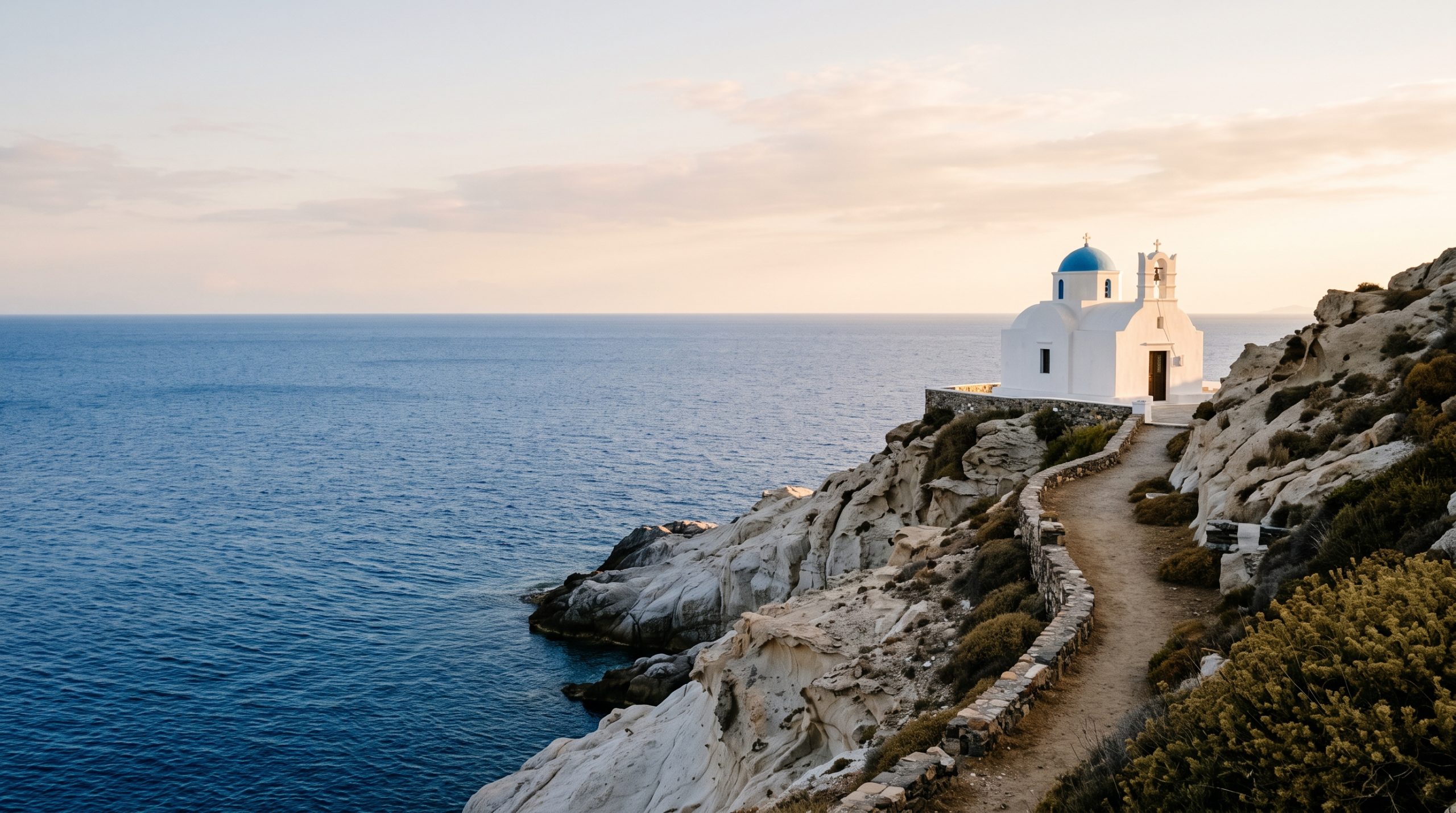
The office that decides whether you are legally married in Greece is not in Athens and it is not your hotel. It is the town hall of the municipality where you plan to stand, and it works to its own document list, its own counter hours and its own eight-day clock.
Almost nobody is stopped by Greek marriage law itself. What stalls a morning is smaller and far more mechanical: a birth certificate that travelled without its apostille, an affidavit signed at the kitchen table instead of in front of a consular officer, a certification counter that closes at one o’clock on the day you needed it open until three.
What follows is the civil route for two visiting Americans, in the order the offices actually deal with you. We plan Greek days around three fixed points: the hour a mayor or deputy mayor is free to officiate, the hour the light on that particular coast is worth standing in, and the forty days you have afterwards to register what happened.
Yes, and it hinges on one municipality
Two visiting Americans can marry in Greece without living there. You apply for a marriage licence at the town hall of the municipality where the ceremony will happen, each of you filing a separate set of apostilled and translated documents. The licence is generally issued eight days after a complete application, and it stays valid for six months.
Where Greek ceremony permissions become awkward
Fiddly is the honest word. There is no residency requirement, no minimum stay in the country, no court appearance, and no need for either of you to be Greek or to belong to any church. The work is clerical and strictly sequential. Half a dozen documents each have to be issued, apostilled, translated and handed across the right counter in the right order, and the chain moves at the speed of its slowest link. The US Embassy in Athens is blunt about the timescale: you do not need to live in Greece to marry there, but the paperwork that produces a Greek marriage certificate can run to several weeks.
Use this as practical wedding-planning guidance for Greece. Rules change and circumstances differ, so confirm the detail with the relevant registry office or your own consulate before you book flights. And if the clerical side is not how you want to spend the fortnight before your ceremony, the route further down this page, legal at home and ceremony in Greece, is a good option rather than a consolation. Our guide to how an elopement day is actually built covers everything that stays the same either way.
Who has to say yes, office by office
Six bodies can be involved in one Greek elopement, and only three of them care about your documents. The rest care about the ground you want to stand on and the hour you want to stand there.
| Who | What they decide | The number that matters |
|---|---|---|
| Town hall of the municipality where you marry | Issues the marriage licence; sets the local document list | Licence generally eight days after a complete application |
| That same municipality, wearing its other hat | Whether an official will officiate away from the town hall, where, and at what hour | Set locally; the Embassy tells couples to ask the town hall first |
| US Embassy, Athens | Swears and notarizes your affidavit of marriage, in English and Greek | Fifty US dollars per affidavit; allow at least two days in Athens |
| Ministry of Foreign Affairs certification office | Authenticates the consular officer’s signature on that affidavit | A 30 euro e-paravolo, and a counter open 9:00 to 13:00 |
| Whoever controls the ground | Access for the ceremony itself: hotel, landowner, farm, monastery, or the archaeological service inside a monument boundary | Case by case, and worth asking early |
| Registry office, the Lixiarcheio | Registers the marriage and issues the Greek marriage certificate | Within 40 days of the ceremony |
The sentence couples read most often online is that a Greek civil marriage may be performed anywhere in Greece. That is true of the licence and not true of the ground. Your licence travels with you to any part of the country, but it does not oblige a municipality to send an official out to a clifftop at seven in the evening, and it says nothing at all about who owns the clifftop. Those are separate yeses, and they are asked separately.
Monuments and archaeological sites are a different world again. They sit with the culture ministry and the local archaeological service rather than with the town hall, on their own permissions and their own opening hours, which is why we design ceremony locations on municipal or private ground and treat a monument as a separate request with a separate answer. It also buys back the hour, because private ground does not close when the ticket office does.
While we are being honest about places: the sunset terraces at Oia are the most crowded half hour in the Cyclades. Once the afternoon coaches empty onto the walkway there is nowhere to stand that does not have forty other people in the frame. The caldera at first light is the same geology with none of the queue, and the light comes over the volcano rather than into your lens. We build most Santorini days backwards from sunrise and leave the evening for dinner. Our destination guides go coast by coast on which hour is worth your best light.
Which Greek office comes first, and which comes next
Order matters more than speed here, because three of these items are built out of the one before. Each of you assembles a complete set; if you are both foreign nationals, the town hall takes two separate files, not one shared one.
- Passports. Originals for the counter, photocopies for the file.
- A certified copy of your birth certificate, then an apostille on it. Order a fresh certified copy rather than digging out an old one, because the apostille is attached to the specific copy you submit and the two travel together from then on. Greece is party to the Hague Convention, so documents from the United States are accepted with an apostille and a Greek translation, and are not accepted without them.
- A Greek translation of the birth certificate. Embassies and consulates do not translate documents. The Embassy points couples to the Greek Ministry of Foreign Affairs in Athens or to the nearest Greek consulate in the United States for an official translation, and you want this in hand before you walk into the Embassy, not after.
- The affidavit of marriage, sworn in Athens. The consular section prepares the form. It is printed on a single two-sided page, completed in both English and Greek, and left unsigned until you are standing in front of a consular officer at the US Embassy in Athens, who returns it to you the same day. The notarial fee is fifty US dollars per person, so a hundred for two American citizens. The Greek half of the form is why you brought the translation.
- Authentication of the consular officer’s signature. Print an e-paravolo for 30 euros, pay it at any Greek bank, then take the receipt and the affidavit to the certification counter. In Athens that counter is at Akadimias 3, open mornings from 9:00 to 13:00.
- If either of you has been married before, the document that ended that marriage. Apostilled and translated into Greek, like the birth certificate.
- A marriage licence from your home state, if the town hall asks for it. Some do. The Embassy flags it as a possible local requirement, which is the whole reason you write to the municipality before you book anything.
- A newspaper announcement, where one of you is a Greek citizen. A wedding notice published in a local Greek newspaper, dated before the licence application goes in. Two foreign nationals should still ask, because the local list is the list that governs.
- The licence application itself, in person at the town hall. It carries a modest state fee, listed at 18 euros on the government’s own register of public services and paid as an e-paravolo. The municipality confirms the code and the exact amount when you write to them.
That is the whole chain for a civil marriage. Note what is not in it: no blood tests, no residency card, no minimum number of nights in the country, and nothing that requires you to be in Greece before the eight-day window opens except your own physical presence at the counter.
Turn the Greek ceremony hour into an office-by-office calendar
Two clocks run at once. The Greek clock starts when a complete application lands at the town hall and runs eight days. The American clock is the apostille, and its length is set by the office in your own state, which is why we start that step first and treat everything else as downstream of it.
| Step | The real minimum | What we plan to |
|---|---|---|
| Birth certificate ordered, apostilled, translated | Whatever your state office takes | Started three months out, before anything else |
| Affidavit sworn in Athens and authenticated | Two days in Athens | Athens at the front of the trip, both mornings kept clear |
| Licence application to licence in hand | Eight days | Ten or more clear days before the ceremony hour |
| Ceremony to registration at the Lixiarcheio | 40 days, and the certificate follows within three days of registering | Registered while you are still in the country |
The licence stays valid six months once issued, which quietly solves the hardest timing problem on this page. Couples who are already coming to Greece on an earlier trip, or who can give the front half of a long stay to Athens, can hold a licence and then choose the ceremony date around weather and light rather than around counter hours.
Then there is the hour itself. A civil ceremony is conducted by the mayor or a deputy mayor, so the earliest and latest hour available to you is a function of when that office works, not of when the coast looks best. On a July island those two things can be four hours apart. Because photography, film and planning come from the same eight-person team here, that hour gets negotiated once, with both cameras and the timeline in the same conversation: one of us covering the reading and the signatures, the other holding the wide frame and the light, and a colleague in reserve if a ferry decides otherwise. You can see how island light behaves across a whole day in our published galleries and films. Highlights reach you five days after the day itself, and the full gallery or film three weeks later.
Eight days, one o’clock, forty days
This is the section other pages skip. None of it is dramatic, and all of it decides whether a Tuesday works.
The eight days count from a complete application, not from your first visit. An untranslated document does not pause the clock, it prevents it from starting. Send the municipality a scan of every document a fortnight before you fly and let them tell you what else they want while you can still sort it from home.
The certification counter keeps banker’s hours. Akadimias 3 in Athens is open 9:00 to 13:00, and the 30 euro e-paravolo is paid at a bank rather than at the desk, so authenticating one signature is realistically a two-stop morning. That is a large part of why the Embassy asks you to allow at least two days in Athens for the paperwork.
Do not sign the affidavit before you get there. It has to be signed in front of the consular officer, so a helpfully pre-signed form means going back a second time. Print it double-sided on one page and bring your translated birth certificate for the Greek column.
Two people, two complete files. Where both of you are foreign nationals, each submits a separate set of documents. The commonest miss we see planned around is a single set of translations for a couple.
The marriage is not legal until it is registered. Registration happens at the Lixiarcheio of the place where the ceremony was held, within 40 days, and the certificate is issued within about three days of registering. The US Embassy does not do this for you, and late registration attracts a fee set locally. If your flight home is the next morning, either build the registry visit into the day after the ceremony or leave a notarized power of attorney with someone who can file it for you.
Some town halls want a licence from your home state. It is not universal and you cannot guess which ones. One email settles it, and it is the same email that tells you whether an official will come to the headland you have in mind.
Before non-refundable travel depends on the Greece process, reconfirm the latest fee and timing with the office responsible for it. When we plan a Greek elopement we do that re-checking as part of the timeline, and we hold your ceremony hour against what the municipality actually confirms rather than what a wedding blog printed in 2019. If you have a date in mind and want to know whether the paperwork fits behind it, Check Your Date and tell us the island.
Legal at home, ceremony on a Greek headland
Many of the days we film in Greece are not legal ceremonies at all. The couple signs at a county office at home, on a Wednesday lunchtime, with two friends and no fuss, and then flies out to marry each other properly in front of the water.
Practically, four things fall away: the eight-day clock, the apostilles and translations, the Athens mornings, and the 40-day registration. What replaces them is a single question about the ground, and that question you were going to ask anyway. Nothing about the day itself changes. Vows still get read aloud, and they can be the vows you actually wrote rather than a statutory form in Greek. Rings, letters, a first look on a gravel track above the sea, dinner somewhere with your name written on nothing: all identical.
Two things genuinely do change, and both are in your favour. The hour becomes free, so a ceremony can sit at 6:40am on a headland with nobody else on it, or at the last twenty minutes of light, rather than at whatever slot a municipal diary offers. And the location list widens, because you are no longer limited to places an official will travel to. Some couples do the reverse and marry legally in Greece precisely because they want the Greek certificate with the island name on it. Both are good. Tell us which one you want and we will build the timeline around it, or tell you honestly which month and which island fit it better.
Common questions
Do we have to live in Greece to get married there?
No. There is no residency requirement for a civil marriage. You do have to apply in person at the town hall of the municipality where the ceremony will take place, and each partner files a separate set of documents.
How long does a Greek marriage licence take?
Authorities generally issue it eight days after the application is submitted, and it is valid for six months once issued. The eight days run from a complete file, so one untranslated document costs you the whole window rather than a day.
Do our American documents need an apostille and a Greek translation?
Yes to both. Greece is a Hague Convention country, so a US birth certificate is accepted with an apostille attached and a Greek translation alongside it. The US Embassy does not translate documents and points couples to the Greek Ministry of Foreign Affairs or the nearest Greek consulate in the United States.
What is the affidavit of marriage and where do we sign it?
It is a sworn statement that nothing prevents your marriage, prepared by the consular section in English and Greek. You sign it in front of a consular officer at the US Embassy in Athens, unsigned beforehand, for fifty US dollars each. Allow at least two days in Athens for that and the signature authentication that follows.
Do we still have to register the marriage after the ceremony?
Yes, and this is the step people forget. The marriage is registered at the Lixiarcheio of the place it was held, within 40 days, and the Greek marriage certificate is issued within about three days of registering. An unregistered marriage has no legal standing.
Can same-sex couples marry in Greece?
Yes. Law 5089/2024 took effect on 16 February 2024 and opened civil marriage to same-sex couples nationwide. The civil route described on this page is the route.
Can we hold the ceremony on a beach or a clifftop instead of the town hall?
Sometimes, and it is two permissions rather than one. The licence itself allows a civil ceremony anywhere in Greece, but the municipality decides whether an official will officiate away from the town hall and at what hour, and whoever controls the land decides the rest. Monuments and archaeological sites sit with the culture ministry and follow a separate route.
Is it easier to marry at home and have the ceremony in Greece?
Considerably, and it costs you nothing that matters. You skip the eight-day licence window, the apostilles and the 40-day registration, and you gain a free choice of hour and location, including ground no municipal official would travel to.
Our role in the Greek day, and the decisions only the authorities can make
We hold the shape of the day. Destination and location design, a timeline built around real travel time and the light on that coast, permit research, the questions that go to the municipality, weather alternatives and a sheltered second location for the afternoon the meltemi arrives. We coordinate the ceremony hour with the light, and we keep your date against office availability rather than against a guess. Team travel is included worldwide, so flights and accommodation for the photographer and filmmaker assigned to you are not a line you have to think about.
What stays with you: the documents themselves, the government and landowner permit fees, your celebrant if you use one, and the signatures. We are not lawyers and we do not file paperwork on your behalf. Coverage options and what each includes are set out on the pricing page.
Everything between us happens in writing. You send an inquiry, we reply with a brochure inside 24 hours, then a tailored proposal, and once the contract is signed and the 30% retainer is paid, planning starts in earnest. Our calendar currently covers 2027, 2028 and 2029, and Greek islands book earliest for the shoulder weeks either side of high summer. Send us the island, the month and whether you want the Greek certificate or just the Greek light, and we will tell you exactly what the paperwork behind it looks like. Tell Us Your Story.