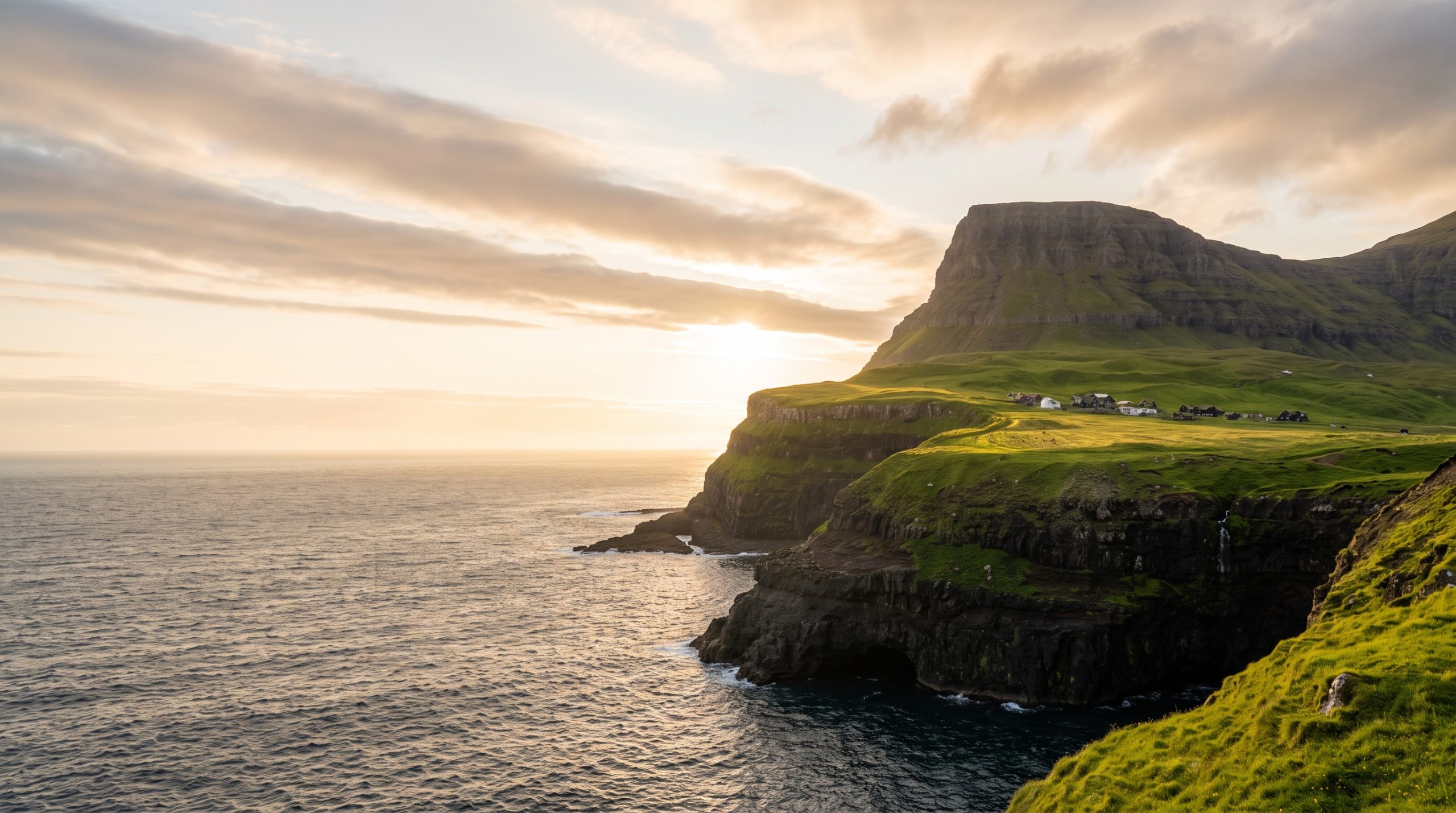
On the longest evening of the year the sun leaves the Faroe Islands at about 11:20pm, somewhere over the north-west horizon, and then almost nothing happens. At solar midnight it sits only around four and a half degrees below the horizon. The north stays copper, wet basalt keeps its shine, and at 1am you can still see the far side of a fjord.
This is not true midnight sun. At 62 degrees north the sun does set, which is better than not setting at all: you get an actual sunset, followed by four hours of light that refuses to fade. There are 41 nights a year in Tórshavn, from 1 June to about 11 July, when it never gets darker than civil twilight.
An 11pm ceremony here is a question of timing rather than luck. Below is the light month by month, the dates the ferries run, and how we build a solstice day around both.
The week we would book for a ceremony at 11pm
The third week of June. Around the solstice the sun rises near 3:36am and sets near 11:22pm, giving close to 19 hours 45 minutes of daylight, and it never falls more than five degrees below the horizon, so the ceremony hour holds its colour. June is also the driest month of the Faroese year.
Solstice week, from a 3:36am sunrise to a 23:22 sunset
On 21 June in Tórshavn the sun clears the horizon at roughly 3:36am, reaches 51 degrees at solar noon just after 1:29pm, and goes down at roughly 11:22pm. That solstice day runs 14 hours 37 minutes longer than the December one.
Inside that week the numbers barely move. The earliest sunrise falls on 19 June and the latest sunset on 22 June, so one night differs from the next by two or three minutes. That flatness is the practical gift of solstice week: if fog sits on a headland on Tuesday, Wednesday at the same hour gives you the same light, which is almost never the case in September.
Sunsets this far north are slow. Across the year, sunset in Tórshavn lasts around 49 minutes, and in June about 37. The sun is not dropping, it is sliding. At 10pm it sits five degrees up on a bearing of 313 degrees, north-west. At 11pm it is half a degree above the water at 326. At solar midnight it is just under the horizon almost due north, and by 3:36am it is back, coming up in the north-east at 30 degrees.
That northern track is the whole reason to shape a day around 11pm here. North-facing cliffs and headlands, the ones that sit flat and grey through the middle of the day, take direct low light late at night. The north tip of Kalsoy above the Kallur lighthouse is the clearest example: a ridge that reads as a silhouette at noon and lights along its spine at eleven.
A typical solstice shape for us: an easy afternoon, vows at 11pm, a slow hour after midnight while the north still burns, then a choice. Some couples go to bed. Some ask us to be out again at 3:40am, the emptiest hour on these islands.
Worth knowing before you pick a venue: the Church of the Faroe Islands marries couples from other countries only where one of them is, or has been, a Faroese citizen and a member of the church. Visiting couples therefore hold an outdoor ceremony with a celebrant, which is exactly why an 11pm hour is available at all. Nobody is waiting to lock a building. Permit research and the paperwork sequence sit with us, and the fundamentals of planning an elopement apply here as anywhere.
Every Faroese month and the light it hands you
Daylight figures below are for the 15th of each month in Tórshavn, local time. They move by a minute or two from year to year, so you can plan a ceremony hour against them years ahead. Weather is less obedient, which is why the verdict column deals in odds.
| Month | Light on the 15th | Conditions | Our verdict |
|---|---|---|---|
| January | 09:31 to 15:42, 6h11m | Wettest month, near 160 mm; days around 6°C, nights 2°C | Aurora season, not ceremony light |
| February | 08:12 to 17:11, 8h59m | Snow dusting the tops, heavy Atlantic swell | Strong film month, tight window |
| March | 06:43 to 18:29, 11h45m | Equinox balance, grass still winter brown | Quiet and dramatic |
| April | 06:02 to 20:52, 14h50m | Puffins return late in the month, green arriving | Good value in light, unsettled |
| May | 04:32 to 22:15, 17h43m | Mykines opens 1 May, calmest winds of the year | Our second choice after June |
| June | 03:37 to 23:18, 19h42m | Driest month, 11°C days, rain on about nine days | Book this one |
| July | 04:11 to 22:55, 18h44m | Warmest and busiest, puffin numbers peak | Excellent, avoid 28 and 29 July |
| August | 05:32 to 21:31, 15h58m | Real darkness returns, puffins thinning out | Long evenings, proper night skies |
| September | 06:54 to 19:51, 12h57m | Swell builds, colour turns, aurora possible again | Best autumn alternative |
| October | 08:12 to 18:13, 10h01m | Sun never climbs past 19 degrees all day | Loveliest light, least reliable |
| November | 08:40 to 15:44, 7h04m | Seven hours of daylight, most of it flat | Winter shape, village anchored |
| December | 09:46 to 14:59, 5h13m | Midday sun under five degrees at the solstice | For couples who want it dark |
The narrow windows: 41 twilight nights, one ferry season
Two kinds of window matter here, and they behave completely differently. Astronomy is fixed. Biology and boats are not.
The twilight nights run from 1 June to about 11 July, and sunset falls at or after 11pm from roughly 3 June to 12 July. Those dates repeat every year within a couple of minutes. If you want vows in visible light at 11pm rather than in dusk, that 40-evening band is the whole of your choice, and the middle of it is the safest part.
Mykines, the puffin island in the west, is open to visitors from 1 May to 31 August. Through those four months the ferry from Sørvágur runs daily when conditions allow, a 45-minute crossing. In April and September it drops to one sailing a day on three days a week, and it does not sail in winter. Visit Vágar’s own advice is to go early in your trip rather than late, because a departure can be delayed by sea conditions. We take that literally: island days go at the front of the week and never on the ceremony day.
Puffins arrive in late April and leave in early September, with numbers peaking in July. That window moves by a week or two with the season, so if birds are part of the picture you want the middle of the range, not the edges. Our destination guides go further into how the islands connect on the ground.
Aurora is the other narrow thing, and it deserves a straight answer. The season runs roughly October to March, the islands sit at the right latitude, and the limiting factor is cloud. The Faroes receive somewhere near 1,000 hours of sunshine a year, which tells you most of what you need to know about how often the sky is clear at 10pm in November. Plan a winter elopement for the ridges, the light on wet rock and the swell. If the sky opens, that is a bonus we will chase, not a promise we will sell.
When an 11pm ceremony stops working, and the weeks we prefer
November to February. Daylight runs from about seven hours down to five, January averages close to 160 mm of rain, and the sun at the December solstice never lifts five degrees off the horizon. That last figure is not all bad news, since it means low light all day, but the working window is short. If you love that mood, we would move you to the last week of September or the first half of October, where the sun still stays low and you have ten to thirteen hours to use.
The end of July. Ólavsøka, the national holiday on 28 and 29 July, fills Tórshavn. It is a genuinely good thing to witness, but it is not the week to expect quiet villages or spare beds. Shift a week earlier, or into mid-August.
Mid-August onward, if puffins matter to you. The birds are leaving and the colonies thin out. Late June and July are the reliable weeks for that, and you gain the late light as well.
None of this applies if your date is already fixed. Tell us the week you have, and we will either build the day around what that week actually does, or tell you honestly which month gives you more of what you described.
What a 51-degree sun and a 19-degree sun do to a frame
The midday sun at the June solstice reaches 51 degrees in the Faroes. That is high, contrasty and unhelpful, and it is the honest reason we do not put the ceremony at 2pm in summer. In the middle of a bright June day, cliffs go chalky and faces need shade. Mid-October is the opposite: the sun tops out at 19 degrees, so every hour of the short day behaves like an evening.
The evening window works out at roughly 93 minutes at the solstice, measuring from six degrees down to the horizon, against about 64 minutes in mid-August and mid-October. And the direction changes as much as the length. In June the sun sets in the north-west and rises in the north-east. By mid-October it goes down at 250 degrees, west-south-west. A location that glows in June can be in shadow in October at the same hour, which is why we build a timeline against the ridge line to the west of you rather than against the sunset time in an app. On these islands the light often leaves a valley 40 minutes to an hour before the sun officially sets.
What that looks like finished is the useful question, and our galleries and films are where to answer it. Highlights reach you within 5 days, the full gallery or film within 3 weeks.
The two-camera question is a seasonal one here. On a solstice evening, with 93 minutes of low sun and four hours of twilight behind it, one photographer or one filmmaker can work slowly and miss nothing. In late September that window is closer to an hour and it does not wait, so a photographer and a filmmaker working the same moment is what puts the vows on film as well as in stills. We are eight people, so a second camera and a colleague in reserve are always there. What each experience covers is set out in full, including our own travel, which is included wherever in the world you take us.
Tell us the week you are looking at and we will tell you what the light does with it. Check Your Date.
Fog, wind direction and the plan written before anyone flies
Faroese weather is described by the people who measure it as mild, usually overcast, foggy and windy, and June is no exception: between 58 and 62 percent of the month is overcast or mostly cloudy. That is not the problem it sounds like. Cloud at 11pm over an open northern horizon is a soft light source the size of the sky, and far kinder to faces than a clear 51-degree noon.
Wind is the constraint that actually reshapes a day. The Danish Meteorological Institute’s 1991 to 2020 normals put the mean annual wind speed in Tórshavn at 6.6 metres per second, with west and south-westerly the most frequent directions and easterly the rarest. June runs a little below that average. Because the prevailing wind is so consistent, we hold east-facing and inland alternatives for every coastal hour, and on the islands that means somewhere sheltered is usually 20 minutes away rather than two hours.
The plan itself is written before anyone gets on a plane: three named options for the ceremony hour chosen by wind direction, a ceremony hour that can move by a day inside solstice week, ferry-dependent locations placed early, and drone work confirmed in advance where it is legal, safe and appropriate. Rain on about nine days of a Faroese June means the question is never whether it rains on your week, only which hour of which day we use.
Common questions
Does it get properly dark in the Faroe Islands in June?
No. From 1 June to about 11 July it never gets darker than civil twilight in Tórshavn, because at solar midnight the sun sits only four to six degrees below the horizon. You can see the landscape all night. Stars and aurora are not available in that period.
What time does the sun set in the Faroe Islands around the solstice?
Around 11:20pm, with the latest sunset falling on 22 June and the earliest sunrise on 19 June. Sunset itself takes about 37 minutes in June, and the sun tracks sideways along the northern horizon rather than dropping, so the colour lasts well past midnight.
Is June or July better for an elopement in the Faroe Islands?
June, by a small margin. It is the driest month of the year, the twilight nights are at their longest, and villages are quieter than in high summer. July is warmer and puffin numbers peak, which is a fair trade if birds matter more to you than the 11pm ceremony hour.
Will there be puffins on Mykines in June?
Yes. Puffins are on the island from late April to early September. The ferry from Sørvágur runs daily between 1 May and 31 August when conditions allow, a 45-minute crossing, and we put Mykines early in the week rather than on your ceremony day.
Our dates are fixed in November. Can that still work?
Yes, with a different shape. November gives about seven hours of daylight, so the ceremony sits near the middle of the day and the low sun works in your favour rather than against it. We anchor the day to a village and a short drive, keep the coastal hour flexible, and plan for aurora as a bonus.
How often does Faroese weather force a change of plan?
Often enough that we plan for it every time. Rain falls on roughly nine days of the driest month, and wind direction moves a location more often than rain does. Changes are usually a swap between prepared alternatives 20 minutes apart, decided that morning, not a lost day.
How far ahead should we pick our week?
For solstice week, a year or more is comfortable. Our calendar is currently open across 2027, 2028 and 2029, and the calmest planning starts from a date chosen against the light rather than a hotel’s availability.
Choosing solstice week by light rather than by year
If an 11pm ceremony is the thing you keep coming back to, the decision is narrower than it looks: 40 evenings, with the most generous light in the middle of them. The celebrant, the permit research and which headland faces the wind all follow from that.
Write to us with the week you are considering and what you want the day to feel like. We work in writing, so you will have a reply and a first brochure within 24 hours, then a tailored proposal, and planning begins once the contract is signed and the 30% retainer is paid. Tell Us Your Story.