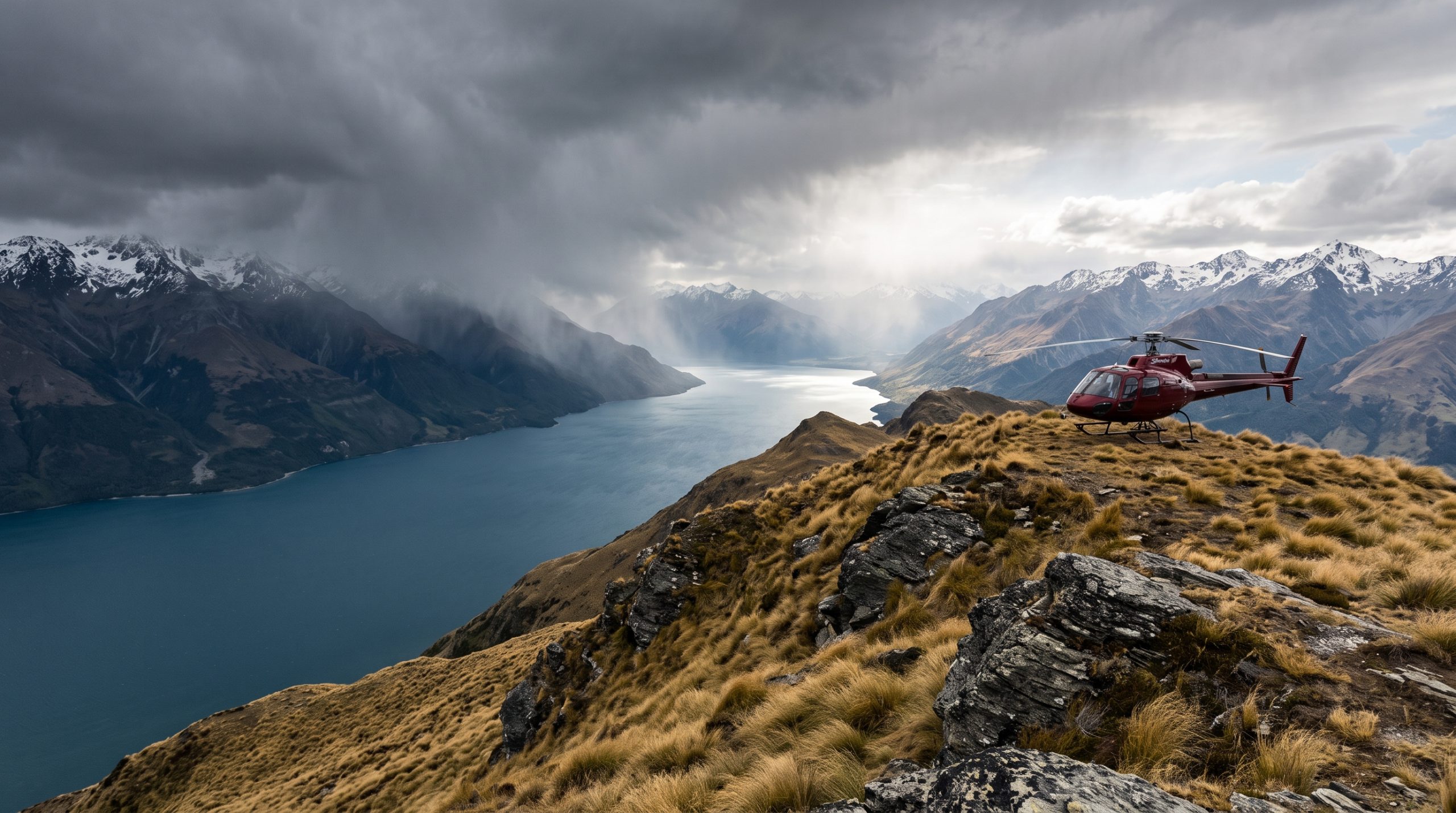
The most useful line in a Queenstown heli wedding is not on the quote from the helicopter company. It sits on your New Zealand marriage licence, in the space where the form lets you name an alternative place of marriage.
Most couples leave it blank, or fill it in with the name of their hotel. Then the cloud sits low on the Remarkables at six in the morning, the landing site is out, and the difference between moving your ceremony down to the lake shore and postponing it altogether turns out to have been settled weeks earlier, at a laptop, by whoever was filling in the form.
We plan, photograph and film elopements around Lake Wakatipu, and the two questions couples send us about flying are the two that websites answer worst: what the aircraft actually costs in New Zealand dollars, and what happens to the morning when the weather says no. Both are below, with the mechanics rather than the marketing.
What the flight costs and what the weather does
A single alpine landing near Queenstown currently starts around NZD 1,800 for the whole aircraft, not per person, with 45 minutes on the ground. Weather moves some mornings. Operators run a check the day before and reschedule, or refund in full where a reschedule is impossible, so the number that matters is how many mornings you hold free.
The line on the licence that carries your backup
New Zealand keeps the legal part refreshingly short. You apply for a marriage licence using a Notice of Intended Marriage, it costs NZD 150, and it has to be done at least three working days before the ceremony. The licence stays valid for three months from issue, so a couple flying in for a two week trip can file long before they land. You need an appointed celebrant, and you need two witnesses who are physically standing there. After the vows, you, your celebrant and both witnesses sign two copies of the Copy of Particulars of Marriage. You keep one. The celebrant sends the other copy back to the registrar, and your marriage is registered.
Here is the part that matters when your ceremony is at 1,800 metres. The licence names the place you intend to marry, and it can also name an alternative place, specifically in case of weather. If you change the venue after the licence is issued, you are expected to tell the registry office that issued it. Naming both locations at the outset takes that job off the one morning when nobody wants an administrative task.
So every flying day we build carries two named locations from the beginning: the landing site, and a ground location we can reach and use the same day. Both go on the licence, both get a timeline, and both get scouted. The rest of the legal groundwork sits with the planning fundamentals we work through with every couple, and it is the least glamorous half hour of the whole process.
Whose permission you are actually flying on
You are not the permit applicant here, which surprises couples who have planned something similar in the American West. The alpine ground around Lake Wakatipu is a patchwork. Public conservation land on one side of a ridge, a working high country station on the other. Where a business operates on public conservation land, the Department of Conservation requires a concession, and that concession belongs to the helicopter company rather than to you. On the stations, the operator holds the landowner agreement.
The practical consequence is worth understanding before you fall for a location. The list of landing sites you can choose from is the list your operator is allowed to land on, and some of the best ones belong to a single company. Heliworks states it holds the only landing rights in the Earnslaw Burn, the glacier valley behind Glenorchy, which means that location arrives with its operator already attached to it.
Our side of this is the research and the logistics: destination and location design, a timeline built around light and real travel time, permit research and the arguments about which site suits which hour. Government, venue and landowner permit fees are paid by you, direct to whoever charges them. Aerial footage runs on airspace clearance and, over conservation land, on separate permission, so we confirm what is actually available at your site before any part of the film depends on a drone.
How the charter bill is built, line by line
Helicopters are chartered by the aircraft, not by the head. That single fact reverses the usual wedding arithmetic. Two of you and four guests cost exactly what two of you cost, right up to the moment the seats run out and a second machine is needed. Operators fly six seat Airbus Squirrels for wedding work out of Queenstown Airport, and they ask for passenger weights when they build the manifest, because seats are sold by weight as well as by number.
Published wedding charter figures move with fuel and with the season, but the shape of them is stable enough to plan against.
| Choice | What it changes on the day | Effect on the charter |
|---|---|---|
| One landing on a peak above the lake | Short flight each way, 45 minutes on the ground | Currently from around NZD 1,800 for the aircraft |
| A second landing on the way home | New altitude, new backdrop, roughly 20 more minutes airborne | Commonly a little over NZD 1,000 more |
| Head of the lake, such as the Earnslaw Burn | Long flight in over the Dart, glacier walls and waterfalls | Currently quoted in the mid NZD 5,000s from Queenstown |
| Same valley, departing from Glenorchy | A 45 minute drive up the western shore replaces half the flying | Roughly half the Queenstown figure, minus any repositioning fee |
| Longer on the ground | 60 minutes instead of 45, so nothing is rushed | Currently around NZD 115 for the extra quarter hour |
The New Zealand dollar has been trading near sixty US cents, so a NZD 1,800 charter sits a little over a thousand US dollars at recent rates. Keep the rest of your budgeting in NZD and you will spend less time reconciling numbers with your operator.
Our coverage sits alongside the charter rather than inside it. The Adventure, from $4,900, puts one dedicated photographer or one dedicated filmmaker on the mountain with you and leaves a seat free for a witness. The Expedition, from $7,900, puts a photographer and a filmmaker up there working together. Team travel to New Zealand is included in both, and the fee does not change with guest count. The aircraft is booked and paid for in your name, which is precisely why the operator’s weather policy applies to you directly. The rest of what each experience covers is set out on our coverage and pricing page.
Sunrise arrives from the southeast, and it changes everything
Queenstown sits at 45 degrees south, and the sun behaves accordingly. On 21 December it rises at 5:54am and does not set until 9:31pm. It comes up in the southeast, around 124 degrees, which from town is straight up behind the Remarkables, and it goes down around 236 degrees, out past the far shore. At solar noon it is 68 degrees above the horizon and sitting in the north, which is the opposite of everything an American eye expects.
Turn the calendar to 21 June and the geometry rotates. Sunrise at 8:23am from the northeast, sunset at 5:09pm to the northwest, and a midday sun that tops out near 22 degrees. Midwinter here is one long, low, side lit day, and an 11am winter landing has better light on it than an 11am landing in January ever will.
Altitude buys you the real horizon. Down in the valley the ridgelines eat the first hour and the last hour of light, and in June the sun does not clear the Remarkables into central Queenstown until well after the almanac says it has risen. On a summit at 1,800 or 2,000 metres you get the sunrise the almanac promised, with the shadow line moving down the far shore beneath you.
The honest part. A bright January noon on a snowfield is the flattest, hardest light of the year up there, and it is also the slot most heli weddings get booked into, because it suits the aircraft roster. Fly at 6am in December, or in the last ninety minutes of an autumn afternoon, and the same ridge is a different photograph. That difference is visible in the elopement films and galleries we have published, and it is worth an early alarm.
Two of us on a patch of shingle
An alpine landing site is smaller than it looks in a wide frame. Often it is a saddle of shingle and tussock about the size of a tennis court, sloping on one side, with the machine parked on the flattest part of it. Two of us working that space is choreography rather than improvisation. The photographer takes the ridge line, the filmmaker drops below the lip and shoots upward, and neither of us appears in the other’s frame. Wind is the real constraint on sound up there, so on an Expedition we set the vows in the lee of a rock or the aircraft, and the audio holds because somebody is there whose entire job that morning is capturing it. Then the helicopter lifts, banks away, and it goes completely silent. That is the part worth flying for.
The morning the mountain is shut
No Queenstown operator publishes a cancellation percentage, and any figure presented to you as one is somebody’s estimate dressed up as data. What operators do publish is the policy, and the policy is the thing that actually protects your money. Companies run a weather check the day before departure and reconfirm the timing then. If weather stops the flight, the standard here is a reschedule, with a full refund where a reschedule is not possible. Glacier Southern Lakes says exactly that in its own FAQ. What does get charged is a cancellation you make yourself inside 24 hours of departure, which is why the reschedule conversation always comes first.
Alpine landings are decided by cloud base and wind, not by whether it is drizzling in Frankton. Grey mornings in town sit under clear ridges more often than couples expect, and a calm blue valley can have a hard westerly running across the tops. This is why the day before check exists, and why an operator will sometimes move you by two hours rather than by two days.
So the planning number is not a percentage. It is how many mornings you hold. One morning gives you one attempt. Three mornings inside a week in Queenstown changes the conversation completely, and we would rather build a window than a date. We place the flight on the first workable morning in that window and keep the rest of the trip flexible behind it. Because team travel is included wherever you are getting married, our team is in the valley for the window rather than for a single sunrise, and moving your flight from Tuesday to Thursday costs nothing on our side of the arrangement.
The ground alternative is not a consolation here, which is the luxury of this particular valley. The road to Glenorchy runs 45 minutes along the western shore, past beech forest and river flats, and delivers you to the head of the lake with the same mountains standing over you from below instead of above. It photographs beautifully in exactly the weather that keeps a helicopter on the apron. If you are still weighing Wakatipu against other regions, our destination elopement guides cover the same questions elsewhere. Tell us the month you are considering and we will tell you honestly what that month does to the odds. Check Your Date.
Common questions
Do we need a permit to get married on a peak we fly to?
Not personally, in most cases. The permission that governs an alpine landing belongs to the operator: a Department of Conservation concession where the site is on public conservation land, a landowner agreement where it is a high country station. What you need is the marriage licence, an appointed celebrant and two witnesses. Where a site does carry a fee, you pay it and we handle the research behind it.
What happens to our money if weather closes the landing site?
The operator standard in Queenstown is a reschedule, and a full refund where a reschedule is not possible, with a weather check run the day before departure. A cancellation you make yourself within 24 hours of the flight is charged in full, so the move is always to reschedule rather than cancel. Our planning and our fee do not change when a date shifts inside your window.
Can a photographer and a filmmaker both fit in the helicopter with us?
Usually yes. You two, a celebrant and both of us is five passengers, and the six seat Squirrels Queenstown operators use for wedding work are built around groups that size. Two witnesses have to be present and sign, and couples flying alone tend to ask the people already on the mountain with them. Operators confirm the manifest by weight as well as by seat count, so we send names and numbers early.
How many mornings should we hold free for the flight?
Three where your trip allows it, and put the first one early in your stay rather than on the last day. We plan the flight for the first workable morning and shape the surrounding days around it, so a move costs you scenery and not the wedding. The alternative ground location goes on your marriage licence at the same time.
Is it cheaper to fly from Glenorchy than from Queenstown Airport?
For head of the lake locations, substantially. The Earnslaw Burn from Glenorchy is quoted at roughly half the Queenstown figure, because the 45 minute drive up the western shore replaces half the flying. Some operators add a repositioning fee, so the real saving is a little narrower than the headline gap, and it costs you an early start on the road.
Booking a window, not a morning
Dates are currently open across our 2027, 2028 and 2029 New Zealand seasons, and Queenstown flying dates tend to be planned a long way out because the good windows are seasonal rather than daily. An inquiry gets a reply and our initial brochure back within 24 hours, then a tailored proposal built around your locations and your light. A signed contract and a 30 percent retainer start the planning. The full planning trail stays written and easy to revisit, whatever the time zone gap between us, so nothing waits on both of us being awake at once. Your highlights arrive 5 days after the day itself, and the full gallery or film within 3 weeks.
Send us the month you are looking at, whether you want the sunrise version or the last light version, and what you would want the ground day to be if the mountain keeps its cloud. We will come back with a shape for it, and an honest read on which weeks in that season give the peak its best chance. Tell Us Your Story.