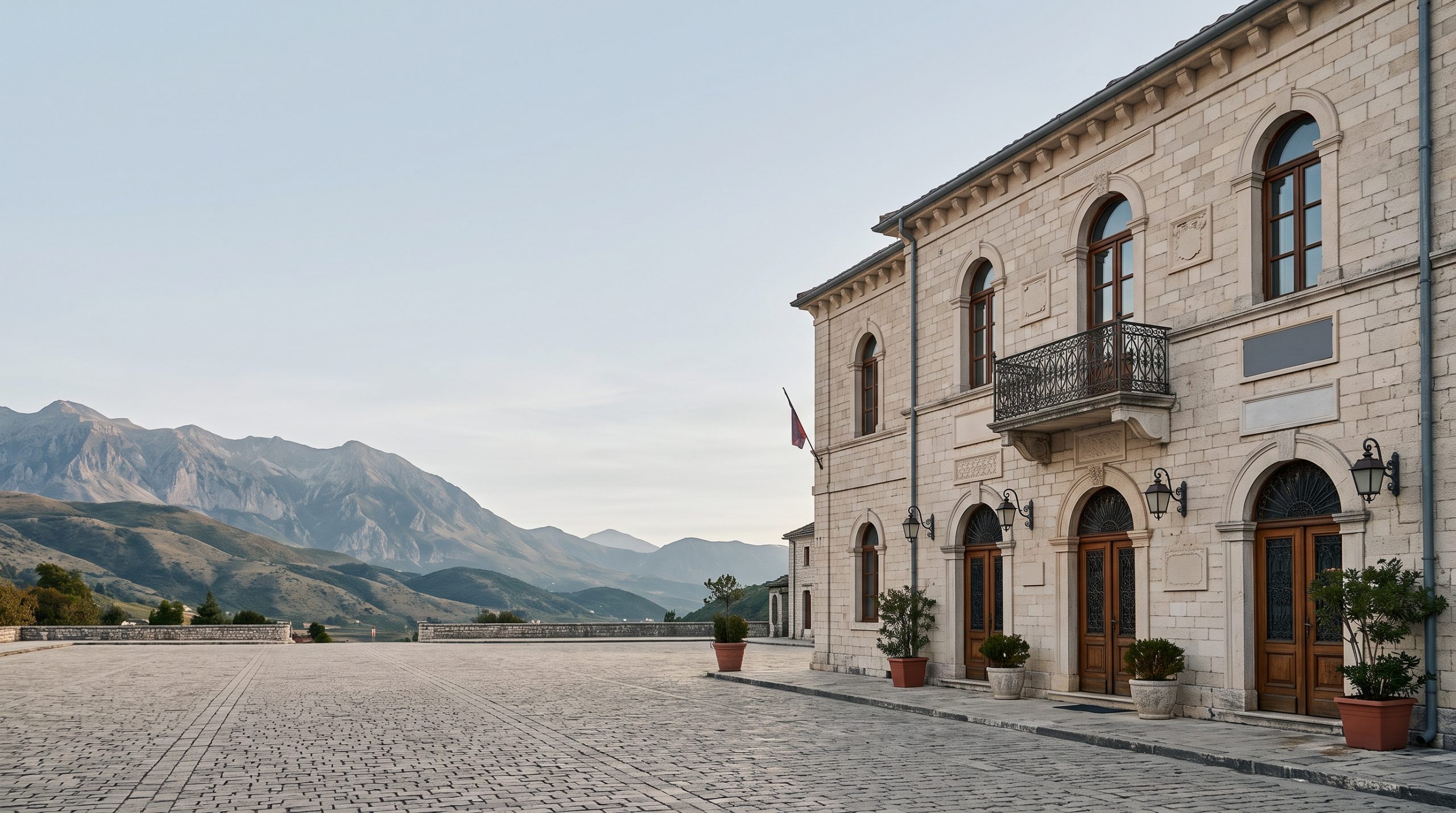
The Albanian Riviera has a wall behind it. The Ceraunian mountains rise straight off the water, so the sun arrives late over the ridge and then spends the whole evening falling into the Ionian, with Corfu sitting out on the horizon. It is a west-facing coast with a mountain range at its back, and that single piece of geography decides what hour we put a ceremony at, long before anyone opens a file.
The paperwork decides the rest. Albania’s civil marriage process is short on documents and very specific about timing: an appearance at the Office of Civil Status at least 11 days before the date, a birth certificate issued inside a three-month window, an apostille on it, a translation done inside Albania, and an affidavit that, for Americans, exists in exactly one building in the country. None of the pieces are complicated. All of them are sequenced, and the sequence is the part couples get wrong.
Below is the order it goes in, which office owns which link, and the alternative a good number of couples choose once they see where those 11 days land in a two-week trip.
The 11 days that set your whole calendar
Foreign couples can marry in Albania. You both appear at the Office of Civil Status at least 11 days before the wedding date, having brought a birth certificate issued within the last three months, apostilled and translated into Albanian, plus proof that no impediment to marriage exists. On the day itself, you and two witnesses sign in person.
Where Albania adds friction to an otherwise short process
There are only a handful of documents here and none of them are exotic. What makes Albania catch people out is that four separate authorities each own one link in the chain, and they sit on two continents: the state that issued your birth certificate, whoever puts the apostille on it, a licensed notary public inside Albania who produces the Albanian translation, and the Office of Civil Status, Zyra e Gjendjes Civile, in the municipality where the marriage is registered. That last office is the one whose answer governs. If its clerk is satisfied, you are married.
The first clause worth slowing down for is about where you file. The U.S. Embassy in Tirana states that where one spouse is an Albanian citizen, the appearance happens in the district where that person has legal residence, and that where neither spouse holds Albanian citizenship, the couple may marry at the Civil Status Office covering their usual place of residence. Which municipal office that turns out to be is the first thing to settle, because the 11 days, the signing and the working hours of a single building all hang off it.
The second is Article 7 of the Family Code, which contracts marriage between a man and a woman who have reached the age of 18. Same-sex couples cannot complete the civil marriage inside Albania under the code as it stands. The ceremony route further down this page is fully open, we plan and shoot those days exactly as we do any other, and Albania is a genuinely warm place to spend them.
Our role is photography, film and practical planning rather than legal advice. Confirm the final Albania requirements with the authority handling your application.
Build the Albanian marriage file in this order
Collect these in sequence. Each one is the input to the next, and getting them out of order is what produces a scramble in the last week.
- A certified copy of each birth certificate, issued within the last three months. This is a validity window, not a formality. Order it so that it is still under three months old on the day you hand it over in Albania, not on the day you booked the trip.
- An apostille on each birth certificate. For a U.S. document going to Albania, the apostille comes from the issuing authority: the state government that issued the certificate, the issuing court, or the federal government, depending on the document. Turnaround varies a lot between states, so this is the step to start first and chase hardest.
- An Albanian translation of the apostilled certificate. The embassy’s guidance points to a licensed Albanian notary public for this. It happens in Albania, on Albanian paper, and it is not the same thing as a certified translation arranged at home.
- Proof that no impediment to your marriage exists. Albanian authorities want certification from a competent authority. The United States does not issue such a document, so Americans instead sign an Affidavit of Eligibility to Marry in the Republic of Albania in front of a consular officer at the U.S. Embassy in Tirana, on a slot arranged in advance with the embassy. The standard notary fee is 50 dollars, payable in dollars or lekë, in cash or by card. Couples from other countries bring their own government’s equivalent certificate of no impediment.
- Valid passports for both of you. Check that the name on the passport and the name on the birth certificate match, character for character, before anything gets apostilled.
- The appearance at the Office of Civil Status, at least 11 days before the date. Both of you attend and give the details of the person you intend to marry. The announcement follows.
- Two witnesses on the day. Both spouses and two witnesses appear in person in front of the civil status clerk to sign the Act of Marriages Record.
- Your marriage certificate, and an apostille on it if you need one abroad. The marriage goes into the national civil status register and certificates are issued on registration. An Albanian certificate destined for use in another country is apostilled by the Legalization Office at the Albanian Ministry for Europe and Foreign Affairs. Americans do not strictly need this step for the marriage to count at home: a legal marriage performed in Albania is fully valid in the United States, and there is nothing to register with the embassy afterwards.
Use the Albania fees and lead times here as a working estimate rather than a permanent rule; confirm the current numbers with the relevant office before filing.
Turn Albania’s 11-day rule into a ceremony calendar
Every timeline for Albania is built backwards from the signing, because two clocks run in opposite directions. The 11 days push your appearance earlier. The three-month birth certificate window pushes it later. Your trip has to satisfy both.
| Working backwards | What happens | Why it sits there |
|---|---|---|
| Ceremony day | You, your spouse and two witnesses sign the Act of Marriages Record in front of the civil status clerk | The signing is the marriage. Everything before it is preparation |
| At least 11 days earlier | You both appear at the Office of Civil Status and the announcement is made | The Family Code holds the marriage until 10 days have passed from the day following the announcement |
| A day or two before that | Americans sign the Affidavit of Eligibility to Marry at the embassy in Tirana | It is issued in Tirana and nowhere else, and Tirana to Sarandë is most of a driving day |
| Just ahead of the appearance | Apostilled birth certificates translated by a licensed Albanian notary public | The clerk reads the file in Albanian |
| Inside three months of the appearance | Certified birth certificates ordered at home, then apostilled | The three-month clock runs to the day the office takes the document |
| Four to six months out | Date held, municipality chosen, ceremony hour set against sunset over the Ionian | Coastal light in Himarë or Ksamil moves by more than an hour across a season |
The real minimum is roughly two weeks in the country. Land in Tirana, sign the affidavit on your second day, appear at the civil status office as soon as you have the translated file in hand, and the earliest the signing can happen is around your thirteenth or fourteenth day in Albania. That is tight but real, and it assumes nothing needs a second visit to a counter.
The comfortable minimum is closer to three weeks, or a split trip: one short run into Albania to make the appearance, then home, then back for the wedding week. That second shape is the one we would build a plan around, because it puts the paperwork days and the day we are photographing at opposite ends of the trip instead of stacked on top of each other.
Six details that decide how smoothly the file moves
- Order the birth certificate late, not early. The three-month window runs to the day the office takes it. Couples who get organised in January for a June date almost always have to order a second time.
- The apostille goes on the certified copy itself. Not on a photocopy, and not on a notarised statement about the copy. It comes from the authority that issued the original document.
- The translation happens in Albania. A licensed Albanian notary public produces it. Arriving with a beautifully bound certified translation from home is the single most common wasted expense on this route.
- Order two certified copies of everything and apostille both. Assume that whatever you hand across a counter stays in the file. A spare apostilled certificate costs very little to obtain at home and is close to unobtainable from a village on the Riviera.
- Settle the surname question before you sign. At registration a bride may keep her maiden name or take her married name, and that choice goes onto the record at that moment.
- The affidavit lives in Tirana. If your ceremony is anywhere south of the Llogara pass, that is a long drive each way built into the trip, and it has to happen before the office appearance, not after.
Sign at home if you want the Albanian coast to carry the whole day
A large share of the couples we work with in Albania do the legal part at home. Ten minutes at a courthouse on a Tuesday, two friends as witnesses, no photographs that matter. Then they fly out and give the entire actual day to the coast or the mountains. We would tell you if this were a lesser version of the thing. It is not, and for a lot of people it is the better plan.
What changes is all administrative. The 11 days disappear. Tirana drops out of the itinerary unless you want it. The three-month clock stops mattering. Nobody has to be inside a municipal building on a working morning in the middle of your trip.
What does not change is the entire day. Your vows, your celebrant, the rings, the letters you read to each other, the walk down into the canyon mouth at Gjipe, the pines above Llogara, an olive terrace over Himarë, the water at Ksamil going that ridiculous colour opposite Corfu, a boat up the Shala river with the walls closing in on both sides. The ceremony happens at the hour the light is right rather than the hour an office is open, which on this coast means somewhere in the last ninety minutes before the sun goes into the Ionian. You can see how that hour reads in the finished work on our elopement stories and films, and how differently the same coastline behaves in June and October.
Albania also has a route for recognising a marriage performed elsewhere. You apostille the foreign marriage certificate and submit it to the Civil Status Office, which registers it. You do not need to do that in order to hold your ceremony here, and most couples never do, but it exists if you have a reason to want the marriage on the Albanian register. If you are weighing the two routes against each other, our guide to how to plan an elopement walks through the trade-offs without the legal detail on top.
Our side of the Albanian plan, and the documents that remain yours
We handle destination and location design, the planning, and a timeline built around light and real travel time rather than optimistic map estimates. That includes permit research and logistics guidance, weather alternatives held in reserve for every outdoor hour, and holding your date against the working calendar of whichever municipality you are filing in. On the civil route we set the ceremony hour so that the office part and the light part do not collide, which on the Riviera in high summer means treating late afternoon as untouchable.
Two witnesses have to be present in person and sign. On an Expedition there are two of us on the ground for the whole day, a photographer and a filmmaker working the same hours rather than two suppliers who first set eyes on each other in the car park at dawn, and we are asked to stand as the two witnesses often enough that it barely counts as a question now. We are glad to. It also means the film has the signature in it and not only the vows.
What stays with you is the legal file itself. We are not lawyers, we do not file paperwork, and we do not stand between you and the registry office. Permit fees, the celebrant, accommodation and anything unusual on the transport side, a boat down to Gjipe or a 4×4 up towards Theth, are yours to book. What each coverage option includes, and the fact that our travel to Albania is part of it, is set out on the pricing page.
If you have a month in mind and a rough idea of the coast or the mountains, that is enough to start with. Send Us a Message and we will come back with what the calendar and the light look like for that week.
Common questions
Do we need to be residents of Albania to get married there?
Albanian citizenship is not required. Where neither spouse holds it, the U.S. Embassy’s guidance is that the couple may marry at the Civil Status Office covering their usual place of residence. The practical question is therefore which municipal office will accept your file, and that is worth settling with the municipality itself before flights and accommodation are booked around it.
How long do we have to be in Albania before we can get married?
At least 11 days must pass between your appearance at the Office of Civil Status and the marriage, and Americans need the embassy affidavit from Tirana before that appearance. In practice that means about two weeks in the country at the absolute tightest, which is why we usually suggest splitting the trip or signing at home instead.
Is a marriage performed in Albania valid in the United States?
Yes. Once the marriage is registered with the Office of Civil Status, a legal marriage performed in Albania is fully valid in the United States, and there is no need to register it with the embassy afterwards. If a U.S. institution asks for the Albanian certificate, the Legalization Office at the Ministry for Europe and Foreign Affairs is where the apostille comes from.
Can we legally get married on a beach in Albania?
The marriage itself is concluded in front of the civil registration office clerk. The Family Code allows a clerk to conclude a marriage away from the office only in narrow, justified circumstances, decided case by case. Plan on signing indoors, then hold the ceremony wherever you actually want to be standing, which is what most couples do anyway.
Do our documents have to be translated into Albanian?
Yes. The apostilled birth certificate is translated into Albanian by a licensed Albanian notary public. Budget a working day for it in whichever town you are filing in, and do not have it done at home first, because the Albanian office is looking for the Albanian notarial version.
Can same-sex couples get married in Albania?
Not under the Family Code as it currently stands, which contracts marriage between a man and a woman aged 18 or over. Couples who marry at home and hold the ceremony in Albania are on completely solid ground, and it is a route we plan often. The day looks identical from where we are standing.
Who can be our witnesses if we do not know anyone in Albania?
Two witnesses have to appear in person with identification and sign the Act of Marriages Record alongside you. Couples bring a parent, a friend, or nobody at all, in which case the two of us covering the day can sign. It is worth confirming with your specific office that it is happy with your choice of witnesses.
How recent does our birth certificate need to be?
It has to be a certified copy issued within the last three months, carrying an apostille, and then translated into Albanian. The three-month clock is measured against the day the office takes the document, so order it roughly six to eight weeks before you travel rather than the moment you decide on Albania.
Choosing a date the office and the light both agree on
Albania rewards couples who do not mind a bit of road. The good hours are at the ends of the day, the best places take a walk or a boat to reach, and the difference between a June evening at Ksamil and an October one at Dhërmi is worth planning around. If you would like to see how other destinations compare on paperwork and light, our elopement guides cover them country by country.
Everything we do runs in writing, at whatever hour suits you. You send us a date and a rough shape, we reply within 24 hours with an initial brochure, and a tailored proposal follows. A signed contract and a 30% retainer start the planning. Highlights reach you 5 days after the day itself and the full gallery or film within 3 weeks. We currently have dates available across the 2027–2029 seasons now, and coastal weekends in the shoulder months go first.
Tell us the week you are thinking about and which coast you keep coming back to on the map, and we will tell you honestly what is possible in it. Check Your Date.