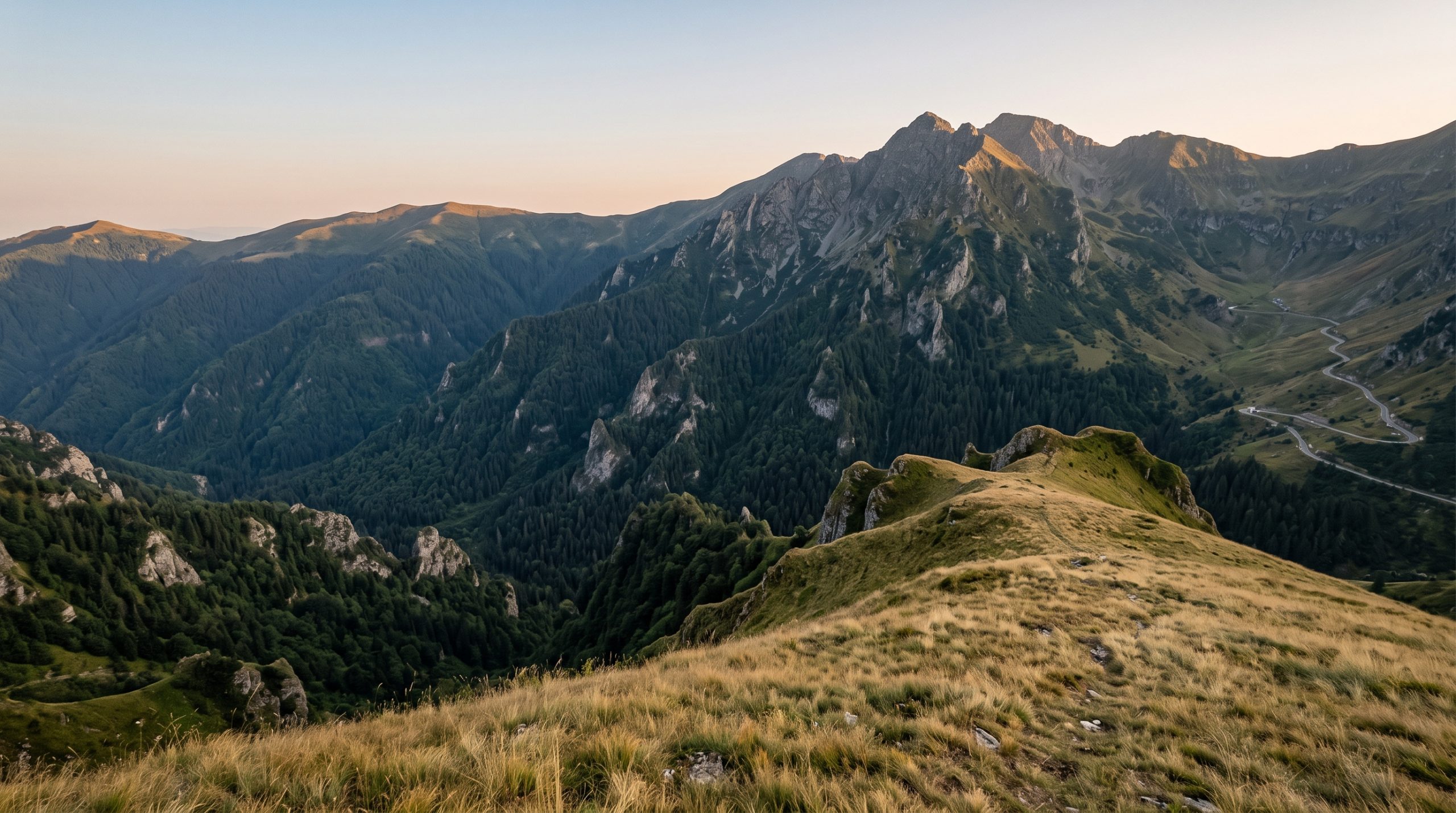
The high section of the Transfagarasan closes to traffic on November 1 and does not open again until June or July, depending on how quickly the snow clears off the alpine stretch between Piscu Negru and Balea Cascada. That one line in a roads bulletin shapes a Carpathian ceremony date far more than any legal question does, because a symbolic ceremony has no legal side to it. Nothing to file, no notice to give, no office to satisfy.
A symbolic ceremony is not a marriage in the eyes of the Romanian state. Nothing is filed, nothing is registered, no civil status officer attends, and no office has to approve your date or your meadow. You marry legally at home, in ten minutes, at a clerk’s counter in your own county. Then you fly to Sibiu or Brasov and hold the ceremony you actually want to remember, at the hour the light works, on ground you picked for reasons that have nothing to do with a filing cabinet.
Both routes are covered below. The Romanian civil marriage, described properly, including the two deadlines that collide if nobody does the arithmetic. And the symbolic route, which is what most couples who write to us choose, along with the access details that take the place of paperwork once the paperwork is gone.
Where the legal marriage actually happens
A symbolic ceremony in the Carpathians carries no Romanian paperwork at all. You marry legally at home, then stand on a ridge in the Fagaras or in a hay meadow under Piatra Craiului and say the words that matter to you. Romanian civil marriage is a separate town hall process, and it is optional here.
The ridge is simple; the registry route is the complicated part
The Romanian civil route is not closed to visiting couples, and it is not quick either. Article 287 of the Civil Code puts the civil marriage in front of a civil status officer at the seat of the town hall or local population records service covering the place where one of you has domicile or residence. Consent is given publicly, in the presence of two witnesses. A ceremony outside that building is possible for well-founded reasons with the mayor’s approval, which makes an outdoor civil marriage an exception granted by one specific mayor’s office rather than a service you can book.
For American couples there is a second wrinkle, and it is not Romania’s doing. The United States has no government-issued certificate of eligibility to marry and no central register of marriages, so the US Embassy in Bucharest cannot certify the marital status or eligibility of people living in the States. What Americans can obtain instead, depending on the state they live in, is a no record of marriage certificate, a letter of single status or a certificate of non-impediment. Embassy staff also cannot perform marriages, which surprises couples who assumed there was a consular shortcut.
So the honest rating is this. The town hall route is fiddly rather than difficult: real documents, real deadlines, an office with its own hours and its own reading of the file. The mountain route is simple. Almost every couple who asks us about the Carpathians ends up marrying legally at home and treating the Romanian day as the ceremony, and we would rate that the better plan rather than the fallback. It puts the vows at 5:40am on a ridge instead of at 11am in a queue, it lets us move the whole day when a front comes through, and it removes the only part of an elopement that can be genuinely stressful. Our guide to planning an elopement works through the same decision in general terms.
If you choose the legal route, this is the Romanian paper sequence
If you do want the Romanian certificate, the file is assembled roughly in this sequence. Each foreign document travels the same way: apostille first, then a Romanian translation, then the translation legalized at a notary in Romania.
- Birth certificates. Long form, from the state that issued them. Romania accepts the Hague apostille, so the apostille comes from your Secretary of State, not from a Romanian office. Order these first, because they are the one part of the chain you cannot speed up from abroad.
- Proof that there is no impediment under your own law. Romanian town halls expect this to be issued or authenticated by your country’s diplomatic mission in Romania. A short list of mostly European states, Austria and Belgium and Croatia among them, is exempt because their own authorities issue a marital capacity certificate that Romania accepts directly, valid three months. The United States is not on that list, which is why the state-level single status document matters.
- The document ending any previous marriage, if either of you has been married before. Apostilled and translated like everything else.
- The prenuptial medical certificate, issued in Romania by a doctor on the basis of blood work and a chest x-ray. It has to state explicitly that you may marry, and it is valid for fourteen calendar days from the date it is issued. This is the item with the shortest fuse in the whole file.
- Passports, valid on the day you file the declaration and still valid on the ceremony date.
- An authorized translator, present with you when you file the marriage declaration if you do not speak Romanian. This is a legal requirement rather than a courtesy, and the couple pays for it.
- Two witnesses with valid identity documents, on the day itself.
Published guidance on the no-impediment document varies between town halls, and there is only one office whose reading governs your file: the registry office that takes your declaration. Ask that office, in writing, what form it wants the document in, and follow its answer rather than a general summary.
Build the Carpathian ceremony calendar from the ridge hour
The Romanian timeline is built around two numbers. The marriage declaration is posted publicly when you file it, and anyone may oppose it within ten days of that posting, which is why the ceremony sits after the ten days have run. The declaration then expires: if the marriage has not taken place within thirty days of posting, you file a fresh one.
| Counting back | What has to be true |
|---|---|
| Four to six months | Apostilles ordered, translations arranged, the month chosen against the road season, our team and your accommodation held |
| Thirty to ten days before | The marriage declaration is filed at the town hall and posted, with the translator present if you need one |
| Inside fourteen days of the ceremony | Medical certificates issued, so they are still inside their fourteen-day validity when the file is submitted |
| Ceremony day | Two witnesses with ID, passports valid, the hour agreed with the office and with us |
The real minimum on the ground is therefore about eleven days in Romania: arrive, see a doctor, file the declaration the same week, wait out the ten days, marry. The comfortable minimum, and the one we build to, is different. Legal marriage done at home months earlier, then three nights in the mountains before the ceremony day so we have room to move the hour, swap a ridge for a forest, or drive an hour west for better cloud.
Five details that catch couples out
None of these are dramatic. They are the small mechanical things that decide whether a week feels organized or feels like errands.
The fourteen-day certificate against the ten-day posting
The medical certificate lives for fourteen calendar days and belongs in the marriage file, and the file has to sit for ten days before the ceremony. Those two windows barely overlap. In practice the blood work, the x-ray and the doctor’s signature all need to land in the same few days as your visit to the town hall, which means booking the appointments before you fly rather than looking for a clinic on arrival.
The declaration has a shelf life
Thirty days from posting and it lapses. Couples who file early to be organized, then shift the date by a fortnight for weather, can find themselves filing twice. Pick the date, then file.
Outdoors is an exception, not a setting
Article 287 allows the civil marriage to be concluded away from the office for well-founded reasons with the mayor’s approval. That is a decision made by a named official in a named commune, not a box on a form, and it is the single most common misreading of Romanian rules we see. A symbolic ceremony has no such constraint, which is a large part of why the ridge wins.
Translation is a formal role
A friend who speaks Romanian is not a substitute. The declaration is submitted through an authorized translator, and foreign documents are translated and then legalized at a Romanian notary. Budget a working day in a town, not an afternoon.
A blessing follows the civil marriage
In Romania a religious ceremony may only be celebrated after the civil marriage. If a village church or a wooden Maramures-style chapel is part of what you are imagining, the parish will expect the civil marriage to exist already, so bring your certificate from home and let us open that conversation with the parish early rather than in the last fortnight.
The symbolic route, and what the mountain day costs in lei
A symbolic ceremony is yours to build. Someone you love officiates, or a celebrant does, or you simply read to each other with nobody standing between you. There is no register to sign, no minimum notice, no office hours, and no reason the vows cannot happen at 5:40am at 2,000 meters or at last light on a shoulder above a shepherd’s fold. Nothing about the photography or the film changes: the same timeline, the same team on the ground, highlights with you in five days and the full gallery or film in three weeks. If you want to see how this range actually reads on camera, the low cloud sitting in the valleys and the hard limestone light, our stories and films are the honest version of it.
What replaces paperwork is access, and access in the Carpathians costs very little money and quite a lot of planning. Much of the open ground that looks empty is somebody’s hay meadow, and permission there is a conversation with a family rather than an application. National parks charge visiting tickets: Retezat, the wildest of them and the one with the glacial lakes, sells a ticket at 10 lei that covers seven days regardless of how many times you go in and out. Government, venue and landowner permit fees are yours to pay; the research and the asking are ours, in every destination we work in.
The Fagaras is where money starts to appear, and it is the one place worth knowing the numbers. When the high road is shut, Balea Lake is reachable only by the cable car from Balea Cascada, a 3,700 meter ride of about fifteen minutes up to roughly 2,034 meters, running from 09:00 to 17:00. A one-way adult ticket currently runs around 80 lei, and the cabin operates with a minimum party of ten, so two people arriving alone either wait for other passengers or cover the difference. At recent rates the leu runs a little over four to the US dollar, which puts that ride under twenty dollars a head and the Retezat ticket at about two and a half. Helicopters, private 4×4 charters and mountain guides sit outside coverage if you want them, as do accommodation, your celebrant and any activity you add around the ceremony.
Our own side is straightforward: one full day with a dedicated photographer or a dedicated filmmaker starts at $4,900, one full day with a photographer and a filmmaker working together starts at $7,900, and the multi-day shape across several valleys is quoted as a proposal on our pricing page. The numbers quoted for the Carpathians are useful for planning rather than permanent tariffs; re-check them with the issuing office when your date is fixed.
Season is the real budget line. The Transfagarasan’s alpine section is closed to traffic from November 1 until the end of June between kilometer 104 at Piscu Negru and Balea Cascada, and the reopening lands in June or July according to the regional roads directorate, so a May date means low-level ground, the cable car, or a different massif entirely. Piatra Craiului and the meadows around Zarnesti and Bran work far earlier in the year, and the destination guides go deeper on which month suits which valley.
What we build around the Carpathian day, and what stays yours
We are eight people, four photographers and four filmmakers, and photography, film and planning arrive as one service rather than two vendors introducing themselves on the morning. On a Carpathian day that matters most in one small way: the vows happen once, at the minute the light is right, because the person filming and the person shooting stills already work together and neither needs the moment repeated for a second camera. There is also always a colleague in reserve, which is worth something when a plan depends on one weather window.
What we hold: location design and the shape of the day, a timeline built around light and real driving times on mountain roads, permit research and logistics, weather alternatives with a sheltered option held in reserve, coordination of the ceremony hour with the office’s availability if you take the civil route, and drone footage where it is legal, safe and appropriate. Flights, accommodation and ordinary travel for the assigned team are inside the fee, in Romania as everywhere else. On the Expedition day, professional audio captures the vows where conditions allow, which on a windy ridge is a real craft question rather than a checkbox.
What stays with you: the paperwork itself. Treat this as a planning map for the Carpathians, not a legal opinion. Rules change and circumstances differ, so confirm the detail with the relevant registry office or your own consulate before you book flights. We will tell you what we have seen work, hold your date while you check, and build the day around whatever answer you get. If you have a month in mind, Check Your Date and tell us which valley you keep coming back to.
Common questions
Is a symbolic ceremony in Romania legally binding?
No, and that is the point of it. Nothing is registered and no civil status officer is involved, so your legal marriage happens at home, before or after the trip. The ceremony in the mountains is the one you write yourselves.
Can we legally marry outdoors in the Romanian Carpathians?
Article 287 of the Civil Code puts the civil marriage at the town hall, and allows it elsewhere only for well-founded reasons with the mayor’s approval. Treat an outdoor civil marriage as something a specific commune may or may not grant, not as a standard option.
Do we need witnesses for a symbolic ceremony in the mountains?
Not legally. A Romanian civil marriage needs two witnesses with valid identity documents; a symbolic ceremony needs nobody but the two of you. Some couples bring two people anyway because they want them there.
How soon before the wedding do we need the Romanian medical certificate?
It is valid for fourteen calendar days from issue and has to be in the marriage file, which itself has to be posted ten days before the ceremony. That leaves a window of a few days, so book the blood work and x-ray before you travel.
Can we add an Orthodox blessing to a symbolic ceremony?
In Romania a religious ceremony is celebrated only after the civil marriage, so a parish will expect your marriage to already exist. If you married at home first, bring the certificate and let us approach the church early in planning.
Can same-sex couples have a symbolic ceremony in the Carpathians?
Yes. Romanian civil marriage is defined as being between a man and a woman, so same-sex couples marry legally at home, exactly as most opposite-sex couples visiting the Carpathians do. A symbolic ceremony has no such definition in it, and we plan those days the same way we plan any other.
When does the Transfagarasan reopen, and how do we reach Balea Lake before that?
The alpine section between Piscu Negru and Balea Cascada is closed to traffic from November 1 until the end of June, with the reopening in June or July depending on snow clearing. During those months the cable car from Balea Cascada is the way up to the lake, running 09:00 to 17:00 and taking about fifteen minutes.
Do we pay to enter the national parks for a ceremony?
Some parks sell a visiting ticket. Retezat charges 10 lei for a ticket valid seven days across any number of entries. Permit fees for parks, venues and private land are paid by you; finding out what applies where is part of our planning.
Choosing your month, then your meadow
Most Carpathian plans start with one image, a ridge at dawn or a lake at 2,000 meters, and then get rebuilt around the month that actually delivers it. Tell us the picture in your head and we will tell you honestly which weeks in the Fagaras, Piatra Craiului or Retezat give you the best shot at it, and which ones would hand you fog and a closed road. Our planning calendar is open for 2027, 2028 and 2029. Everything between us happens in writing: send the form and you will have a reply and our brochure within 24 hours, a tailored proposal after that, and planning begins once the contract is signed and the 30 percent retainer is paid. Tell Us Your Story.