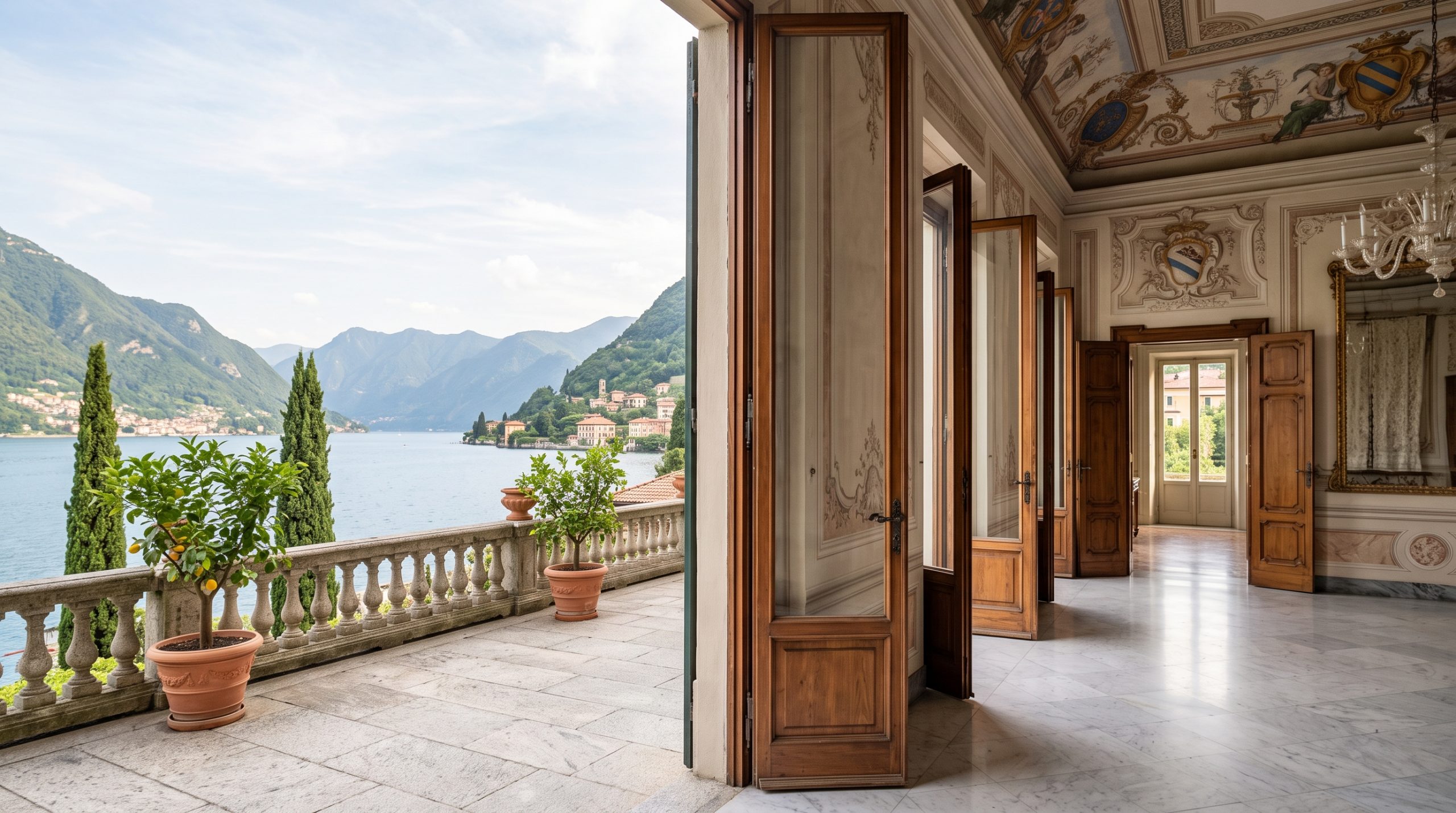
On Lake Como a civil ceremony is legally valid in the places where a town hall has agreed to send its registrar, and nowhere else. That is why the camellia terrace at Villa Carlotta in Tremezzina is on the list. The Comune di Tremezzina sends its civil registrar, or an officer delegated by the comune, and the ceremony becomes a public act with legal weight. A symbolic ceremony in the same spot, with the same view over the water toward Bellagio, has no legal value at all.
Across the water, Varenna has pushed the idea further than most small towns. The Comune di Varenna and the Provincia di Lecco, which owns Villa Monastero, run a separate civil registry office inside the museum complex, an arrangement in place since 2017, so a ceremony in the botanical garden or in one of the villa’s named rooms carries the same legal weight as one at the municipio. Villa Cipressi stands immediately next door on Via 4 Novembre, a hotel again after its years as the Serponti family house, and its signature room is the sala degli stemmi, wall after wall of painted coats of arms.
The venues are the straightforward part. For an American couple the chain that makes the ceremony legal runs through an Italian consulate in your own state, the US Consulate General in Milan, a Prefettura and one town hall’s marriage office, in that order, with a 90-day clock running on one of the documents. None of it is hard. All of it is sequential, which is why it pays to read the order before you book flights.
Yes, and the sequence matters more than the difficulty
American couples can marry legally on Lake Como. Every venue belongs to one comune, and that comune’s registrar officiates. The paperwork is a fixed sequence: apostilled US documents, an Atto Notorio valid for 90 days, a sworn declaration at the US Consulate General in Milan, legalization at a Prefettura, then the declaration of intention at the town hall.
Three town halls hold the pen
Almost every question couples send us about Lake Como legalities is really a question about jurisdiction. Choose Villa Carlotta and you are dealing with Tremezzina. Choose Villa Monastero, Villa Cipressi or the Varenna municipio and you are dealing with Varenna. Choose Como itself and you are in Palazzo Cernezzi, where civil marriages take place in the Sala Consiliare or the Sala Giunta and the mayor or the civil registrar officiates.
The three town halls do not work the same way. Varenna publishes its locations, available hours and costs on its own booking platform, Varenna Weddings, where you register, choose the place, the date and the time slot, check that it is free, then confirm and pay. Ceremonies are free for Varenna residents and carry a tariff for everyone else. Tremezzina works by email and paper: its Ufficio Stato Civile publishes its tariff sheet, a list of required documents and a request form for the celebration, and the villa’s own events office is copied into the conversation because Villa Carlotta is a working museum and botanical garden with its own calendar. Como asks you to contact the office directly to fix a date, and its guidance is blunt about the fact that the date has to allow for the administrative steps and for the room actually being free.
| Venue | Registrar | Booking route | Worth knowing |
|---|---|---|---|
| Terrazza delle Camelie, Villa Carlotta, Via Regina 2, Tremezzina | Comune di Tremezzina, or a delegated officer | Town hall marriage office and the villa’s events office, both by email | Two separate fees: the base fee is due to the town hall, the guest fee to Villa Carlotta |
| Villa Monastero garden and interior rooms, Varenna | Comune di Varenna, through the separate registry office inside the museum | Varenna Weddings platform, by location, date and time slot | The Province publishes a venue fee of 1,500 euro, reduced for couples resident in the province of Lecco |
| Villa Cipressi, Via 4 Novembre, Varenna | Comune di Varenna | Varenna Weddings platform | Next door to Villa Monastero; the sala degli stemmi is the room it is known for |
| Varenna municipio | Comune di Varenna | Varenna Weddings platform | The quiet option, and free if either of you is a Varenna resident |
| Sala Consiliare or Sala Giunta, Palazzo Cernezzi, Como | Comune di Como, mayor or civil registrar | Direct contact with the Ufficio Stato Civile | City-centre rooms rather than a garden; date depends on room availability |
The Villa Monastero rooms are licensed with named capacities, and those numbers decide the guest list rather than the other way round:
- Sala Fermi, up to 80 people
- Sala Polvani, up to 30
- Sala Musica, up to 15
- Sala Biliardo, up to 12
- Loggiato, up to 8
- Salottino Orientale, up to 6
- The garden in front of the villa, which is where the botanical garden runs for close to two kilometers along the shore
The Salottino Orientale at six is the most elopement-shaped room on the lake: two of you, the officer, and almost nobody else. The Loggiato at eight is the one we point couples toward when the weather looks unsettled and they still want the water in frame. If you want your ceremony outdoors on that side of the lake, the garden in front of the villa is the space to ask for, and it books by time slot like everything else in Varenna.
The document chain, in the order you collect it
This is the part worth printing out. It is written for two US citizens with no Italian residence, marrying in one of the comuni above.
- Apostilles on your US documents. A US document only works in Italy once it carries an apostille from the secretary of state of the state that issued it. That is a mail or courier step at home, and it is the one that sets the whole timeline, because everything downstream waits on it.
- The Atto Notorio, at an Italian consulate covering your state. This is the sworn affidavit that nothing under US law prevents your marriage. It is signed in front of the Italian consular officer by both of you together with adult attestants who are not related to you. It is valid for only 90 days, so it cannot be done a year in advance. Published guidance on the number of attestants varies between consulates: the Miami consulate describes two adults holding valid passports, the Houston consulate describes four witnesses who are not family, so the office covering your state is the one to ask.
- The Dichiarazione Giurata, once you are in Italy. Lake Como sits in the consular district of Milan, so this sworn declaration is signed before a US consular officer at the Consulate General in Milan, with your passports or other proof of US citizenship in hand. Appointment slots are the constraint here, not the paperwork.
- Legalization of that declaration at a Prefettura. A Dichiarazione Giurata issued in Milan can be legalized at any Prefettura inside the Milan jurisdiction, which includes Como and Lecco. Couples assume this means a second trip to Milan. It does not.
- The declaration of intention to marry, at the town hall. You present the whole file to the marriage office of the comune where you are marrying and make the declaration of intention in person, by appointment. Tremezzina, Varenna and Como each publish their own document list, and the list belongs to the office that will marry you.
- Publications, if they apply to you. Foreign citizens who are not resident in Italy are sometimes released from the obligation, and the office that decides is the Stato Civile of the comune where the ceremony takes place. Where publications do apply, the mechanics are fixed: the notice is posted for eight days, a revenue stamp of 16 euro is involved, the certificate follows once at least eleven days have run, and the marriage can be celebrated from the fourth day after the posting ends.
- The ceremony. The registrar or the delegated officer conducts it, in the room or garden you booked, in the time slot you booked.
- The marriage certificate, with an apostille. Ask for a copy of the certificate before you leave Italy rather than after, and get the apostille onto it so that it is accepted at home without a second round of correspondence.
Build the civil-venue calendar around your ceremony hour
Work from the ceremony date, never forward from today. Two timelines matter, and they are not the same length.
The real minimum is short. The steps inside Italy can be compressed into a handful of working days, which is what the US Embassy means when it says to allow several days for the procedures. Compress them and you accept a consequence: the office calendar picks your ceremony hour, and it will not pick the hour the light is good.
The comfortable minimum, which is what we build toward, works like this. The date and the venue are held first, roughly six to twelve months out, because waiting lists in popular towns are normal and May, June and September are the months the embassy singles out. The Atto Notorio is timed to land inside its 90-day window, which in practice means starting the consulate appointment hunt at home two to three months before the wedding. The apostilles are done before that. You then arrive in Italy with a working week in hand, spend the first days on the consulate and Prefettura steps and the town hall appointment, and keep the ceremony hour free to be chosen for light rather than for administration.
If your date falls in one of those three busy months, that is not a reason to move it. It is a reason to lock the venue slot early and let the paperwork follow the slot. Our planning fundamentals for eloping abroad cover the same ordering logic for destinations where the constraint is a ferry or a permit window rather than a registrar.
The 90-day clock and other things to get right
None of these are dramatic. Every one of them has quietly rearranged somebody’s week.
- Two affidavits, not one. The Italian consular system asks for the Atto Notorio at an Italian consulate in the US and the sworn declaration at a US consulate in Italy. They are different documents, signed on different continents, and only having both satisfies the free-status requirement, because there is no federal marriage registry in the United States.
- The 90 days cut both ways. Too early is as much of a problem as too late. An Atto Notorio signed nine months out will have expired by the ceremony.
- The Prefettura step is easy to forget entirely. The Milan declaration is not finished until it has been legalized, and the Prefetture in Como and Lecco can both do it.
- Villa Carlotta is two invoices. The base fee goes to Tremezzina town hall and the guest fee goes to the villa. If you choose a blessing rather than a civil ceremony, both parts go to the villa instead, and the town hall drops out of the picture.
- Varenna sells time slots, not days. The platform shows location, date and available hours together, so the room you want and the hour you want are one decision rather than two.
- Small-town offices publish their closures. Tremezzina posts notices for its demographic services office on the town’s own site, and the ones that catch people out cluster in August. A Saturday closure in the middle of a wedding week is worth knowing about in March.
- Ask about publications early. Do not assume you are exempt and do not assume you are not. One email to the right Stato Civile office settles it, and the answer changes your timeline by more than a week.
Treat the quoted fees and processing windows as the version used to build this timeline. Re-check the current amount and deadline with the issuing office before you lock in flights or appointments for sala stemmi, villa carlotta.
Sign at home and keep the Lake Como ceremony here
Plenty of the couples we work with on this lake sign the legal marriage at their county office at home, then come to Italy for the ceremony that actually matters to them. It is not a compromise, and it removes the single biggest constraint on the day: the registrar’s timetable.
What changes is small. A symbolic ceremony at Villa Carlotta has no legal value, and the fee structure inverts, with both the base fee and the guest fee due to the villa. In Varenna the published tariff for the Villa Monastero garden or one of its rooms covers civil weddings and symbolic ceremonies alike, so the venue side of the decision barely moves.
What does not change is everything you came for. The camellias on that terrace, the coats of arms on that wall, the two kilometers of garden along the shore, the ferry wake catching the light at the end of the afternoon. You also gain the freedom to hold the ceremony at first light, before the garden gates let the day’s visitors in, which is the single best hour on this lake and the one no registrar’s diary will ever give you. Tell us which of the two routes you are leaning toward and we will build the timeline around it, or tell you honestly which month gives you the quieter version of the same place.
Send Us a Message with your date and the venue you have in mind, and we will tell you what the hour looks like there.
How we build the photography around the registrar’s timetable
We are photographers and filmmakers, not lawyers. Rules change and circumstances differ, so confirm the detail with the relevant registry office or your own consulate before you book flights. What we do is everything that sits around the paperwork: destination and location design, a custom timeline built around light and real travel time, permit research and logistics guidance, weather alternatives, and holding your shortlist of dates against what the registrar and the venue can actually offer. We do not file documents on your behalf and we would not want to be the ones who did.
Photography, film and planning come from one team of eight rather than a photographer plus a separately hired videographer who first work together on your wedding morning. In a room like the Sala Musica that matters more than it sounds. A civil ceremony is short, the officer speaks once, and there is one angle on the exchange of rings. With a dedicated photographer and filmmaker working together, one camera stays with the register and the officer’s table while the other holds the wider room, and nobody is choosing between the two. Our published galleries and films show how the ceremony hour and the hour after it read on this coastline. Coverage runs from a single day with one photographer or one filmmaker, through a day with both, to multi-day work across one or several destinations, and the shape of each is set out on our experiences and pricing page.
Team travel is included worldwide, so flights and accommodation for the assigned team are not a line you will see for Lombardy or anywhere else. Highlights reach you in five days and the full gallery or film in three weeks. The guest count does not change the fee, only the access, permits, transport and timeline. We are currently booking 2027, 2028 and 2029, and planning starts once the contract is signed and the 30 percent retainer is paid.
Common questions
Can we legally get married at Villa Carlotta, or is it symbolic only?
Both are possible on the Terrazza delle Camelie. A civil marriage there is a public act with legal value, conducted by the civil registrar of the Comune di Tremezzina or a delegated officer. A symbolic ceremony in the same place has no legal value, and the fees are structured differently: for the civil route the base fee goes to the town hall and the guest fee to the villa.
Do we have to be in Italy before the wedding day?
Yes. The Dichiarazione Giurata is signed in front of a US consular officer inside Italy, and for Lake Como that is the Consulate General in Milan. It then needs legalizing at a Prefettura, and you have to make the declaration of intention at the town hall. The US Embassy advises allowing several days on the ground for the procedures.
How long is the Atto Notorio valid?
Ninety days, according to the Italian consular offices that issue it. That single number governs your whole timeline: the affidavit has to be signed inside the 90 days before your ceremony, which is why couples who organize everything else a year ahead still book that appointment two to three months out.
Do American couples need marriage publications in Italy?
Sometimes, and only the Stato Civile office of the comune where you are marrying can tell you. Foreign citizens not resident in Italy are sometimes released from the obligation. Where it does apply, the notice is posted for eight days, a 16 euro revenue stamp is involved, the certificate follows after at least eleven days, and the ceremony can take place from the fourth day after the posting ends.
Is Varenna or Tremezzina easier to arrange from the US?
Varenna is more transparent, because the town publishes its locations, hours and costs on its own booking platform and you can see availability before you commit. Tremezzina runs on email and its published forms, with the town hall and the Villa Carlotta events office both in the conversation. Neither is difficult. Varenna simply lets you check a Saturday in June yourself.
Can two women or two men have a legally recognized ceremony on Lake Como?
Italy provides for civil unions under Law 76/2016 rather than civil marriage, and the same venues host them. Villa Monastero’s arrangement with the Comune di Varenna covers civil unions explicitly, and Varenna’s platform handles them alongside civil marriages for non-resident and foreign couples. The US Embassy publishes the document chain for civil unions in the Milan consular district in the same form as the marriage chain. Confirm with your own consulate how the resulting document is recorded at home.
How far ahead should we lock the date?
Six to twelve months for the venue and the time slot, earlier if you want a Saturday in May, June or September, which the US Embassy names as the months when waiting lists build in popular towns. The paperwork then fits inside that, since its longest fixed element is the 90-day affidavit window.
Choosing the hour before you pick the room
The couples who enjoy this process are the ones who decide the hour first. Sunrise on the Varenna shore, or the last of the light on the camellia terrace, and then the room and the office steps arranged to serve it. Send us your date, the venue you are circling and whether you are marrying legally here or at home, and we will come back in writing within 24 hours with an initial brochure and an honest read on the timeline. Everything between us happens in writing, which is exactly what a paperwork week needs, and our destination guides are a good place to wander in the meantime.