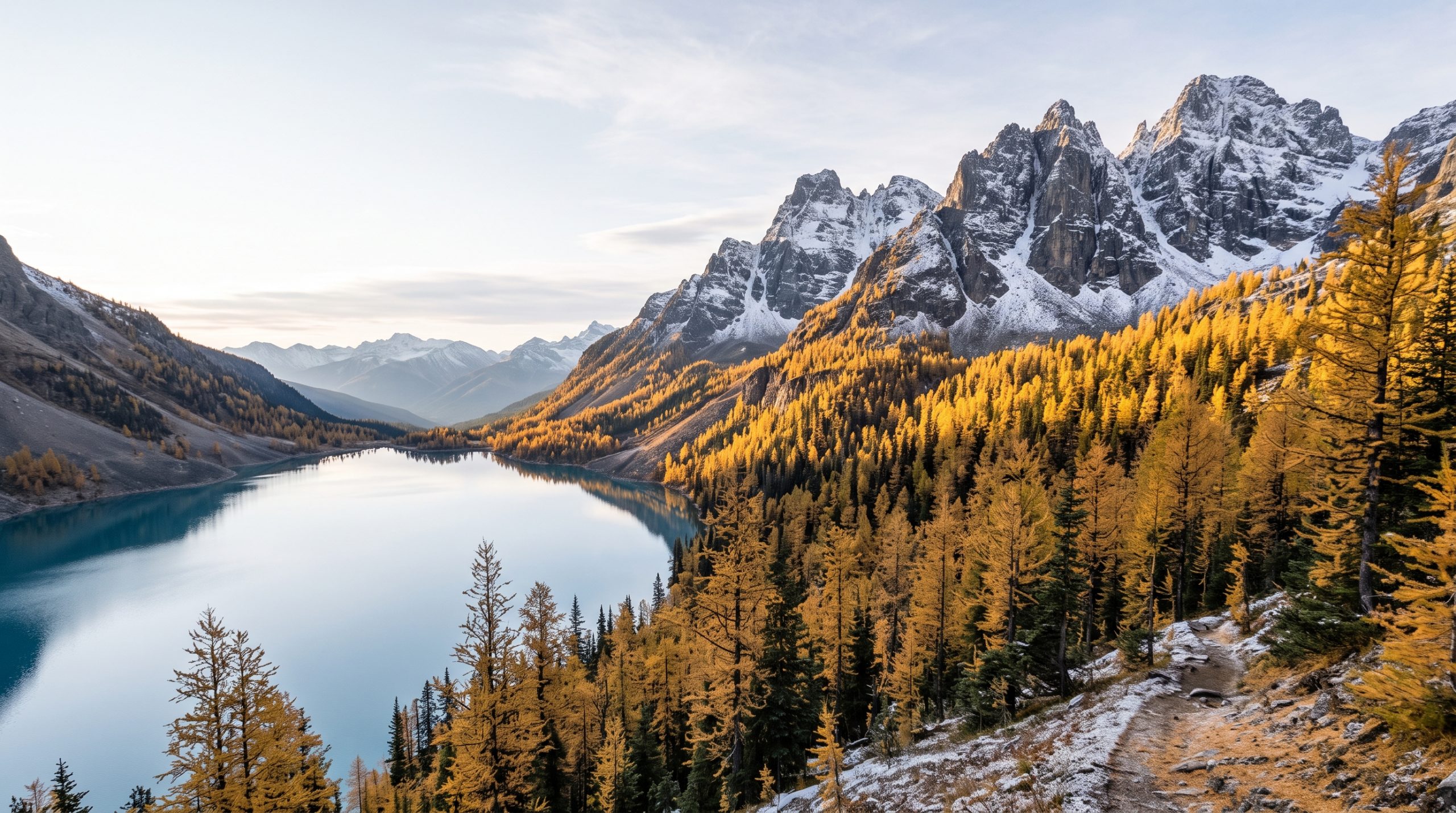
On the last Saturday of September the trail out of Moraine Lake climbs about 550 metres in 4.3 kilometres, and for the first hour it is spruce and switchbacks and not much else. Then the forest thins. The ground opens onto a shelf under Pinnacle Mountain and Eiffel Peak, and the alpine larches are standing there in full gold, thousands of them, with new snow on the Ten Peaks behind.
Ten days later that same shelf is bare grey sticks. Alpine larch is a conifer that drops its needles every autumn, and once the needles start to go they go fast. One hard frost, one windy night, and a whole slope lets go.
So the useful question is not whether the Canadian Rockies are good in fall. It is which fourteen days you fly for, what the light is doing on those days, and what the rest of the calendar gives you if those days are already spoken for at work. This is the timing, with numbers.
The window we build the whole year around
The last week of September into the first days of October. That is when the larches above Moraine Lake hold full gold, and the whole peak runs seven to ten days rather than a month. We aim couples at the final Monday through Thursday of September, and we treat everything on either side of that as a planned fallback.
Month by month above Moraine Lake
Daylight and sun angle are calculated for Lake Louise at 51.4 degrees north. Temperatures are village-level averages in Celsius, so subtract several degrees for anything above 2,000 metres. Moraine Lake Road itself is only open for part of the year, which shortens the list of months that can include Larch Valley at all.
| Month | Conditions | Light | Crowds | Our verdict |
|---|---|---|---|---|
| January | Deep cold, lakes frozen, Moraine Lake Road shut | 8h19 of daylight, sun peaks 17 degrees up | Empty outside the ski hills | Low sun all day, if you can take the cold |
| February | Averages near minus 8 by day, minus 18 at night | Just under 10 hours | Quiet midweek | The cleanest winter light of the year |
| March | Snowpack still deep, softening at valley level | 11h46, sunset 19:47 | Building on weekends | Winter scenery, spring day length |
| April | Melt at low elevation, full winter up high | 13h48 | Thin | Our least favourite month here |
| May | Green below, white above, road still closed | 15h33 | Rising fast late in the month | Good for waterfalls, not for larches |
| June | Wettest month of the year, road opens around June 1 | 16h35, sunset after 22:00 | Heavy from mid-month | Longest evenings, least reliable sky |
| July | Warmest month, averaging 16 by day and 5 at night | 16h13 | Peak of the year | Wildflowers, and company everywhere |
| August | Warm and often hazy late in the month | 14h41 | Still very busy | Best swimming, softest distant peaks |
| September | Average high 10, low 0.6, first snow of the season | 12h44 mid-month, sun at 42 degrees | Peaks hard in the final week | The month. Book the last week |
| October | Gold to bare in days, road closes second week | 10h47 mid-month | Collapses once the needles drop | First five days only |
| November | Freeze-up, bare larches, snow not yet settled | 8h57 | The quietest weeks in the park | Quiet and moody, thin on colour |
| December | Cold and bright, lakes locking up | 7h53, sun peaks 15 degrees up | Holiday spike in town only | Warm light from open to close |
Why the gold moves a week either way
Larches do not turn on a date. They turn on accumulated cold, and the cold arrives at different times each autumn. Across a normal run of years the peak lands somewhere between about September 20 and October 5, which sounds generous until you realise the genuinely golden stretch inside that is only seven to ten days long.
Elevation spreads it out a little. The trees lower on the Larch Valley trail, around 2,100 metres, colour up first and drop first. The upper meadow toward Sentinel Pass at 2,600 metres runs a few days behind, so on a good morning you can walk from copper into gold in forty minutes. That gradient is the single most useful thing to know if your date has landed slightly early.
Realistic odds, stated plainly. Book the final week of September and in most years you are standing in full colour. Book October 8 and you are betting against the average. If your date lands after the drop, the day is still strong and it looks different: bare silver branches, copper ground, and a much higher chance of fresh snow on Deltaform and Neptuak, which is a photograph most people planning a fall elopement have never seen. We would shift weight to Moraine Lake itself and to Consolation Lakes and build the film around the snowline instead of the trees.
The shuttle decides your morning before you do
This is the part couples underestimate. Moraine Lake Road is closed to personal vehicles year-round. Parks Canada allows only its own shuttle buses, Roam Public Transit, and commercial buses holding a Moraine Lake Road add-on licence. There is no arriving at 4am and parking, no matter how early you set the alarm.
The road itself opens once the snowpack above it has settled, usually around June 1, and closes in the second week of October, near Canadian Thanksgiving. Larch season sits in the last three weeks of that window, which is exactly why those shuttle seats are the hardest of the year to get.
The reservation system works in two releases. Parks Canada puts forty per cent of the seats for the entire season on sale in mid-April at 8am mountain time, and holds the remaining sixty per cent for a rolling window that opens at 8am mountain time two days before each departure. You park at the Lake Louise Park and Ride at the ski resort and ride in from there. Worth knowing for late finishes: the access road to the Park and Ride is gated for wildlife movement between 8pm and 6am from May to October.
Permits run on a separate track. Parks Canada operates a wedding ceremony registration for the park, submitted in advance, and every vendor working inside park boundaries needs a Parks Canada business licence. Park entry is charged per person per day, currently around 12 Canadian dollars for an adult with a group rate covering up to seven people in one vehicle, and the rate is reset at the start of each calendar year. We handle the research, the applications and the timeline that fits around all of it; you pay the government fees, the shuttle tickets and the park passes, and what our coverage costs is set out on our pricing page.
Light at 51 degrees north in the last week of September
On September 25 at Lake Louise the sun comes up at 07:34 and sets at 19:39. That is 12 hours and 5 minutes of daylight, and the sun never climbs higher than 38 degrees above the horizon all day. Compare that with June 15, when it reaches 62 degrees and stands almost overhead at lunchtime.
The low arc is the whole reason late September photographs the way it does. Shadows stay long. The sun sits under 6 degrees until roughly 08:18 in the morning and drops back under 6 degrees around 18:55, which gives you two soft stretches of about three quarters of an hour each. Between them the light is still angled rather than flat, so a midday ceremony in Larch Valley holds up in a way a midday ceremony in July simply does not.
One local correction to the clock. Larch Valley sits in a bowl with high ground to the east, so direct sun reaches the meadow noticeably later than the published sunrise. The peaks light first, the valley floor fills in afterward. We plan the ceremony for the fill, not the official time, and we use the earlier stretch on the Ten Peaks and the lake. You can see how that reads in finished work across our stories and films.
Those soft stretches are short enough that having one dedicated photographer and one dedicated filmmaker working at the same moment stops mattering in theory and starts mattering in practice. Vows in a 45-minute light window happen once. With two of us on the ground, nobody asks you to repeat the walk in for the camera that missed it, and the audio for the vows is being recorded while the stills are being made.
Mid-October to May, and what we book instead
We will say it directly. Between the second week of October and about mid-December, the Lake Louise alpine is at its weakest for a wedding day. Moraine Lake Road is shut, the larches are bare, the snow has not yet built enough to make the peaks read white, and the ground is brown. November has the quietest trails of the year and the least to point a camera at.
April is the other soft spot. Down at 1,500 metres it is melt and gravel, up at 2,400 metres it is still full winter with no access, and you get the worst of both.
None of that means those dates are lost. It means we move you rather than argue with the mountain. Late November through February we build days around frozen Lake Louise, the Vermilion Lakes flats at first light, and Emerald Lake over in Yoho, where the low December sun at 15 degrees gives you warm light from open to close. February brings the clear cold air and the bubble ice on Abraham Lake out on the David Thompson Highway. April and May go to waterfall country and the lower Bow Valley while the high ground sorts itself out. If your date is fixed and it falls in a month we have just described as thin, tell us the date first. We will show you where in this region that particular week is genuinely strong, and build the day there.
Send Us a Message with the week you have and we will tell you honestly what it looks like on the ground.
How we build around the larch window before you arrive
September in the Rockies is the first month of the year that reliably snows. Lake Louise averages 10 degrees Celsius by day and 0.6 at night, with rain on roughly 13 days of the month and close to 5 days carrying snow. Add 900 metres of elevation to reach Larch Valley and the dawn temperature drops well below freezing. So we do not plan for good weather. We plan for the actual distribution.
Every timeline we write for a larch elopement carries three alternates chosen before anyone gets on a plane, and they are chosen by what the weather is doing rather than by what looks nice on a map.
- Cloud sitting on the pass. We drop elevation and gain intimacy. Consolation Lakes, a short walk from Moraine Lake, keeps you in boulders and larch fringe with a ceiling you can actually see.
- Wind on the ridge. The Plain of Six Glaciers trail above Lake Louise gives shelter on the lower half and a very different set of frames.
- Snow closing the alpine early. Sunshine Meadows and Healy Pass hold larches on a gentler grade, and the Yoho side around Emerald Lake stays workable when the Bow Valley is socked in.
The ceremony hour moves too. It is anchored to the shuttle we hold, not to a number written in June, and we will shift it by ninety minutes on the morning if the cloud is lifting. Our destination guides cover the same logic for other regions, and the general shape of planning one of these days sits in our guide to how to elope.
Common questions
When exactly do the larches peak at Moraine Lake?
There is no fixed date. The golden stretch usually falls between about September 20 and October 5, and the genuinely full colour inside that runs seven to ten days. The last week of September is the safest single bet, and lower trees on the trail turn several days before the upper meadow.
Can we drive ourselves to Moraine Lake for a sunrise ceremony?
No. Moraine Lake Road is closed to personal vehicles year-round. Access is by Parks Canada shuttle, Roam Public Transit, or a commercial bus holding a Moraine Lake Road add-on licence. We build the morning around the seat times we hold, and that constraint is part of every timeline we write for this valley.
How far ahead do we need to book the shuttle for late September?
Forty per cent of the seats for the whole season go on sale in mid-April at 8am mountain time, and the last week of September moves quickly. The other sixty per cent are released at 8am mountain time two days before departure. We plan for both releases rather than relying on one.
How cold is Larch Valley at first light in late September?
Lake Louise averages a low of 0.6 degrees in September at village level. Larch Valley sits roughly 900 metres higher, so expect a dawn several degrees below freezing, frost on the grass, and hands that need gloves right up until the vows. It warms quickly once the sun clears the eastern ridge.
What happens if it snows on our date?
Usually it improves the pictures. Snow on gold larch is the frame everyone hopes for and few people time correctly. If it snows hard enough to close the high ground, we go to a lower alternate that was chosen months earlier, and the ceremony hour moves with the cloud rather than against it.
Do we need a permit for a ceremony in Banff National Park?
Parks Canada runs a wedding ceremony registration for the park, submitted in advance, with designated locations. Everyone working on your day inside park boundaries also needs a Parks Canada business licence. We do the research and the paperwork guidance; the government fees themselves are paid by you.
Is the first week of October still worth flying for?
The first five days, yes. After that you are relying on a late season, and the road closes in the second week of October anyway. If your only available window is mid-October, we would move the day to Lake Louise, Emerald Lake and the Bow Valley rather than promise you a valley that has already dropped its needles.
Choosing the two weeks around peak gold
Pick the date first, then the location. That order matters more here than almost anywhere we work, because the shuttle, the road closure and the larches all key off the same fortnight in late September. We are currently taking 2027, 2028 and 2029 dates.
Send us the week you are considering and what you want the morning to feel like. Everything from that point runs in writing, so you can read it, think about it and answer when it suits you: a reply and our initial brochure inside 24 hours, then a tailored proposal for your dates. Start Your Story.