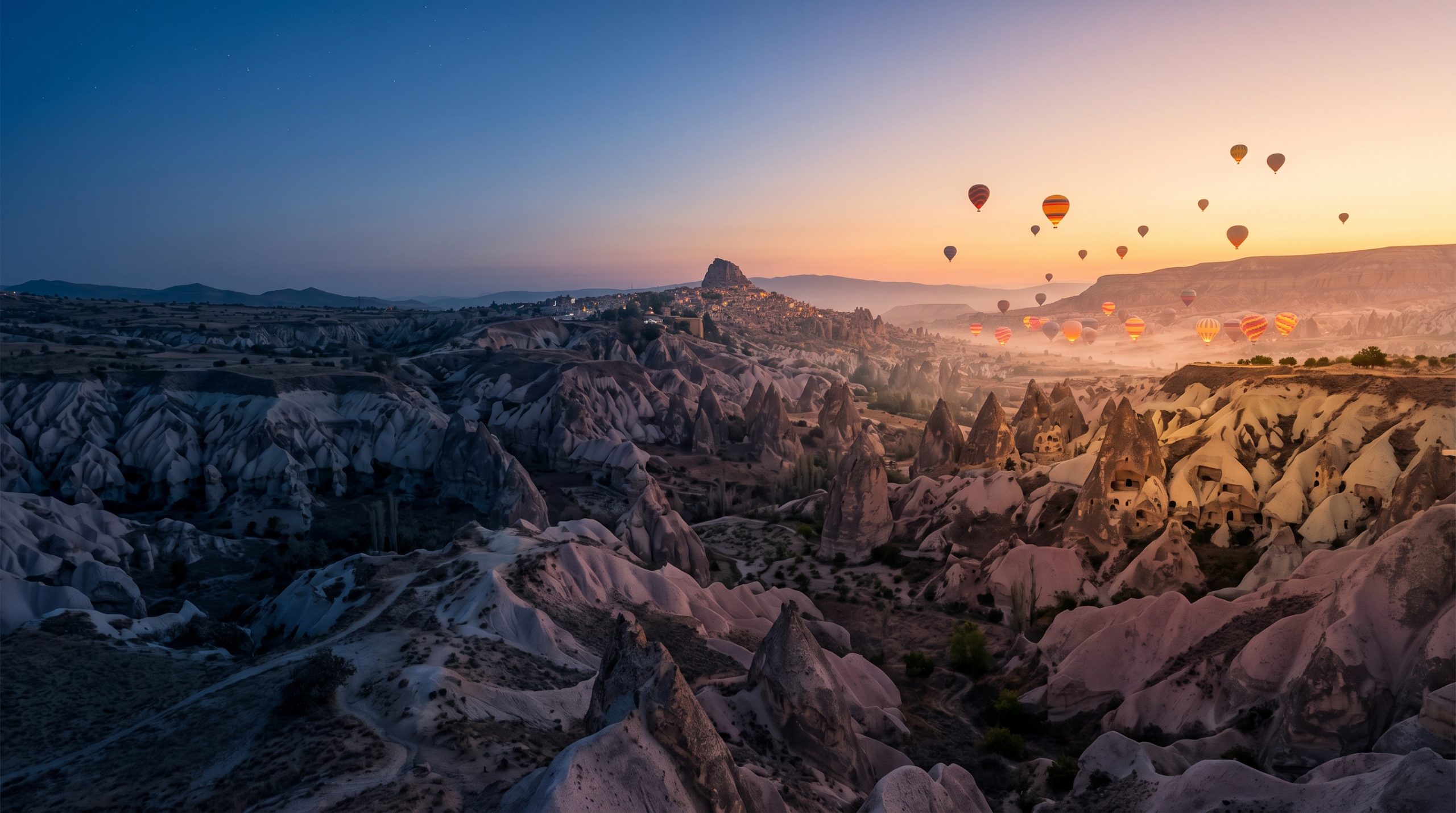
The first burners fire while it is still dark. From a terrace in Goreme in the third week of June you hear them before you see anything, a soft thump somewhere down in the valley, then another, and then whole patches of the basin start glowing orange from the inside. Sunrise is still half an hour off. That is what a 4am alarm buys you here.
What almost no itinerary mentions is the hour afterwards. By half past seven the baskets are down, the minibuses have gone back to the hotels for breakfast, and the valley floors are empty with the light still low and warm across the rock. That hour is the reason we build a Cappadocia day in this particular order.
Below is the day as we actually run it, with the real solar times for Goreme and what shifts if you come in October instead of June. All times are local, and Turkey stays on UTC+3 the whole year with no clock change, so nothing in your timeline moves by an hour overnight in spring.
Balloon hour first, everything else after
Fly into Kayseri, about 75 km from Goreme, or Nevsehir, about 40 km, and give Cappadocia three nights. The day runs on the sunrise balloon launch: alarm near 4am in June, vows on an empty valley floor by 7:30, the flat middle spent on rest and interiors, then a valley rim at sunset.
4:00am to 7:30am: terrace, launch field, empty valley
Ballooning in Cappadocia is a sunrise-only operation. Operators are authorised by Turkey’s civil aviation authority, which keeps a representation office in the region precisely because everything happens inside one narrow window of calm air, and no commercial flight goes up in the afternoon. Pickups land roughly ninety minutes before sunrise. Envelopes are inflated 20 to 30 minutes before launch, the standard flight runs about an hour, and the fleet leaves the ground in two waves separated by around half an hour.
In mid-June that puts the first baskets in the air near 4:30, with the sun itself clearing the ridge at 5:16. If you are flying, you are collected in the dark, and you are back at your hotel between seven and half past. We do not build vows into a basket. It is a shared aircraft, the burner is loud, and the decision to fly is made on the morning by people watching wind, not by anyone holding a timeline. Far better to fly on the first morning of your stay and keep the ceremony morning on the ground, where nothing can be cancelled.
On the ceremony morning itself, we are out before the burners. One of us stays with you on a terrace or a valley rim through the launch, when the sky over Goreme goes from three dots of flame to a hundred envelopes drifting over the chimneys. Then the fleet starts landing, and Cappadocia does something genuinely useful: it empties. Between about 6:45 and 8:00 the tour vans have gone, the light is still raking sideways across the tuff, and the valley floors below Rose Valley and Pigeon Valley belong to almost nobody. That is where we put the vows, roughly 7:30 in June, with your first hour of married light still ahead of you.
Why the same day starts at 5:30 in October
The alarm in the title is a June number. Goreme’s sunrise moves across the year by well over two and a half hours, and the first launches sit roughly forty-five minutes ahead of it, swinging from about 4:30 in midsummer to around 7:30 at the other end of the calendar. Mid-June gives you 14 hours and 51 minutes between sunrise and sunset. Mid-October gives you 11 hours and 13 minutes. Those three and a half hours are one location, one outfit change, or one long drive, and it is better to choose which before you land.
| When | Sunrise | Sunset | Alarm we set | What it does to the day |
|---|---|---|---|---|
| Mid-June | 5:16am | 8:07pm | 4:00am | Effectively the longest day of the year. Two distinct halves with a real gap for rest between them. |
| Mid-August | 5:55am | 7:36pm | 4:45am | Calmest launching weeks. Hot afternoons, so the middle of the day goes indoors. |
| Late September | 6:29am | 6:38pm | 5:15am | The best balance. Soft mornings, warm evenings, dinner outside after dark. |
| Mid-October | 6:50am | 6:03pm | 5:30am | Golden poplars in the valleys. One location has to come out of the plan. |
| Early December | 7:46am | 5:19pm | 6:30am | Snow on the chimneys some mornings. Everything finishes before dinner. |
Two things follow from that table. In high summer you can hold a ceremony at 7:30am and still have five hours of usable evening light after 4pm, which is why June and August days feel like two elopements stitched together. In late autumn the whole thing is one continuous run from dark to dark, and it is calmer for it. If you already know which of those you want, say so in your first message, and if you do not, our destination guides are organised around exactly that question.
Where the map lies: village lanes, cut steps and the airport road
The long drive is the honest part of the journey. Both airport roads are good dual carriageway for most of their length, and a route planner will get you close.
| Airport | To Goreme | Realistic drive | Why you would choose it |
|---|---|---|---|
| Kayseri Erkilet (ASR) | About 75 km | 60 to 80 minutes | Far more connections, so most couples land here even though it is the longer transfer. |
| Nevsehir Kapadokya (NAV) | About 40 km | Around 40 minutes | Much closer to the cave villages, with a thinner timetable to work around. |
Where the map genuinely misleads you is the last kilometre. Balloon hour is the one moment in twenty-four hours when Goreme’s single-lane village streets are full of minibuses collecting passengers from every cave hotel at once, all of them working to the same launch time. A five-minute hop across town at 4:20am is not a five-minute hop. We give it twenty-five, or we walk it.
Then there is the front door problem. A great many rooms in Goreme and Uchisar sit above the street on stepped lanes, so the car stops and the last stretch is done on foot, up cut steps, carrying a dress and a case of gear. Nothing about that is difficult once you know, and it is miserable as a surprise at 4am in the dark. The same applies in the valleys: several of the lines a map draws as roads are dust and gravel tracks, and the final approach to a rim is on your feet. Walking shoes travel in the car, ceremony shoes are carried, and we plan the order of the day so you are never changing footwear in a hurry.
The flat middle, and the sunset you have to walk to
From roughly eleven until four in summer, Cappadocia is not at its best and we would rather say so. The sun goes vertical, the tuff turns white and glary, the dust lifts off the tracks, and July afternoons are hot enough that nobody enjoys a long walk in wedding clothes. We do not fight it. Breakfast happens late and properly, there is time to sleep, and where we do keep working it is inside: arched cave rooms, a courtyard with a fig tree, carpets and lamplight and thick cool walls that are as much a part of this region as the chimneys are.
That is also the window for the drive, if the second half of your day belongs somewhere further out. The far valleys and church-cut gorges are a real journey rather than a hop, and spending the harsh hours in a vehicle costs you nothing you wanted.
From about 4:30 in June the rock warms back up to apricot and everything improves. Uchisar’s castle rock, the ridges above Rose and Red valleys, the quieter side of Ortahisar. All of them ask for a short uphill walk on loose ground, which is the price of standing above the chimneys instead of among the parked cars. Here is the part that surprises people: because flights only go at sunrise, there are no balloons at sunset. The evening sky is completely empty, and after 8:07pm in mid-June the blue hour holds for a good half hour with the rock still giving back its heat.
Aerials: the window, the register and who signs
Drone work here is a paperwork question before it is a creative one. Turkey’s Directorate General of Civil Aviation, SHGM, runs the national drone register and issues operating permission, aircraft from 500 g upwards have to be registered along with the pilot, and foreign operators go through a separate application route rather than the domestic online form. In Cappadocia there is a second layer, with local sign-off from the Nevsehir governor’s office alongside the national approval, and one absolute piece of sequencing: while balloons are operating, that airspace belongs to the balloons.
What this means in practice is that aerials are never the thing a film leans on. We confirm the permission and the time window first, we place any drone work after the fleet has landed or into the evening, and we build the film so it stands entirely on the ground. Then the aerials go in where they are cleared. It is the same principle we apply to every location permission: research and logistics are part of the planning, the paperwork starts months rather than weeks out, and any government or landowner fee is paid by you directly so there is no markup sitting on top of it.
If you have a date in mind, or two candidate weeks and no idea which one is better here, Check Your Date and tell us what you picture. We will tell you what that month actually looks like at 5am.
How we build it: two vehicles, one valley held back
A Cappadocia day has three fixed points that cannot be negotiated with, and everything else bends around them: the launch window, solar noon, and sunset. We build the timeline outward from those, then add buffers where the map cannot be trusted. No fixed departure sits within ninety minutes of the ceremony hour. There is always a second valley held in reserve, chosen because it works in a different wind direction from the first, and the sequence of the morning is written so a cancelled launch changes nothing except how much sleep you got.
This is where a photographer and filmmaker travelling as one team stops being a marketing line. At 4:20am one of us is on the terrace with you while the first envelopes light, and the other is already down at the vow location, watching where the sun will actually break the ridge and whether the track in is dry. Two vehicles means the scout happens while you are still drinking tea. Two full sets of gear means a long day on dusty ground has no single point of failure, and with eight of us there is always a colleague in reserve.
Team travel to Turkey is included, flights and accommodation and the ordinary cost of getting the assigned team to Goreme, with no long-haul surcharge for the distance. Highlights reach you five days after the date, and the full gallery or film lands within three weeks. If you want to see how this landscape behaves on camera before you commit to a 4am start, the balloon light and the empty valley hour are both in our published stories and films. One full day with a dedicated photographer and filmmaker working the same hours is our Expedition experience, and the tiers and what sits inside each one are set out on the pricing page. If you are still at the stage of deciding how many days you need and in what order to book things, start with our guide to planning an elopement.
Common questions
What time do the balloons actually take off in Cappadocia?
Sunrise only, roughly forty-five minutes before the sun itself, in two waves about half an hour apart. In mid-June the first wave leaves near 4:30am with sunrise at 5:16. By early December sunrise is 7:46am and launches shift back accordingly, so takeoff moves by well over two hours across the year.
Should we book our balloon flight for the morning of the ceremony?
We would not. Flying is a weather decision made in the small hours, so we put the flight on your first available morning and keep the ceremony morning entirely on the ground. If the launch does not go ahead, you still have a spare morning, and your wedding day is untouched.
Kayseri or Nevsehir, which airport should we fly into?
Kayseri Erkilet is about 75 km from Goreme, a 60 to 80 minute transfer, and has considerably more connections. Nevsehir Kapadokya is about 40 km and around 40 minutes, but the timetable is thinner. Most couples land at Kayseri and accept the longer drive.
How many nights do we need in Cappadocia?
Three as a minimum. One morning reserved for the balloon flight, one full elopement day, and one night that exists purely so a delayed connection or a windy morning does not land on the ceremony. Four nights lets us take the second half of the day somewhere further out.
Can you fly a drone over the Cappadocia valleys?
With permission and inside a time window that sits outside balloon operations. SHGM issues the national approval and holds the drone register, with local sign-off from the Nevsehir governor’s office as well. We confirm both before any part of a film is planned around aerials.
Do the balloons fly at sunset as well as sunrise?
No. Commercial flights here run only in the sunrise window, which is why photographs of Cappadocia almost always show morning. The upside is that your sunset hour has a completely empty sky over it, and the ridges above the valleys are much quieter in the evening than at dawn.
Do we need a permit for a ceremony out in a valley?
It depends entirely on whose ground it is, and it changes between a public rim, a ticketed site and private land. Permit research and logistics guidance are part of every experience we run. Any government, venue or landowner fee is paid by you directly.
Sending us your date, and what happens next
Everything on our side happens in writing, which is the only sane way to plan across eight to eleven hours of time difference. You send the inquiry form, and a reply with our initial brochure comes back inside 24 hours. A tailored proposal follows, and once the contract is signed and a 30% retainer is paid, planning begins in earnest: the timeline built around Goreme’s real light for your month, the permissions, the launch window, the second valley held in reserve. We are currently booking 2027, 2028 and 2029, and the earliest conversations are the ones where we can still shape the whole trip rather than fit around it. Tell us the month you are picturing, whether 4am sounds thrilling or dreadful, and what you want the day to feel like by dinner. Start Your Story.