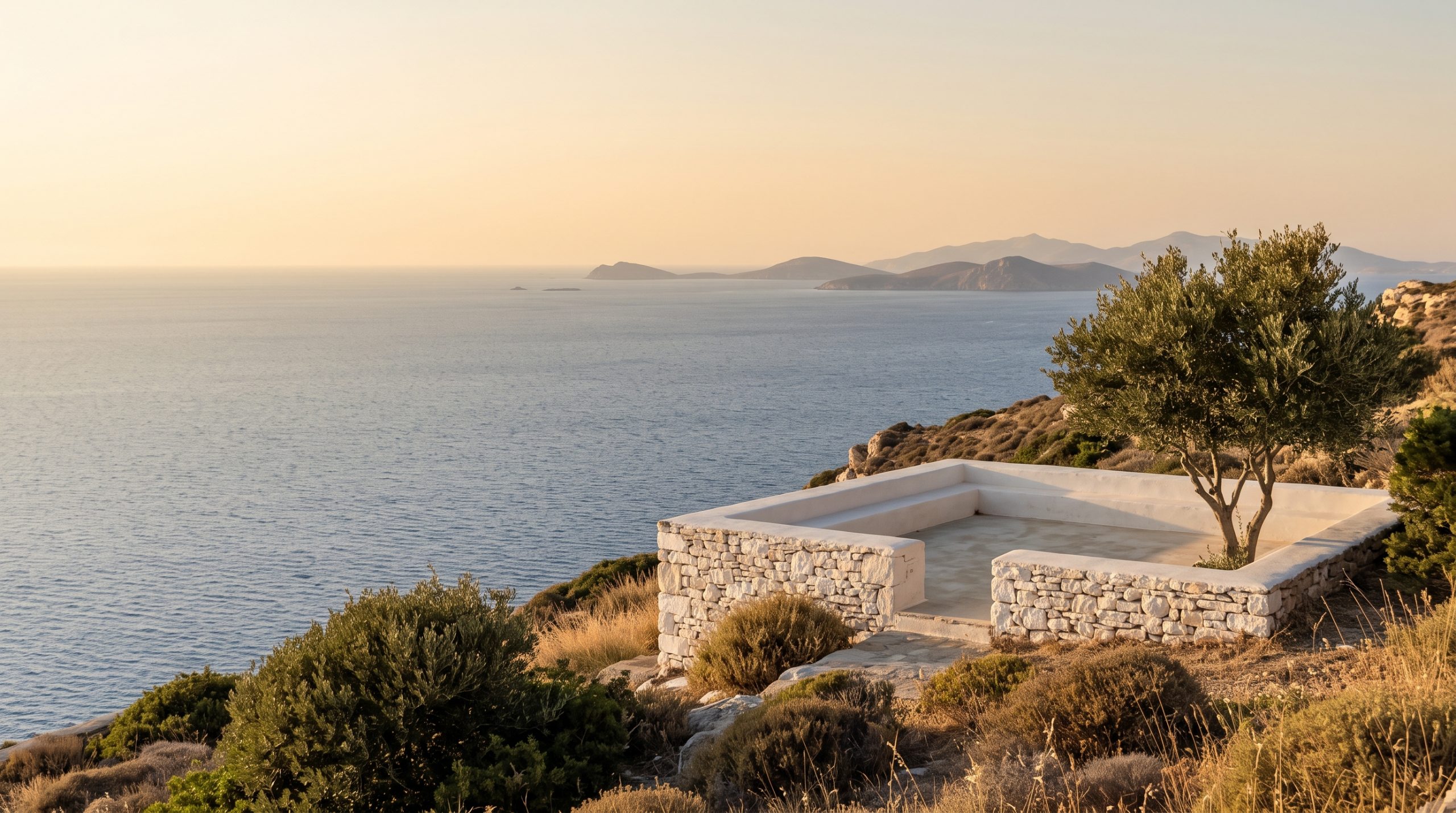
The Portara stands on Palatia, a low rocky islet joined to Naxos town by a causeway you can walk in a few minutes. The marble doorway was cut for a temple of Apollo that was never finished, it faces Delos, and through high summer the sun goes down inside the frame. Nobody needs to see a document for you to stand under it and make promises to each other.
That is the practical appeal of a symbolic ceremony in the Cyclades. It is not a legal marriage, so no municipality has to approve it, nothing has to be apostilled, and no official’s diary decides what time you begin. What it does need is permission for the ground you stand on, an hour chosen for the light and the wind, and someone to hold the ceremony together while you say what you came to say.
On Paros, the equivalent decisions run through the town hall in Parikia. Antiparos, a short ferry hop across the channel from Pounta, is a separate municipality with its own mayor and its own registry office, and couples who assume the two islands share one counter lose two weeks finding out otherwise.
Symbolic, civil, or both: what each route needs
A symbolic ceremony needs no license, no notice period and no Greek documents; you settle the location, the celebrant and the hour. A legal civil marriage in Greece needs a license from the municipality, issued after a one-week objection wait, apostilled and translated papers, two witnesses on the day, and registration at the local registry office within 40 days.
The honest rating, and why most couples sign at home first
On a scale from straightforward to genuinely obstructive, the Greek civil route is fiddly. Nothing in it is difficult on its own. The difficulty is sequence. Several documents have to be recent when they reach the counter, each one has to carry an apostille before it can be officially translated, and the license has to exist before any official will fix your ceremony date.
So the shape most of the American couples we plan for land on is this. The legal marriage happens at home, at a county clerk’s office, in their own language, weeks or months before the flights. Naxos or Paros then carries the ceremony. This is not a lesser version of a wedding, and it is worth saying plainly that it is the route we see chosen most often by couples who could have done either.
What changes practically is the admin. No translations, no six-month validity windows, no two days in Athens, no 40-day deadline to chase from a different continent. Civil ceremony slots also follow the office’s own timetable, which depending on the municipality can mean the middle of the day or the late afternoon, while a symbolic ceremony can start at 8pm in late June because that is when the light comes off the water in Naoussa bay. Our guide to planning an elopement walks through how the rest of a day gets built once the paperwork stops driving the clock.
What does not change is everything else. The vows are yours either way. The rings, the people standing with you, the walk out along the causeway, the audio of what you actually said to each other: none of it knows which country stamped the certificate. This is practical planning guidance from photographers and filmmakers, not legal advice. Rules change and circumstances differ, so confirm the detail with the relevant registry office or your own consulate before you book flights.
The Greek civil file, in the order you gather it
If you do want the legal marriage to happen in Greece, the file below is what a town hall in the Cyclades will be looking for. Gather it in this order, because two of the steps only work once the step before them is done.
- A recent birth certificate for each of you. Order it late rather than early. The Municipality of Athens, which publishes the fullest English guidance of any Greek town hall, requires every submitted document to have been issued within the previous six months, so a certificate ordered a year ahead can be too old by the time it is handed over.
- An apostille on every document, one apiece. Greece is a Hague Convention country, and for a certificate issued in the United States the apostille comes from the authority in the issuing state, usually the Secretary of State’s office. This step is first for a reason: a foreign public document is only officially translatable once it carries its apostille.
- An official Greek translation, made after the apostille. The Ministry of Foreign Affairs no longer runs a walk-in translation counter for the public. Official translations now come from a translator listed on the ministry’s Register of Certified Translators, or from a Greek consular authority. Minimum fees per page are fixed by law, so quotes tend to land in a narrow band.
- Proof that any earlier marriage has ended, apostilled and translated the same way. The US Embassy in Athens lists apostilled evidence of the termination of all previous marriages among the papers you bring with you.
- The Affidavit of Marriage, where the town hall asks for one. It is printed in English and Greek, left unsigned, and sworn in front of a consular officer at the US Embassy in Athens, which charges a notarial fee of 50 dollars a person. The embassy tells couples to allow at least two days in Athens for it, and the consular signature may then need authenticating at the Ministry of Foreign Affairs validation office in the city, which keeps morning hours.
- Passports, with a photocopy for each application.
- A newspaper announcement, if your town hall requires one. Published guidance genuinely varies here. The national registry of administrative procedures lists a marriage announcement in a local daily paper among the supporting documents, while the US Embassy’s briefing attaches that requirement to marriages where one party is a Greek citizen. The town hall performing your ceremony is the office whose answer governs, and that is the answer we build the timeline around.
With the file assembled, each of you submits your own license application to the municipality, with your own set of documents and your own state duty, currently 18 euros per applicant, paid as an e-paravolo. The office then waits a week from the date of application for any third-party objection before it issues the license. The Municipality of Athens publishes both halves of that clock plainly: seven days to issue, and six months of validity once issued. The US Embassy’s briefing says eight days rather than seven, so we plan on eight and treat a quicker answer as a gift.
Holding the license is not the same as holding a date. Once it is in your hands, the two of you apply jointly to the mayor of the municipality where you want to marry, and the official sets the day. Two witnesses with photo ID stand with you. Afterwards the marriage has to be recorded at the Lixiarcheio, the registry office of the municipality where the ceremony took place, within 40 days, and until that entry exists Greece does not treat you as married. Either spouse can register it, or someone can do it on your behalf under a power of attorney after you have flown home.
Build the Paros or Naxos day backwards from the ceremony hour
Two clocks run at once. One belongs to the offices and cannot be hurried. The other is yours, and it is mostly about not ordering documents so early that they age out before anyone reads them. Laid out backwards from the day itself, the Greek civil route looks like this.
| Counting back | What happens | Which office |
|---|---|---|
| 12 to 9 months | Island, ceremony hour and date chosen, and the date held | You and us |
| 5 months | Birth certificates and any papers proving an earlier marriage ended are ordered, then apostilled | Vital records and apostille authority in the issuing state |
| 3 months | Official Greek translations made | Certified translator on the ministry register |
| 6 weeks | The town hall’s own document list confirmed, and the mayor’s availability for your date | Parikia, Naxos Chora, or Antiparos, which is its own municipality |
| 2 weeks | Affidavit of Marriage sworn, where the town hall requires it, allowing two days in the city | US Embassy, Athens |
| 8 days | One license application per person, with an 18 euro state duty each, then the objection week runs | Municipality where you will marry |
| Ceremony day | Two witnesses with photo ID attend | Mayor or authorized deputy |
| Within 40 days after | Marriage recorded, in person or by proxy | Lixiarcheio of that same municipality |
The real minimum, if you are organized, is apostilles and translations finished before you fly and then roughly ten working days in Greece to cover the affidavit in Athens, the two license applications and the objection week. The comfortable minimum is four to five months of document work and five days on the island ahead of the ceremony. That second one is what we plan to, because it leaves room for a boat that does not sail and for a holiday nobody warned you about: 15 August is a national holiday in Greece and the largest feast of the year at the Ekatontapiliani in Parikia, and offices, roads and rooms all behave accordingly.
Treat the fees and processing windows in this Paros or Naxos guide as a planning snapshot; reconfirm the live figures with the office that issues them before you book around them.
Six details that catch couples out in the Cyclades
None of these are dramatic. Each one has quietly rearranged somebody’s timeline, and all six are easy to get right once you know they exist.
- The six-month freshness window. A birth certificate ordered fourteen months before the date can be rejected for being stale. Order documents once the ceremony date is fixed, not the week you get engaged.
- The license’s own six-month life. It is valid for six months from issue. Apply too early and it can lapse before the ceremony; apply too late and the objection week eats the days you meant to spend on the island.
- Who is allowed to translate. A translation done by a bilingual friend, or by an agency at home, is not an official Greek translation. The translator needs to be on the ministry’s register, or the translation needs to come from a Greek consular authority, and the apostille has to be on the document first.
- Antiparos is not Paros. The channel takes minutes to cross and the administration does not cross it. A ceremony there means a different municipality, a different mayor and a different registry office from Parikia.
- The mayor sets the ceremony date, not you. After the license is issued, you apply jointly and the official fixes the day. A 7pm Friday slot in August is a request rather than a booking, which is the single strongest argument for signing at home and keeping the island hour for yourselves.
- The 40-day registration. No entry at the Lixiarcheio, no legal marriage in Greece, however well the ceremony went. If you are flying out the next morning, arrange the power of attorney before you leave rather than after.
Paros, Naxos, and who actually grants permission
Marriage law is national. Permission for a place is not, and this is where the two islands genuinely differ.
Naxos is the largest of the Cyclades and the highest, with Zas rising just past 1,000 meters above the interior. The municipality is Naxos and Small Cyclades, seated in Chora, which also administers Koufonisia, Schinoussa, Iraklia and Donousa, so an islet ceremony still runs through the same town hall. The Portara itself is a different matter. Palatia is an archaeological site administered by the Ephorate of Antiquities of the Cyclades under the Ministry of Culture, so anything beyond ordinary visiting is the Ephorate’s decision rather than the mayor’s, and arrangements at the monument can be adjusted at short notice. We treat the Portara as one strong part of a day rather than the ceremony spot, with a second sunset position held along the Chora waterfront. Inland, the mountain village of Halki, marble-paved Apiranthos and the temple of Demeter above Sangri give you a whole afternoon that has nothing to do with a beach.
Paros is smaller, faster to move around, and organized around Parikia and Naoussa. Naoussa’s harbor faces north, which matters more than it sounds: the meltemi is a northerly, it blows hardest through July and August, and it decides which coast is standing in the lee. Kolymbithres, across the bay, has granite worn into soft shapes that hold light beautifully in the last hour. Lefkes sits inland with marble lanes and no sea wind at all, and the old quarries at Marathi cut back into the hill that gave Parian marble its name. When wind is the constraint, we move the ceremony to the southern beaches or into a village lane and keep the exposed coast for the walk afterwards, which is also how we protect clean audio for the vows.
Beyond the ceremony’s legal status, the permission you need comes from whoever holds the ground. Public shoreline is the municipality’s to allow. A villa, an olive grove or a hotel terrace is the owner’s. Many of the small whitewashed chapels on both islands are family property, so the yes comes from a family and often from whoever keeps the key, which is a conversation rather than a form. An Orthodox church wedding is a separate track altogether, with its own document set going to the clergy rather than to the town hall. Our destination elopement guides go deeper into how the Cycladic islands compare month by month.
What we handle for the island day, and what remains in your name
Planning, location design and the timeline are ours. We build the day around the light, the real driving times on Naxos, and the ferry that connects the two islands in under an hour if you want both. We research the permits that apply to your locations and tell you which office issues what, we hold your date against the town hall’s availability if you are marrying legally in Greece, and we carry weather alternatives for every part of the day, because the wind here changes the plan more often than the rain does.
Because the photographer and the filmmaker come from the same team of eight rather than being hired separately and introduced on the morning, the ceremony hour only has to be argued once. When an official fixes a midday slot, one plan covers both stills and film, and nobody is competing for the same three meters of shade.
What stays with you is the file itself and the fees attached to it: government, venue and landowner permit fees, your celebrant, accommodation, and any unusual transport such as a private boat around the Naxos coast. We are not lawyers and we do not file paperwork. Our coverage is one price whatever the guest count, team travel is included wherever in the world we are working, and highlights reach you five days after the day with the full gallery or film three weeks later. Our published elopement stories and films will show you how Cycladic light actually behaves on camera at both ends of the day.
A single full day with one dedicated photographer or one dedicated filmmaker starts at $4,900, and the version with a photographer and filmmaker working together is set out beside it on our pricing page. If you already have a date in mind on either island, check your date and tell us which route you are leaning towards.
Common questions
Is a symbolic ceremony on Paros or Naxos legally binding?
No, and that is the point of it. A symbolic ceremony has no legal effect in Greece or at home, which is exactly why it needs no license, no notice period and no translated documents. To be married in law you either complete a civil marriage in Greece or sign at home before you travel.
How much does a Greek marriage license cost?
The state duty on the license is currently 18 euros per applicant, paid as an e-paravolo, so two applications rather than one. Around it sit the apostille fees charged by your own state, certified translation priced per page against minimums fixed by Greek law, a 50 dollar notarial fee per person at the US Embassy in Athens where an affidavit is required, and a ceremony fee set by each municipality’s own council decision.
Do we have to live in Greece or arrive weeks early to marry there?
There is no residency requirement, and the US Embassy states plainly that you need not reside in Greece to marry in Greece. What binds you is the one-week objection period after the license applications, the days the offices are actually open, and two days in Athens if the town hall wants the affidavit.
Who is allowed to translate our documents into Greek?
A translator listed on the Ministry of Foreign Affairs Register of Certified Translators, or a Greek consular authority. The ministry’s old walk-in translation service for the public no longer operates. The apostille goes on the document before translation, not after.
Can two men or two women marry legally in Greece?
Yes. Same-sex civil marriage has been legal in Greece since February 2024, when parliament passed the bill by 176 votes to 76, making Greece the first majority Orthodox country to do so. The same file, the same offices and the same one-week wait apply.
Do we need witnesses for a symbolic ceremony on the beach?
Not in law. A Greek civil marriage requires two witnesses with photo ID; a symbolic ceremony requires nobody to sign anything, so the people present are there because you want them there. Plenty of couples on Paros and Naxos have none at all.
Will a marriage performed in Greece be recognized in the United States?
The US Embassy’s guidance is that marriages performed abroad and valid where they took place are generally considered valid in the United States. The embassy does not register them, so you record the marriage in the state where you will live, and in Greece it only becomes legal once the Lixiarcheio entry is made within 40 days.
Can we hold our ceremony at the Portara on Naxos?
Palatia is an archaeological site under the Ephorate of Antiquities of the Cyclades, so anything beyond ordinary visiting is the Ephorate’s decision, and the causeway is public and busy in the last hour before sunset. We plan it as one part of the day, usually with a second position nearby, rather than as the place you stand to exchange vows.
Your date, your hour, and the file behind it
Tell us the island, the month and whether you want the legal marriage to happen in Greece or at home, and we will send back the shape of a real day: the ceremony hour that works with the light, the coast that sits in the lee if the meltemi is up, and the offices you will deal with if the file is going through Parikia or Chora. Everything on our side happens in writing, at whatever hour suits you, with a reply and the initial brochure inside 24 hours. From there it is a tailored proposal, a signed contract and a 30% retainer, and planning begins. Our calendar currently covers 2027, 2028 and 2029 across both islands. Tell Us Your Story and we will tell you honestly which month fits the day you are describing.