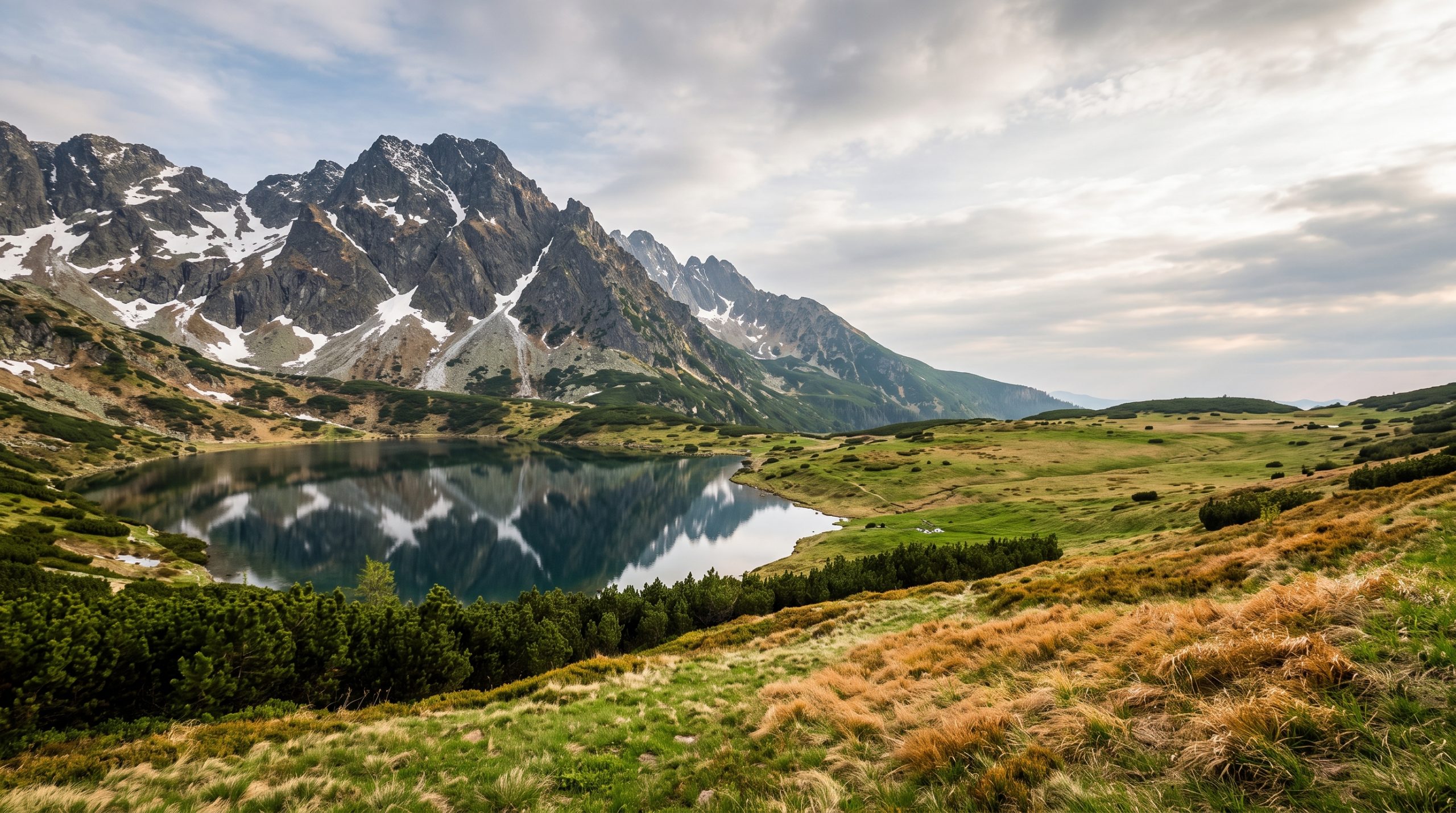
In mid-June the sun clears the horizon over Zakopane at about 4:34 in the morning and does not set until nearly 8:47 in the evening. On the December solstice the same mountains hand you 8 hours and 14 minutes of daylight, and only the last of them is much use for photographs. That eight-hour swing between the two ends of the year is the real subject of this page.
Everything else follows from it: how many places you can reach in one day, whether the ceremony sits at breakfast or at dinner, whether the high ridges are open at all, and how many other people are standing on the same patch of meadow when you turn to each other. The Tatras are small for a mountain range and enormously popular, and those two facts pull against each other in different ways in different months.
We work both sides of the border, Polish and Slovak, and the seasons behave differently on each. What follows is the calendar we actually plan from.
The Tatra window we would choose first
Mid-September to the second week of October. Daylight is still generous at roughly 12 hours 39 minutes in mid-September, sunset lands near 6:55pm rather than 9pm, the summer coaches have thinned out, and the valleys turn gold in October while the first snow settles on the high tops.
Month by month, with the light and the crowds
Sunrise and sunset below are mid-month for Zakopane. Temperatures and rainfall are long-term averages for the town, which sits at around 850 metres; everything above you is colder, wetter and windier than the numbers suggest, and the higher you plan to stand, the more you should read the table as optimistic.
| Month | Conditions | Light, mid-month | Crowds | Our verdict |
|---|---|---|---|---|
| January | Highs near 0 °C, nights near -8 °C. Driest month by volume at 60 mm, spread over 18 snowy days | 07:30 to 16:08 | Zakopane full, mountains empty | Deep snow, one usable hour |
| February | Snowpack at its deepest, air often clearer than January | 06:50 to 16:59 | Ski traffic on the pistes only | Best of the three winter months |
| March | Valley thaw, snow still upstairs. First crocuses late in the month | 05:55 to 17:44 | Light until the flowers arrive | A gamble that sometimes pays |
| April | Lowest humidity of the year at about 73 per cent, so the clearest long views | 05:49 to 19:31 | Busy at Chochołowska, quiet elsewhere | Underrated and we say so |
| May | Green valleys, waterfalls at full volume, high ground still under seasonal closure | 04:57 to 20:15 | Moderate, spikes over the May holidays | Beautiful low, shut high |
| June | High trails reopen on 1 June. Warm, unstable afternoons | 04:34 to 20:47 | Rising fast through the month | The longest light of the year |
| July | Wettest month at 151 mm across 17 rainy days, and also the sunniest at 199 hours | 04:50 to 20:42 | Peak. Morskie Oko at its fullest | Start at 4am or not at all |
| August | Warmest: highs near 22 °C, nights near 11 °C | 05:31 to 19:59 | Still peak, eases in the last week | Warm, crowded, workable early |
| September | Settled spells, cold clear mornings, valley mist | 06:16 to 18:55 | Drops sharply after the first week | Our first choice |
| October | Gold in the valleys, first snow on the tops around mid-month | 07:00 to 17:51 | Quiet midweek | Book the first half |
| November | Wettest air of the year at about 87 per cent humidity, colour gone, snow not yet set | 06:51 to 16:00 | Almost nobody | The month we redirect |
| December | Cloudiest month by a wide margin: 58 hours of sunshine in the whole month | 07:29 to 15:42 | Heavy in town from Christmas on | Short, dark, and lovely if planned tight |
Three windows that move: crocus, gold, first snow
The crocus bloom in Dolina Chochołowska is the shortest of them. In a normal year the meadows peak somewhere between the last days of March and the middle of April, and in a cold spring the whole thing slides toward the end of the month. The window is roughly ten days wide at full strength and it moves two to three weeks year to year, which means nobody can promise you a date twelve months out. What we can do is hold two shapes for the same morning and decide late.
The walk in starts from Siwa Polana and the flowers are seen from the track, not from among them, which is both the rule and, as it happens, where the better frames are. Standing back with the whole meadow running toward the ridge gives you scale a close-up never will. Be walking before 7am. By ten the valley has a queue in it.
Autumn colour is broader and easier to plan. October turns the beech and larch in Dolina Kościeliska and Dolina Chochołowska, and the sequence people underestimate is the overlap: around the middle of October the High Tatras often take their first snow while the meadows below are still fully gold. Rusinowa Polana is the classic place to see both at once, on an easy walk rather than a climb. That overlap lasts days, not weeks, and it is the single most photographically interesting thing the Tatra calendar does. Our destination guides go further into where each of those valleys works for a ceremony.
Winter has a narrow window of its own. On settled cold days between late December and February the Zakopane basin fills with cloud while the ridge above stands in clean sunlight, which makes that day a cable car question rather than a weather one.
When the Tatra calendar gives you neither colour nor snow
November. It is the only month we actively argue against. The colour has gone from the valleys, snow has not yet built into anything worth photographing, humidity averages around 87 per cent so the long views close down, and daylight is already under 9 hours 10 minutes by mid-month. On the Slovak side the seasonal closure of the higher trails, saddles and peaks begins on 1 November, so the ridges you may have been picturing are resting. Move two to three weeks earlier and you get the gold. Move eight weeks later and you get real snow and low winter sun. Both are better days than November’s hours will buy.
Late May is the other one, and for a reason that surprises people. The valleys are at their greenest and the water is loud, but the Slovak seasonal closure runs to 31 May, and the Kasprowy Wierch cable car takes its spring technical inspection in this part of the year, which in some years has swallowed most of May. The first week of June solves both at once and costs you nothing in light.
If your date is already fixed in one of those months, that is not a problem to unpick. It is a brief. A November elopement built on the valley floors, the wooden architecture around Zakopane, and a ceremony placed inside the two brightest hours of a 9-hour day is a genuinely good day out. Tell us the date and we will tell you what that month gives us and what it takes away.
What the sun actually does here across the year
The main Tatra ridge runs roughly east to west, and Poland sits on its northern side. That one line of geography explains most of what happens to your photographs. In deep winter the sun rises well south of east and stays low, so the big north-facing walls above Morskie Oko sit in shadow all day and the warm light lands instead on ridgelines, on snow-covered meadows and on faces. In midsummer the sun comes up far enough round to the northeast that those same walls catch fifteen minutes of genuine early light before anyone has reached them.
The practical consequence is that summer and winter want opposite timelines. In June, with sunset near 8:47pm, we can put the ceremony at 6pm, walk for two hours afterward and still be shooting in colour. In December, with sunset at about 3:42pm, everything compresses into a single afternoon block and the ceremony goes at 2pm because there is no second chance at that light. September, at 12 hours 39 minutes mid-month, is the month that behaves like a normal wedding day: an afternoon ceremony and an hour of low gold light at the end without anyone setting a 3am alarm.
December is also the clearest argument we have for two people working at once. When the whole of the good light is 50 minutes long, a photographer and a filmmaker covering it simultaneously means the vows are stills and film in the same breath, not performed twice for two different lenses. In June the opposite is true, and a long evening gives one person room to work slowly. Both shapes exist in our coverage, and you can see how each season looks finished in our galleries and films. Which of the two suits you is set out on the coverage and pricing page.
Cable cars, closed ridges and the trailhead calendar
The Slovak High Tatras operate a formal seasonal closure of selected trails, saddles and peaks from 1 November to 31 May. Trails leading to the mountain huts stay open all year, with the exception of Chata pod Rysmi, which is the detail that makes winter and early spring workable rather than off-limits. One route comes back earlier than all the others: Juráňova dolina in the Western Tatras reopens on 1 May. Designated winter touring corridors, including Mengusovská dolina and the Studená dolina area, are usable from 15 December to 15 April and not after that, regardless of how much snow is still lying.
On the Polish side the constraint is mechanical rather than seasonal. Polskie Koleje Linowe runs technical inspections on the Kasprowy Wierch cable car twice a year, in spring and again in autumn, and the spring break has in some years run from early May to the end of the month. The Gubałówka funicular takes a shorter break of its own, usually a week or two around the start of April. If a summit hour matters to your day, we confirm the published inspection dates before we build anything around it.
Tatra National Park charges for entry to the trails, currently 11 zł a person, which at roughly four złoty to the dollar is under three dollars. Some ticket points are seasonal and staffed from 1 April to 30 September only, so a pre-dawn start in October means buying in the park’s app the night before rather than hoping someone is in the kiosk at half past five.
Commercial photography and filming inside the Polish park needs written permission from the park director, issued as a formal decision, with fees the director sets. Filming away from the marked trails requires consent from the Ministry of Climate and Environment on top of that. Applications go in at least a week ahead, and in practice much further. Permit research and the paperwork logic are part of every experience we run; the fees themselves are paid by you, and we tell you what they will be while there is still time to choose a different valley. If you want the wider planning sequence first, start with how to elope, then send us the date. Check Your Date.
What we do when the cloud comes down
Not much of a Tatra weather plan involves hoping. July averages 17 rainy days, so on a summer date the honest assumption is that one of your two shortlisted mornings will be wet, and the plan is written for that before anyone lands.
Two things drive the alternatives. The first is cloud height. A low grey ceiling over Zakopane in winter is often an inversion, and the answer is to go up rather than down, because Kasprowy Wierch at 1,987 metres is frequently above it. In summer the same low ceiling usually means the whole column is wet, and we drop to the forest and the water in Dolina Kościeliska, where cloud reads as atmosphere instead of absence.
The second is wind direction. When the halny blows warm from the south the sky scours clean and the ridges get loud, so we move the ceremony to a sheltered valley floor and keep the high ground for stills later in the day, when audio no longer matters. That decision is made on the morning, from a shortlist agreed weeks earlier, with a ceremony hour we have already agreed can slide three hours either way.
Common questions
What is the single best month to elope in the Tatras?
September, and the second half of it if you can. The weather settles, the summer traffic collapses after the first week, and mid-month daylight of about 12 hours 39 minutes gives a full day without an alarm before four. Early October is a close second and adds the colour.
Can we elope in the Tatras in winter?
Yes, and February is the month we would pick. The snowpack is deepest, mid-month daylight runs 06:50 to 16:59, and the trails to the mountain huts stay open all year. Winter days are built on valley floors, hut approaches and lift-served high ground rather than on ridges.
When do the crocuses bloom in Dolina Chochołowska?
Usually between the last week of March and the middle of April, with the strongest ten days somewhere inside that. A cold spring pushes the peak toward the end of April. The dates move by two to three weeks year to year, so we plan the morning with a second option and confirm late.
How early do we have to start to have Morskie Oko to ourselves?
In July and August, before dawn. Sunrise in mid-July is at 04:50, and being on the road up from Palenica Białczańska well before that is the whole trick. In late September the same solitude is available at a far kinder hour, with sunrise closer to 06:30.
Do we need a permit to film or photograph in Tatra National Park?
Yes. Commercial photography and filming needs written permission from the park director, and filming off the marked trails also needs consent from the Ministry of Climate and Environment. Applications are submitted at least a week in advance. We handle the research and the sequencing; the fees are paid by you.
Will the Kasprowy Wierch cable car be running on our date?
Usually, but it closes for technical inspection twice a year, in spring and in autumn, and the spring break has run for most of May in some years. We check the operator’s published dates before a summit hour goes into your timeline, and we hold a ground-level alternative regardless.
How many days should we allow for weather in the Tatras?
Two, if your dates allow it. With 17 rainy days in an average July, a single fixed date is a coin toss on the high ground and a certainty in the valleys, which still photograph beautifully wet. Multi-day coverage exists partly for this reason.
Our date is in November and cannot move. Is that a bad idea?
No, it is a different plan. November gives about 9 hours 10 minutes of light mid-month and closed high trails on the Slovak side, so we build around the valleys, the wooden architecture of the Podhale villages and the two brightest hours of the afternoon. Tell us the date and we will send you the shape of that day.
Choosing your Tatra date for 2027, 2028 or 2029
Send us the month you are circling and we will tell you what the light does, what is open, and where the crowds will be at the hour you want to stand still. We keep the planning in one written thread, starting with a reply and an initial brochure inside 24 hours, so you can read it at your own pace from the other side of the Atlantic. Tell Us Your Story.