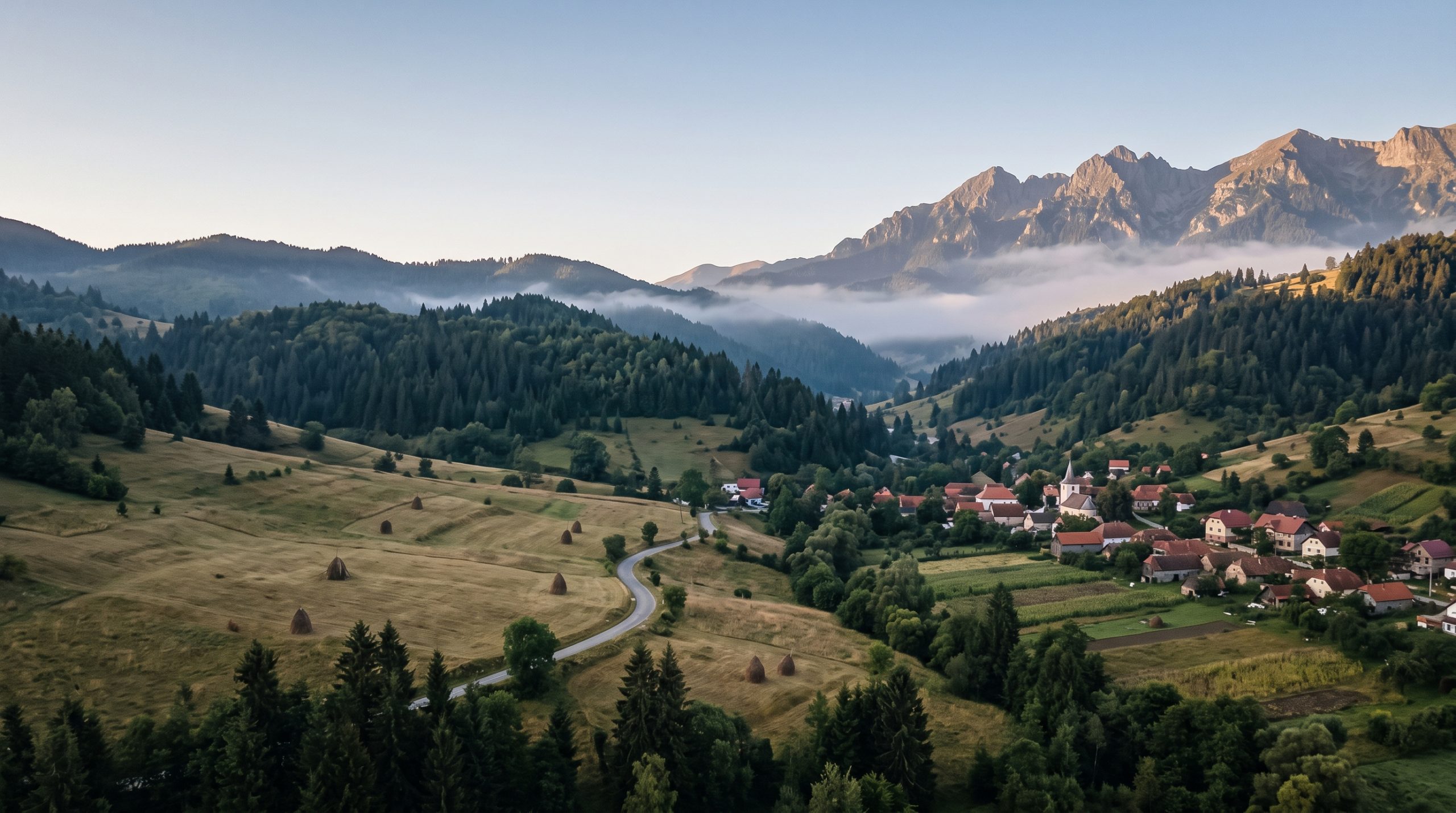
The gate on the high section of the Transfăgărășan opens at seven in the morning. On a mid-June date the sun is up at 05:32, and the light in the Bâlea cirque is worth standing in well before that. Those two facts do not fit together, and a Romania elopement budget really begins with what you decide to do about it: sleep at 2,034 m, or spend the best hour of your morning lower down the valley.
The road above Piscu Negru closes for the winter and comes back when the snow is cleared, not on a date you can hold in advance. It reopened on June 6 in 2027 and on June 12 in 2028, and CNAIR set the hours it could be driven at 7 a.m. to 9 p.m. daily. For a May or early-June date, the cable car up from Bâlea Cascadă is how you reach the lake instead, which changes how much gear travels with you and how long the whole day runs.
This page is about money, in both columns. What a full day of photography and film with our team costs in Romania, and what the country itself adds in lei once you are standing in it. Romania is not an expensive place to be. That does not make the day simple, and the lines nobody writes down are the ones that decide whether your plan survives contact with the mountain.
The two numbers that answer this page
A full day of Romania coverage starts at $4,900 with one dedicated photographer or one dedicated filmmaker, and at $7,900 with both working the same day together. Team travel to Romania is included, as it is everywhere. Everything you add on the ground here is quoted in lei, and most of those lines are smaller than couples expect.
One June day, built around a gate that opens at seven
What follows is a real mid-June shape in the Făgăraș, the version we run most often. The times come from the sun and the road, not a template.
04:20. Awake at the lake, because no car is coming up from Bâlea Cascadă for another three hours. Civil twilight starts at 04:54. The bowl holds its blue up here: the lake sits directly under the main ridge, so the sun that rises on paper at 05:32 takes far longer to reach the water. The ridge above catches it first. That is the frame worth the alarm, and almost nobody photographs it, because almost everybody drives up after breakfast.
05:40 to 06:45. Vows. We hold them at the outflow end, in the lee of the moraine, where the saddle wind drops enough for a recorder to earn its place. Then we walk up onto the shoulder for the wide frames once the light is properly on the rock. You have the lake to yourselves until roughly 07:40, when the first cars through the gate reach the top.
08:15. Breakfast, dry socks, a warm room. This is not padding in the timeline. A June morning at 2,000 m sits in the low forties Fahrenheit, colder with wind on it, and the difference between a couple who look happy at nine and a couple who are quietly enduring the day is twenty minutes indoors.
09:00. Down the switchbacks while the sun is still low and side-on. Roughly 800 m of descent in a dozen kilometers of hairpins, which is the best piece of moving film in the country, and it needs a camera above the road rather than in the car. The road authority reminds drivers every season not to stop for the bears that use the verges, so we work from pull-offs chosen in advance and bring a local mountain guide on any day that leaves the road.
11:00 to 16:00. Off the mountain and out of the light. Carpathian afternoons build cloud from the inside, and high sun flattens gray rock into nothing. This is the hour for a long lunch in Cârțișoara or a village below the range, a change of clothes, and a look at the sky before we commit to the evening plan.
16:30. Foothill country. Hay meadows still cut by hand in places, storks on the poles until they leave in August, lanes wide enough for a horse cart and not much else. It photographs like a different country from the one you stood in at dawn, which is why we put both halves in one day.
18:30 onward. The long end of a Romanian June evening. Sunset at 21:13 over the Olt valley, then usable light to civil dusk at 21:51. A day that starts at 04:20 and ends near ten at night is not a normal working day, and it is the reason there are eight of us rather than two.
Move the same day to another month and it reshapes itself completely.
| Window | Almanac sunrise and sunset | Access to Bâlea Lake | What the day becomes |
|---|---|---|---|
| Mid-May | 05:58 and 20:39 | Cable car from Bâlea Cascadă; the road above Piscu Negru is still shut | Snow at the lake, waterfalls at full volume, ceremony lower down and one trip up |
| Mid-June | 05:32 and 21:13 | Road usually open by now, drivable inside set daytime hours | The longest light of the year, and the lake to yourselves if you sleep high |
| Late September | 07:06 and 19:26 | Road open, traffic thinning through the week | A civilized alarm, cold clear mornings, first snow dusting the tops |
| Mid-October | 07:34 and 18:44 | Road open until the winter closure arrives | Valley fog under a clear ridge, beech gold coming up the slopes, early finish |
There is a second shape that has nothing to do with altitude. Vows in the courtyard of a fortified Saxon church at Viscri or Biertan, an afternoon in the Sighișoara citadel, the evening back out in the meadows. Gentler, with driving measured in tens of kilometers rather than mountain hours, and it holds together in April and November when the high ground will not. Tell us in your first message which of the two you want. Check Your Date and name the window you are looking at.
What the second camera changes on a hairpin road
Here is the practical problem with the Făgăraș. Good light in the cirque is not an evening that stretches on. It is a window that opens when the sun clears the ridge and closes when the wind comes up the valley, and it can be twenty minutes wide. One person working alone in it is constantly choosing between a still frame and a moving one, and whichever they take, the other is gone.
On the Expedition, a dedicated photographer and a dedicated filmmaker work the same day together. They built the timeline in the same document weeks earlier, they drive up the same road in the same car, and neither of them is introduced to the other at four in the morning. It matters more here than in most places we work. While the photographer stays close for the vows in the lee of the moraine, the filmmaker is already 200 m up the shoulder with the lake and the tunnel above it in frame. Both things happen inside one window.
Wind is the other reason. A ridge saddle at 2,000 m is a hostile place for sound, and the Expedition adds professional audio for vows where conditions allow, which in the Făgăraș means choosing the sheltered ground first and the pretty ground second. A filmmaker planning that with us in advance picks a spot ten meters lower and out of the funnel, so your vows are audible in the finished film rather than a wall of noise with subtitles.
Drone footage goes in where it is legal, safe and appropriate, and the Transfăgărășan is one of the few roads on earth that genuinely earns an aerial. Aerials run on registration and an authorization with a time window, so we confirm both before the film is planned around them, and with two of us on the ground one can fly while the other keeps shooting, instead of the day pausing while one pair of hands changes job. You can see how both halves of that land in our galleries and films, where the film from a day sits next to the photographs from the same hours.
The Adventure is the same planning and the same standard with one of the two, and plenty of couples choose it deliberately. What it cannot do is be in two places inside a twenty-minute window.
What is in the plan, and when the work arrives
Every experience we run in Romania carries the same planning work, on the Adventure, the Expedition, or an Odyssey spread across several days and regions.
- Destination and location design, chosen for your dates and your tolerance for altitude, distance and early starts.
- A custom timeline built around real light and real travel time, including the gate hours on the high roads and the cable car hours when the road is closed.
- Permit research and logistics guidance for every site in the plan, from a national park administration to a town hall.
- Weather alternatives and backup planning, which in the Carpathians means a sheltered option and a low-level option written down before you fly.
- Drone footage where it is legal, safe and appropriate.
- Professional audio for vows and meaningful moments on the Expedition, where conditions allow.
- Team travel worldwide: flights, accommodation and ordinary travel for the assigned team, in Romania as everywhere else.
- Highlights delivered in 5 days, and the full gallery or film in 3 weeks.
The fee does not move with your guest count. Two of you at the lake and eleven of you in a Saxon churchyard cost the same to cover. Guests change access, permits, transport and the timeline, which is why we ask early. They do not change the fee.
Your column, in lei
Everything below is paid locally, in lei, and it is the part of a Romania elopement that surprises couples in the good direction. The research, the applications and the correspondence are ours. The fees themselves sit with you.
- Accommodation, including a night high up if you want the lake at dawn, and a guesthouse in the villages for the rest of the trip.
- Your celebrant, and the registry office fees if you are marrying legally in Romania rather than at home.
- Site fees. Ticketed castles charge admission and then charge again for professional photography inside. National parks and the Danube Delta Biosphere Reserve have their own access and filming authorizations. All of it is priced in lei and none of it is large.
- Unusual transport: a 4×4 over an unsurfaced pass, a boat in the Delta, a mountain guide, the cable car when the road above Piscu Negru is shut.
- Ordinary road costs, including the rovinietă every car needs on national roads, usually bundled into a rental, plus fuel.
We do not print those tariffs here, because Romanian site fees are reset locally and quietly and a number typed into an article ages badly. The current figures for the exact places in your plan go into your proposal in writing, before you sign anything. Where each of our experiences begins is set out on the pricing page, and team travel to Romania is inside that figure rather than added to it later.
Why our fee is the same here as anywhere else
This is the question we get most often about Romania, and it deserves a straight answer. A guesthouse room and a good dinner cost less here than in the Alps, so couples reasonably expect coverage to follow. It does not, because nothing that drives our fee gets cheaper by moving east. The same two people work the same seventeen-hour day, and the edit takes the same weeks. If anything the planning takes longer here, because a Făgăraș day has to survive a road with opening hours, a cirque that makes its own cloud, and airports nowhere near each other: Sibiu is a little over an hour from Bâlea Cascadă, Bucharest four hours or more depending on which side of the range you drive.
What Romania genuinely gives you is a different split. In a lot of destinations, the ground costs eat the plan. Here the ground is affordable, so more of what you spend goes into the day itself and into what you keep afterwards. Couples who priced an Alpine version first usually end up adding days here rather than trimming them.
The legal file, and where it sits
Only a civil marriage in front of a Romanian registrar carries legal weight. A ceremony on a ridge, however moving, is a ceremony. If you want the legal act done in Romania, the declaration is filed at a town hall and the marriage takes place ten days later, counting the day you file and the day you marry, and your documents need authorized Romanian translations plus a statement from your own embassy that you are free to marry. It is a straightforward file, and also ten days of your trip.
Most couples we work with in Romania handle the paperwork at home and treat the day here as the ceremony that actually matters. Both routes are normal, and our planning fundamentals walk through how to decide. Tell us which one you want early, because it changes the shape of the week rather than the day.
From first message to signed contract
- You send the inquiry form with your window, your rough idea, and how many people are coming.
- We reply within 24 hours with our initial brochure and a few real questions about access and light.
- We come back with a tailored proposal: the region, the shape of the day, the team assigned to you, and the third-party costs Romania adds.
- You sign the contract and pay a 30% retainer, with the remaining payments set out in the proposal.
- Planning begins: location design, permit research, the hour-by-hour timeline, and the written alternatives for weather.
- We travel, we shoot your day, and your highlights land 5 days later.
Romania rewards early risers and a plan that moves
The couples who get the most out of this country are the ones who are genuinely happy at 04:20, comfortable on moraine boulders and wet grass in decent footwear, and relaxed about a morning where we change the order of things because the ridge is in cloud. Nothing about that requires you to be an athlete. It does require you to want the mountain more than you want a fixed running order.
If a pre-dawn alarm sounds like a poor start to a marriage, the honest fix is a date in late September, when the sun comes up at 07:06 and the light stays cold and clean for longer. If altitude and wind are not your idea of a good time at all, Romania has an entire second personality: the Saxon villages and the Apuseni gorges, Maramureș with its wooden churches, the reed channels of the Danube Delta at first light. Our destination guides cover those regions, and an Odyssey can string two of them together across several days. Write to us with the version of the day you actually want, and we will either build it or tell you plainly which month and which region fits it better.
Common questions
Can we legally get married in Romania as Americans, or should we do the paperwork at home?
Both work. Marrying in Romania means filing a declaration at a town hall and marrying ten days later, with translated documents and a statement from your embassy that you are free to marry. Most couples we work with here complete the legal side at home first and keep the Romanian day for the ceremony itself.
When does the road up to Bâlea Lake actually open?
The high section reopens once the snow is cleared rather than on a fixed date. It came back on June 6 in 2027 and June 12 in 2028, and it is drivable inside set daytime hours after that. Before it opens, the cable car from Bâlea Cascadă gets you to the lake, and we plan the day around the lift rather than the road.
How many days in Romania do we need?
Three nights is workable for a single-region day: arrive, cover the day, keep the third as your weather spare. Five to seven nights lets you pair the mountains with the Saxon villages or the Delta, which is where an Odyssey fits. If you are marrying legally in Romania, add the ten-day waiting period to your travel plan.
What actually changes if we add a filmmaker to the day?
Coverage stops being sequential. In a twenty-minute window at the lake, one person chooses between a photograph and a moving image, and two people do not. You also get vows recorded with proper audio in the shelter we picked for that purpose, and aerials flown without the day stopping while one person changes tools.
What do we pay for locally, and in what currency?
Everything local is in lei: accommodation, your celebrant, castle and park fees, filming authorizations, guides, boats, the cable car, fuel and the road vignette. We research and apply for the permits, you pay the fees, and the current figures for your specific sites are written into your proposal instead of guessed at from an article.
Can you fly a drone at Bâlea Lake?
Often, and it is worth it, because the road below the lake is one of the great aerial subjects anywhere. Aerials depend on operator registration, an authorization and a time window, so we confirm all three before building any part of the film around them.
What happens if the mountain is in cloud on our date?
Your plan already contains the alternative. The cirque generates cloud that the valleys never see, so every Făgăraș timeline we write carries a sheltered option and a low-level option, usually in the foothills or a fortified village half an hour away. We decide together over breakfast, not at the trailhead.
How far ahead do couples book a Romania date?
We are currently taking 2027, 2028 and 2029. June dates at Bâlea are the ones couples ask for most, since the road only opens weeks before them. Anything from six months out is comfortable for the shoulder months, and earlier is simpler if you want a specific weekend high up.
Writing to us about a 2027 date
All of this happens in writing, in your own time and across your time zone. You send the form, we reply inside 24 hours with the brochure, and the proposal follows once we know what your day looks like. Everything sits in your inbox, and there is no pressure anywhere in it.
Tell us the month you are thinking about, whether you want to be at 2,034 m at dawn or in a churchyard at four in the afternoon, and how many people are with you. We will come back with the plan and the numbers behind it. Tell Us Your Story.