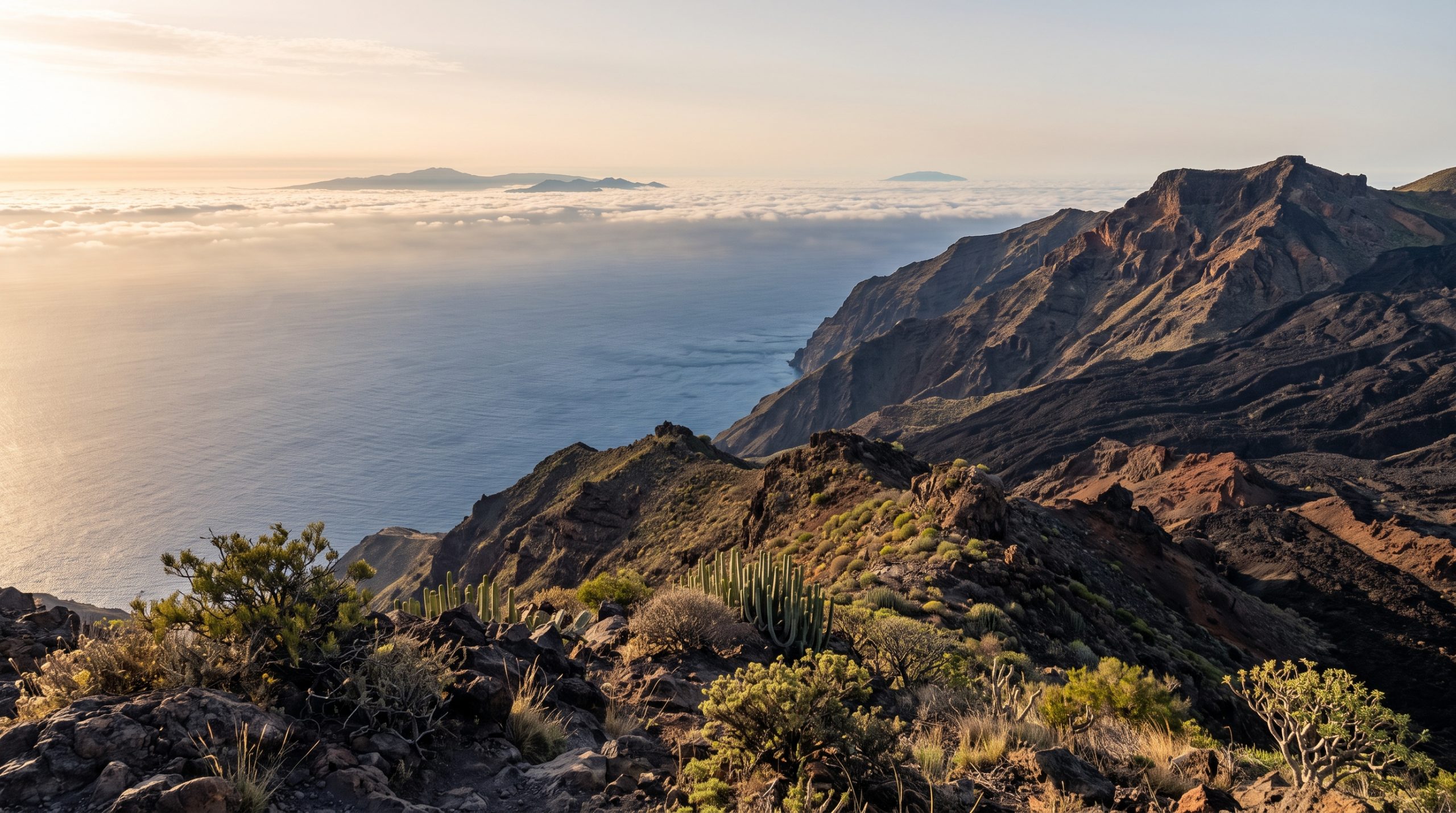
The Canaries make a poor first impression on paper. Budget flights, resort strips, a reputation as somewhere Europeans go for winter sun. Then you drive up out of the pine belt on Tenerife before the coaches wake, the road tips you onto a lava floor at around 2,000 meters, and the whole cliche falls apart in about four seconds.
That contrast is why we keep coming back, and it is also why budgeting for an elopement here catches couples out. The cost splits into two piles that behave nothing like each other. Our side is one fixed figure, published, travel included. The islands’ side is small, in euros, and almost entirely a question of permissions and driving: professional photography and film inside Teide National Park needs written authorization from the park, applied for at least a month before the day, while the coast is governed by a different office of the Canary Islands government and a village square belongs to its town hall.
None of that is expensive. All of it is a calendar problem, which is a much better problem to have. So this page does the arithmetic out loud, in the order couples actually ask it.
Two budgets, not one
Photography, film and planning for a Canary Islands elopement come from one team of eight, with our travel included. Coverage starts with a single full day on one island, and the figures live on our coverage and pricing page. The islands add a separate euro layer: permit fees, a celebrant, a car, and beds.
Why we start at altitude and finish at sea level
The Canaries sit at 28 degrees north but keep the same clock as London, which produces a day shape almost nobody plans for correctly. In late June the sun does not set until after 9pm. In late December it is gone before 6:30pm. And because you are that far south, the color afterward is brief: figure on roughly twenty-five usable minutes rather than the long, forgiving northern gloaming you may have shot in before.
That single fact drives the timeline. One pass at the good light, morning and evening, and no drifting.
So we build the morning high and the evening low. Before dawn we are already on the caldera floor, where the trade wind inversion usually parks a cloud layer on the northern slopes well below you. The air up there is cold, dry and completely still in the hour before sunrise, and Teide National Park is a UNESCO World Heritage Site with the visual density to match: pumice fields, black and rust lava, ancient rock walls, and a volcano that catches light maybe ten minutes before anything at sea level does. Vows work beautifully here because there is nobody else in the frame yet.
Then we come down. The drop from the caldera to the Atlantic is around 2,000 meters of switchbacks, and it doubles as the wardrobe change, the coffee, and the part of the morning where you stop being nervous. By late morning the sun at this latitude is high and hard, shadows go short, and honestly the islands do not photograph well in the middle of the day. We use that gap for the swim, the lunch, the drive to the north coast or the boat, and we do not pretend it is portrait time.
Late afternoon we work sea level: black sand, the volcanic shelf, laurel forest in the north, or the cliffs on the west coast where the light comes in flat off the water. Then that quick twilight, and dinner.
Two notes on the mountain, because they change plans. The cable car is a daytime service, so it is not carrying anyone up for sunrise or sunset, and the trail from the top station at 3,555 meters to the actual summit runs on its own permit with a hard cap of 200 people per day in timed slots. It is a wonderful thing to do on a spare afternoon. It is a bad place to build a ceremony, and we will tell you so.
| Month | Evening light | How the day tends to shape |
|---|---|---|
| Late June to August | Sunset after 9pm | Very early alarm, long empty midday, late dinner. Warmest water, busiest coast. |
| March to May | Sunset moving past 8pm | Our favorite window. Sociable alarm, green north, high ground open and quiet. |
| November to January | Sunset before 6:30pm | Compact day, gentle start, cold at altitude. Cloud on the north is likelier and often gorgeous. |
Calima days, when Saharan dust drifts over the islands, flatten the light and soften the horizon to nothing. They are part of the deal here. They also make for some of the strangest, most beautiful frames we have shot in the archipelago, and the reason we always hold a second location in a different microclimate is that these islands change character within a twenty-minute drive.
Tell Us Your Story and we will send back the shape of a real day on the island you have in mind, built around that month’s light rather than a template.
Short light, steady wind, and why we bring two cameras
Here is the part that matters most in this specific landscape. Twenty-five minutes of good evening light is not enough time for one person to make both a photograph and a film. A photographer working alone on the caldera rim has to choose, every ninety seconds, between the still frame and the moving one. What you get back is one of them done properly and the other done in the gaps.
On our Expedition day a dedicated photographer and a dedicated filmmaker work the same hour from different positions. Not two freelancers who introduced themselves at breakfast. Two people from the same team of eight, who planned the same timeline, know which ridge the wind is coming over, and have agreed in advance who owns the wide shot and who moves.
The wind is the other Canary-specific reason. The trade winds are almost always doing something on an exposed ridge, and wind is the enemy of vows on film. That is why the Expedition adds professional audio where conditions allow, with a filmmaker whose entire job in that moment is your voices rather than your outline against the sky. It is also why we scout a sheltered fallback inside a short drive of every high location, and build the ceremony hour around wind direction as deliberately as around sunrise.
Drone footage goes in where it is legal, safe and appropriate. Aerials here run on a permit and a time window, so we confirm both before designing a sequence around them, and we plan a version of the film that stands up without them.
If you want to see how this actually looks, our published galleries and films are the honest test. Look at what happens in the frames shot within an hour of sunrise at altitude, and at what the film does with wind and silence.
Everything that sits inside the fee
Every experience we run, on every island, includes the following. There is no tiered version of this list.
- Destination and location design, chosen for the month you are traveling and the light you want.
- Planning, and a custom timeline built around real sunrise times and real driving times, not optimistic ones.
- Permit research and logistics guidance for the park, coast and municipal permissions your locations need.
- Weather alternatives and backup planning, with a second microclimate identified for each key hour.
- Drone footage where it is legal, safe and appropriate.
- Professional audio for vows and meaningful moments on the Expedition, where conditions allow.
- Team travel worldwide: flights, accommodation and ordinary travel for the assigned team, with no long-haul surcharge.
- Highlights delivered in 5 days. The full gallery or film in 3 weeks.
Two things that are not on the list because they do not exist: a half day, and a price that moves with your guest count. Guests change access, permits, transport and the timeline. They do not change the fee.
Where coverage starts, and what the islands add
The Adventure is one full day with one dedicated photographer or one dedicated filmmaker, from $4,900. The Expedition is one full day with a dedicated photographer and filmmaker working together, from $7,900. The Odyssey runs from two to seven days across one or several islands, with photography and film, quoted as a custom proposal because a three-island route and a two-day Tenerife route are not the same job. Our planning calendar for Canary Islands currently covers 2027, 2028 and 2029.
Because our travel is included, the Canaries cost you the same as anywhere else we work. There is no European rate and no long-haul rate. The euro costs below are the ones you pay directly, and they are genuinely modest compared with most premium elopement destinations.
- Permit fees for the park, coast or municipality, paid to the issuing authority. The research and the applications are ours.
- A celebrant or officiant for the ceremony.
- Accommodation, and a rental car. On some islands a 4×4 for unpaved access.
- Inter-island travel if your route crosses water, by ferry or a short Binter flight.
- Anything unusual we arrange for you: a private boat off Los Gigantes, a mountain guide, a helicopter.
The permit question, answered
This is where couples expect a nasty surprise, and where the Canaries are better than their reputation. Three separate desks can be involved, and they do not talk to each other. Professional photography and film inside Teide National Park needs written authorization from the park administration, submitted a minimum of one month ahead. Coast and beach work goes to the Canary Islands government’s coasts directorate, in Spanish, through its electronic office. Public streets and squares belong to the relevant town hall.
The park also sets a refundable security deposit against any damage to the protected area, starting at €300 and scaling with the size and scope of what you are doing, returned after the day. For two people, a celebrant and a small crew, you are at the quiet end of that scale. The work here is paperwork and lead time, not money, and the lead time is exactly why we ask which island and roughly which week before anything else. Full pricing and what each experience covers sits on the pricing page.
From first email to a booked date
- You send the inquiry form with your date, or your rough month, and the island you are drawn to.
- We reply within 24 hours with our initial brochure and first questions.
- We build a tailored proposal: experience, locations, the permissions each one needs, and an outline timeline.
- You sign the contract and pay a 30% retainer. The rest of the schedule is set out in the proposal.
- Planning begins. Permit research, timeline drafts, vendor guidance, and the backup plan for each hour.
- We travel in, we shoot your day, and highlights land in 5 days with everything else inside 3 weeks.
Cold hands at dawn, warm water by noon
The couples who get the most out of these islands are the ones who will set an alarm for a time that feels unreasonable, put a coat over the dress at 2,000 meters, and then be in the Atlantic by lunchtime. Uneven ground is part of it. Lava is sharp, pumice slides, and the good places are a short walk from the car rather than a car park view.
You also want to be relaxed about a plan that moves on the morning. We will sometimes swap the whole first location at 5am because the cloud sat lower than forecast, and the couples who love that day are the ones who treat it as the interesting part.
If a pre-dawn start genuinely is not your idea of a good morning, say so in the first email. There is a gentler version of this that runs on late-afternoon and evening light, and there are islands that suit it better: Lanzarote’s low volcanic ground and La Graciosa’s sand are kinder late in the day than the high caldera is. If you want green rather than lunar, the north of Tenerife, La Palma’s ridges and La Gomera’s laurel forest are a different archipelago entirely. Our destination guides are a good place to start narrowing it, and telling us what you actually want to be doing at 6am narrows it faster.
Common questions
Can we legally get married in the Canary Islands as Americans?
A Spanish civil marriage runs through a file opened at the Registro Civil of the municipality where one of you is registered as a resident, which is what stops most visiting couples. Almost every couple we work with here handles the legal marriage at home, before or after, and holds the ceremony that matters on the island with a celebrant. Tell us which route you want and we will build the timeline around it.
Do we need a permit to be photographed in Teide National Park?
For professional photography and film, yes. Authorization comes from the park administration and has to be requested in writing at least a month before the day, which is the single strongest argument for choosing your island early. We research it and prepare the application as part of planning. You pay the fee and any refundable deposit directly.
Which island should we choose if we only have one day?
Tenerife, in most cases, because the caldera and the Atlantic are the same morning and the contrast between them is the story. Lanzarote is the pick if you want the graphic volcanic version with a shorter drive between locations. La Palma and La Gomera reward a second day rather than a first one.
Is the cable car worth building the day around?
No. It runs daytime hours only, so it cannot give you sunrise or sunset, and the trail above the top station is capped at 200 permits a day. Go up for yourselves on a spare afternoon. We will spend your light where it is actually good.
What happens if calima or heavy cloud arrives on our morning?
We move. Every timeline we send has a second location in a different microclimate, usually within a twenty-minute drive, and on these islands that can mean the difference between flat haze and clear sky. Cloud below you at altitude is frequently the best thing that can happen to your photographs.
Are your team’s flights and hotels included?
Yes. Team travel is included worldwide, in every destination, with no distinction between a European trip and a long-haul one. Flights, accommodation and ordinary travel for the assigned team sit inside the fee.
How far ahead should we book a 2027 date?
Earlier than you think, and not because of us. The month-ahead minimum on park authorization is a floor, not a target, and the good months on these islands are the ones everyone else also wants. Our planning calendar for Canary Islands currently covers 2027, 2028 and 2029 now.
Can our parents and a few friends come?
Yes, and the fee does not change. What changes is access: more people means more vehicles on narrow roads, different permit conditions in protected areas, and a slower timeline. Tell us the number early and we design around it instead of absorbing it on the day.
Send us the date and the shape you want
Everything we do runs in writing. You will never be asked to schedule anything or find a slot in your week. Send the island, the month, and one sentence about what you want the morning to feel like, and we will come back within 24 hours with a brochure and honest questions about light, permits and driving times.
If you are still deciding between islands, send us both. Telling you which one fits your month is part of the job, and it is a better conversation than a brochure. Check Your Date.