The legal route to a Greek marriage runs through Athens. American citizens swear an affidavit stating there is no impediment to the marriage in front of a consular officer at the US Embassy, and that affidavit then has to be authenticated by the Greek Ministry of Foreign Affairs before any island office will build a file around it. The Embassy’s own advice is to plan on two days in the capital for that step alone.
A symbolic ceremony skips every line of it. No license, no apostille, no translation into Greek, no 40-day deadline waiting for you afterwards. You handle the legal marriage at home, in your own language, on your own timetable, and the ceremony on the caldera rim becomes the one you actually plan: the one your people fly for, the one that ends up in the film.
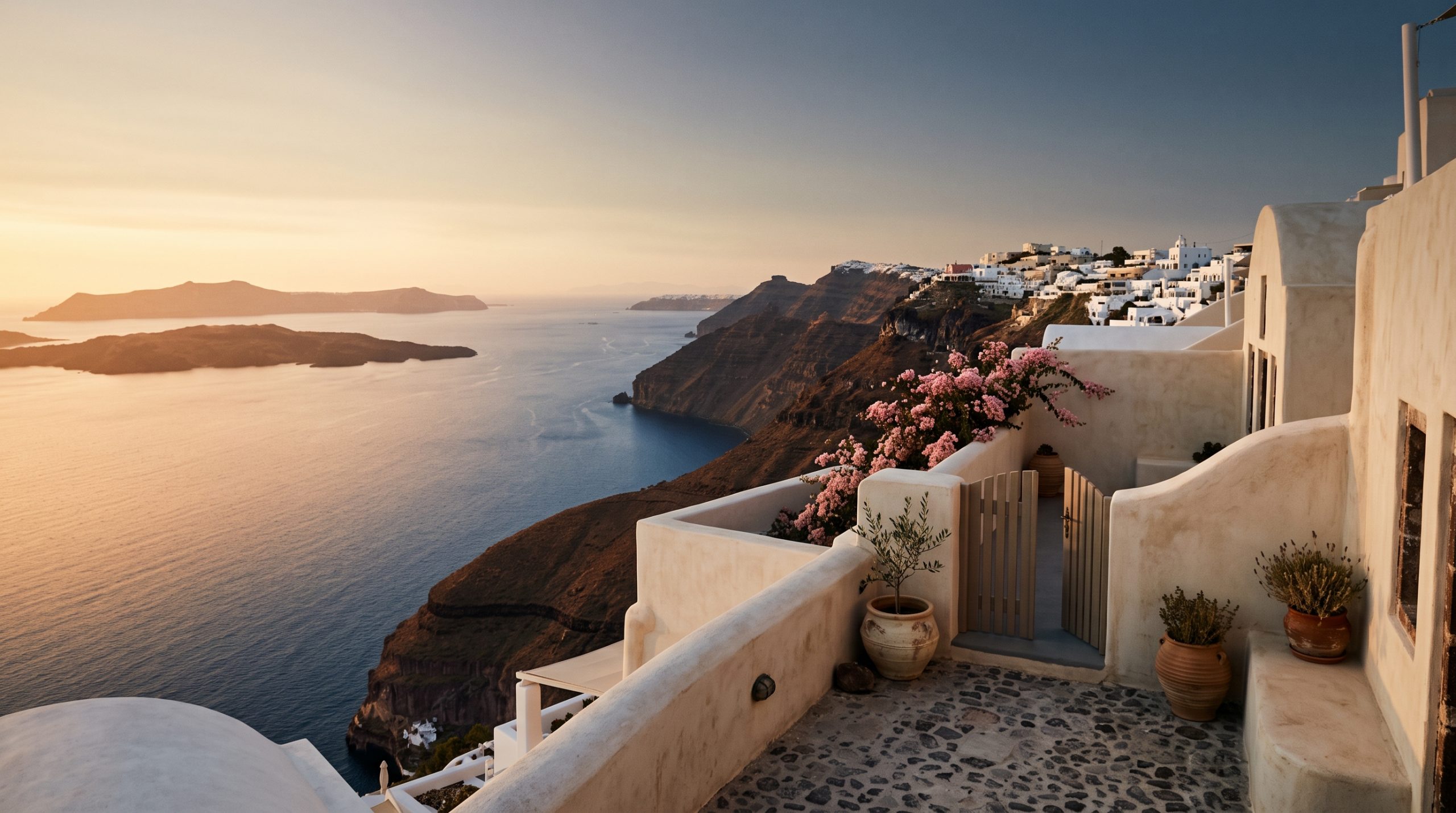
The cliff does not know the difference. The light that comes off the Imerovigli terraces at 8:40 on a mid-June evening is the same light on either route. What changes is how much of your week belongs to paper.
Nothing to file, nothing to translate
A symbolic ceremony in Santorini needs no Greek paperwork. There is no license, no apostille, no sworn translation and no registration deadline, because nothing is being filed. You marry legally at home, before or after the trip, and the island day is planned entirely around location permission, the hour of the light and the people you want there.
Two days in Athens before you see the caldera
Here is the honest rating: a civil marriage in Greece is well within reach for visiting couples, and it is fiddly. The US Embassy in Greece states plainly that you do not need to reside in Greece to marry there, that the bureaucratic process of getting to a marriage certificate can take several weeks, and that the local town hall, not the Embassy, sets the requirements you actually have to meet. For Santorini that office is the Civil Marriage Office of the Municipality of Thira, in Fira.
The part that catches people is geographic rather than legal. The affidavit is sworn before a consular officer at the Embassy in Athens or the Consulate in Thessaloniki, at a notarial fee of 50 US dollars per person, 100 dollars if you are both American. Santorini is a 45-minute flight from Athens, or most of a day on a ferry. So the legal route inserts a mainland stop into a trip that most couples want to begin on the island, and it inserts it at the front, when you would rather be watching the ferry come around the point at Oia.
Same-sex couples stand in exactly the same place in the queue. Greece legalized same-sex civil marriage in February 2024, in a vote that drew cross-party support, and became the first majority Orthodox Christian country to establish marriage equality. The document chain is identical.
The guide explains the workflow from a planning perspective, not as legal counsel. Confirm the final requirements for your circumstances with the relevant registry office or consulate before travel is fixed.
The Greek document chain, in the order it happens
If you do want the marriage itself to be Greek, this is the sequence. Each step feeds the next, so the order matters more than the individual pieces.
- Long-form birth certificate for each of you, apostilled. The apostille has to be obtained in the United States, from the office in the state that issued the certificate. The Embassy in Athens has no authority to add it.
- Official Greek translation. Documents from countries in the Hague Convention are accepted only when they carry the apostille and have been translated into Greek by a Greek translator. An English certified translation you already own does not carry across.
- Evidence that any previous marriage ended, if that applies to either of you, also apostilled and also translated.
- The Affidavit of Marriage, sworn in person before a consular officer, stating that no impediment to the marriage exists. This is the Athens step, and it is the one that shapes your travel.
- Authentication of that affidavit by the Greek Ministry of Foreign Affairs. A public fee voucher, the e-paravolo, of 30 euros is required for it. Plenty of couples assume the consular signature is the finish line. It is not.
- The application at the town hall. Where both partners are foreign nationals, each one submits a separate, complete set of documents. Two people, two files.
- The newspaper notice. Greece’s national register of administrative procedures lists a marriage announcement published in a local daily paper among the supporting documents for a marriage license. Whether it lands on your file is a question for the office issuing the license, and it is worth asking early because it is published in Greek.
- The license itself. Authorities generally issue it eight days after the application goes in. Published guidance varies slightly, with some municipalities quoting seven days, and the office that issues yours is the one whose number counts.
- Registration after the ceremony. The marriage is recorded at the Vital Statistics Office, the Lixiarcheio, of the place where it was performed, within 40 days. The US Embassy does not do this for you.
Two dates govern that list. The license is valid for six months, and once it exists the civil ceremony can be performed anywhere in Greece. The 40 days start the moment the ceremony ends.
Build the legal calendar around the caldera sunset
Start from the hour, not the month. In mid-June the sun goes down over the caldera at around 8:40 in the evening and comes up at about 6:00 in the morning. By mid-October sunset has pulled back to roughly 6:45. We usually place vows 60 to 75 minutes before sunset, which leaves the whole descent of the light for the walk afterwards, and on a June date that means a ceremony starting at about 7:30pm.
The castle ruin at the end of Oia is the most photographed place in the Cyclades, and at sunset it is also one of the least comfortable: shoulder to shoulder, cameras up, nowhere to stand still. Ten minutes back along the caldera path the crowd thins out to almost nobody, and from the Imerovigli side, with Skaros below you, the light does exactly the same thing to exactly the same cliffs. That is the sort of trade we make for you at the planning stage rather than on the evening.
- Six months out. The earliest useful start for the legal route, because a Greek marriage license expires six months after issue. Earlier than that and the paper ages out before the date arrives.
- Four to six months out. The comfortable minimum, and the one we work to. Certificates ordered, apostilles moving, translation commissioned, the island days drafted around the mainland stop.
- Six to eight weeks out. The realistic bare minimum if everything cooperates, and it leaves no room for a certified copy arriving from the wrong county office.
- Two weeks out. The application should already be in, so that the eight days of processing land well clear of your flights.
- Within 40 days after. Registration at the Lixiarcheio.
For the symbolic route, that whole ladder collapses into one date: the day the light is right and the place is available. We hold dates for 2027, 2028 and 2029, and the further out you are, the more freely we can choose the hour rather than accept it. If you are still deciding on the shape of the trip before the shape of the ceremony, our guide to how to plan an elopement from the ground up is the better place to start, and the destination guides cover what each island actually gives you across the seasons.
Five small things that decide the whole file
None of these are hard. All of them are the reason a file comes back across the counter.
The apostille is a state stamp
Vital records in the United States are issued by individual states rather than by the federal government, and the apostille comes from the Secretary of State of the state that issued the document. The Embassy in Athens cannot affix it, and neither can a notary. Order the long-form certificate first, then send it for the apostille, and allow for the fact that one of you may be dealing with a state office three time zones from home.
Two nationals, two complete sets
Where both partners are foreign nationals, each submits their own full set of documents. That means two long-form certificates, two apostilles, two Greek translations, two affidavits. Order a spare certified copy of everything while you are at it, since the municipality builds a file it keeps.
The translation has to be Greek, by a Greek translator
This is the step couples most often try to solve at home, and it is the one where local rules bite. Foreign documents are accepted with the apostille and a translation into Greek by a Greek translator, so the sensible order is apostille first, translation second, and the translation commissioned from someone who works into Greek professionally.
The affidavit needs a second stamp and 30 euros
After the consular officer signs, the affidavit goes to the Greek Ministry of Foreign Affairs validation department, and the authentication runs on an e-paravolo of 30 euros. Two offices, one document, in that order.
Two clocks run at once
The license is good for six months. The registration window is 40 days from the ceremony. Neither is generous enough to be casual about, and neither is tight enough to be stressful once it is written into the timeline. Fees and deadlines quoted here were correct at the time of writing and are worth re-checking with the office that issues them.
What actually changes when you marry at home first
Almost nothing that you would notice, and everything that you would resent.
What stays exactly the same: the cliff, the hour, the vows you wrote, the rings, the people who flew, the walk down toward Ammoudi afterwards, the film. Nobody at the ceremony can tell which route you took unless you say so, and plenty of couples read the same vows in both rooms.
What changes is the machinery underneath. A Greek civil ceremony sits inside a municipal system: under the 2017 local government reform a mayor fixes regular days of the week for marriages, including Saturdays and Sundays, along with a start hour, and may designate more than one municipal building and outdoor communal spaces for them. That is a real and welcome flexibility. It is still the municipality’s clock. A symbolic ceremony starts at 7:32 in the evening because that is when the sun clears the terraces, and for nobody else’s reason.
| Question | Symbolic in Santorini, legal at home | Civil marriage in Greece |
|---|---|---|
| Greek documents | None | Apostilled certificates, Greek translations, affidavit, ministry authentication |
| Mainland travel | Only if you want it | Around two days in Athens for the affidavit |
| Who sets the hour | You and the light | The municipality’s fixed days and start hour |
| Language of the ceremony | Yours | Greek, with a witness interpreting |
| Witnesses | Whoever you like, or none at all | Two, carrying passports |
| Afterwards | Nothing to file in Greece | Registration at the Lixiarcheio within 40 days |
| Lead time we plan to | Led by your date | Led by the license, four to six months |
One practical note on the symbolic route. Because nothing is being registered, the person leading the ceremony can be anyone you trust: a friend, a sibling, a celebrant you engage separately. What that person needs is a running order, and building one that fits the walk, the light and the boat you may be catching afterwards is part of the planning we do.
Who holds which part of the day
We handle destination and location design, the planning, and a timeline built around the light and real travel time on an island where the drive from Fira to Akrotiri lighthouse takes longer than the map suggests in August. We research permits and give you the logistics guidance to act on them, we hold weather alternatives ready, and we work our dates against the municipality’s availability if you are taking the civil route. Team travel is included worldwide, so flights and accommodation for the assigned team are not a line you have to think about. Highlights reach you in 5 days and the full gallery or film in 3 weeks. What we do not do is file paperwork or give legal advice, and the government, venue and landowner permit fees themselves stay with you, along with accommodation, a celebrant and any unusual transport such as a private boat to Thirassia.
On a Greek civil ceremony you need two witnesses, one of whom acts as interpreter, both carrying passports. With a dedicated photographer and a dedicated filmmaker both on the ground, that moment is covered from two angles at once, one close on the hands and the register, one wide enough to hold the room, and neither of us has to abandon a camera to stand in. It is also why the ceremony hour and the light can be pinned together instead of traded off. You can see how the caldera actually reads on film and in stills in our published elopement stories and films.
Drone footage is part of the coverage where it is legal, safe and appropriate. In Greece that means operator registration and a check of the national zone map before we plan an aerial, separate permission over archaeological ground, and an awareness that the airport sits between Kamari and Monolithos and shapes what is possible on the east side of the island. We confirm all of that before we design a sequence around it. Coverage and what each experience includes are set out on our pricing page.
Tell us the date you are circling and whether you want the marriage itself to be Greek, and we will come back with the shape of the day, the hour we would put the vows at, and an honest read on the paperwork in front of it. Tell Us Your Story.
Common questions
Do we need any Greek paperwork for a symbolic ceremony in Santorini?
No. Nothing is filed with a Greek office, so there is no license, no apostille, no translation and no registration afterwards. What you do need is permission for the place you stand in, which is a venue or landowner question rather than a legal one, and we research that as part of the planning.
Is a symbolic ceremony in Santorini legally binding?
It is not, and that is the point of it. The legal marriage happens at home under your own state’s rules, and the ceremony in Santorini carries the vows, the rings and the people. Couples usually sign at home in the weeks before they fly, then say nothing about it on the island.
Can Americans legally marry in Greece without living there?
Yes. The US Embassy in Greece is clear that residence is not required, though it also warns that the process of reaching a marriage certificate can take several weeks. The requirements that bind you are the ones set by the town hall where you marry, which for Santorini is the Municipality of Thira.
How long does a Greek marriage license take, and how long is it valid?
Authorities generally issue it eight days after the application is submitted, and it is valid for six months, during which the civil ceremony can be held anywhere in Greece. Some municipalities publish seven days rather than eight, so the number that matters is the one from the office issuing yours.
Do we need witnesses for a symbolic ceremony?
Not legally. A Greek civil ceremony requires two witnesses with passports, one of whom acts as interpreter because the ceremony is conducted in Greek. A symbolic ceremony can have two hundred guests or nobody at all, and the fee we charge does not change with the number, though guest count does change access, transport and the timeline.
Where on the caldera can we actually hold a ceremony?
The realistic options are private terraces you have access to, hotel and venue ground where you have permission, and public ground where a small group standing quietly is welcome. Imerovigli, the path above Skaros, the south of the island around Akrotiri and Vlychada, and the inland villages of Pyrgos and Emporio all work at different hours of the day, and each one has a different answer on parking, steps and crowds.
Can you fly a drone over our ceremony in Santorini?
Where the rules allow it on that spot, on that date. Aerials run on operator registration, the published zone map, and separate permission over archaeological ground, so we confirm the position before we plan any part of the film around it rather than turning up hoping.
Should we get legally married at home before or after the trip?
Most couples do it before, usually a week or two out, because it removes the last piece of admin from the trip and means the rings are already yours when you land. Doing it after works just as well. Tell us which you have chosen and we will build the running order to match.
Pick the hour first, then pick the route
Decide what you want the evening to feel like, and the paperwork question answers itself: if the Greek certificate matters to you, we plan around Athens and the eight days; if it does not, we plan around the light and nothing else. Everything on our side happens in writing, so you can read, think and reply on your own time. An inquiry gets a reply and our brochure back within 24 hours, then a tailored proposal, and planning begins once the contract is signed and the 30% retainer is paid.
Check Your Date and tell us which route you are leaning toward. We will tell you honestly what each one costs you in days.