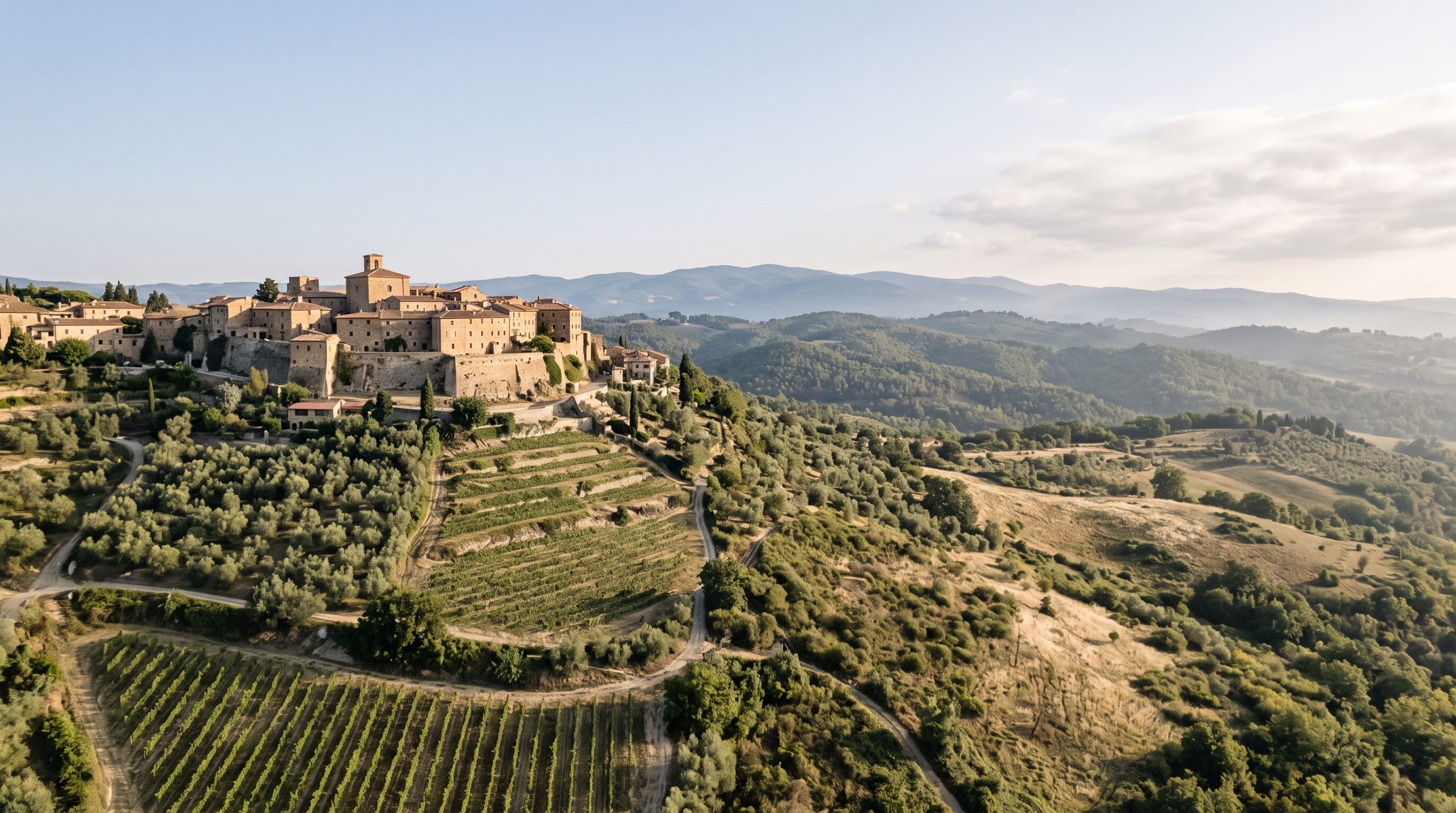
Nearly every Tuscany message that reaches us names the same valley. Cypress rows on a ridge, one small chapel on a green hill. Val d’Orcia has been on the UNESCO World Heritage list since 2004, and the citation is about Renaissance landscape design rather than pretty scenery, which tells you how deliberately those hills were arranged.
What the pictures leave out is the shape of the morning. The chapel of Madonna di Vitaleta is privately owned and closed, so you leave the car where the dirt road forks and walk ten minutes to stand on the same slope as everyone else who read the same article. Meanwhile the region around that valley runs from marble at 1,947 meters down to Etruscan roads sunk 20 meters into volcanic tuff, and almost none of it shows up in a planning thread.
We work across all of it. Here is where else in Tuscany holds a full elopement day, what each place is genuinely better at, and the constraints that settle the choice faster than any view ever will.
Our answer: the tuff country south of Monte Amiata
For most couples leaving Val d’Orcia, we point south to the tuff country around Pitigliano, Sovana and Sorano. Three rock-built towns sit within 20 minutes of each other, linked by Etruscan sunken roads with walls up to 20 meters high, and the dawn hour belongs to you. It is closer to Rome’s airports than to Florence’s.
Five regions on one planning page, and what the valley still wins
| Region | Landscape | Legal ceremony | Season that works | Best at |
|---|---|---|---|---|
| Val d’Orcia (Pienza, San Quirico, Montalcino) | Wheat hills, cypress rows, UNESCO listed since 2004 | Civil rooms in the valley comuni, plus private estates | Green from late autumn to May, gold briefly in June | Several recognizable frames inside a 20 minute drive |
| Città del Tufo (Pitigliano, Sovana, Sorano) | Tuff spurs above gorges, sunken roads cut 20 meters deep | Small comuni, and the paperwork follows the town you pick | April to early June, then late September into November | Deep shade, so the middle of the day still works |
| Volterra and the Val di Cecina | Walled hill town, alabaster workshops, the Balze cliffs | Sala del Maggior Consiglio, non-resident rate published at 500 euro, one hour of room time | March to November | A legal ceremony inside the oldest town hall in Tuscany |
| Alpi Apuane and the Garfagnana | Marble peaks to 1,947 meters, chestnut forest, UNESCO Global Geopark | Comune rooms in the valley towns, working quarries are private ground | June to October on high ground | Sea level and high altitude in one day |
| Maremma coast and the Uccellina hills | Pinewood, dune, long stretches of undeveloped beach | Coastal comuni, park ground needs its own permission | May, then mid September through October | Water, wind and everything you hear as well as see |
Coverage costs the same wherever in Tuscany you land, because team travel is included worldwide. The Adventure starts at $4,900 for one full day with a dedicated photographer or a dedicated filmmaker. The Expedition starts at $7,900 and puts both on the same day, working together. The Odyssey runs two to seven days across one or several destinations as a custom proposal, and the detail of what each experience includes is set out on the pricing page.
Now the concession, because it is a real one. Val d’Orcia is still the most efficient landscape in Tuscany. Nowhere else lets us put a cypress ridge, a hot stone pool at Bagno Vignoni and a Brunello vineyard into one day with 20 minute transfers between them, and that compactness is worth more than couples realize when the light does something unexpected and the whole timeline has to move by an hour.
The valley is also bigger than its three famous pull-offs. The UNESCO area covers Castiglione d’Orcia, Montalcino, Pienza, Radicofani and San Quirico d’Orcia, reaching from the hills south of Siena all the way to Monte Amiata. Radicofani and Castiglione d’Orcia sit inside that boundary and hardly get photographed at all. If you want the valley, we would build your morning at that end of it rather than at the roadside where the tripods gather.
Pitigliano and Sovana: cutting a day into the tuff
Pitigliano stands on a spur of volcanic tuff with houses grown straight out of the cliff, and from the road opposite it reads as one solid piece of rock. That is the frame that sells the region, and it is only the first hour. What makes this country hold a whole day is what the Etruscans cut into it.
The vie cave are roads sliced down into the tuff, some over a kilometer long, with walls rising as much as 20 meters on either side. Moss and fern on the walls, with a narrow strip of sky overhead. The San Giuseppe cut below Pitigliano is the most straightforward to reach and takes about an hour on foot out and back. It is also the reason we push couples here for late spring: at eleven in the morning, when a hilltop has gone flat and white, the sunken road is still cool and green and full of shape.
A day here has a rhythm that suits it. First light across the gorge from Pitigliano, the ceremony mid morning in Sovana, whose single paved street runs between two small piazzas with the Romanesque cathedral just beyond the houses. Then the vie cave through the harsh part of the day, and the last hour back on the ridge with the town lighting up behind you. Sorano, the third of the tuff towns, gives you the Masso Leopoldino terrace if you want a walled platform above the valley instead of a canyon.
Photographically the two regions could not be less alike, and the difference is obvious in finished work rather than in description. Val d’Orcia gives soft repeated curves and long lenses. The tuff gives verticals, hard contrast between shade and sun, ochre stone against green. Our published elopement stories and films are the fastest way to see which of those two looks like your marriage rather than someone else’s mood board.
The honest limit: the tuff will not fake a wheat hill. If the frame you have carried around for two years is a couple alone on a bare golden ridge, this is not the place that gives it to you, and we would rather tell you that now and build you a morning in the quiet end of Val d’Orcia instead. Aerials over the gorge are worth having, and they run on a permit and a time window, so we confirm both before any part of the film depends on them.
Volterra: the ceremony and the paperwork in one building
Volterra is the answer when the legal marriage has to happen on this trip and you want the room itself to mean something. Civil ceremonies are held in the Sala del Maggior Consiglio inside the Palazzo dei Priori, which the comune describes as the oldest town hall in Tuscany. The hall seats around 90 people beyond the couple and witnesses, though most of our couples bring two witnesses and nobody else.
The numbers are published, which is rarer than it should be. Volterra lists 100 euro for residents and 500 euro for non-residents, and holds the room for one hour. That hour is a planning fact, not a formality. It sets when you leave your accommodation, how long you can spend on the piazza afterwards, and whether the drive west to the Balze cliffs lands in good evening light or twenty minutes after it.
There is a second reason this town works for American couples. Alongside the sworn declaration you make in front of a United States consular officer in Italy, Italian law wants an Atto Notorio, and that can be sworn before an Italian consul in the States or, once you are in Italy, before a court official in the city where the marriage takes place. The town you choose therefore shapes your paperwork, not the other way around. We handle that sequencing as part of planning, and the groundwork is laid out in our guide to how an elopement actually comes together.
West of the walls the plateau breaks away into the Balze, a run of pale eroded cliffs that takes late sun better than anything inside the town. Fifteen minutes from a signing table to that edge is a good trade for a one hour slot.
Marble, chestnut and a coast with a summer rule
North west of everything else, the Apuan Alps rise almost straight off the sea. Monte Pisanino tops the range at 1,947 meters, the whole area is a UNESCO Global Geopark, and marble has been quarried out of these mountains since Etruscan times and cut by Renaissance sculptors including Michelangelo. Pizzo d’Uccello, the sharp one, gets called the Matterhorn of the Apuan Alps and earns it. A day here can start at sea level, reach a white marble basin above a thousand meters by late morning, and end in the chestnut forest of the Garfagnana. Working quarries are private industrial ground, so access there is arranged in advance or not at all, which is exactly the kind of thing we sort before you ever see a timeline.
The Maremma coast has one rule worth knowing early. Inside the Parco Regionale della Maremma, the park’s own visiting rules make guided visits compulsory through the summer window, normally 15 June to 15 September, with trails like the walk out to the Uccellina towers or the climb to San Rabano covered that way. In practice, a July elopement inside the park means walking with a guide on the park’s schedule, so we either build the coastal hours outside the park boundary or move the whole thing to May or late September, when the trails open up again and the water is still warm.
Why default Tuscany itineraries over-focus on Val d’Orcia
The first bad steer is the June gold. Wheat is a crop on a farmer’s calendar, not a season you can reserve. By the week the hills read gold, the harvest is days away, and after the cut the same slopes turn stubble brown and stay that way for a long stretch of high summer. It is also the busiest month on those roads. Winter and early spring give the valley a deep even green, cold clean air and low sun all day, and hardly anybody plans for it.
The second is sequence. Couples choose a view, fall for it, and then discover what their comune requires. Because the Atto Notorio route inside Italy is tied to the city where you marry, and because each comune sets its own room, hours and fee, the legal side quietly decides the region. Working from the ceremony outwards takes a week off the planning and usually improves the day.
The third is the belief that everything must sit within 20 minutes. That density is genuinely useful, and it is also precisely why the same three pull-offs are shared at the same hour by everyone who drove out for sunrise. One hour of driving south buys a region with no queue for the light.
Tell us the dates you can actually hold, where you are flying from, and whether the legal marriage has to happen on this trip. We will come back with the region we would build it in and why. Send Us a Message and we will put a shape on it.
Which region fits the days you have
Two days, flying into Rome, legal ceremony on the trip: the tuff country, every time. Rome is the natural gateway rather than Florence, the comuni are small and quick to deal with, and you can spend the second day entirely in the vie cave without repeating a single frame.
One day, flying into Pisa or Florence, and the room matters as much as the landscape: Volterra. The signing, the piazza and the Balze fit inside one afternoon and evening without a rushed drive between them.
Three days or more, and you want scale: the Apuan Alps with a night on the coast. This is the pairing where sound does real work, from the wind on a marble ridge to water on the Maremma sand, and it is the case where we would put a dedicated filmmaker on the ground alongside the photographer rather than choose between them, because half of what happens up there is not visible in a still.
A summer-only travel window: go high or go early. Altitude in the Garfagnana holds its light and its temperature far better than the wheat hills in August, and the coast works before eight in the morning. Our destination guides go deeper on the month-by-month picture for Italy.
If none of these shapes matches yours, the constraint you are carrying is the useful thing to send us. Two days instead of five, a Tuesday that has to work for reasons of your own, a parent who would rather not walk a trail. We build around constraints rather than around a favorite location, and we will tell you honestly which region and which month fits what you have.
Common questions
Is Val d’Orcia too busy to elope in now?
No, but the postcard corners are shared. The UNESCO area reaches from south of Siena to Monte Amiata and includes Radicofani and Castiglione d’Orcia, which see a fraction of the attention. We build valley days at that end and treat the famous pull-offs as a short stop rather than the spine of the morning.
Can we legally marry in a small Tuscan town rather than a city?
Yes. Small comuni hold civil ceremonies and publish their own rooms, hours and fees. Volterra, for example, uses the Sala del Maggior Consiglio at a published non-resident rate and reserves the room for a single hour. We check the current rules for the specific comune while your timeline is still being drawn.
What paperwork do American couples need to marry in Italy?
Two documents drive it. A sworn declaration made in front of a United States consular officer in Italy, and an Atto Notorio, which can be sworn before an Italian consul in the States or before a court official in the Italian city where the marriage takes place. Permit and document research is part of planning on our side.
Which part of Tuscany works in July and August?
High ground and early coast. The Garfagnana and the Apuan Alps stay workable through summer, and coastal hours before eight in the morning are excellent. Inside the Parco Regionale della Maremma, guided visits are required from roughly 15 June to 15 September, which changes how a day in the park is built.
Can we have our ceremony at the Vitaleta chapel?
The chapel is private and not open inside, and the land around it belongs to a working farm, so any frame there rests on landowner permission rather than public access. We research who to ask, and we usually find a stronger and quieter alternative within a few kilometers.
How many days do we need to combine two of these regions?
Three at least. The Apuan Alps to the tuff towns is most of a driving day across the width of Tuscany, and pairing regions only pays off when each gets its own light. That is what the Odyssey is for, covering two to seven days and one or several destinations.
Do you fly a drone in these places?
Where it is legal, safe and appropriate, yes, and gorge country like Pitigliano is where aerials add the most. Flights run on a permit and a set time window, so we confirm both in advance and never plan a film around footage we cannot guarantee.
If Tuscany is already decided
Send us the region you are drawn to and the one thing you are not willing to give up, whether that is a legal signing, a specific week, or waking up somewhere with no other cars in sight. We reply within 24 hours with an initial brochure, then a tailored proposal built around your dates. Everything between us happens in writing, on your schedule, across whatever time zones are involved. We currently have elopement dates open across 2027–2029 now.
Start Your Story and tell us which Tuscany you actually want.