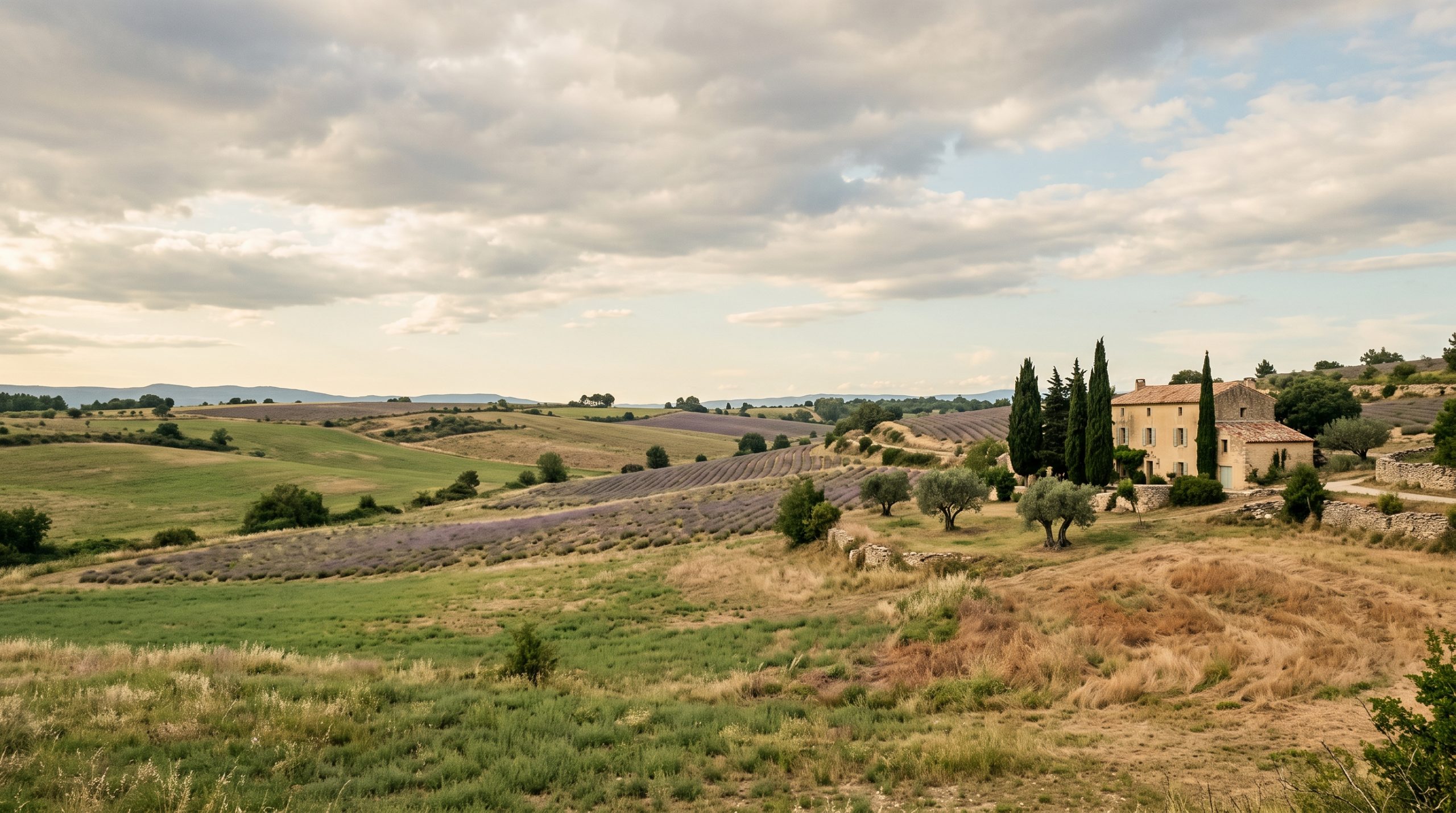
The lavender on the Valensole plateau is generally cut from around 15 July. Not thinned, not trimmed. Cut, in long straight lines, by machines that work in the cool of the night. Couples who book the third week of July for the purple picture find stubble, a strong green smell and a lot of dust, and they are always surprised, because half the internet is still showing them a frame made on 28 June.
Provence is not one climate on one calendar. Valensole is an open plateau. Sault sits between roughly 700 and 900 meters on the flank of Mont Ventoux and flowers weeks later. The Calanques are at sea level and run on their own summer rules. Choosing a month here is really choosing an altitude, an hour of sunset, and how much company you want on the road.
What follows is the light, the weather and the closures month by month, with the hours we actually build days around. If you are earlier in the process than that, our notes on how an elopement day is put together cover the shape before the date.
Why 15–30 September gets first choice
Take the second half of September. Mid-month the sun rises at 07:20 and sets at 19:52, which leaves twelve and a half hours to work with, the August crowds have gone, the heat has broken, and the midday sun sits at 49 degrees instead of straight overhead. Late June is the alternative, for lavender.
Every month, with the hour the sun goes down
Sunrise and sunset below are for Avignon on the fifteenth of each month, which is close enough for the Luberon, the Alpilles and Valensole, and within a few minutes for the coast. Clocks move forward on the last Sunday in March and back on the last Sunday in October, which is why April evenings jump so hard against March ones. Rainfall and sunshine figures are long-term averages for Avignon.
| Month | Conditions | Light, mid-month | Company | Our verdict |
|---|---|---|---|---|
| January | Coldest month, highs near 12°C (54°F), the windiest stretch of the year | 08:13 to 17:29 | Villages to yourselves | Short day, low sun through all of it |
| February | Windy, hard bright light between systems | 07:41 to 18:11 | Empty | Strong for stone villages and interiors |
| March | Green, changeable, clocks go forward | 06:54 to 18:47 | Quiet | Honest light, unreliable sky |
| April | Warm afternoons, cold dawns; Ventoux summit reachable from mid-month via Chalet Reynard | 06:58 to 20:25 | Builds over Easter | Underrated all-rounder |
| May | Fields green, wildflowers, Malaucène road to Mont Serein opens mid-month | 06:16 to 21:00 | Moderate | Long evenings, no lavender yet |
| June | Heat building, first color on the plateau in the last week | 05:58 to 21:26 | Heavy from mid-month | The best light of the year |
| July | Driest month, 26 mm across five rainy days, highs around 33°C (91°F); Valensole cut from about the 15th | 06:12 to 21:22 | Avignon full for the festival, 4 to 25 July | First week for lavender, then move uphill |
| August | Heat holds into the evening; Sault harvested in the first fortnight | 06:45 to 20:46 | Fullest month of the year | Dawn starts and altitude, or another month |
| September | Warm days, cool mornings, occasional heavy shower | 07:20 to 19:52 | Thins out fast after the first week | Our first choice |
| October | Soft all day, sun never higher than 37 degrees | 07:56 to 18:58 | Light | Best month for color in the vines |
| November | Wettest month, 101 mm over nine rainy days; Route des Crêtes shuts on the last Friday | 07:36 to 17:15 | None | Two dry days in three, and nobody about |
| December | 135 hours of sunshine in the entire month | 08:09 to 17:04 | None | The whole day behaves like golden hour |
Lavender is a three-week window, and it climbs
The single most common planning mistake in Provence is treating lavender as a season. It is not a season. It is a rolling window that starts low and moves uphill, and it is over on any given plateau in about three weeks.
The lower ground goes first. The Luberon and the Valensole plateau usually hold their strongest color from the last week of June into the first week of July, and Valensole is harvested from around 15 July. Sault, up on the Ventoux flank, is a different calendar entirely: the fields there generally flower from early July into mid-August, with the harvest starting in the first or second week of August, just before the village festival on 15 August.
Those dates move. A hot spring pulls the cut forward, a cool one pushes it back, and no two years land in the same place. What does not move is the order, and that is the part you can plan on. If lavender is the reason you are coming, the reliable shape is a date in the last days of June with the higher ground held in reserve, rather than a mid-July date that depends on a farmer deciding to wait.
It is also the strongest argument we know for spreading a Provence elopement over two days. One morning down on Valensole while the low fields are still standing, one at Sault a week later at nearly a thousand meters, is the kind of shape our multi-day coverage exists for. Team travel is included wherever the day goes, so the second location is a logistics question rather than a budget one.
August and November, and what we would suggest instead
August is the month we most often ask couples to move, and we will say why plainly. It is the fullest month of the year in Provence, the heat holds well into the evening, the lavender at Sault is cut in the first fortnight, and access to the Bouches-du-Rhône massifs, including the Calanques, is regulated by prefecture order every day from 1 June to 30 September. Late September gives you the same warm stone and the same swimmable sea with a fraction of the traffic.
If your date is already fixed in August, that is not a problem, it is a brief. We build August days at altitude and at the edges: a 06:45 start when the air is still cold, the high ground around Sault and Ventoux through the middle of the day, and the last hour before a 20:46 sunset back down on limestone that is throwing warm light back at you. It works. It just has to be built that way from the start rather than improvised on the morning.
November is the other one. It is the wettest month in Avignon, 101 mm across about nine rainy days, sunset comes at 17:15, and the one-way section of the Route des Crêtes above the Verdon closes on the last Friday of the month. Mid-October holds almost everything November is reaching for, with sunset at 18:58 and color still in the vines. February is the other swap worth considering, when the villages are empty and the light is hard and clean.
A 69 degree sun in June, a 23 degree sun in December
The number that changes your photographs and your film more than temperature ever will is the height of the sun at midday. In mid-June it reaches 69 degrees over Provence, which is close enough to overhead that the middle six hours of the day are functionally unusable for anything except shade, water and interiors. In mid-December it tops out at 23 degrees. The sun never really gets up, and the entire day carries the long shadows and warm angle that most places give you for forty minutes.
That flips the working day completely. In June you plan around a 05:58 sunrise and a 21:26 sunset and simply accept that the day has a hole in the middle of it. In December the whole of the 8.9 hours between sunrise and sunset is workable, and the sun stays below 10 degrees for roughly the first seventy-eight minutes after it comes up, which is the longest soft window of the entire year.
September and October sit in the useful middle. The noon sun is at 49 degrees in mid-September and 37 degrees in mid-October, so midday stops being a write-off and a ceremony at 18:30 still finishes with an hour of warm light behind it. Provence also does something specific with reflected light that colder countries do not: the pale limestone of Gordes and the Alpilles, and the ochre around Roussillon, bounce light upward into faces well after the sun has left the ground. You can see how that reads in the finished work in our galleries and films, which is a more useful way to compare months than any description we could write here.
The Route des Crêtes, the Ventoux summit and the summer gates
Provence has fewer hard closures than an alpine destination, but the ones it has land on exactly the locations couples ask for.
- Route des Crêtes, Verdon. The 24 km panoramic loop from La Palud-sur-Verdon serves fourteen belvederes over the canyon. Its one-way section closes from the last Friday in November to the last Friday in March. The best-known lookouts, Trescaïre, Carelle and Dent d’Aïre, stay reachable through the winter.
- Mont Ventoux summit, 1,910 m. The summit is generally reachable from mid-April on the Bédoin and Sault side via Chalet Reynard, and from mid-May on the Malaucène side through Mont Serein. Winter equipment rules apply on the mountain from 1 November to 15 March.
- Calanques and the Bouches-du-Rhône massifs. Access is regulated by prefecture order every day from 1 June to 30 September, with the following day’s conditions published the evening before. The roads down to Sormiou, Morgiou and Callelongue close to cars from the Easter holidays, at weekends first and then daily through the summer.
None of this is a reason to avoid a season. It is a reason to know which alternative is already written into your timeline before you land, and it is why permit research and access checking sit inside the planning rather than beside it. Our destination guides go further into individual locations. If you have a month in mind and want to know what is open in it, Check Your Date and we will tell you straight.
What we do when the mistral arrives
The mistral is a cold northerly that funnels down the Rhône corridor, most often in winter and spring, and it usually runs for two or three days once it starts. Average wind speeds in Avignon peak in January and February at around 22 km/h. It is not a reason to skip those months. It is the single thing your timeline has to be able to answer.
Our answer is written before anyone flies. Every hour of the day has an alternative attached to it, and the alternatives are chosen by wind direction rather than by preference. A hard northerly means we work the south-facing lanes and the lee side of the hill villages, olive terraces below the ridge line, cloisters and courtyards, and we keep the exposed plateau for a calm morning. A wet forecast means we look at the actual shape of the day, because even November, the wettest month here, averages nine rainy days out of thirty. Two days in three are dry.
The ceremony hour is the other lever, and it is the one couples forget they own. With sunset at 19:52 in mid-September there is room to move vows from 18:30 to 16:00, or to the following dawn, without touching anything else in the plan. Because we handle photography, film and planning as one service, moving that hour takes one message rather than a negotiation between vendors who met that morning.
Season decides how much that matters. In June a 15.5 hour day lets a photographer work slowly and a filmmaker circle the same moment twice. In December you have 8.9 hours and one long low block of good light, and having a dedicated photographer and a dedicated filmmaker working the same moment at once means you walk the ridge once instead of three times. Coverage is one price wherever in Provence the day goes, with team travel included, and the detail sits on our pricing page.
Common questions
When is the lavender actually out, and when is it cut?
The Luberon and Valensole hold their best color from roughly the last week of June into the first week of July, and Valensole is harvested from around 15 July. Sault, at 700 to 900 meters, flowers from early July into mid-August and is cut in the first half of August. The dates shift with the spring, so we build around the order rather than a fixed day.
Is August too hot for a Provence elopement?
No, but it changes the shape of the day rather than just the clothing. August is the busiest month, the heat holds late, and the Bouches-du-Rhône massifs run on a daily access decision from 1 June to 30 September. We start around 06:45, spend the middle hours high up near Sault or Ventoux, and come back down for the last light before a 20:46 sunset.
What do you do if the mistral is blowing on our date?
We move, and we already know where. Each block of the timeline carries a wind-direction alternative within a short drive, usually a south-facing village lane, an olive terrace or a courtyard that is out of the northerly. The ceremony hour can move too, which is normally the simplest fix of all.
Can we legally marry in Provence, or should we sign at home?
A French civil marriage has to take place at a mairie in a commune where one of you has genuinely lived for a month before the banns go up, which rarely suits a traveling couple. Most people we work with complete the legal paperwork at home and hold the real ceremony here, with their own vows and their own celebrant, in the place they chose.
Is the Verdon Gorge worth planning in winter?
Yes, with one adjustment. The one-way section of the Route des Crêtes is closed from the last Friday in November to the last Friday in March, so the full 24 km loop is out, but Trescaïre, Carelle and Dent d’Aïre are still reachable and the canyon is almost entirely yours. Winter light here is low all day, which suits the scale of the place.
Which month gives the best light for photography and film in Provence?
Late September and October for balance, December for pure quality. Mid-September gives twelve and a half hours of daylight and a 49 degree noon sun, so nothing is off limits. December gives only 8.9 hours, but the sun peaks at 23 degrees and the whole day behaves like the last hour of a summer evening.
Picking your month, and what happens after that
Tell us the month you are drawn to, or the two weeks your work will let you take, and we will tell you honestly what that window gives you in Provence and what it does not. If a shift of ten days would put you in front of standing lavender instead of cut fields, we will say so. Everything runs in writing, with a reply and an initial brochure within 24 hours, no calls and nothing to schedule. Highlights reach you five days after the day itself, and the full gallery or film within three weeks. Our calendar is currently open across 2027, 2028 and 2029. Tell Us Your Story.