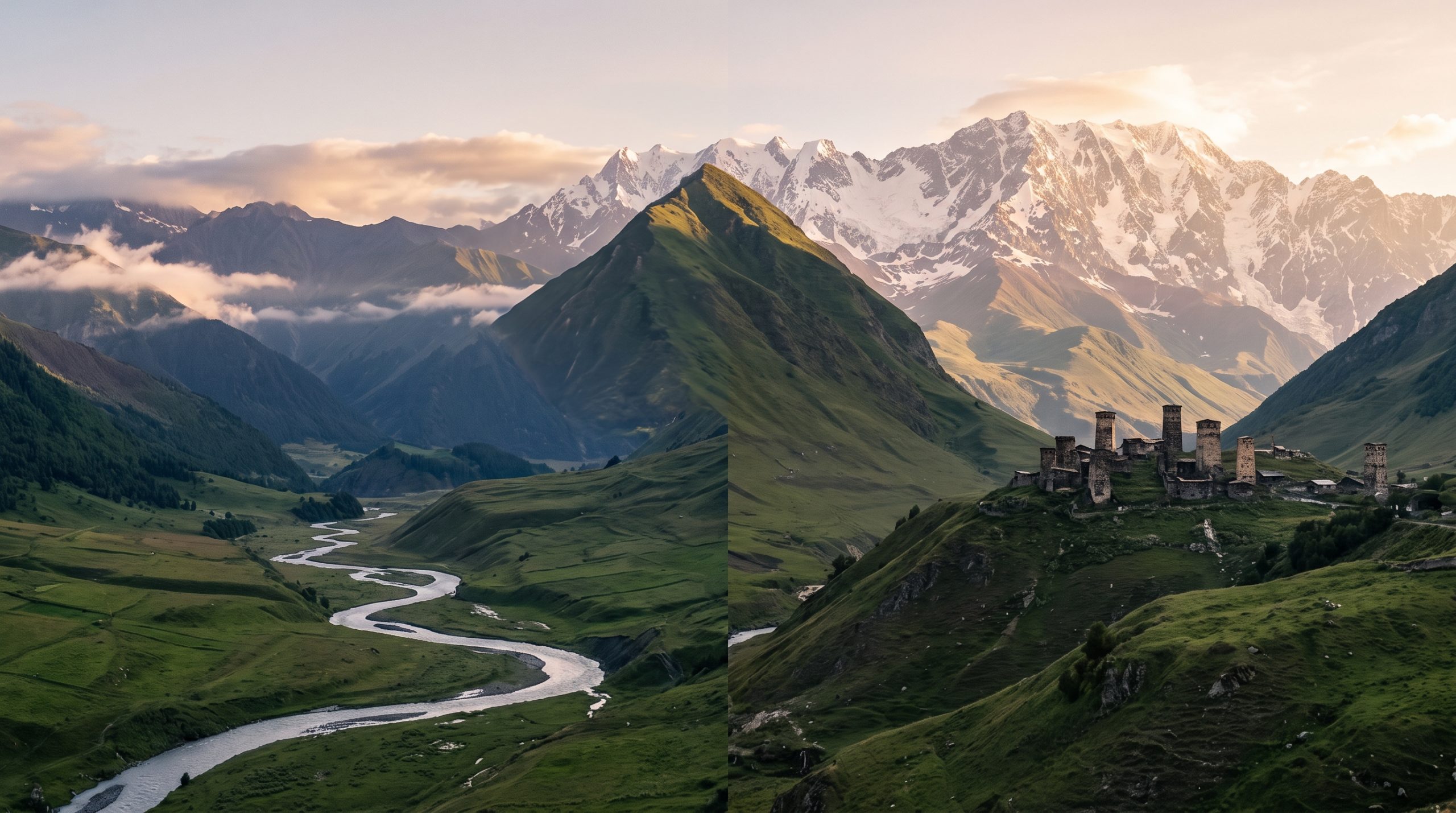
The 4×4 that grinds up the track to Gergeti Trinity Church costs somewhere around 100 lari for the whole vehicle and takes about a quarter of an hour. That is the kind of figure couples find first when they start pricing a Georgia elopement, and it is close to the least useful number available.
The numbers that actually shape the day are these. The church stands at 2,170 metres under Kazbek, roughly 150 kilometres of Georgian Military Highway from Tbilisi, on the far side of a pass that tops out at 2,395 metres. In late September the sun officially clears the horizon at Stepantsminda at about 6:46 a.m., but the ridge east of the village holds it back well past that, so you stand in blue shade watching the snow on Kazbek’s face already burning orange above you. Almost every planning decision in Khevi comes out of that gap between printed sunrise and real light.
One more thing worth knowing before you price anything. The legal marriage does not happen on the mountain. It happens at a Public Service Hall, both of you present, two adult witnesses in the room, and Georgia’s civil registry charges nothing for a registration without ceremony services. The costly part of eloping in Georgia is never the wedding itself. It is the road, the hours of light you can reach, and who is standing on the ridge with you when the wind picks up.
Where the number lands for a Caucasus elopement
We photograph, film and plan elopements across Georgia, from Kazbegi and Khevsureti to Svaneti. One full day with a dedicated photographer or a dedicated filmmaker starts at $4,900. One full day with both, working as a pair, starts at $7,900. Team travel to Georgia is included. Permit fees, lodging and your celebrant are paid directly.
First light hits Kazbek before it reaches the village
What follows is a late-September shape, because that is the month we argue for when a couple asks us cold. Sunrise at Stepantsminda lands near 6:46 a.m. and sunset near 7:03 p.m., which puts both ends of the day inside a twelve-hour frame and means nobody has to be awake at four in the morning to catch anything.
5:45 a.m. Out of the guesthouse in Stepantsminda with coffee in hand. The church is three kilometres away and about 300 metres above the village, ten to fifteen minutes in a 4×4 on a track that a hire car has no business attempting.
6:10 a.m. On the grass above the church while the valley is still cold blue. Civil dawn is around 6:18 a.m. and Kazbek lights from the summit down, so for twenty minutes the mountain is doing something the ground is not. This is the single most useful piece of local knowledge on the page: shoot the mountain first, shoot the couple in soft shade, and wait for the sun to walk down the slope toward you.
7:00 a.m. Vows on open ground with the belltower in frame. The wind at 2,170 metres almost always gets up as the sun arrives, which is a gift for a veil and a problem for audio, and both of those are solved in advance rather than negotiated on the spot.
8:15 a.m. Back down for breakfast and an hour of nothing. We build that hour in deliberately. A day with no gap in it photographs like a timetable.
12:30 p.m. Out along the Sno valley, or higher into Juta under the Chaukhi towers, where the last stretch of road again wants four driven wheels. Kazbegi rewards couples who leave the famous viewpoint behind for a few hours. The Gergeti ridge at eleven in the morning belongs to day-trip vans out of Tbilisi, and it is flat, crowded and unremarkable at exactly that hour.
4:30 p.m. Slow walking hour in the upper valley, jackets on, nobody in the frame but you.
6:20 p.m. Back on the Gergeti side of the valley for the last forty minutes of direct sun, then civil dusk at about 7:32 p.m. with the whole massif going pink behind the church.
Late June is a different animal. Civil dawn arrives around 4:48 a.m. and light holds until roughly 9:18 p.m., so you are handed more than sixteen usable hours. That sounds generous until you try to stay present for all of it, which is why a June timeline gets two long rest blocks and two working windows rather than one continuous push.
| Month | Sunrise at Stepantsminda | Sunset | What it does to the plan |
|---|---|---|---|
| Mid-May | 5:40 a.m. | 8:16 p.m. | High tracks are still opening. We build on valley floors, rivers and lower meadows. |
| Late June | 5:23 a.m. | 8:43 p.m. | Green meadows and wildflowers, an early start, and a day split into two blocks. |
| Late September | 6:46 a.m. | 7:03 p.m. | Colour in the birches, a twelve-hour frame, the gentlest version of the morning. |
| Mid-October | 7:08 a.m. | 6:28 p.m. | Fresh snow returning to the ridges. Short, simple, cold, and often the best film. |
Svaneti runs about seven minutes later than Khevi on both ends of the day, which sounds trivial and is not when your ceremony is timed to the moment light leaves the Ushguli towers. If you want to see how these hours read once they are finished, our published galleries and films are the honest version: the blue-shade frames, the twenty seconds of alpenglow, the walking shots nobody posed for.
If you already have dates in mind for 2027, tell us the week and we will tell you what the light is doing. Check Your Date.
Two cameras out of the same 4×4
Here is where a Georgia elopement differs from most places we work. Access to the good ground is narrow and shared. One track up to Gergeti. One vehicle. One window of light on the mountain before it flattens out. If your photographer and your videographer were hired separately and meet you at breakfast, that window is where the mismatch shows, because the two of them are solving different problems with the same twenty minutes and no agreed plan for who stands where.
We are eight people, four photographers and four filmmakers, and photography, film and planning are one service rather than three bookings. On the Expedition, a photographer and a filmmaker travel together, ride up the same track, and split the ridge by design. The filmmaker sets a long lens on Kazbek from forty metres back on the slope while the photographer works at two metres in close, and neither of them is asking the other to move, because that division was drawn weeks earlier in the timeline.
The specifics of this landscape make that matter more than it does on a beach. Kazbek needs distance and patience to read on film, and a film that only lives at portrait range makes a five-thousand-metre mountain look like a hill. Meanwhile the vows themselves happen in wind, at altitude, with your voices competing against it, which is why the Expedition carries professional audio for vows and for the quiet things people say when conditions allow it. Aerials add the third scale, the one that shows the church as a dot on a shoulder of grass with the glacier above. Drone footage is included where it is legal, safe and appropriate, and in Georgia that means the aircraft is registered with the Civil Aviation Agency and the flight fits the category it is flown under. We confirm both before the film is planned around them.
There is a quieter benefit to a team of eight. Somebody is always in reserve, and there is always a second camera on the ground rather than one person carrying the entire record of your morning.
Planning, permits, drone and delivery windows
Every experience we run in Georgia, at either level of coverage, includes all of this:
- Destination and location design, including the valleys most itineraries skip.
- A custom timeline built around real light and real travel time on the Georgian Military Highway, not an idealised drive.
- Permit research and logistics guidance, so you know which permissions your day needs and in what order.
- Weather alternatives and backup planning for the days the Caucasus decides otherwise.
- Drone footage where it is legal, safe and appropriate.
- Professional audio for vows and meaningful moments on the Expedition, where conditions allow.
- Team travel worldwide: flights, accommodation and ordinary travel for the assigned team, with no long-haul surcharge for Tbilisi.
- Highlights delivered in 5 days, and the full gallery or film in 3 weeks.
New to the mechanics of an elopement rather than a wedding, we keep the fundamentals plain in our guide to how eloping actually works, and the regional detail sits in our destination guides.
The costs that are yours, in lari
Georgia is inexpensive on the ground and that is genuinely good news for your total. The lari has run a little under three to the dollar for the past few years, so the roughly 100 lari 4×4 charter that gets you to 2,170 metres is somewhere in the mid-thirties in dollars. Holding a vehicle for a private pre-dawn run rather than sharing the daytime shuttle costs more than that, and it is still one of the smallest lines in your budget.
What sits outside our coverage in this country, specifically:
- Civil registration itself. A standard registration at a Public Service Hall branch, without ceremony services, is free. The registry’s ceremony options carry a service fee in lari, paid when you submit documents.
- Any government, venue or landowner permit fees your locations require. The research and the guidance are ours, the fees are yours.
- Accommodation in Stepantsminda, Mestia or Tbilisi, your celebrant, flowers, dinner and anything else you want on the day.
- Unusual transport. The 4×4 charter up the Gergeti track, a light aircraft from Natakhtari into Mestia instead of most of a day on the road, a helicopter, a mountain guide for glacier ground.
Everything else, including getting our team to Georgia and keeping them there, is inside the fee. The two starting figures and what separates them sit on our pricing page, along with the Odyssey, which runs two to seven days across one or several destinations and is quoted as a custom proposal.
The morning Kazbek stays in cloud
The fee is fixed when you sign, and it does not move when the mountain does. This is the worry we hear most often about Kazbegi, and it deserves a real answer rather than reassurance.
The answer is structural. We bias the ceremony toward the first hours after dawn, when the massif is most often clear of the cloud that builds through the afternoon. We hold two alternatives inside an hour’s drive, usually the Sno valley and the road toward Juta, both of which read beautifully with the high peaks hidden and a low ceiling sitting on the ridgelines. And we write the timeline with a movable ceremony hour rather than a fixed one, so shifting it by ninety minutes on the morning is a decision, not a crisis. Kazbegi in cloud is not a lost day. It is a quieter and more intimate film, and some of the frames we like most were made on days the mountain never appeared.
How a Georgia cost enquiry becomes a signed date
- Send the inquiry form with your dates, your destination and roughly what you picture.
- We reply within 24 hours with an initial brochure.
- We build a tailored proposal around your dates, your locations and the coverage that fits.
- You sign the contract and pay a 30% retainer. The rest of the payments are set out in the proposal.
- Planning begins: locations, timeline, permit research, transport, weather alternatives.
- We shoot the day, then deliver highlights in 5 days and the full gallery or film in 3 weeks.
Dates are currently open across our 2027, 2028 and 2029 Georgia seasons, and 2028 dates in the September and October windows are the ones couples ask about first.
Couples who do well in Khevi
The Caucasus suits people who are content to be awake before the village is, comfortable walking on uneven ground at altitude, and relaxed about a plan that changes shape at breakfast. You do not need to be a mountaineer. You do need to be willing to put on a jacket over the dress between locations and to accept that the good light is early and the good ground is a track away from the car park.
If a 5 a.m. alarm sounds like the opposite of a good morning, say so in your first message and we will build you a late-September or October day, where sunrise is after 6:46 a.m. and the whole thing fits in twelve civilised hours. If you want green meadows and long evenings instead, June is the month and the early start comes with it. If steep ground is not for you, Svaneti’s tower villages and the meadows below Ushguli give you the Caucasus at walking pace. Tell us what you actually want out of the day and we will shape it around that, or tell you honestly which month or which valley fits it better.
Common questions
Is a marriage registered in Georgia valid back home?
Georgia registers civil marriage through its Public Service Hall system. Both of you apply in person, both must be at least 18, registration through a representative is not allowed, and two adult witnesses attend. If either of you has been married before, bring the document that ended that marriage. The certificate can then be apostilled so it travels, and we set out the order of those steps in your proposal.
Do we pay for your flights to Tbilisi?
No. Team travel is included worldwide, which means flights, accommodation and ordinary travel for the assigned team, with no separate long-haul figure for Georgia. That is one of the reasons our number looks the same for Kazbegi as it does for a destination three hours from home.
How do you get to Kazbegi, and what does that part cost us?
It is roughly 150 kilometres from Tbilisi on the Georgian Military Highway, about three hours, over the pass at 2,395 metres. Our transport is our cost. Yours is your lodging in Stepantsminda and the 4×4 up the Gergeti track, which runs around 100 lari for the vehicle. In spring the Gudauri to Kobi stretch can work on restricted midday hours while crews are on it, so we drive that section early or late.
Can we hold the ceremony inside Gergeti Trinity Church?
Gergeti is a working monastery before it is anything else, so we plan vows on the open ground outside, with the 14th-century church and its belltower in frame. If you go inside, women wear a dress with hair covered and men do not enter in shorts. Any permissions your locations need are part of the permit research we do for you.
Can you fly a drone over Kazbegi?
Aerials in Georgia sit under the Civil Aviation Agency’s framework: the aircraft is registered and the flight has to fit the category it is flown under. We confirm the registration and the window before we plan a single sequence around aerials, and drone footage is included wherever it is legal, safe and appropriate.
Which month gives the calmest version of a Kazbegi day?
Late September. Sunrise near 6:46 a.m. and sunset near 7:03 p.m. means you get both ends of the light without a pre-four start, the birches are turning, and the summer vans have thinned out. Mid-October brings sunrise at 7:08 a.m. and snow back on the ridges, which films beautifully.
Does the price change if six people come with us?
No. Our fee does not change with guest count. Guests affect access, permits, transport and the shape of the timeline, so tell us the number early and we plan the vehicles and the ground around it.
How soon do we see the photographs and the film?
Highlights reach you 5 days after the day itself. The full gallery or film follows within 3 weeks.
Writing to us from eight time zones ahead
Tbilisi runs eight or nine hours ahead of the US East Coast, which is exactly why everything we do with you happens in writing. You send a message when it suits you, we reply within 24 hours with a brochure, and the proposal, the timeline and every question about the Gergeti track arrive as something you can read twice and forward to each other. No coordination of clocks required.
Tell us the week you are thinking about, whether you want the mountain or the towers, and how early you are honestly willing to get up. We will come back with a plan for that specific week of light in the Caucasus. Tell Us Your Story.