The first thing that catches couples out about marrying in Crete has nothing to do with Crete. It is a stamp. Greek town halls need to see the date and place you entered the Schengen area printed in your passport, and without it they will not marry you. A flight routed through a hub where nobody reaches for the ink can undo months of paperwork, so that is the detail we check before we check anything else.
The second is the clock. In the last week of June the sun comes up over Chania at about ten past six and does not go down until twenty to nine, and it rises well north of east, which means a north-facing headland can take its sunrise over water and its sunset over water on the same day. That is fourteen and a half hours of daylight with a hard, vertical, unusable middle.
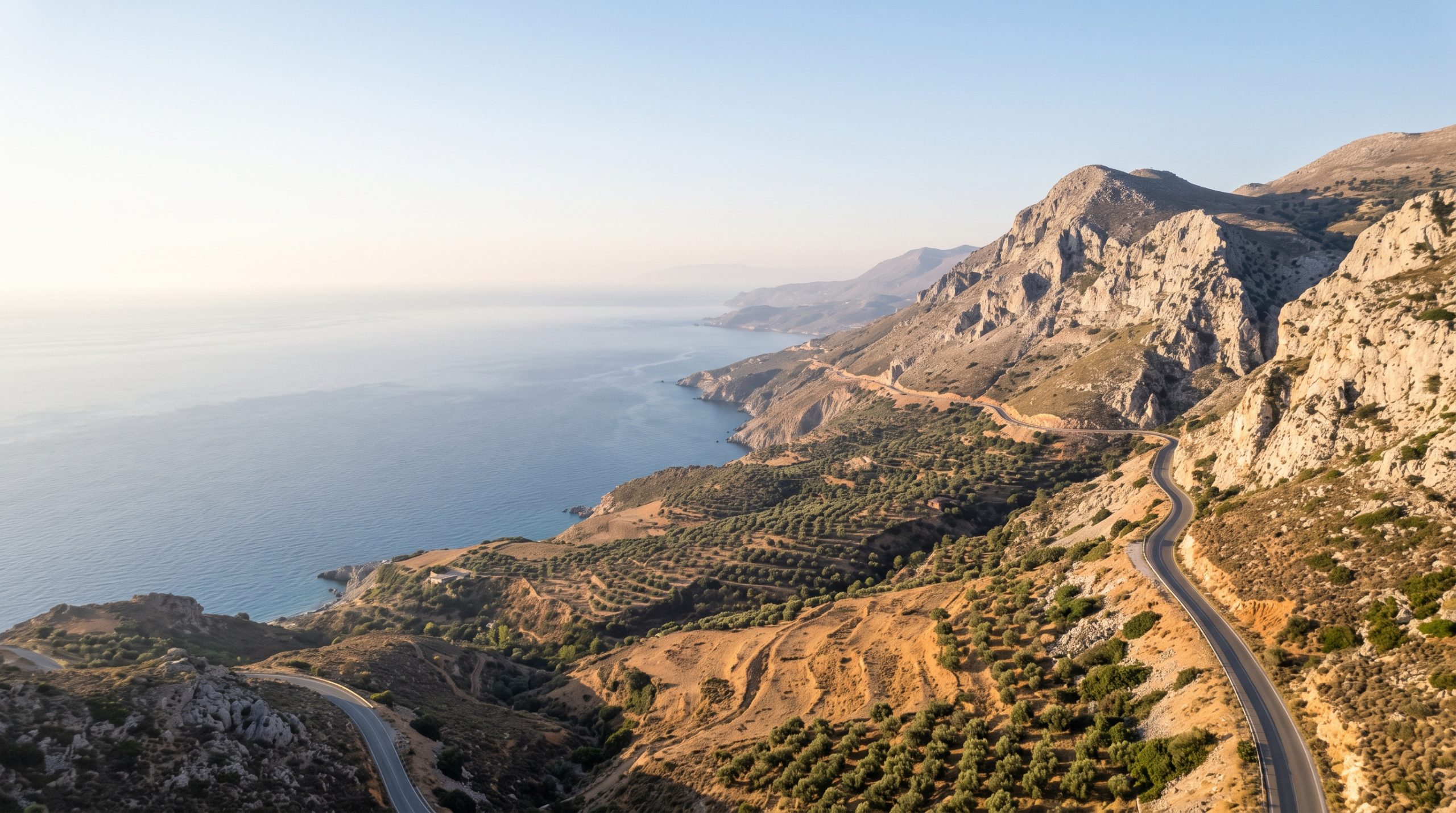
The third is the ground. Balos lies roughly 52 km from Chania, and the last eight of those kilometres are an unsurfaced track across the Gramvousa peninsula, followed by a walk of about a kilometre and a half down to the sand. Most timelines written for that lagoon give the track ten minutes. We give it twenty-five, and we are still standing on the sandbar before there is any colour in the sky.
The cost of a Crete elopement, in one paragraph
We photograph, film and plan elopements across Crete, from the Gramvousa peninsula to the Sfakia coast. Coverage starts at $4,900 for one full day with a dedicated photographer or filmmaker, and at $7,900 for a photographer and filmmaker working together. Team flights and accommodation are included. Permit fees, celebrant, lodging and charter transport are yours.
A June day in west Crete, 4:40am to 9:10pm
Crete gives you a very long day and then takes the middle of it away. Between eleven and five in high summer the sun sits almost overhead, the shadows go short and ugly, and the island sensibly stops. So we do not build one continuous day here. We build two ends of one, and we protect the gap in between as seriously as we protect the light.
A west Crete day in late June usually runs like this. Out of the room at 4:40 with coffee in the car. Onto the Gramvousa track by twenty past five, moving slowly, because that surface rewards patience and punishes a schedule written in a spreadsheet. First light at about 5:40, which is when you start down the path, so the walk happens in cool air and you arrive with your breath back. Sunrise at roughly 6:10, coming in from the northeast, straight down the length of the lagoon.
Vows somewhere between seven and eight, on wet sand, with nobody else in the frame. Back up the path by half nine before the heat sets in properly. Breakfast in Kissamos. Then six hours that belong to you: sleep, swim, eat, drive south. We reappear around half five for the second half, and the second half is where the film usually finds its ending. Golden light from about half seven, sunset at twenty to nine, and a last usable frame at around ten past nine when civil twilight closes.
Move the same day into the shoulder months and everything compresses in your favour.
| When | Sunrise at Chania | Sunset | What it changes |
|---|---|---|---|
| Mid-May | about 6:20am | about 8:20pm | Warm sea, thin crowds, hillsides still green. The best all-round compromise on the island. |
| Late June | about 6:10am | about 8:40pm | Longest day, sun rising and setting north of east and west. Earliest alarm of the year. |
| Mid-September | about 7:05am | about 7:30pm | Sunrise almost due east, sea at its warmest, a civilised start time. |
| Mid-October | about 7:25am | about 6:55pm | Sun rising south of east, long low light all day. Clocks go back on the last Sunday, pulling sunset to around half five. |
That last column is the whole argument for a shoulder-season Crete elopement. In October the sun never climbs high enough to ruin the middle of the day, so a single continuous timeline becomes possible and the alarm goes off at a reasonable hour. What you trade is water temperature and daylight length. We will tell you plainly which of those two things your day actually needs.
The objection we hear most about Crete is crowds, and it deserves a straight answer rather than reassurance. We are not sentimental about famous places. Elafonissi at noon in August is a car park with a beach attached, and the Balos lagoon at one in the afternoon has several hundred people in the shallows and a line of hulls off the point. If the quiet version is the image in your head, it was made at 6:40am, and the reason it looks like that is the hour, not the lens.
The arithmetic is on your side. Boats leave Kissamos in the morning, spend an hour reaching Gramvousa and another twenty minutes running down to the lagoon, so the crowd arrives in the middle of the day. Arrive at first light and you have the place to yourselves for three hours. Elafonissi now works the same way: cars stay out of the protected Natura 2000 zone, you leave the vehicle in the designated lots and walk in across the dunes on boardwalks, which quietly turns the beach into a place you have to want to reach.
The other lever is the island itself. Crete runs about 260 km end to end and is narrow enough to cross in a morning, so a north coast that is unworkable at eight can be swapped for the south coast around Sfakia by mid-afternoon. That is not improvisation. It is a second location named in your timeline weeks earlier, with the drive time already measured.
If you have a month in mind and want to know what the light and the boat traffic are doing that week, Check Your Date and we will tell you what we would build.
Wind, audio and two cameras on the same headland
From June to September a dry northerly called the meltemi runs down across the Aegean, strongest through July and August, easier in June and September. It does two useful things and one inconvenient one. It keeps the heat bearable, it flattens the water on the lee side of the island, and it turns any vow spoken on an exposed headland into a rush of noise on the recording.
This is where photography and film coming from one team stops being a slogan and starts being the reason your film has your actual voices in it. On an Expedition day a dedicated photographer and a dedicated filmmaker work the same hour, and professional audio for the vows is part of it wherever conditions allow. In Crete, that phrase gets decided in the forty minutes before you speak: which side of the rock you stand on, how low you sit, whether the microphone rides on a lapel or stays just out of frame, whether we move you thirty metres into shelter and lose the wide view to keep the words. One person holding both jobs cannot make that call and also be watching your face at the moment your voice catches.
Then there is the light budget. On a Cretan headland at sunrise you get somewhere near twenty-five genuinely good minutes before the contrast goes hard. Somebody working alone spends a third of that window swapping a stills body for a gimbal, and the frames lost are always the same ones: the walk in, the first look, the unrepeatable middle of a first kiss. Two people means the photographer stays on your faces while the filmmaker builds the wide shot behind them, and neither of them is asking you to do it again.
Aerials over a lagoon are the frames people remember, and in Greece they run on a process rather than a whim. Drone work sits under civil aviation registration and a check of the published flight zones, and archaeological sites, monuments and monasteries need their own permission on top. We confirm the window and the zone before the day is designed around them, we fly where it is legal, safe and appropriate, and our professional equipment is declared to customs on the way into the country, which is our paperwork and not yours.
What all of that produces is easier to look at than to describe, so the galleries and films in our stories are the fairest test of whether our eye matches yours. Look at how the wide frames handle empty space, and at how the films sound.
What travels with us on a Crete elopement day
There are eight of us: photographers Serg, Alex, Alex and Viktoria, filmmakers Lara, Mike, Anthony and Stas. That number matters on an island where the plan can change with the wind direction, because it means there is always a second camera on the ground and a colleague in reserve. Every Crete experience includes:
- Destination and location design across the island, built around light, coastline aspect and real driving time between two coasts
- A custom timeline written to the hour, including the walk-in times that most plans forget
- Permit research and logistics guidance, including the ceremony slot your chosen municipality can actually give you and the order the documents need to happen in
- Weather alternatives and backup planning, with a named second location on the sheltered side of the island
- Drone footage where it is legal, safe and appropriate
- Professional audio for vows and meaningful moments on the Expedition, where conditions allow
- Team travel worldwide: flights, accommodation and ordinary travel for the assigned team, with no European or long-haul distinction
- Highlights delivered in 5 days, and the full gallery or film in 3 weeks
- A fee that does not move with your guest count. Guests change access, permits, transport and timing, not the price
What lands on your card, and what does not
Our figures cover the team getting to Crete and being there properly. Flights, accommodation and ordinary travel for the assigned photographer and filmmaker are inside the number already, in every destination we work, so there is no island surcharge and no long-haul line item waiting for you. Full detail on the three experiences, the Adventure, the Expedition and the Odyssey for two to seven days across one or several destinations, sits on our pricing page.
What Crete adds on top is third-party, and we quote it in euros because euros are what you will hand over at the desk.
| Cost | Who pays | What to expect |
|---|---|---|
| Municipal civil ceremony fee | You | Set by each town hall, not by the country. Some municipalities charge a modest fee for a ceremony inside the building and considerably more for an approved outdoor spot |
| Apostilles and certified translations | You | Priced per document. Translations into Greek must be done by a Greek translator, which is why we start this early |
| Samaria Gorge entry | You | A national park with a per-person entrance fee, currently around 10 euros a head |
| Balos by boat from Kissamos | You | Roughly 25 euros a seat, plus a small per-person lagoon fee collected at boarding |
| Accommodation, celebrant, flowers, dinner | You | Entirely a function of the day you want. We are happy to advise on the shape of it |
| 4×4 charter, private boat, mountain guide | You | Quoted per charter when the day needs one, and often it does not |
| Permit research, logistics, timeline, backup plan | Us | Included. The research and the paperwork chasing are ours; only the government and landowner fees themselves are yours |
We do not publish an exchange rate for those figures, because nobody honestly knows what the euro will be doing by your date. What we can promise is that the euro items are the only ones that arrive after our proposal, and that they appear in your timeline by name rather than as a surprise.
From first email to a signed date
- You send the inquiry form with your rough dates and the shape of day you have in mind.
- We reply within 24 hours with our initial brochure and a few real questions about the day.
- We put together a tailored proposal for your dates, your coastline and your paperwork route.
- You sign the contract and pay a 30% retainer.
- Planning begins: locations, timeline, permit research, the municipal ceremony slot, the backup coast.
- The remaining payment schedule is set out in your proposal, so you know it before you commit to anything.
We are currently taking Crete elopement bookings for 2027 through 2029. Crete paperwork is the part that rewards early starts most: the U.S. Embassy in Greece is blunt that the bureaucratic route to a Greek marriage certificate can take several weeks, and that local requirements come from the town hall where you marry rather than from any national rulebook. Our planning fundamentals cover the sequence that applies wherever you go.
Early risers, dirt roads and a plan that moves
Crete is generous to three kinds of couple. Those who will get up at 4:40 for one morning of their lives. Those who are comfortable walking twenty minutes downhill on loose ground in good shoes, carrying the dress rather than wearing it. And those who can hear the words “the wind has gone north, we are going to the south coast” at seven in the morning and find that exciting rather than upsetting.
If the 4:40 alarm is where you stop reading, that is genuinely useful information and not a problem. A mid-October day starts at twenty-five past seven, keeps low light for most of the afternoon and still gives you an hour of gold before a sunset just before seven. The same island, a completely different pace. Tell us that a slow morning matters more to you than the longest possible day, and we will build for October instead of June, or move you east toward the Mirabello coast where the shape of a day is gentler.
Guest numbers work the same way. Two of you on the Gramvousa track is a different logistical animal from twelve, and the fee does not change either way, but the access and the timings do. Say the number early and the timeline absorbs it. Our destination guides are a reasonable place to test whether Crete is really your island or whether something else has been quietly pulling at you.
Common questions
Can we legally get married in Crete as Americans, or should we do the paperwork at home?
Both work. Greece has no residency requirement and a civil ceremony there is a legal marriage, valid at home. It is also slower: documents go in person to the town hall where you marry, each foreign partner files a separate set, and the process can run several weeks. Many couples marry at home and hold the ceremony here.
How far ahead do we need to start the Crete paperwork?
Earlier than feels necessary. Birth certificates need apostilles, and translations into Greek must be produced by a Greek translator, so the chain has several links outside your control. We build the document order into planning as soon as your date is signed, and we work to the specific town hall you have chosen rather than a generic checklist.
Is Balos actually reachable for an elopement, or is it too much effort?
It is reachable and it is effort, which is exactly why it is empty at sunrise. Eight kilometres of unsurfaced track at walking pace, then about a kilometre and a half downhill to the sand. We build the timings around that, in daylight, with a sensible margin. Couples who like the walk love the result.
What happens if the wind blows out our beach on the morning?
We move to the plan we already wrote. The meltemi comes from the north, so the sheltered ground is south, and Crete is narrow enough to cross in a morning. Your timeline names the alternative coast with drive times attached before you ever land, which is why the decision at 7am takes about four minutes.
Do we need a permit to fly a drone over our Crete elopement?
Aerial work in Greece runs on civil aviation registration and a check of the published flight zones, and heritage sites and monasteries require separate permission. That research and those requests are part of the planning we do. We fly where it is legal, safe and appropriate, and we tell you in advance which locations will and will not give you aerials.
Is Crete too busy in August for an elopement?
Not at 6am, and very much so at 1pm. August is the peak of both crowds and the meltemi, so August days get built tight: first light on the coast, a long break, then evening on the sheltered side. If your dates are flexible, September and October give you the same water with a quieter island.
Can two women or two men marry legally in Crete?
Yes. Greece recognised same-sex civil marriage in February 2024, and a good deal of the elopement writing online has not caught up with that. The paperwork route is the same one every foreign couple follows, and the town hall you choose still sets the local requirements.
How soon do we see the photographs and the film?
Highlights reach you 5 days after the day itself, while you are probably still on the island. The full gallery or film follows within 3 weeks. Nothing about that changes with the destination, the guest count or how far the team travelled to get to you.
Choosing your morning in Crete
Every good Crete day we have built started with a couple telling us something honest: that they wanted the lagoon to themselves, or that they would rather sleep until seven and take the low October light, or that the vows mattered more than the view and should happen where they could be heard. We can plan around any of those. We cannot guess them.
The full planning trail stays written and easy to revisit, which is easier anyway across the seven hours between the U.S. east coast and Cretan time. You write, we reply within a day with a brochure and questions, and the plan takes shape in your inbox while you carry on with your life. When you are ready, Tell Us Your Story and tell us which month you are circling.