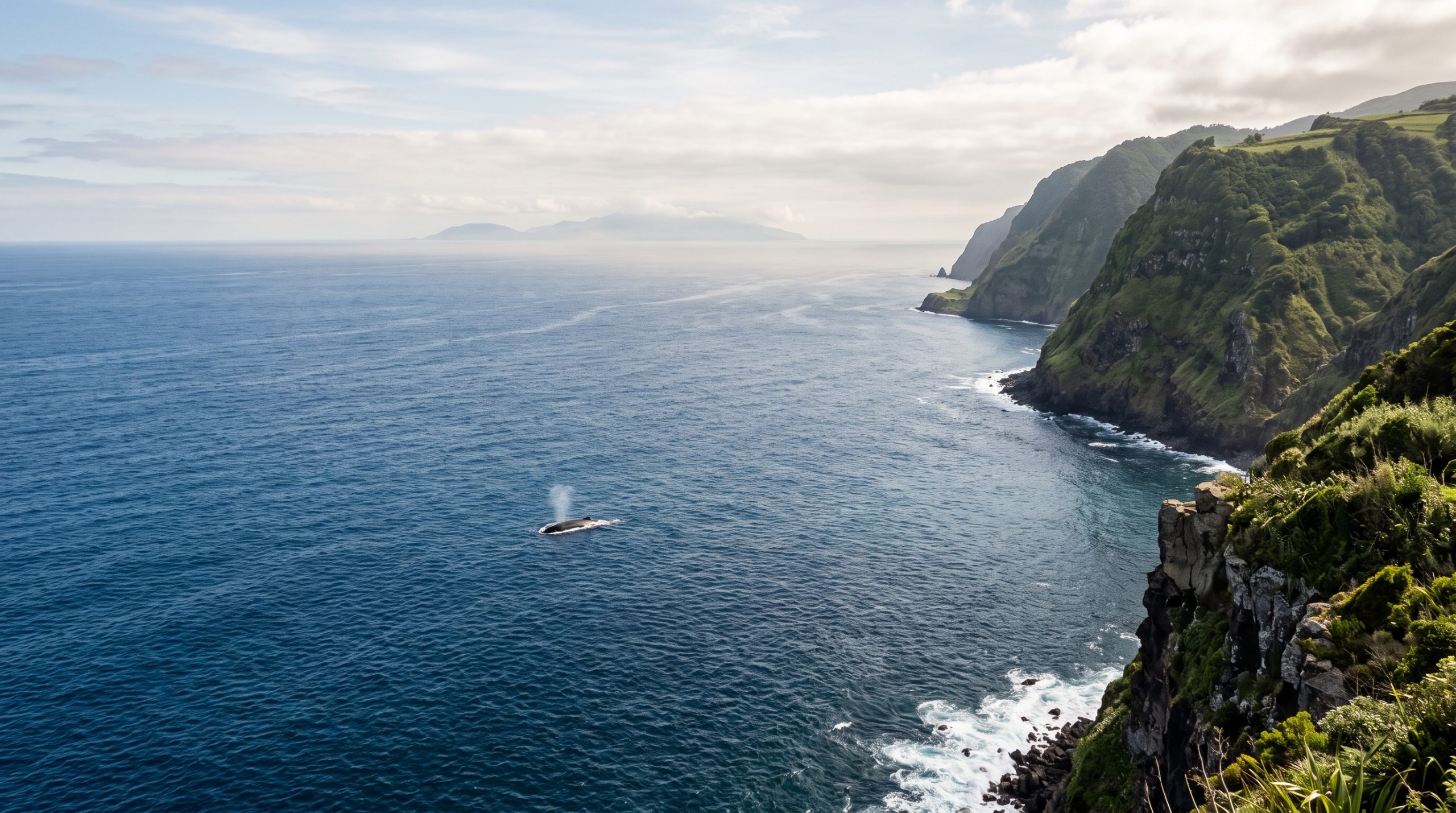
The lookout comes first. On Pico’s south coast above Lajes, a spotter sits high on the hillside with heavy binoculars and radios the boats when a blow shows on the water, so the crews leave after an animal has been found rather than in hope of one. The geography lets them do it. The seabed off Pico falls toward 1,000 meters within a few kilometers of the shoreline, which puts deep-water species inside a three-hour morning trip.
So the question for an elopement here is never whether there are whales. It is which whales, and what the light and the sea are doing in the same week. Sperm whales live in these waters all year. The giants that people picture, blue and fin and sei, pass through on spring migration in a window only a few weeks wide, and that window opens well before the long summer evenings arrive.
Twenty-eight cetacean species have been recorded across the archipelago, roughly a third of every cetacean species on earth, and the region holds Whale Heritage Area status. What follows is how we time a day around them, with the sunrise and sunset figures that actually decide the shape of it.
The whale-season fortnight we would choose
The first two weeks of May. Blue, fin and sei whales are still moving through on the tail of the spring migration, sperm whales are resident and settled, and the sun sets close to nine, which gives you a long warm evening on land after a morning at sea. Summer ferry traffic has not started.
Month by month: whales, light and boats
Sunrise and sunset below are for Horta on Faial, and the rest of the central group sits within a few minutes of them. Local time is UTC minus one hour in winter and UTC in summer, with the clocks going forward on 29 March 2028.
| Month | At sea | Sunrise to sunset, Horta | Boats and visitors | Our verdict |
|---|---|---|---|---|
| January to February | Sperm whales and dolphins, trips led by conditions | 8:10am to 6:00pm in January, 7:45am to 6:30pm in February | Almost nobody | Short days, land-led |
| March | First blue and fin whales appear | 7:05am to 7:00pm | Very quiet | Early giants, restless sea |
| April | Migration peak begins, sperm whales throughout | 7:20am to 8:30pm | Quiet | Strongest odds of the year |
| May | Migration tapering, resident whales reliable | 6:45am to 9:00pm | Building slowly | Our first choice |
| June | Sperm whales, big dolphin pods | 6:30am to 9:20pm at the solstice | Summer ferry lines open 1 June | Longest evenings |
| July | Sperm whale sightings at their highest | 6:40am to 9:15pm | Busiest, with August | Whales and hydrangeas together |
| August | Sperm whales, calmest water | 7:10am to 8:50pm | Peak visitors | Warm, crowded harbors |
| September | Sperm whales, mixed pods | 7:35am to 8:00pm | Thins after mid-month | The underrated month |
| October | Sperm whales and dolphins | 8:05am to 7:15pm | Seasonal ferries stop 30 September | Low sun all afternoon |
| November to December | Sperm whales when the channel allows | 7:35am to 5:40pm in November, 8:10am to 5:35pm at the solstice | Empty | One usable block of light |
Two whale calendars, and how far the dates move
The first calendar barely moves. Sperm whales are the only resident whale species in the Azores, and one Pico operator working these waters since the early nineties records them on an average of 60 percent of trips, with sightings highest in summer and July the strongest single month. Six times out of ten, across a full season, is an honest number to plan against. It is also why we treat a boat morning as one part of a day rather than the reason for the day.
The second calendar moves a great deal. Blue whale sightings usually begin in March and run to June, peaking in April and May, and the same operator now logs them on 16 percent of excursions since 2014, up from around 5 percent in earlier years. Fin and sei whales travel the same corridor in the same weeks. The edges of that season shift year to year, sometimes starting earlier, sometimes stretching into early summer, so we plan a window rather than a date. Two consecutive weeks in the second half of April or the first half of May gives the migration room to be late or early without wrecking the plan.
Hydrangeas are the other narrow window worth naming, because they change what the island looks like more than any other seasonal shift. They start flowering along the field walls in late June, hold through July and fade through mid-August. That timing slides by a week or two depending on the winter, which is enough to matter if you have picked a date for the flowers alone.
If your date is already set for February
February and the first half of March are the two stretches we would move if a date can move, and the reason is daylight rather than weather. Mid-February gives you ten hours and forty-five minutes between sunrise and sunset, with the sun down by half past six, so it is a single-location day rather than an island-hopping one. Boat mornings in those weeks belong to the sea rather than the calendar. Late April adds nearly three hours of daylight, and it adds the migration.
If the date is fixed, we build differently instead of apologizing for it. Horta’s waterfront, the black sand at Porto Pim, the lava at Capelinhos on the western tip: all of them read better under a soft February sky than under a July midday sun, and winter light in the Azores never climbs high enough to go harsh. We put the ceremony hour in the middle of the day, keep the whole day inside twenty minutes of driving, and give the boat trip its own morning earlier in the week. Our guide to how an elopement day is actually built walks through that shape in more detail.
What the light does from March to October
The single biggest change in the year is not the weather, it is the clock. When the islands go forward at the end of March, sunset jumps from a quarter past seven to a quarter past eight, and that hour is the difference between a ceremony squeezed in behind a boat trip and a ceremony with a full warm hour in front of it. By mid-May the sun sets at nine. At the solstice it sets close to twenty past nine in Horta, and the longest day of the year runs to nearly fourteen hours and fifty minutes against nine and a half hours in late December.
What that gives you in May and June is genuine room. The sun drops at a slant this far out in the Atlantic, so the warm light lasts closer to ninety minutes than the twenty you get in the tropics, and the sea holds color long after the sun has gone. July and August pay for their long evenings with a brutal middle of the day. Sun overhead on black basalt at one in the afternoon, which is exactly when the boats come back in, is the flattest light of the year here, and no amount of good intent fixes it. We shoot the returning harbor and then stop until five.
October is the quiet argument for autumn. The sun never gets high, so the entire afternoon behaves like a late afternoon anywhere else, and a day that ends at quarter past seven can start at nine without wasting anything. You can see how these different hours look across finished work in our galleries and films, which is more useful than any description of light we could write.
Season also decides how many people we put on the ground. A May evening is generous enough that one photographer can work slowly through it. A boat morning is not: the animal surfaces once, the couple turns to watch, and both of those things happen at the same second in a moving hull you cannot reposition. That is the case for a photographer and a filmmaker working as a pair from the same team, both briefed on the same plan, rather than two people meeting on the pontoon.
Ferries, channels and what only runs in summer
Atlanticoline, which carries passengers and vehicles between the islands, splits its service into two things: a year-round operation between certain islands, and a seasonal one across the whole group in spring and summer. For elopements that distinction is the whole planning question. The short crossing between Horta on Faial and Madalena on Pico runs all year, which is why almost every whale-season day we build sits on those two islands.
The wider links are seasonal. The line joining Horta, Madalena and Calheta on Sao Jorge to Praia da Vitoria on Terceira runs from 1 June to 30 September, on Tuesdays and Saturdays only, and other seasonal routes across the central group follow the same spring-to-autumn pattern. A three-island shape is realistic in July and awkward in March, when the honest answer is one channel crossing plus a flight. We book vehicle space on the crossings as soon as a timeline is signed off, because the summer sailings fill first. Our destination guides cover how the triangle fits together for a longer trip.
How we plan around the wind
A weather plan for the Azores is not optimism, it is a written list of substitutions made before anyone flies. Horta collects around 844 mm of rain a year, December is the wettest month, and June through August is the driest stretch. None of that tells you about your Tuesday, so we plan by wind direction instead of by forecast summary.
When the swell comes in from the west or northwest, the lava fields at Capelinhos are spectacular and unusable, and we move to Porto Pim and Monte da Guia on the sheltered southeast side of Horta, fifteen minutes away. When the wind swings north, Pico’s north coast at Cachorro is out and the walled vineyards at Criacao Velha on the southwest flank are calm. When cloud sits on the shoulder of the island and fills the Caldeira do Faial, which it does often and without warning, we drop to sea level rather than wait it out. Every one of those pairs is written into the timeline with a driving time next to it.
Boat trips get the same treatment. Operators here run year-round and reschedule when conditions are wrong rather than push out, so we place the whale morning on a different day from the vows wherever the trip length allows. That way a rescheduled boat costs you a lie-in, not a ceremony. If you already have dates in mind, check your date with us and we will tell you what that week usually does.
Common questions
When is blue whale season in the Azores?
Sightings usually start in March and continue into June, with April and May the strongest weeks. The edges of that season move from year to year, so a fortnight in late April or early May gives you the best overlap with fin and sei whales moving along the same corridor.
Can we plan our vows around seeing a whale?
Not the vows themselves. Resident sperm whales show on roughly six trips in ten across a season, which is a good number and not a promise, so we build the ceremony on land and treat the boat morning as its own chapter. When the sea does give you a blow off the bow, you will have two cameras on it.
Is April or May better for an Azores elopement?
April has the higher odds on migrating giants. May has the longer evenings, with sunset at nine rather than half past eight, and the resident whales are just as present. If the whales are the point, take late April. If the day matters more than the species list, take the first half of May.
Do whale trips run in winter?
Yes. Operators work through the year and simply move a trip to another day when the sea is not right, which is why we schedule winter boat mornings early in a multi-day stay rather than on the one morning that also carries the ceremony.
Which island should we base on for whale season?
Pico and Faial, with the year-round crossing between Horta and Madalena as your spine. Lajes do Pico sits closest to the deep water where the lookouts work. Sao Miguel has strong operators too and easier flights, but the channel islands put you nearer the animals.
Can we see whales and hydrangeas in the same week?
July is the week for that. Sperm whale sightings are at their highest and the hydrangeas are at full flower along the field walls, with sunset still after nine. You give up the migrating giants and you share the harbors, and for a lot of couples that trade is worth making.
Choosing the week around whales, sea state and light
Send us the two or three weeks you are considering and we will tell you what each one usually delivers at sea, on land and in the sky, then build the timeline around the strongest of them. We are currently taking elopement bookings for 2027 through 2029, and the coverage shapes are set out on our pricing page. Planning starts once a contract is signed and a 30 percent retainer is paid.
All of it happens in writing, at whatever hour suits you, and the first reply and brochure reach you within 24 hours. Tell Us Your Story and tell us which month you are circling.