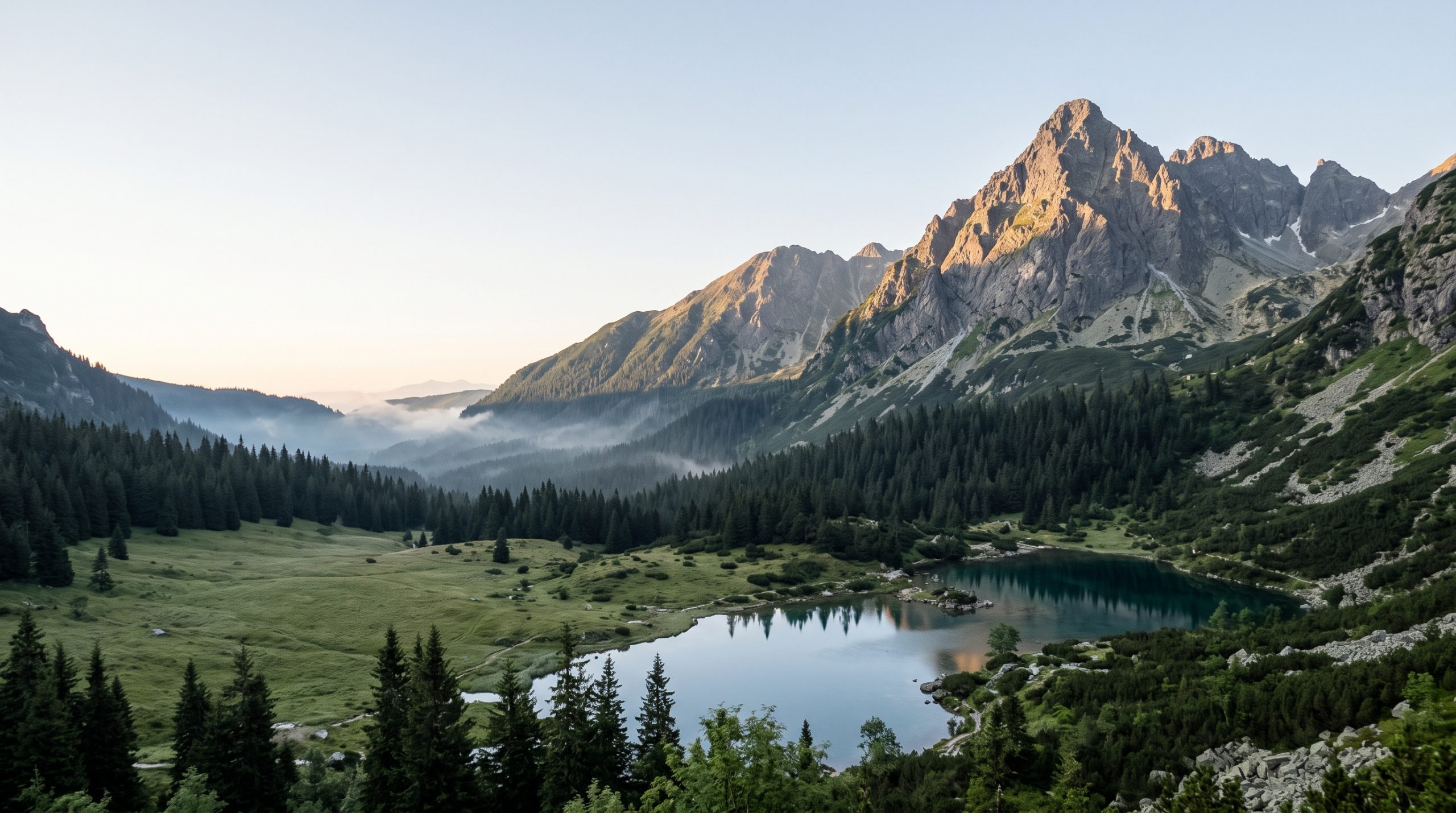
In Tatra National Park you photograph a wedding from the marked trail, or you do not photograph it at all. Stepping off the path is not a matter of good manners here. It is written into the permission the park issues, and the same document rules out a drone. The park charges 250 zł for a day of wedding photography on its trails, on top of the 11 zł entry ticket every person walking through the gate pays.
The other thing that shapes a Tatra day is how much light this corner of Poland gets at 49 degrees north. In late June the sky starts to lift before four, the sun clears the ridge around 4:35, and there is still usable light on Giewont close to nine at night. At the December solstice the whole day fits inside eight hours and fourteen minutes, sunrise near 7:30 and sunset near 15:45, and the sun never climbs high enough to go flat.
Those two facts, the trail rule and the light, decide nearly everything: where you can stand, what hour you leave Zakopane, whether your ceremony happens on an open pasture or a valley floor. This page sets out what a Tatra elopement costs for a 2027 date, ours and Poland’s, and how the day gets built around both. If you are still choosing between mountain ranges, our destination guides are the better place to begin.
What a Tatra elopement actually costs
We photograph, film and plan Tatra elopements as one team, and our travel to Poland is included. One full day with a dedicated photographer or a dedicated filmmaker starts at $4,900. Poland then adds its own modest line items: 11 zł park entry per person and 250 zł for the day’s photography permission on the trails.
The two Tatra days: sixteen hours in June, eight in December
Most couples arrive imagining one Tatra day. There are really two, and the month you choose decides which one you get. A midsummer day here runs over sixteen hours and asks you to be walking in the dark. A late December day gives you eight hours and fourteen minutes of low, sideways light and lets you sleep until six.
A June day, hour by hour
We leave Zakopane between three and half past, depending on how long the walk in takes. Headlamps, boots in the car, the dress in a bag. For an eastern-facing start the broad path up from Zazadnia towards Rusinowa Polana gets you onto open pasture in the dark without any technical ground, which matters when you are doing it once, at that hour, in clothes you are getting married in.
The sky is already working by four. Sunrise lands around 4:35 and the first fifteen minutes are the ones worth the alarm, because the light comes across the pasture rather than down onto it, and the Tatra wall opposite goes from grey to copper while you are standing still. Vows at five. Nobody else is up there. The cable car from Kuźnice does not begin running until hours after a June sunrise, and the coach traffic to Palenica Białczańska has not started, which is the entire reason we build the ceremony into that window rather than a civilised mid-morning one.
By half past nine the valleys belong to everyone else. That is the moment to stop working. Breakfast in Zakopane, a change of clothes, an hour that does not appear in anybody’s timeline but should. Midday in the Tatras is honestly the weakest light of the day, high and hard on a ridge, so we spend it low: the dark wooden Zakopane-style buildings on the edge of town, spruce forest where the sun comes through in shafts, a stream in Dolina Kościeliska where the walls of the valley do the shading for us.
Late afternoon we go north and look back. Some of the best Tatra frames are shot from outside the park, from the pastures above Głodówka or the Gubałówka side, because the whole range stands up in one line and the evening sun hits its face instead of your lens. Sunset near 20:50, then a long slow blue hour behind it. A June day here delivers two completely different sets of pictures, four hours apart at either end of the light.
A December day, hour by hour
Winter reverses the pressure. Sunrise at 7:30 means a warm breakfast before you go anywhere, and because the sun never gets high at this latitude in December, the light stays raking and long from the moment it arrives. Nothing about the middle of the day needs to be avoided.
We keep December days on valley floors and low pastures, where the walking is simple in snow and a horse sleigh can bring guests in: Dolina Kościeliska and Dolina Chochołowska both work, both hold snow, and both empty out completely once you are twenty minutes past the entrance. Ceremony at half past ten. Peak light through the afternoon. Sunset near 15:45, dinner in Zakopane at a sensible hour, and the high panoramas saved for whichever morning in your window the ridges are actually clear.
Why the film here is made on the ground
Drone flight in Tatra National Park is closed to visitors, and the park’s own wedding photography permission states it plainly: no leaving the trail, no drone. That single line changes how a Tatra film has to be built, and it is where hiring a photographer and a videographer separately starts to hurt.
Without aerials, the scale in the film has to come from ground craft. A long lens from across a valley floor, so the two of you read as small figures under a thousand metres of rock. The filmmaker moving up the path ahead of the ceremony spot while the photographer stays in close. A locked wide that lets the cloud move instead of the camera. None of that works if the two people holding cameras are improvising around each other, and on a Tatra trail there is nowhere to improvise: the path is often two people wide with protected ground on both sides, so whoever is not shooting is in the frame.
Ours are not meeting on the morning. They plan positions from one timeline the night before, they know who takes the trail and who takes the slope above it, and they swap sides on a word. When the cloud base lifts off Giewont for six minutes, which is genuinely how Tatra weather behaves, nobody is asking where to stand. You can see how that reads on screen in the films and galleries we publish, and the mountain days are the ones to look at first.
Audio is the other thing this landscape punishes. The Expedition adds professional audio for vows where conditions allow, and in the Tatras that means the audio plan and the ceremony spot get chosen together, on the sheltered side of the pasture, with a sound person who knew about the wind before you did. Sheep bells and running water belong in a Tatra film. Wind hammering a microphone does not.
There are eight of us, four photographers and four filmmakers, which means there is always a second camera on the ground and a colleague in reserve. It also means the people who planned your day are the people who shoot it.
Where Tatra coverage begins, and what stays outside the fee
One full day with a dedicated photographer and a dedicated filmmaker working together, the Expedition, starts at $7,900. The Odyssey runs two to seven days across one or several destinations and is quoted as a custom proposal. Full detail on all three sits on our pricing page, and the figure does not move with your guest count. Ten people change the trail we choose, the transport and the permissions. They do not change the fee.
What comes with every Tatra day
- Destination and location design, and a timeline built from the real sunrise for your date and real walking times between places.
- Permit research and logistics guidance: the park’s trail photography permission, the written film permission the park director signs, ticketing, parking and who needs to be where.
- Weather alternatives at different altitudes, not the same ridge on a different day.
- Drone footage where it is legal, safe and appropriate. Inside this park that is nowhere, so aerials are either planned outside the boundary or designed out of the film from the start.
- Professional audio for vows and meaningful moments on the Expedition, where conditions allow.
- Team travel worldwide: flights, accommodation and ordinary travel for the assigned team, with no long-haul surcharge and no European exception.
- Highlights delivered in 5 days. The full gallery or film in 3 weeks.
What you pay locally, in złoty
Polish costs are small and worth seeing in the local currency. Złoty run roughly four to the dollar, so the park and registry line items for a two-person day come to a few hundred dollars, not a few thousand. The park adjusted its entry ticket in March 2027 and reviews it periodically, so treat the figures below as current rather than fixed forever.
| Local cost | Current figure | When it applies |
|---|---|---|
| Tatra National Park entry ticket | 11 zł per person | Any day you cross the park boundary. Reduced tickets run half that, and a seven-day ticket is 55 zł if your days run consecutively. |
| Wedding photography on park trails | 250 zł per shooting day | Charged per shooting day rather than per location, so a three-location timeline costs the same as one. |
| Civil ceremony held outside a registry office | 1,000 zł | Only if you are marrying legally in Poland rather than at home. |
| Celebrant, accommodation, florals, hair | Booked direct | We research and recommend. You contract and pay. |
| Horse sleigh, 4×4 transfer, mountain guide | Booked direct | Only where the shape of your day needs it. Most Tatra days need none of it. |
One small thing we do not pass on: when we have several Polish days in a year, we hold the park’s annual photographer subscription at 1,500 zł instead of paying per day, and you are not billed for a permission we already carry. Send us the month you are looking at and we will tell you which of those lines your day actually triggers.
Poland’s most-walked mountains, and the hours that get around them
Here is the honest part. Morskie Oko at eleven in the morning in August is a queue with a lake behind it. The shoreline everybody photographs is flat, hemmed in, and busiest at exactly the hour the coaches empty at Palenica Białczańska. Kasprowy Wierch in the middle of a summer day is a viewing platform, not a wedding location. If you have seen those two names on every Tatra list and assumed they are where you would stand, that is the picture worth correcting before you plan anything.
The fix is hours and geography rather than secret places. There are no secret places in a park this well walked. What there is: a two-hour window after 4:35 when the pastures are yours, valley floors that empty completely twenty minutes past the ticket gate, and a whole northern shelf of viewpoints outside the park boundary where there is no gate and no trail rule and the entire range faces you. Because the 250 zł permission covers a shooting day and not a place, moving between three of those locations costs nothing but driving time.
Two windows are genuinely busy whatever we do: August weekends, and the spring weeks when the crocuses come up in Dolina Chochołowska and the valley floor fills by mid-morning. If your date is fixed inside one of those, we move the hours rather than the place, and we tell you in the proposal exactly what the eleven o’clock version of that location looks like so nothing about the day is a surprise.
How a Tatra cost enquiry moves from first message to hold
- Send the inquiry form with your dates, or just the month you are circling.
- We reply within 24 hours with an initial brochure.
- We build a tailored proposal: locations, the shape of the day, which coverage fits what you want.
- Contract signed and a 30% retainer paid. The remaining schedule is set out in the proposal.
- Planning begins: your sunrise timeline, the park permissions, the film permission with the park director at least a week ahead of the date, weather alternatives at three altitudes.
- After the day, highlights in 5 days and the full gallery or film in 3 weeks.
Who the Tatras fit, and which month fits them better
This range suits couples who are comfortable walking. Not mountaineering, but two or three hours across roots, limestone and wet stone, sometimes in the dark, in the clothes you are getting married in. It suits couples who are relaxed about a plan that names two locations and picks one on the morning depending on where the cloud base is sitting. And it suits people who like the idea that the best hour of their day happens before the first cable car runs.
If a three o’clock alarm is not your idea of a good morning, say so in your first message rather than agreeing to it politely. A late September sunrise here lands near 6:45, and the afternoon light stays low for hours. Larch colour arrives on the valley floors in October. If you would rather not set an alarm at all, December hands you a 7:30 sunrise, snow, and a full day of raking light. Those are three genuinely different days, and all three are ours to build. Our guide to planning an elopement covers the fundamentals that apply wherever you land.
Guests are a logistics question, never a pricing one. Six people can walk to Rusinowa Polana at four in the morning if they are told honestly what that involves. Sixteen probably want a valley floor, a sleigh in winter, and a shorter approach. Tell us the number and we will design around it.
Common questions
Do we need a permit to be photographed in Tatra National Park?
Yes. The park charges 250 zł for a shooting day of wedding or family photography on its trails, applied for through its own system, and it can be arranged at short notice. Film footage is separate and slower: it needs written permission from the park director, applied for at least a week before the date. We handle both applications and build the timeline around what they allow.
Can we fly a drone over Morskie Oko or the ridges?
No. Drone flight inside Tatra National Park is closed to visitors, and the park’s trail photography permission spells out that no drone may be used. Where aerials matter to you, we plan them outside the park boundary in airspace that permits them, and confirm that before any part of the film depends on it.
Can Americans marry legally in Poland, or should we do the paperwork at home?
US federal authorities do not issue the certificate of legal capacity to marry that Polish registry offices ask foreigners for. The US Embassy in Poland publishes a bilingual letter explaining this, which Americans use to petition a Polish court to be released from the requirement, and that route needs time built into your planning. Many couples handle the legal step at home and treat the mountain ceremony as the one that counts. If you want it binding in Poland, a civil ceremony held outside the registry office carries a 1,000 zł additional fee, and we plan the calendar backwards from the court step.
How early do we actually have to get up in June?
Sunrise sits around 4:35 near the solstice and the sky begins working before four, so we leave Zakopane between three and half past depending on the walk in. You are on your ceremony spot with light to spare, and you are back down having breakfast before the day visitors reach the valleys.
Is a Tatra winter elopement workable with so little daylight?
Eight hours and fourteen minutes at the solstice is plenty when the sun never climbs high. Sunrise near 7:30, sunset near 15:45, and everything in between is the kind of low raking light you would otherwise wait until evening for. Winter days sit on valley floors and low pastures, and the walking is straightforward in snow.
What happens if the ridges are in cloud all day?
Every Tatra timeline we write carries alternatives at different altitudes, because cloud here sits in a band. When the tops are grey the valley floors and the forest are often better than they would be in sun. The 250 zł permission covers the day rather than a location, so moving costs nothing but the drive.
Does bringing our parents and a few friends change the price?
No. The fee is the same whether it is the two of you or a group of twelve. What guests change is access: which trail, how long the approach can reasonably be, the transport, and the permissions we file. Tell us the number early and it stops being a problem.
How soon do we see the photographs and the film?
Highlights reach you in 5 days, while you are probably still in Poland or on the way home. The full gallery or film follows within 3 weeks.
Writing to us about a Tatra date
The planning stays in writing from the first message onward, on your schedule and across time zones, from the first message to the final delivery. Our planning calendar for Tatras currently covers 2027, 2028 and 2029. Send us the month you are circling, whether you want film as well as photographs, and how early you are honestly willing to get up, and we will come back within 24 hours with a brochure and a first read on the day. Tell Us Your Story