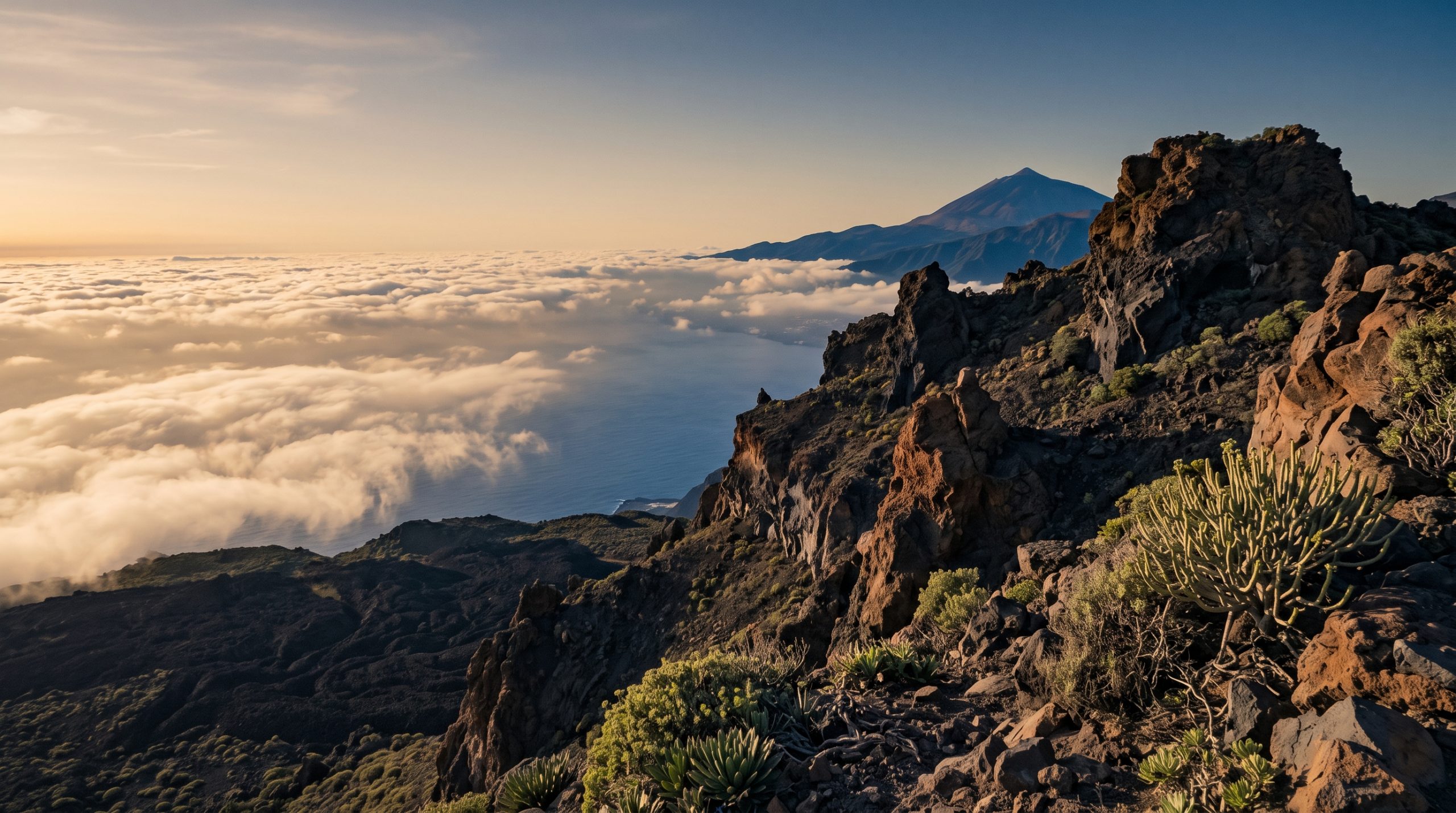
The road up from the coast takes a little over an hour, and somewhere around 1,500 metres you drive out of the cloud. Above it there is pumice, the TF-21 unspooling ahead of you, and Teide at 3,715 metres already holding the light while the beach you left is still grey.
That is the ceremony most couples come to Tenerife for. It is also, almost always, a symbolic ceremony rather than a legal one, because Spanish marriage law is built around where you live rather than where you want to stand. Once you understand that single rule, the whole thing gets simpler instead of harder.
What follows is the practical version. What a symbolic ceremony means in Spanish terms, the paperwork that genuinely applies to you, how far ahead to start, and what the day asks of your budget.
What a symbolic ceremony means in Spanish terms
A symbolic ceremony in Tenerife is a full ceremony with a celebrant, vows and readings that is not registered with the Spanish state. Nothing is filed, no notice period applies and no residency is needed. Couples marry legally at home, then choose any hour and any location here, from black sand to 2,000 metres.
The domicile rule that decides this for you
Spain does not ask where you would like to be married. It asks where you live. A civil marriage here runs on a marriage file, the expediente matrimonial, opened at the civil registry of the municipality where one of you is a registered resident, and for two foreign nationals the first requirement is that at least one partner holds a domicile in Spanish territory. Residence is proven with a certificado de empadronamiento from that town hall. The ceremony itself can then be authorised by the mayor, a councillor acting on delegation, a court clerk, or a notary competent in the place where it is held.
So the honest difficulty rating splits in two. A legal Spanish marriage is not realistically available to a couple flying in for ten days, because the file cannot be opened without that residence. A symbolic ceremony is the least complicated thing in this entire article: no notice period, no file, no residency test, no document list, and no restriction on who speaks or in what language.
Which leaves the route almost every couple we work with on this island actually uses. Marry legally at home, in a courthouse or a registry office, on a Tuesday morning with two friends and a coffee afterwards. Then fly to Tenerife and hold the ceremony that matters to you, at the hour you choose, on ground no registry office can offer. The fundamentals behind that split are the same wherever you go, and we have set them out in our guide to how eloping actually works.
What changes: the legal signing happens on another day, in another country, and it is usually brisk and unceremonious. What does not change: your vows, your celebrant, the readings, the rings, the hour, the location, the film, the photographs, and the fact that you spend that day married. Nobody looking at a single frame afterwards can tell which of the two ceremonies was the legal one.
| Element | Spanish civil marriage | Symbolic ceremony in Tenerife |
|---|---|---|
| Who can do it | Couples where at least one partner is domiciled in Spain | Any couple, any nationality, no residency test |
| Where it happens | The office of the registry, notary or town hall handling the file | Anywhere the landowner or the authority permits, including at altitude |
| The hour | Office hours, on a day the official sits | Any hour, including well before sunrise |
| Language | Spanish, with an interpreter if either of you needs one | Whatever language you want, in your own words |
| Witnesses | Two adults | None required |
| Paperwork | The marriage file, with certificates, apostilles and sworn translations | None in Spain |
| What you leave with | An entry in the Spanish civil register | A keepsake certificate, plus your marriage certificate from home |
The paper chain, in the order it has to happen
Because the symbolic ceremony itself needs nothing filed in Spain, your chain is short and it runs mostly through your own country. Two of the steps only matter if Spain will ever need to see your marriage, which for most couples is never.
- Your marriage licence at home. Issued by your county or state, and it carries an expiry window set by whoever issues it. Pick a date for the legal step that sits comfortably inside that window rather than at the edge of it.
- The legal marriage itself. Most couples do this before flying, which means you land in Tenerife already married and the island day is entirely yours. Doing it after you fly home works just as well; only the order of the story changes.
- Certified copies of the marriage certificate. Order more than one. No airline, hotel or celebrant in Tenerife will ask to see it, but a name change at home will, and so will everything downstream of that.
- An apostille, only if Spain will ever need the certificate. Spain is party to the Hague Apostille Convention, so a certificate from a United States authority is accepted here once the Secretary of State of the issuing state has apostilled it. Nobody asks for this on the morning of a symbolic ceremony.
- A sworn translation, and only alongside that apostille. Documents put to official use in Spain have to be translated by a traductor-intérprete jurado appointed by Spain’s Ministry of Foreign Affairs, which publishes the list of appointed names. A translator at home cannot do this, however good they are.
- Permission for the location. Written authorisation from the park administration for national park ground, the town hall for anything that counts as an event on a public beach, or the owner for a villa or finca. We research this, we submit it, and we tell you which fee sits with you.
- The celebrant. Booked to your hour and your language, with the wording agreed in advance so that nothing is being read for the first time at 07:00 in the wind.
Work back from the Teide light you want
A symbolic ceremony has no legal lead time at all. The real minimum is a few weeks, and days do get built on less notice than couples expect. The comfortable minimum is different: six to nine months, because accommodation, a celebrant you actually warm to, and written permission for ground like the national park all move at their own pace. Six to nine months is what we work to whenever the calendar allows it.
- Nine to six months out. Date held, contract signed, retainer paid, accommodation booked, and the shape of the day agreed: which coast, which altitude, sunrise or last light.
- Six to four months out. The legal step at home is scheduled. The location list is locked and we submit the permission requests that need submitting. Celebrant confirmed for your hour.
- Two months out. The timeline goes to the minute, built around the sun rather than the other way round. Midwinter sunrise here does not arrive until close to 08:00, while in midsummer the light holds until nearly 21:00, and the Canaries run an hour behind mainland Spain.
- Four weeks out. Ceremony wording finished. Cable car or gorge tickets bought if your day uses them, since timed slots in high season go long before the week itself.
- The week itself. We scout in the real light, watch the wind and the cloud base, and confirm the alternative location we are holding in reserve.
How a pre-dawn hour above the cloud line reads on camera is easier to see than to describe, so the finished films and galleries sit on our stories page. Highlights reach you within five days of the day itself, and the full gallery or film within three weeks.
Where Tenerife symbolic ceremonies usually get complicated
The clock, twice over. The Canary Islands run an hour behind mainland Spain, so a celebrant or supplier quoting you a time from Madrid is not on your clock. Anything transactional here also happens in the morning. Town hall and registry business is a before-lunch activity, and an afternoon email often becomes tomorrow’s answer.
The cloud line is usually on your side. The inversion layer that greys out the resorts tends to sit below the park, so a flat morning at sea level is frequently a clear morning at 2,200 metres. Couples cancel the mountain from a hotel window and regret it. We check the cloud base, not the view from the balcony.
Calima. Saharan dust reaches the islands most often in the first months of the year, and it takes Teide’s outline out of the frame completely. Those days can be beautiful in a smeared, orange way, and useless for the picture you had in your head. We hold a forest or coastal alternative for them and shift the hour rather than the whole day.
Wind before cold. The park floor runs above 2,000 metres and ten to fifteen degrees below the coast you left an hour earlier. The temperature is manageable with a coat you take off for four minutes. The wind is what decides where you stand, so we choose the sheltered pocket for the vows and keep the exposed ridge for the walking frames.
Permission is paperwork, not a favour. Professional photography and filming in Teide National Park is authorised in writing by the park administration, and aerial work belongs on the same request with its own time window. We submit, then plan the ceremony hour around the answer that comes back, which is exactly why the location list gets locked months before the date.
Beaches are public land. Under Spanish coastal law the shore belongs to everybody. The difference between two people standing on black sand with a celebrant and a set-up with chairs, an arch and twenty guests is the difference between arriving and applying. The second is an event, and events on the sand are the town hall’s business, whether that is Adeje, Santiago del Teide or Santa Cruz.
The coach clock at Roques de García. The Roque Cinchado view is the most photographed thing in the park, and by eleven in the morning it is hot, flat and shared with a full car park. At 07:30 the same ground is yours, the shadows are long, and you can hear each other speak. We start early here for reasons that have nothing to do with romance.
Access windows on the far edges. The road out to the Punta de Teno lighthouse limits private vehicles for much of the day and runs a shuttle from Buenavista del Norte instead, and the Masca gorge is entered on booked, capacity-limited access. Both are entirely workable. Both are worth confirming at the moment we plan them, because the authorities that set those windows review them.
The keepsake certificate is a keepsake. Most celebrants hand you something signed and lovely at the end of a symbolic ceremony. It is not a Spanish marriage record, and it will not do anything at a bank, a passport office or an immigration desk. The certified copy from home is the document that works.
Fees and processing windows can move. Treat the figures here as a planning snapshot and reconfirm them with the issuing office before you file.
What the day costs, and what sits outside our fee
One full day with a dedicated photographer or a dedicated filmmaker starts at $4,900, one full day with a photographer and filmmaker working together starts at $7,900, and the multi-day option along with everything each experience includes is set out on our pricing page.
Team travel to Tenerife sits inside that. Flights, accommodation and the ordinary travel of the assigned team are ours to arrange and ours to pay for, in every destination we work in, with no long-haul surcharge attached. The fee does not move with your guest count either. Two of you at Llano de Ucanca and fourteen of you on a villa terrace above Adeje cost the same to photograph, because guests change access, permits, transport and timeline rather than the price.
Paid separately, and paid by you: the celebrant; government, park or landowner permit fees where the location carries them, though the research and the submissions are ours; accommodation; the celebration afterwards; and unusual transport, meaning a helicopter, a private boat out under the Los Gigantes cliffs, a 4×4 charter or a mountain guide. Cable car and gorge tickets belong in the same column.
If you have a month in mind, or a location you cannot stop thinking about, Check Your Date with us and we will tell you honestly what that hour looks like in that month, and which month would suit it better if it does not.
What we can coordinate on the island
This guide is practical planning help, not legal advice. Confirm the final requirements with the registry office or your consulate before booking travel. We do not file paperwork on your behalf and we will never tell you what your own county requires.
What we do hold: destination and location design, a timeline built around light and real travel time, permit research and the logistics guidance that comes with it, weather alternatives and backup planning, and the coordination between your celebrant’s availability and the hour the sun actually does what you want it to. Drone footage where it is legal, safe and appropriate. On The Expedition, professional audio for the vows where conditions allow, which on an exposed ridge is a real craft problem and the reason the vow position gets planned first.
There are eight of us, so there is always a second camera on the ground and a colleague in reserve. On a day with a photographer and a filmmaker both working, one of us can be watching your faces while the other watches the light move across the mountain behind you. And when a symbolic ceremony wants two names at the bottom of the keepsake certificate and you have brought nobody with you, the two of us are already standing there.
Common questions
Is a symbolic ceremony in Tenerife legally binding?
No, and that is the point of it. Nothing is registered with the Spanish state, which is why it needs no documents, no notice period and no residency. Couples marry legally at home, before or after the trip, and the ceremony in Tenerife carries the vows, the readings and the hour you chose.
Can two Americans get legally married in Tenerife?
Not on a holiday timeline. A civil marriage in Spain runs on a marriage file opened at the civil registry of the municipality where one of you is a registered resident, and for two foreign nationals at least one partner must hold a domicile in Spain. Without that, the file cannot be opened.
Do we need witnesses for a symbolic ceremony?
There is no legal requirement for any. Most celebrants like two names at the bottom of the keepsake certificate, and if you are eloping with nobody else present, the team covering your day is right there to sign it. A Spanish civil marriage is a different matter and needs two adult witnesses.
Can we hold our ceremony inside Teide National Park?
Couples do. Professional photography and filming in the park is authorised in writing by the park administration rather than decided on the morning, so we submit once your location list is set and then build the ceremony hour around what that authorisation allows.
Can we get married on a beach in Tenerife?
The shore is public land under Spanish coastal law. A small standing ceremony with a celebrant leaves almost no footprint. Chairs, an arch and a guest list make it an event, and events on the sand go through the town hall for that stretch of coast, so we plan which of the two you are doing early.
How far ahead should we book a symbolic ceremony in Tenerife?
There is no notice period, so a few weeks is technically possible. Six to nine months is comfortable and is what we work to, because celebrants, accommodation and written permission for ground like the national park all move slowly. We are booking 2027, 2028 and 2029 now.
Do our documents need an apostille or a sworn translation?
Not for a symbolic ceremony, where nothing is filed in Spain. If you later need your marriage recognised here, for residency or property, the certificate needs an apostille from the authority that issued it and a translation by a sworn translator appointed by Spain’s Ministry of Foreign Affairs.
What if calima or low cloud sits over the mountain that morning?
We move, and we planned for it months earlier. Weather alternatives are part of every experience: a laurel forest hour in Anaga, a north coast headland, or the same location two hours later once the dust thins. The cloud base and the wind direction set the running order on the day.
Pick the month, then pick the hour
Tenerife is not one place. February above the clouds and September on the black sand at Benijo are different islands, and the month you choose shapes your day more than the location does. Our destination guides are a good place to start narrowing that down. We are booking 2027, 2028 and 2029, and everything between us happens in writing, which suits planning across time zones: send the form, and a reply with our first brochure reaches you inside 24 hours, then a proposal built for your date, then a contract and a 30% retainer, and the planning begins. Tell Us Your Story.