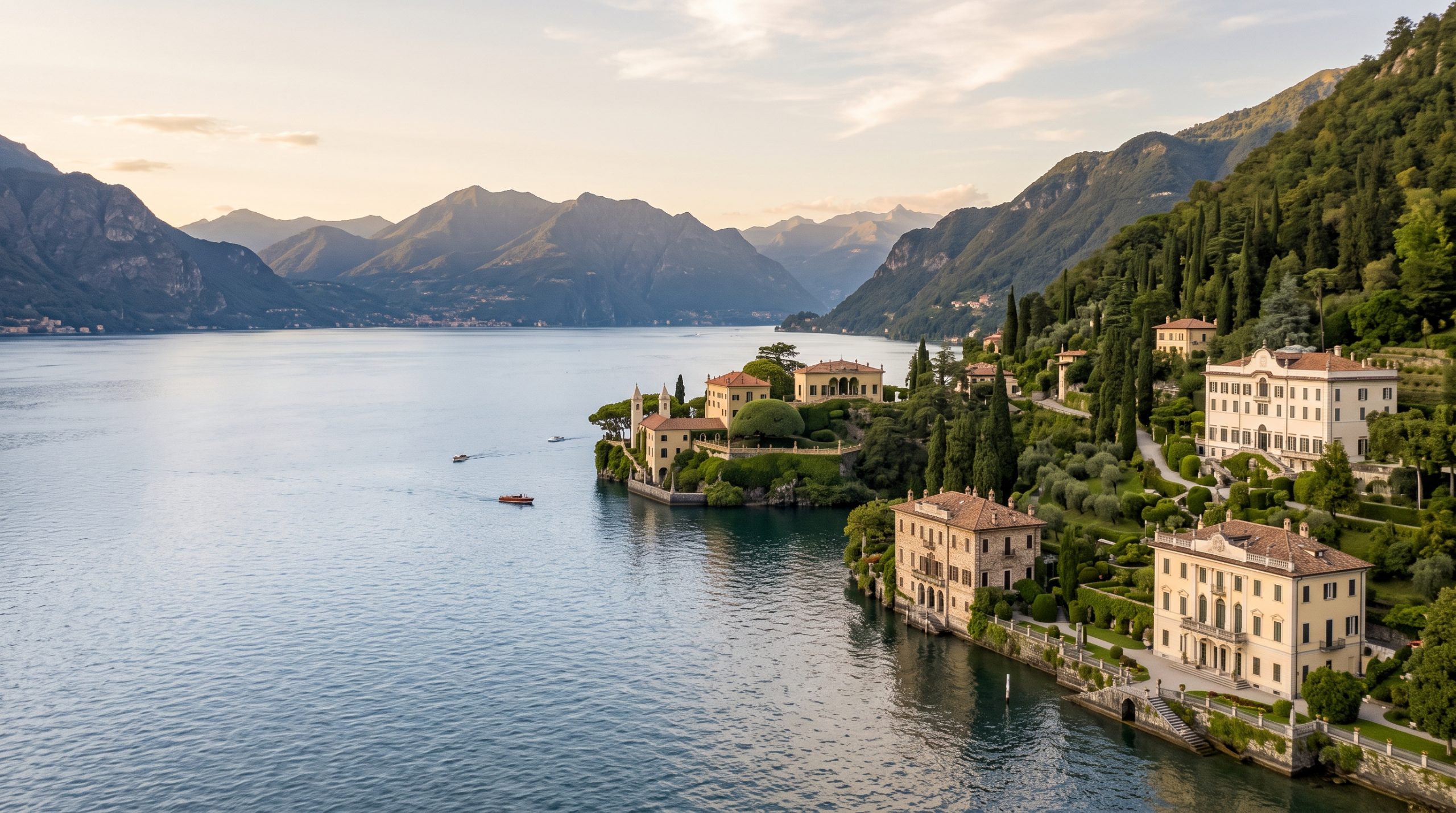
Villa Olmo will marry you in the small neoclassical temple in its park. Monday to Saturday, mornings only, and only between 1 April and 30 October. Up the eastern shore, Varenna will marry you in a botanical garden in the evening, and publishes the price of that slot on its own booking portal.
Same lake, same week in June, two entirely different sets of rules. The rules are not the lake’s and they are not really the villa’s. They belong to the comune, the town whose registrar signs your certificate, and they change from one headland to the next. Get that one idea straight and the rest of this stops being a mystery and becomes admin.
So here is the honest difficulty rating for two Americans marrying legally on Lake Como: fiddly, not hard. It is a short chain of documents, two counters to stand at, and a slot in a book that a small number of officials control. Nothing in it is complicated. Almost all of it is date-sensitive, which is a different problem and a much more solvable one.
Who says yes: the comune, not the villa
A Lake Como villa can hold a legally binding civil wedding only where its comune has set up a separate registry office inside it. Como has done that at Villa Olmo, including the Tempietto in the park. Varenna has done it at Villa Cipressi and Villa Monastero. Days, hours and fees are then set town by town.
The villas with a registrar’s desk, and the days they use it
Two comuni on this lake publish their venues, days and prices clearly enough that you can plan against them, and they happen to sit on opposite shores. Como runs the western basin around the city. Varenna handles the eastern side, where Villa Cipressi and Villa Monastero stand a few hundred metres apart above the same stretch of water.
| Venue | Comune | When a registrar celebrates there | What the ceremony itself costs |
|---|---|---|---|
| Sala Consiliare or Sala Giunta, Palazzo Cernezzi | Como | Registry service hours: 8.30 to 12.30 Monday to Friday, 8.30 to 12.00 Saturday | Free of charge |
| Sala Ovale, Villa Olmo | Como | Monday to Saturday, mornings only | €500 including VAT |
| Tempietto, in the park at Villa Olmo | Como | Monday to Saturday mornings, 1 April to 30 October only | €500 including VAT |
| Villa del Grumello, the example named in the city’s own resolution | Como | Registry service hours, or weekdays after 12.30 by agreement with the mayor or a delegate | Banded, from €1,000 with a Como resident, more for non-residents |
| Villa Cipressi, gardens or salons | Varenna | Weekday, Saturday and public holiday, and evening bands. Daytime only in December, January, February | €800 to €2,000 to the comune by band, plus the villa’s own charge |
| Villa Monastero, botanical garden or interior halls | Varenna | Same bands as above, in a museum that opens to visitors | Comune band, plus a separate charge set by the Province of Lecco |
| Villa del Balbianello, Lenno | Tremezzina | Civil or symbolic ceremonies by arrangement with FAI, which owns and runs it | FAI event charge. Wedding photography there is paid and booked in advance |
Varenna is the most transparent town on the lake about this, because it put the whole thing online. You choose Villa Monastero, Villa Cipressi or the municipio, pick a date and a time band, check availability and pay, all on the comune’s own portal. Non-resident and foreign couples pay €1,200 from Monday to Friday for the morning and up to 17.30, €1,500 on Saturdays and public holidays, and €2,000 for an evening slot. December, January and February run in daylight only, at €800 to €1,000. Varenna residents marry free. The euro has been trading a little above 1.15 dollars for a while, which puts that €1,200 weekday band somewhere near 1,400 US dollars.
Villa Monastero adds a second layer, and it is the single most useful thing to understand about that address. The villa belongs to the Province of Lecco, not to Varenna. A separate registry office has existed inside the museum complex since 2017 under a convention between the two, and the first civil marriage there was celebrated on 4 July 2017. The province sets its own tariff for the use of the botanical garden or a hall, most recently €1,500, reduced to €1,000 where one of you lives in the province of Lecco. That is on top of Varenna’s celebration band. Villa Cipressi behaves the same way: it is owned by the Comune di Varenna and run as a hotel and restaurant, so the comune bills the ceremony and the hotel bills the use of the gardens and salons.
The mechanism behind all of it is worth knowing, because it explains why any villa list has a shelf life. Como has publicly invited private owners to lend suitable premises to the city free of charge so that they can be designated as separate registry offices, with a commission assessing what comes in. The city’s model agreement is unusually clear about who takes which payment: the celebration tariff is fixed by the council and paid to the comune, while the cost of using the building is negotiated directly between the owner and the couple. Two invoices, two deadlines, two sets of people to be kind to.
One clause in that same agreement matters to us more than any other. The premises must at minimum guarantee the celebration itself, including the possibility of taking photographs inside and outside the building. That is written into the arrangement between the city and the property, rather than left to whoever happens to be on the gate that morning. Both cities also publish their venue lists and fees for civil marriages and civil unions together, at the same venues and in the same bands, so the table above reads the same way whoever is standing in front of the registrar.
Fees and deadlines quoted here were correct at the time of writing and are worth re-checking with the office that issues them. Como’s current tariff regime is explicitly a trial, and Varenna’s portal is updated in place.
The document chain for an American couple, in order
The US Consulate General in Milan covers the whole of Lake Como, and the sequence it sets out is short. Follow it in this order and nothing doubles back on itself. If you want the wider shape of the planning around it, our guide to eloping covers the parts that are not paperwork.
- Atto notorio. A sworn declaration that there is no impediment to your marriage. Obtain it from an Italian consulate in the United States before you fly if you possibly can. Milan’s guidance treats getting it in Italy as the fallback rather than the plan.
- Nulla osta. The certificate of no impediment that Article 116 of the Italian Civil Code requires of a foreign national marrying in Italy. You sign it in front of a consular officer at the US Consulate General in Milan, Via Principe Amedeo 2/10, and you bring the atto notorio with you.
- Valid passports for both of you. If either of you has been married before, raise it with the comune at the beginning rather than the end, because the registrar will add documents to this list for that.
- The declaration of intention to marry. Made in person at the marriage office of the comune where you are marrying, with everything above in hand. This is the moment your ceremony exists in the register rather than in a diary.
- The venue booking and its fee. Varenna takes it online, venue and date and band and payment in one go. Como wants its celebration fee paid no later than 60 days before the date it has held for you.
- The apostille on your Italian marriage certificate. After the wedding, not before, and it is what makes the certificate usable at home. It can only exist once the marriage does.
Publication, the Italian banns, is the one item on every checklist you can stop worrying about. It is a residents’ procedure. Bellagio’s guidance is typical of the lake: at least one of you must be resident in the comune to request it, the notice then sits on the comune’s website for eight days, and the certificate follows at least eleven days after publication. For couples who have published, Como opens a window that starts on the fourth day after publication and closes six months later. None of that timetable belongs to you if you are flying in from Chicago. The nulla osta does that work instead, which is exactly why Como’s guidance tells couples to bring it to the ceremony whenever one of them is not an Italian citizen.
Fit the villa calendar around the hour you want
Work back from the ceremony hour rather than forward from today. The hour is the thing everything else hangs off, because it decides the tariff band, the light and how much of the day you get.
- Twelve to nine months out. This is where we like to be, holding a villa date and a registrar’s band at the same time so the two never drift apart. It is our preference, not a legal requirement, and we have built very good days on far less notice.
- Sixty days out. Como’s celebration fee has to be paid by then for the date to stay yours. Put it in the calendar the week you book, not the month it falls due.
- Three days out. Como’s tariff rules set three days before the date as the outer limit for moving the celebration to a different venue, and recalculates the charge when that happens. Useful to know about, better not to need.
- The working days immediately before. Milan for the nulla osta, then the comune counter for the declaration of intention to marry. We plan those onto separate weekdays with a spare working day behind them, because Italian offices keep their own hours and a Saturday afternoon fixes nothing.
- The morning itself. Varenna’s published tariff includes a late fee: €100 to €150 for a couple running 15 to 30 minutes behind, €250 to €300 between 30 and 60 minutes. We build the drive, the ferry and the walk up from the water with real numbers rather than optimistic ones.
The genuine minimum is much shorter than couples expect. Nothing in the document chain takes months, and the two counters can be visited in the same week as the wedding. The comfortable minimum is set by the venue’s book rather than by the law, and by the fact that a Saturday behaves differently from a Tuesday everywhere on this lake. That is the number we would work to. Our destination guides go further into how the shoulder months change what a day on Como can be.
Five details that decide how the morning goes
- Mornings are not a suggestion in Como. The city’s registry service hours are 8.30 to 12.30 Monday to Friday and 8.30 to noon on Saturday, and Villa Olmo celebrates in the mornings only. The legal hour and the best light therefore sit at opposite ends of the day, so we plan the vows early and hold the water, the ferry crossing and the portrait hour for the end of the afternoon.
- Two invoices, from two organisations. At Villa Monastero the Province of Lecco charges for the garden or a hall and Varenna charges for the celebration. Villa Cipressi splits the same way between comune and hotel. Couples who budget for one number are usually looking at the smaller one.
- Your witnesses are paperwork. Comuni want the two witnesses named in writing ahead of the date, with copies of their identity documents, and the rite itself is read in front of them. If you are travelling alone, tell us in the planning brief and we build two named people into the timeline rather than solving it on the morning.
- The ceremony is a public act. Como states it plainly: a marriage is celebrated in a place open to the public, and free access to the detached registry office has to be guaranteed while it happens. The gardens at Villa Cipressi and the Balbianello are open to visitors too. We scout the sightlines the day before and place ourselves so that a curious afternoon visitor never ends up in the middle of your vows.
- The Tempietto is seasonal. It celebrates only between 1 April and 30 October, so a late March or November date in Como means the Sala Ovale indoors or the frescoed rooms at Palazzo Cernezzi. Worth knowing before you fix a month around one photograph you saw.
Keep the legal signing at home and celebrate on the lake
A large share of the ceremonies these villas host are symbolic, and there is nothing second-best about that. Varenna reports couples arriving from the United States, Australia and elsewhere specifically for ceremonies with no legal effect, and FAI lists symbolic ceremonies alongside civil ones among the events it hosts at the Balbianello. Couples sign the register at a courthouse at home, then stand on the Loggia Durini at Lenno or on the lake terrace at Villa Monastero and say the words they actually wrote.
What changes is the clock, and it changes in your favour. Without a registrar there is no morning-only cap, no service-hours band, and no €2,000 evening tariff, because the hour is now a private arrangement between you and the property. Sunday at seven in the evening becomes as workable as Tuesday at ten in the morning. On a lake that faces west across the water from Varenna and east from Tremezzina, that freedom is worth a great deal.
What does not change: the villa’s own charge, the guest ceiling, which at the Balbianello runs to 130 for a reception, the museum’s opening day around you, and the boat you booked to get there. Nor does anything about how we work. Photography, film and planning are one commission either way. You can see how both routes come out, films and galleries side by side, in the stories we have published.
What we can coordinate across the villa and registrar calendars
We design the destination and the locations, then build a timeline around light and honest travel times rather than hopeful ones. We research the permits and the access rules that apply to your specific villa and hour, hold weather alternatives within a short drive, and fly a drone where that is legal, safe and appropriate. Practically, on a Lake Como day, the work is holding the villa’s calendar against the registrar’s calendar until the two agree on an hour that also happens to look like something.
That is where having one team matters. When your ceremony is fixed at ten in the morning because the comune’s hours say so, a photographer and a filmmaker who arrived together cover that one short rite from two angles at once, one close on your faces and one wide with the lake behind you, and nobody asks you to put the ring on twice. The same two people then take the light at the other end of the day, which is the only part of a Como timeline you actually get to choose.
We are photographers and filmmakers, not lawyers. Rules change and circumstances differ, so confirm the detail with the relevant registry office or your own consulate before you book flights. We do not file paperwork or represent you at a counter, and the celebration tariffs, provincial charges and villa fees on this page are paid by you to the offices and owners that levy them.
Coverage runs as one full day or as a multi-day commission, with photography and film from the same team, and the shape of each is set out on our pricing page.
If you already have a villa in mind, or a date and no villa at all, send us a message with the month you are thinking about and we will tell you which comune governs it and how its calendar behaves.
Common questions
Can we legally get married at Villa del Balbianello?
FAI, which owns and runs the villa at Lenno, lists both civil and symbolic wedding ceremonies among the events it hosts there, along with receptions of up to 130 guests. It is a museum property that opens to the public, so the ceremony sits inside a working visitor day, and wedding photography on site is a paid arrangement booked in advance.
Why can’t we have our Lake Como ceremony at sunset?
In Como you can’t, because the city celebrates civil marriages within registry service hours and Villa Olmo celebrates in the mornings only. In Varenna you can: the comune publishes an evening band at €2,000 for non-resident couples from March to November. It is a town-by-town answer, and it is one of the first things we check when a couple sends us a shortlist.
How much does the comune charge to marry us at a Lake Como villa?
Como’s rooms at Palazzo Cernezzi are free and Villa Olmo is €500 including VAT. Como’s newer venues in borrowed buildings start at €1,000 for residents and cost more for everyone else. Varenna runs €800 to €2,000 depending on month, day and hour. None of those figures include the villa’s own charge.
Do we need to spend time in Italy before the wedding?
Two steps happen on the ground: signing the nulla osta at the US Consulate General in Milan, and making the declaration of intention to marry at the comune where you are marrying. We plan those onto separate weekdays before the ceremony with a spare working day behind them, which usually means arriving earlier than couples first imagine.
Is a ceremony in a villa garden legally binding in Italy?
Yes, where that garden has been designated a separate registry office. The Tempietto in the park at Villa Olmo and the botanical garden at Villa Monastero are both outdoor spaces where a registrar celebrates legally binding marriages. A garden with no such designation gives you a symbolic ceremony, which is a fine choice made deliberately.
Can we get married on a Sunday on Lake Como?
Varenna prices Saturdays and public holidays as one band, at €1,500 for non-resident couples. Como’s town hall rooms and Villa Olmo run Monday to Saturday, with Saturday ending at noon. So a Sunday is a question you ask of a specific comune rather than of the lake, and the answer moves the whole plan when it comes back.
Do we have to publish banns in Italy?
Publication is built for residents. Bellagio’s guidance requires that at least one of you lives in the comune to request it, after which the notice sits on the comune’s website for eight days and the certificate follows at least eleven days after publication. Visiting American couples go the nulla osta route instead, under Article 116 of the Civil Code.
Holding two calendars against each other
Almost every Lake Como question that looks legal turns out to be a calendar question. Which villa, which comune, which band, which hour, and whether the hour you have been given leaves you any of the light. That is the work, and we have done it on both shores.
Everything from here happens in writing. You send us the month, the shore and the shape of day you have in mind, we reply within 24 hours with an initial brochure, and a tailored proposal follows. A signed contract and a 30% retainer open the planning, and we are booking 2027, 2028 and 2029. If you have a date in mind, check your date with us and we will start from the registrar’s book.