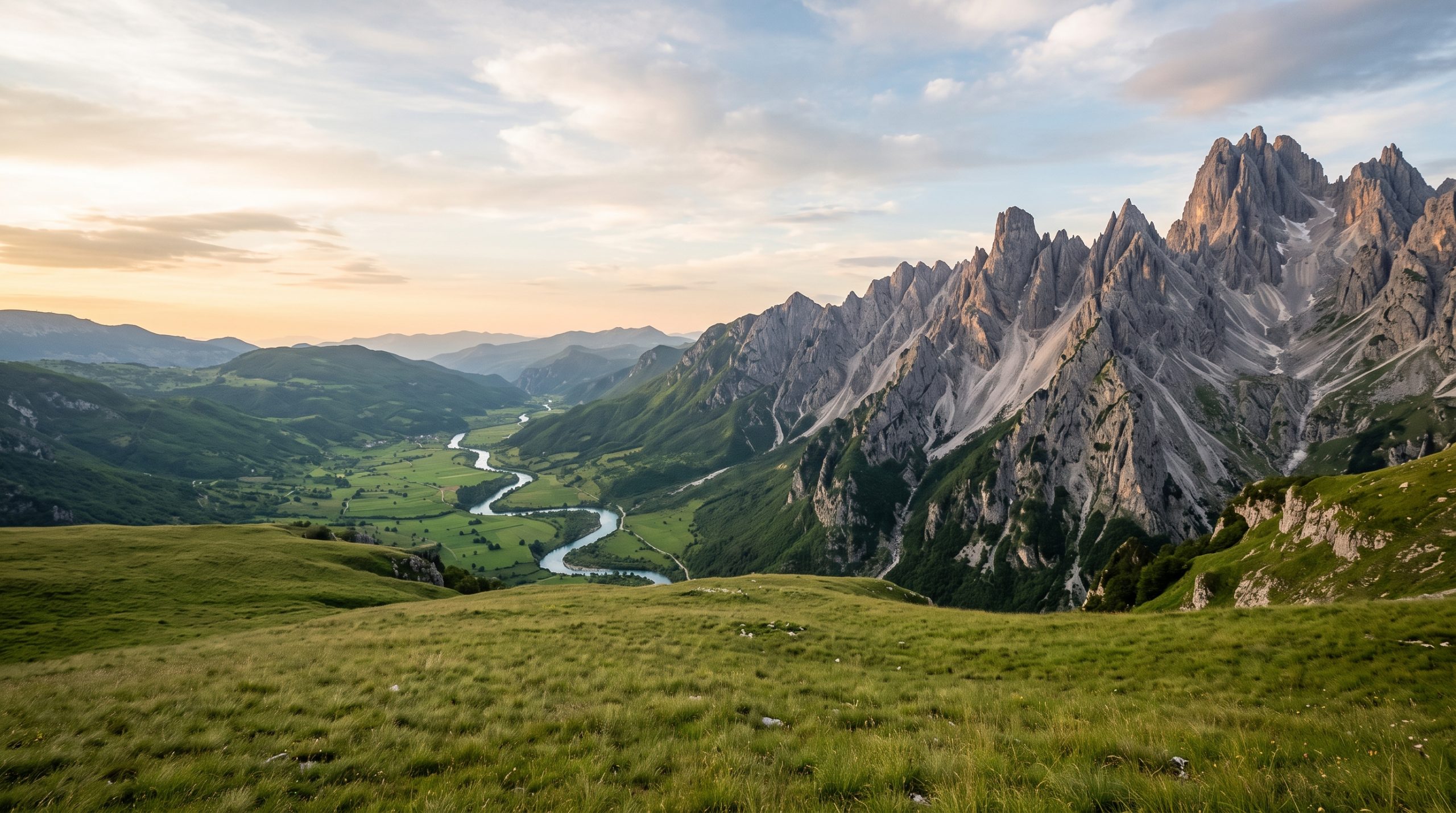
The Albanian legal route asks something very specific of you: both of you standing inside a municipal Office of Civil Status at least 11 days before your ceremony date, holding an apostilled birth certificate issued within the last three months and an affidavit that only the US Embassy in Tirana can produce. Most couples read that sentence twice.
Then they do the sensible thing. They sign the license at home, in their own county, and land in Albania with nothing left to file. The ceremony on the Llogara ridge above the Ionian, or up in the Valbona valley, becomes what they wanted it to be in the first place, which is a ceremony rather than an errand.
This is a guide to that version of the week: what a symbolic ceremony in Albania costs, what paperwork it does and does not need, and how we shape the day around light, access and the one morning boat out of Koman.
The symbolic Albania route keeps the registry out of the mountain day
A symbolic ceremony carries no legal weight in Albania, so it needs no notice period, no apostille, no translated birth certificate and no registry office. You marry legally at home before you fly, then hold the ceremony anywhere you have permission to stand. Cost sits in coverage, travel and access rather than in government fees.
What it costs, and what nobody charges you for
Start with the line that surprises people. A symbolic ceremony has no state fee attached to it anywhere in Albania. Nothing is filed, so there is no registration charge, no apostille bill, no notary translation to pay for, and no fee for a certificate that has to be legalized afterwards. The entire paperwork column of your budget disappears, and it does not come back in another form.
What remains is real but short. Our coverage begins at $4,900 for The Adventure, one full day with a dedicated photographer or a dedicated filmmaker, and at $7,900 for The Expedition, where a photographer and a filmmaker work the same day together, and the detail of what each one includes sits on its own page. Team travel is inside that figure worldwide, so flights and accommodation for the people we send to Albania are not a separate line for you to carry.
Then the local costs, which are yours and are genuinely modest by the standards of a destination wedding. If you want someone to lead the ceremony, an English-speaking celebrant is booked and paid separately, and plenty of couples skip that entirely and ask a friend or a parent instead. Access is the other one: Butrint takes an entrance fee per person at the kiosk inside the gate, cards are not reliably accepted there, and the same is true in most mountain villages, so we plan for lek in cash. A driver, a 4×4 for the upper valleys or a private boat along the Riviera is charged by whoever operates it. Accommodation, celebrant, flowers and anything you eat are yours as well.
Guest count does not move our fee. Ten people instead of two changes access, transport, the permissions we need to ask for and the timeline we build, and none of that changes what you pay us. Before non-refundable travel depends on the Albania process, reconfirm the latest fee and timing with the office responsible for it.
The 11 days that decide it
Here is our honest rating of the legal route in Albania for two visiting Americans: possible, well documented, and fiddly enough that it reshapes the whole trip. The US Embassy in Tirana is clear about the sequence: the marriage must be registered with the Office of Civil Status, the Zyra e Gjendjes Civile, and at least 11 days before the planned marriage both future spouses must appear at that office in person. Where neither of you holds Albanian citizenship, the office that handles you is the one covering your usual place of residence, which is exactly the clause that makes the route awkward for people arriving on a two-week trip.
So the legal marriage swallows the front half of your time in the country. That is a perfectly good trip if you want it, and a marriage registered in Albania is fully valid back in the United States, but it does mean choosing between two shapes of week. Registering at home costs you one short errand at your county clerk and buys back every day in Albania.
Albanian civil marriage is also registered between a man and a woman who are both at least 18, with court approval required below that age, and same-sex marriage is not recognized under the Albanian Family Code. For same-sex couples the symbolic ceremony is not a compromise but the actual route, and the country itself is warm, curious and increasingly used to couples arriving to do exactly this. Marry legally at home, then stand on a ridge in the Ceraunian mountains and mean every word of it.
| Step | Registering the marriage in Albania | Symbolic ceremony, license signed at home |
|---|---|---|
| Notice | Both of you appear at the Office of Civil Status at least 11 days before the date | None in Albania |
| Core documents | Birth certificate issued within three months, apostilled, then translated in Albania; affidavit of eligibility from the embassy in Tirana | Whatever your own county asks for, done before you fly |
| Witnesses | Two, present at registration, and not related to either of you | Anyone you like, or nobody at all |
| Where the ceremony can happen | Registration runs through the civil status office | Any ground you have permission to stand on |
| Certificate | Issued in Albanian, then needs an apostille from the Ministry for Europe and Foreign Affairs to use at home | Already in your hands before departure |
If you also want the Albanian legal route, this is the paper sequence
If you want the Albanian certificate anyway, and some couples do because Albania is where their family comes from, this is the sequence. Each item depends on the one above it, which is why order matters more than speed.
- Order a certified copy of your birth certificate. It must have been issued within the last three months, and the clock runs from the issue date, not from your ceremony date.
- Have that copy apostilled by the state that issued it. Albania is a party to the Hague Apostille Convention, so an apostille is the whole legalization route and no consular stamp is needed on top of it.
- Get the apostilled copy translated into Albanian. The translation is done on the Albanian side, at a licensed Albanian notary public, not by an agency at home.
- Obtain the Affidavit of Eligibility to Marry in the Republic of Albania from the US Embassy in Tirana. No American authority issues a certificate of no impediment, which is why this document exists and why it can only be produced in Tirana. The standard consular notarial fee is $50 per signature and is settled in advance online rather than at the window.
- If either of you was married before, add a certified copy of the divorce decree, apostilled and officially translated in the same way as the birth certificate.
- Bring passports and a copy of the biographic page of each.
- Both of you appear at the Office of Civil Status at least 11 days ahead, and two witnesses who are not related to either of you are present when the marriage is registered.
- Afterwards, the certificate is issued in Albanian. To use it in the United States it needs an apostille from the Legalization Office at the Albanian Ministry for Europe and Foreign Affairs, which is a separate errand after the registry is finished.
Use this as practical wedding-planning guidance for Albania. For a binding answer on your documents, ask the authority or consulate handling your file.
Start with the Albanian ceremony hour, then add only the paperwork you need
Work from the hour you want to be standing somewhere, and everything else falls into place behind it. This is how we build an Albanian timeline, and it is the same logic we use in our planning fundamentals.
- Twelve months to eighteen months out. The date is held and the region is chosen. North and south are different countries in practice, and this is the decision that shapes everything after it.
- Three months out. Locations are settled, access permissions are researched, and the ceremony hour is placed against sunrise and sunset for your actual date rather than an average one.
- Three to four weeks out. Your license paperwork at home is done or in motion, transport is confirmed, and the timeline goes to everyone who needs it.
- Three days out. You are in the country. Two nights of margin before the ceremony covers a delayed flight, a road closed for works, and the day the wind comes hard off the sea.
- The morning itself. One weather decision, one alternative already planned, and no improvising.
The real minimum for the symbolic route is short, and the only deadline we cannot see from here is your own county’s lead time on the license. The comfortable minimum, which is what we would actually work to, gives you those two nights of margin in Albania before the ceremony day. For the legal route, count 11 clear days on the ground plus the ceremony itself, add a day in Tirana for the embassy affidavit before that clock starts, and you are looking at roughly two full weeks in the country with the wedding sitting at the end of it.
The details nobody warns you about
The three-month window on the birth certificate is the one that quietly ruins timelines. Couples order documents early because they are organized, and a certificate issued eight months before the date is simply the wrong document by the time it reaches a counter in Albania. Order it late, apostille it fast.
The translation cannot come with you. The embassy’s own guidance sends you to a licensed Albanian notary public to have the apostilled birth certificate translated into Albanian, which means a beautifully bound translation from a service at home is money you did not need to spend. Budget an afternoon in Tirana or Shkodër for it instead.
The affidavit puts Tirana into your itinerary whether you planned on it or not. It is issued at the embassy, the fee is paid ahead rather than at the counter, and it has to exist before you start the 11 days. Couples who route Tirana to the end of the trip discover the sequence runs the other way.
Cash matters more here than in most of Europe. Park kiosks, village guesthouses and the smaller boat operators want lek in hand, and the machine in the last town before the mountains is not somewhere to place a bet. We tell couples to draw cash in Shkodër, Sarandë or Tirana and carry more than feels necessary.
Two small border details are worth thirty seconds of your attention. US citizens need no visa and may stay up to a year without a residence permit, but your passport must have at least three months of validity remaining, and officers increasingly record your entry electronically instead of stamping the page, so keeping your boarding pass is a sensible piece of proof to hold on to. Neither of these ever becomes a problem when it is checked in advance.
Who reads the vows, and where you stand
Nobody needs a license to lead a ceremony that registers nothing. That opens the whole thing up. A friend can do it, a parent can do it, an English-speaking celebrant can do it in two languages, and some of our favorite Albanian mornings have been two people alone with their own handwriting and nobody else within a mile. You choose the order, the readings, the length and whether anyone speaks at all.
Where you stand is a light problem before it is anything else. The Riviera between Vlorë and Sarandë faces roughly west, with the Ceraunian mountains standing behind it, so the beaches sit in shade well into the morning while the sea keeps the whole of the sunset. That single fact reorders most Albanian coastal days: vows late, dinner later, and the swimming in the middle when the light is flat anyway. In the north the constraint is transport rather than the sun, because the Berisha boat currently leaves Koman at 9:00 and comes back out of Fierza at 13:00, and a day built around Lake Koman is really a day built around those two departures.
We will also tell you what a guide with something to sell will not. Ksamil in August is loud and busy by nine in the morning, and the beaches everyone photographs are the ones everyone else is standing on. Butrint rewards the first hour after the gate opens and very little after that. Gjirokastër’s stone lanes hold beautifully in almost any weather, which is why we keep the town in reserve for days when the coast is blown out. The high northern valleys stay under snow long after the coast has warmed up, so an April date belongs on low ground and a Theth ceremony belongs to summer. Tell us what kind of morning you actually want, and we will either build it or tell you honestly which month in Albania delivers it properly, and our destination guides are a good place to start narrowing that down.
This is the one place the two-camera arrangement earns its keep. When the ceremony hour is pinned to the last twenty minutes of light on a ridge, nothing can be repeated for a second angle, so the photographer holds the close frames and the filmmaker holds the wide while both are happening once. On The Expedition we run professional audio for the vows where conditions allow, which matters on an Albanian ridge, because wind is the thing that eats spoken words. Highlights reach you five days after the ceremony and the full gallery or film lands within three weeks, and our published stories and films will show you what that looks like in practice better than any paragraph here can.
If you already have a month in mind and a rough idea of the shape you want, that is enough to start with. Send Us a Message and we will come back with what is realistic for that week.
Common questions
Is a symbolic ceremony in Albania legally binding?
No, and that is the point of it. Nothing is registered, so no notice period, apostille or translation applies. The legal marriage happens at home, before or after the trip, and the ceremony in Albania carries all the meaning without any of the filing.
Do we need a marriage license before we fly to Albania?
Only if you want to be legally married by the time you leave home. Many couples sign at their county clerk a week or two before departure and treat the Albanian ceremony as the real one. Others hold the ceremony first and register when they get back. Both work.
Can we legally get married in Albania as visitors?
Yes, though it takes planning. Both of you must appear at the Office of Civil Status at least 11 days before the date, and where neither of you is an Albanian citizen the office handling you is the one covering your usual place of residence, so confirm with that specific office which municipality will register you.
Do we need witnesses for a symbolic ceremony?
Not legally. Witnesses are a requirement of registration, and a symbolic ceremony registers nothing. If you are taking the legal route in Albania, two witnesses must be present when the marriage is registered and neither can be related to either of you.
Can two women or two men have a ceremony in Albania?
Yes. Same-sex marriage is not recognized under the Albanian Family Code, so the legal marriage happens at home, and the ceremony here is symbolic. Practically nothing about the day changes: same locations, same hour, same vows, same coverage.
Who can officiate our symbolic ceremony in Albania?
Anyone you choose. A friend, a sibling, a parent, or an English-speaking celebrant hired locally and paid separately from our coverage. Because there is no legal function to perform, there is no credential to check.
Do we need a permit for a ceremony on a beach or in a national park?
There is no marriage permit, because no marriage is being registered. What you may need is permission to use the ground, from a park authority, a landowner or a hotel, and an entrance fee where one applies. We research that and guide the logistics; the fees themselves are paid by you.
How far ahead should we book photography and film for Albania?
Our planning calendar is open for 2027, 2028 and 2029, and the northern valleys and the Riviera are planned around different months, so writing to us early gives us more to work with. Once a contract is signed and the 30% retainer is paid, planning begins and the date is yours.
What we take off your hands for the Albanian symbolic route
Our side is the design and the logistics: destination and location choices, a timeline built around real travel time and the light on your actual date, permit research, access permissions, weather alternatives held in reserve, and the ceremony hour placed where it belongs. Your side is the legal marriage, the celebrant if you want one, accommodation, permit fees themselves and any unusual transport. We are not the people who file your paperwork, and we will always say so plainly.
All of it runs in writing. You write to us, we reply with an initial brochure within 24 hours, and a tailored proposal follows, so nothing has to be arranged live across a six-hour time difference. When you are ready, tell us the month, the region and the kind of morning you want to wake up to, and we will tell you exactly how the Albanian version of it works. Tell Us Your Story.