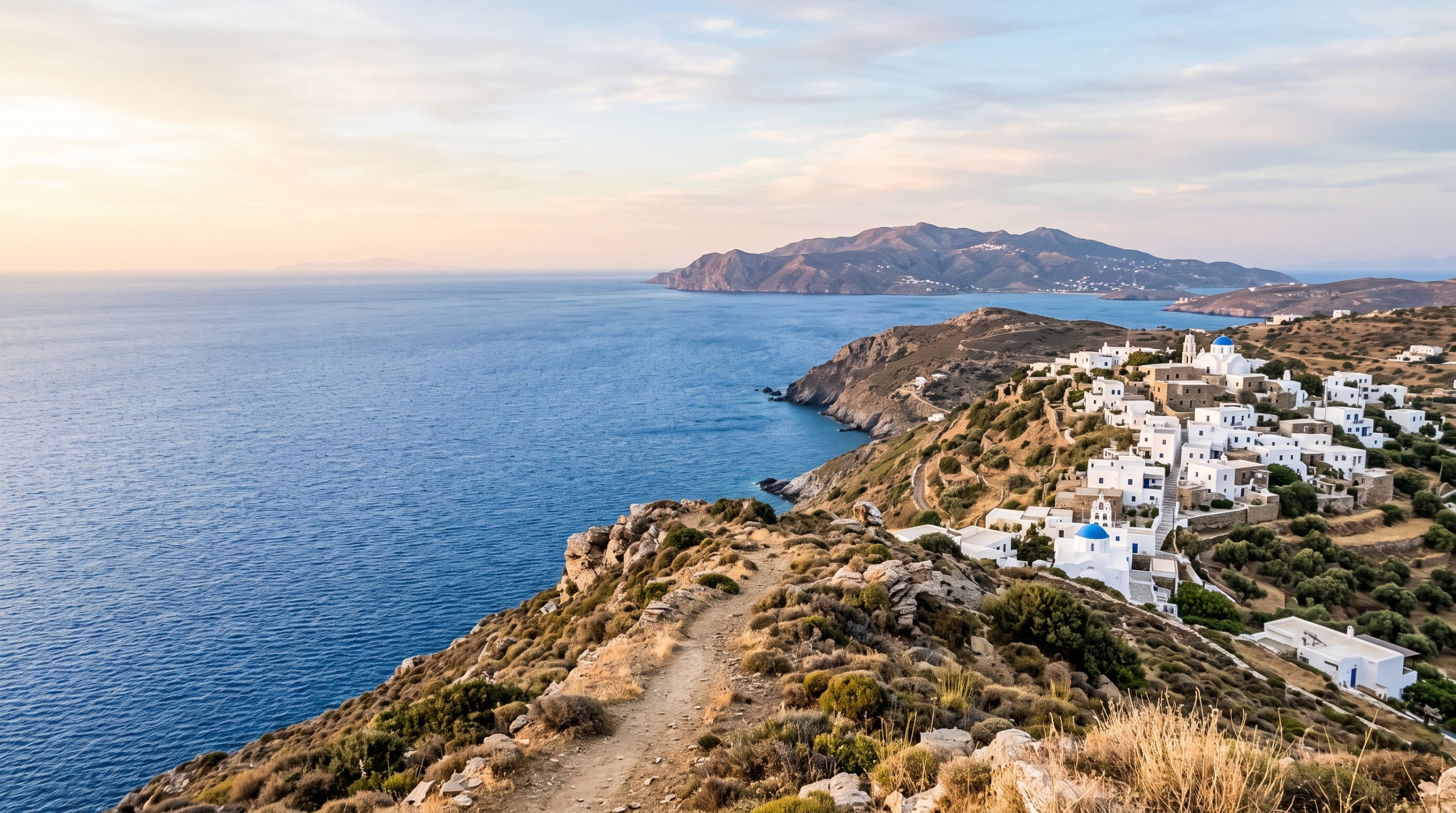
The causeway out to the Portara at Naxos Chora is short enough to walk in a couple of minutes. In mid-June, sunset falls at 20:40 and that stone is shoulder to shoulder long before it, cameras up, everyone waiting for the same frame through the same marble doorway. At 05:10 the next morning it is yours. Civil twilight opens at 05:27, sunrise is logged at 05:58, and the sun needs a few minutes more to clear the hills behind town and land on the doorway from the landward side.
Paros runs on the same clock and looks nothing like it. Naoussa harbor at 06:00 has fishermen and no tables set out. The weathered granite at Kolymbithres, ten kilometers from Parikia, stays empty until the first water taxi crosses the bay mid-morning. Naxos tops out at 1,004 meters on Zas, the highest point in the Cyclades, and drives like a small country. Paros reaches roughly 770 meters at Profitis Ilias and does most of its work at sea level, in marble and whitewash. The boat between Parikia and Naxos Chora takes well under an hour, which is why we treat the two islands as one planning problem rather than two shortlisted options.
This page is about money. So here is the shape of it: what we charge for photography, film and planning, what the Greek state charges for the paperwork, and what the islands add on top. There are no view minimums to clear here and no guest multiplier on our side. Most of the cost of a good day out here is paid in timing rather than in cash.
The cost picture for Paros and Naxos in one paragraph
We plan, photograph and film elopements on Paros and Naxos as one team. A full day with a dedicated photographer or a dedicated filmmaker starts at $4,900, with team flights and accommodation included. What you pay locally is Greek paperwork fees, your rooms, a celebrant, and whatever boat or car the day genuinely needs.
A mid-June day on Naxos, 05:10 to 21:11
This is the shape we build most often out here. Every time in it comes from the actual sun on these islands, not from a template.
04:50. Out of the room in Chora. Nobody is awake except the bakery and one street cleaner. 05:10. On the causeway at Palatia with the sea flat and the marble still dark. Civil twilight opens at 05:27 and the stone turns cool blue, and there is no queue, no tripod line, no waiting for a gap.
06:15. Up into the Kastro. The Venetian lanes, the marble stairs, the low arches under the old tower. Shops stay shut until mid-morning, so for an hour the old town belongs to whoever got up. 07:15. Breakfast somewhere with a chair, because the next move is a drive.
08:15. Chora to Filoti is around 20 kilometers and half an hour on the ring road, and it climbs the whole way. The Aria spring path onto Zas starts above the village. Terraces, drystone walls, goat bells, and light still coming in sideways. If you want the summit at 1,004 meters, that is a morning of its own and we plan the rest of the day around it.
11:00 to 16:30. Honestly, this is the weakest light of the day. Overhead, hard, and in July or August the north wind is usually building through the afternoon as well. Chora is at its busiest and nothing photographs the way it did at six. We do not fight it. This is the window for the town hall slot, for lunch, for a swim, for the drive to wherever the evening happens.
17:00. Vows. If you are marrying at the town hall, that slot belongs to the municipality and its office hours, and it is short. Everything else is built around that fixed point, which is why we ask for the ceremony time before we write a timeline. Away from the town hall, a courtyard in Halki or an olive terrace above Filoti gives you shade, quiet, and walls that keep the wind off your voices.
18:30. West coast. Plaka’s sand runs for kilometers, Mikri Vigla has granite to stand on, and the cedars behind Alyko grow straight out of dunes. The sun sets behind Paros from here, and on a clear evening you can see the island you are not standing on.
20:40. Sunset. The light does not stop there. Civil twilight holds until 21:11 in mid-June, and the sand keeps a soft pink glow for a good twenty minutes after the sun has gone. That last stretch is where the quietest frames of the day usually happen, once the wind drops and the beach empties.
21:20. Back into Chora with the lanes lit. Dinner is yours, and we are done.
Mid-September rewrites all of it. Sunrise moves to 07:00 and sunset to 19:27, so the day is a little over two hours shorter, the middle of it is workable again, and the sea is at its warmest. Couples who want the 05:10 causeway and couples who want to start at seven are both right. They want different months, and telling us which one you are changes the island we suggest as well as the week.
What the second camera changes when the meltemi is up
The meltemi is the dry north wind that runs hardest across the Cyclades in July and August. It is the reason Golden Beach on Paros is a windsurfing venue and Mikri Vigla on Naxos is a kite spot. It is also the single condition that separates a photographer’s ideal morning from a filmmaker’s.
A photographer wants that wind. Fabric horizontal, hair up, sea white behind you, the whole coast alive. A filmmaker needs your vows to be audible, and a microphone on an exposed headland at Force 6 hears nothing but the wind. If those two people were hired separately and met on the morning, one of them loses that hour, and it is usually the film.
Because photography, film and planning are the same service here, that argument never happens on your day. It happens weeks earlier, on paper. We put the vows on the lee side of a headland or inside a village courtyard where the Expedition’s audio kit can actually hear you, then take the exposed ridge afterwards for stills, where wind is a gift rather than a problem.
Eight of us work under this name, four photographers and four filmmakers, so there is always a second camera on the ground and a colleague in reserve. On a morning like the one above, one of us is across the causeway on a long lens while the other is at your shoulder catching what you say to each other. Both halves are on our published stories and films, which answers what these islands look like on film better than anything we could write here.
Aerials are part of that plan, not an afterthought. Drone work in Greece runs under European rules with the Hellenic Civil Aviation Authority overseeing them, archaeological sites need their own permission from the Ministry of Culture, and the Naxos runway sits between Chora and Agios Prokopios, which quietly rules out a stretch of very photogenic coast. We check the zone and the window before we build any part of the film around a shot from above, and we include drone footage wherever it is legal, safe and appropriate.
If the wind moves the boat, the day still happens
This is the worry couples write to us about more than any other for the Cyclades, and it deserves a straight answer rather than reassurance. In high summer the meltemi occasionally rearranges a ferry timetable for a day. That is a planning problem with known solutions, and we solve it in advance rather than at 07:00 on the morning.
Our team travels in ahead of your date, not on it, and we ask you to do the same by at least a day. Parikia and Naxos Chora are under an hour apart, so if the vows are set on one island and a second morning was planned on the other, we swap the order instead of losing anything. Every coastal hour we build has a sheltered alternative inland within about twenty minutes: on Naxos the lanes of Halki and the terraces above Filoti, on Paros the old marble road at Lefkes and the quarry ground at Marathi, where the north wind simply does not reach. Your date is held by contract, and if the sea reshuffles a timetable then the timeline moves, not the coverage.
One date we will always flag: 15 August. Dekapentavgoustos is the biggest domestic travel day of the Greek year, and every boat, room and taverna on both islands feels it. In 2027, Orthodox Easter falls on 2 May, which is the other week where the islands fill with Greek families rather than foreign visitors. Neither is a reason to stay away. Both are reasons to book earlier and to hear it from us now.
Send us the week you are thinking about and the island you are drawn to, and we will tell you what the light and the wind are usually doing then. Check Your Date.
What we bring, where coverage starts, and what Greece bills separately
Included in every Paros or Naxos elopement
- Destination and location design across both islands, including the inland ground most visitors never drive to.
- Full planning support and a custom timeline built around real sunrise and sunset times and real travel time, ferries included.
- Permit research and logistics guidance, so you know which sites need paperwork before you fall for them.
- Weather alternatives and backup planning for wind, heat and a changed boat.
- Drone footage where it is legal, safe and appropriate.
- Professional audio for vows and other meaningful moments on the Expedition, wherever conditions allow it.
- Team travel worldwide: flights, accommodation and ordinary travel for the assigned team, with no long-haul surcharge and no distinction between Europe and anywhere else.
- Highlights delivered in 5 days. The full gallery or film in 3 weeks.
Where coverage starts
The Adventure is one full day with either a dedicated photographer or a dedicated filmmaker, at the figure in the second paragraph of this page. The Expedition is one full day with a dedicated photographer and a dedicated filmmaker working together, from $7,900. The Odyssey runs two to seven days across one or several islands, which out here might mean Naxos, Paros and a morning on Koufonisia, and it is quoted as a written proposal because no two multi-day routes are alike. Full detail sits on our coverage and pricing page. Guest count does not change any of it. It changes access, permits, transport and the timeline.
Paid locally, in euros
- Greek paperwork. A state fee per person for the marriage license, paid online through the e-paravolo system and currently under 20 euros each, plus certified Greek translations of your apostilled documents. American couples also pay a 30 euro paravolo to have the Affidavit of Marriage authenticated by the Greek Ministry of Foreign Affairs.
- Your celebrant or the municipal registrar, and an interpreter where the municipality asks for one.
- Accommodation, plus the per-night stay fee Greek properties add according to their category.
- Wheels. A hire car for two or three days, or a driver on the day itself. On Paros, add the Pounta crossing to Antiparos if you want that morning, which is a matter of minutes on the water.
- Boats. A private caique for a morning is the line item that moves a Cyclades budget most; a seat on the regular boat to the Small Cyclades costs a fraction of it.
- Permit fees themselves, where a site, landowner or municipality charges one. Professional work at archaeological sites is licensed through the Ministry of Culture and the Ephorate of Antiquities of the Cyclades, and the park at Agios Ioannis Detis on Paros has its own gate.
- Flowers, hair and makeup, which on both islands generally travel to you rather than the other way round.
If a cost belongs on that second list, it appears in your proposal with a euro figure beside it before you sign anything. Planning fundamentals for couples still deciding on the country sit in our guide to how to elope, and the location research lives in the elopement guides.
Six steps from first email to a held date
- You send the inquiry form with your dates, your island, and whatever shape of day you already have in your head.
- We reply within 24 hours with our initial brochure and real questions about your week.
- We write a tailored proposal: the team assigned to you, the coverage, the euro costs that belong to Greece, and a first sketch of the day.
- You sign the contract and pay a 30% retainer. That holds your date and your team. The remaining payment steps are set out in the proposal.
- Planning begins in earnest. Location design, the hour-by-hour timeline, permit research, and the sheltered alternatives we hope not to use.
- After the day, highlights reach you in 5 days and the full gallery or film in 3 weeks.
Dates are currently open across our 2027, 2028 and 2029 Cyclades seasons, and the paperwork chain for a Greek civil marriage is the slowest moving part of it, which is the honest argument for starting earlier than feels necessary.
Choosing Paros or Naxos by the day you actually want
Naxos suits couples who want a mountain as well as a coastline. It is the largest island in the Cyclades and it rewards driving: 20 kilometers to Filoti, close to 50 to the unfinished kouros above Apollonas, marble-paved Apiranthos on the way. If a morning that starts at 05:10 and ends with a climb sounds right to you, this is your island.
Paros suits couples who want everything within reach. Nothing is much more than half an hour from Parikia, Naoussa gives you a working harbor and lanes to walk at dawn, Kolymbithres gives you granite, and Antiparos is a short crossing from Pounta. It is also the easier island to combine with a second one.
If pre-dawn starts are not who you are, say so plainly in your first email. There is a version of both islands that begins at 07:00 in late September, keeps the middle of the day for the sea, and puts the vows into the long light before a 19:27 sunset. If uneven ground is a concern, the marble road at Lefkes, the village lanes of Halki and both harbor fronts work in shoes you can actually walk in, and we will keep the Zas path out of your timeline. If your parents and two friends are flying in, bring them: the fee does not move with guest count, though access and transport need more thought.
The only shape we cannot plan around is the one we do not know about. Tell us what you actually want from the day, including the parts that sound unromantic, and we will either build it or tell you honestly which month or which island fits it better.
Common questions
Is eloping on Paros or Naxos cheaper than Santorini?
Our fee is identical in every destination because team travel is included worldwide, so the difference sits in local costs. Neither island carries caldera-view venue minimums, rooms in Naoussa or Naxos Chora sit below their Santorini equivalents in the same week, and far fewer cruise passengers means fewer people between you and the light you came for.
Can two Americans legally get married on Naxos or Paros?
Yes. Your documents are apostilled at home and translated into Greek, the Affidavit of Marriage is authenticated by the Greek Ministry of Foreign Affairs with a 30 euro paravolo, and the license is issued by the municipality where you are marrying. None of that is same-day work, so we start the chain months out and tell you exactly what needs to be in whose hands and when.
How many days before our date should we arrive on the island?
Two full days is our strong preference, three if you are flying from the US. That buys a night to sleep off the journey, a clear window for the town hall paperwork, and enough slack that a rearranged boat is an inconvenience rather than a redesign.
Do we pay for your flights and hotels in Greece?
No. Flights, accommodation and ordinary travel for your assigned team are included in every experience, in every destination, with no European or long-haul distinction. What you pay in Greece is on the euro list above.
What happens if our ferry does not run the day before the wedding?
We are already on the island, because our team travels in ahead of your date. If your own crossing shifts, we move the timeline rather than the coverage, and the sheltered inland alternatives we planned for wind work equally well for a late arrival.
Can we cover both Paros and Naxos in one elopement?
Yes, and the short crossing between them is what makes it practical. Two islands over two or more days is the Odyssey, which runs from two to seven days, can take in the Small Cyclades as well, and comes to you as a custom written proposal.
Do we need a permit to fly a drone at the Portara or Kolymbithres?
Aerials in Greece run under European rules with the Hellenic Civil Aviation Authority overseeing them, and archaeological sites additionally require permission from the Ministry of Culture. Airport zones matter here too. We research every permit your locations need and guide the applications, and any fee charged is paid by you.
When do we get our photos and film after the day?
Highlights reach you within 5 days, while you are often still on the island or on your way home. The full gallery or the finished film follows within 3 weeks.
We handle the planning in writing so nothing depends on matching time zones
Every part of this is written down. You write, we write back inside 24 hours with a brochure and real questions, and the whole plan builds in text you can reread at midnight in your own time zone. Give us the week, the island you cannot stop thinking about, and which you would rather have: the empty causeway at 05:10 or the sand at 20:40. Tell Us Your Story.