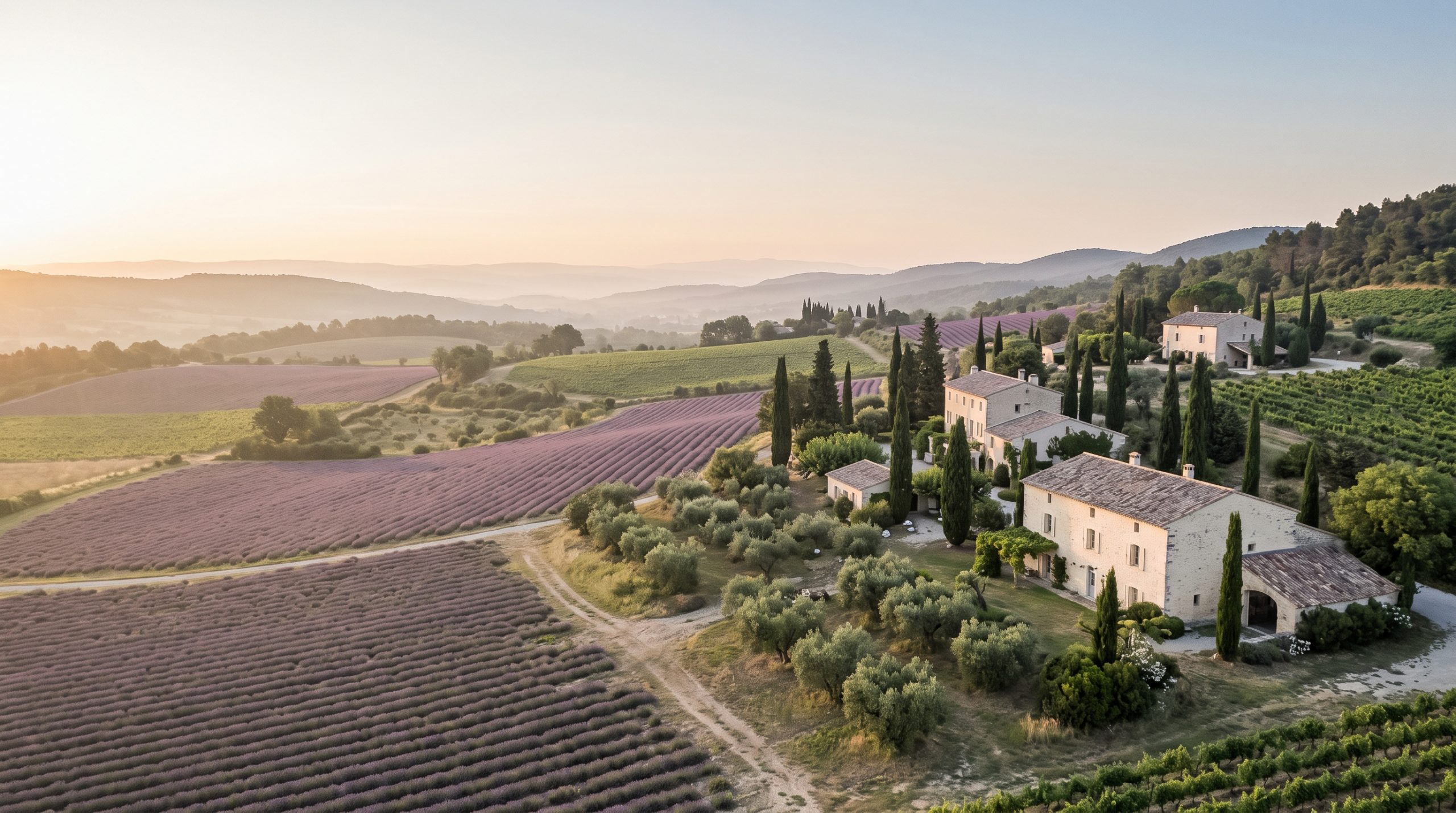
On the Valensole plateau in the first week of July, the sky begins to hold light at around 5:22am and the last usable frame of the evening comes at about 9:58pm. Sixteen and a half hours, end to end. Couples plan for sunrise and sunset without quite registering how far apart those two things sit in a Provençal July, and then the day arrives with a seven-hour hole in the middle of it.
The other number governing your date is agricultural. The Alpes-de-Haute-Provence tourism board tells visitors to plan the plateau between mid-June and mid-July, with the flowers usually peaking in early July and the harvest starting around the middle of the month. Higher up around Sault, the season starts in July and runs into August. The overlap between peak color and the longest days of the year is roughly two weeks wide, it shifts with the weather, and it is what your date is really buying.
So this page is about what a Provence day costs: what we charge, what France charges, and what the difference actually buys you on the ground at six in the morning. We are photographers, filmmakers and planners in one team of eight, which is why that first hour on the plateau looks the way it does in our work instead of the way it looks when one person is trying to cover it alone.
Provence elopements, in one paragraph
We photograph, film and plan elopements across the Luberon and the Valensole plateau as one team of eight. One full day with a dedicated photographer or a dedicated filmmaker starts at $4,900. One full day with both working side by side starts at $7,900. Team travel to France is included in every experience. Permit fees are yours.
Sixteen and a half hours of July light, and how we spend them
The alarm goes at 4:45am. That is not a flourish, it is arithmetic: the plateau villages sit ten to twenty minutes from the fields, and the light we are driving toward does not wait. By 5:05am you are on an empty road with the windows down and the whole plateau still the color of slate.
At 5:22am the rows read as texture rather than color. This is the hour nobody photographs and it is one of the best ones, because the shapes are clean and there is no wind yet. Bring a layer. Provence at dawn in July is cool enough that people who packed only for the heat are always surprised.
Sunrise is at about 5:58am, low and slightly north of east, which means it comes in along the rows rather than across them. For the next forty minutes the light rakes down the furrows and everything glows from the side. That is the frame people picture when they imagine this place, and it exists for about as long as it takes to drink a coffee.
Then it changes, and we may as well be honest about how. By 7:15am the first cars are pulling up at the two or three lone trees you have seen on the internet, and people are climbing into rows that belong to somebody’s working farm. By mid-morning the narrow road down to the Abbaye de Sénanque below Gordes is a parked line. None of that is a problem if you are already finished. It is the entire problem if you were planning to start at nine.
So we finish. Breakfast happens somewhere with shade around 8:30am, and then the middle of the day goes deliberately quiet. Between about 10am and 5pm the sun is close to vertical, the plateau turns white, and heat shimmer eats the long-lens frames that worked so well at six. Fighting that is pointless. Instead we put those hours under stone: a courtyard, a shuttered room in a mas, a lunch that runs two hours, whatever getting-ready frames you want made in one-sided light through a half-open shutter. If your base is the Luberon rather than the plateau, this is also the hour to know that Gordes charges for parking every day from 8am to 7pm, which is another small argument for being in the village at six and out of it by nine.
At 6:30pm we go out again, usually to different ground than the morning. The ceremony sits at about 7:45pm, with the sun still up but dropping and the heat off the stone. Golden hour then runs from roughly 8:20pm until sunset at 9:22pm, which is a genuine full hour of it rather than the twenty rushed minutes you get in a Scottish October. Dusk carries on until nearly 10pm, and the rows go grey-violet in a way that only shows up on a sensor, not to the eye.
Dinner at 10pm is a normal hour to sit down here. That is the shape of a Provence day, and it is the opposite of a mountain day: two intense ends, a long soft middle, and no need to hurry between them. We build the whole thing backward from those two clock times, and we say so in more detail across our destination elopement guides.
When the harvest arrives early
This is the thing couples write to us worried about, and they are right to. The plateau sits below the 800-metre line where fine lavender grows, so its big geometric rows are lavandin, and lavandin comes and goes earlier than the fine lavender on the higher ground around Sault. Harvest on the plateau generally begins around mid-July, and in a hot dry year it starts sooner. A date chosen from a photograph taken three summers ago is a guess.
The answer is altitude and a plan with layers. We build lavender days with a primary field, a second field several hundred metres higher, and a third location that does not depend on lavender at all: the ochre at Roussillon, wheat that is gold at exactly the same hour, the turquoise water below the Verdon. If the plateau is cut when you arrive, the day still has a spine. Nothing about your timeline collapses because a tractor came through on Tuesday.
| Window | Plateau sunrise and sunset | What is standing in the fields |
|---|---|---|
| Mid-May | 6:11am and 8:55pm | Rows green and shaped, poppies in the wheat, no purple yet |
| Late June | 5:55am and 9:22pm | Color climbing fast, plateau close to peak |
| First week of July | 5:58am and 9:22pm | Usual peak on Valensole, higher ground still coming |
| After mid-July | 6:12am and 9:12pm | Harvest underway below, Sault running into August |
| Late September | 7:26am and 7:29pm | Cut fields, vines turning, cold clear mornings |
If you already have a fixed week, send it to us and we will tell you honestly what tends to be standing then and which altitude to build the day around. If the week is still open, we will tell you which one we would pick.
Two cameras on a plateau with no shade
The argument for two disciplines on one day is usually made in the abstract. On this plateau it is concrete, and it comes down to a single forty-minute stretch.
At 6:05am the two best frames on the plateau require two opposite positions. One is a long lens from 200 metres back, lying low in a furrow, compressing the rows until you read as two small figures inside a purple grid. The other is 24mm, moving, walking backward down the same furrow with a gimbal so the rows rush past the lens. A single person has to choose, and whichever they choose, the other one is gone forever, because by 10am heat shimmer has softened every long lens on the plateau and the compression frame will not come back until evening. Two of us means both exist, made at the same moment, in the same light, of the same forty minutes.
Wind is the second reason. When the mistral gets up, lavandin moves in sheets and it is one of the most beautiful things you will ever see on film. It is also the enemy of vow audio. The Expedition adds professional audio for vows and the moments that matter, which is what makes speech survive a day like that, and we place the ceremony with stone or a treeline upwind and hold a sheltered alternative in the folds below the plateau, fifteen minutes away.
Aerials are the third. The shot straight down the rows, where the geometry of the plateau finally makes sense, is the one that stops people scrolling. It runs on a permit and a time window, so we confirm both before we build any part of the film around it, and in the villages and above the abbey we plan for ground work instead. That decision gets made in the planning stage, not at 6am with a drone in a bag.
Then there is everything a microphone picks up that a still frame cannot. Bees working the rows at 6:30am. Cicadas the moment the stone warms. A tractor two fields over. Someone who was there at 6:30am has all of it. Someone who arrived at nine has traffic. You can see how the two disciplines sit together across our published galleries and films, including how differently Provence reads at each end of the day.
Being eight people is the quiet part of this. There is always a second camera on the ground and a colleague in reserve, which matters more in a place where the whole day rests on two short windows.
What travels with us, and what Provence adds in euros
Every experience, from a single-discipline day upward, includes the planning as well as the shooting. That is the part couples underestimate when comparing us with a photographer who arrives on the morning with a location list from Pinterest.
- Destination and location design across the Luberon, the plateau and the Verdon.
- A custom timeline built around the actual light and real travel time between villages, not optimistic drive estimates.
- Permit research and logistics guidance for the sites you want.
- Weather alternatives and backup planning, including the sheltered options for a mistral morning.
- Drone footage where it is legal, safe and appropriate.
- Professional audio for vows and meaningful moments on the Expedition, where conditions allow.
- Team travel worldwide: flights, accommodation and ordinary travel for the assigned team, with no European or long-haul distinction.
- Highlights delivered in 5 days. Full gallery or film in 3 weeks.
Your guest count does not change the fee. It changes access, permits, transport and the timeline, so we need to know about it early, but two people and twelve people cost the same to cover.
What Provence adds on top is paid in euros and paid by you. Permit fees where a site, commune or landowner charges them. A location fee if you want a private mas or domaine for the ceremony. Your celebrant. Accommodation, plus the taxe de séjour that Provençal communes add per person per night. A hire car, which is not optional out here, because there is no useful bus between the plateau villages. Village parking. Gordes charges every day from 8am to 7pm and a four-hour visitor stay currently runs around 8 euros, which tells you most of what you need to know about arriving at nine. And unusual transport if you want it: a balloon over the Luberon, a boat on Lac de Sainte-Croix, a 4×4 to reach a track a hire car should not attempt. The full breakdown of what each level of coverage covers sits on our pricing page.
From your first message to first light
- Send the inquiry form with your dates, or the week you are circling, and what you want the day to feel like.
- We reply within 24 hours with our initial brochure.
- We put together a tailored proposal for your dates, your destination and the coverage that fits.
- You sign the contract and pay a 30% retainer.
- Planning begins: location design, the timeline, permit research, the weather alternatives.
- The remaining payments are set out in your proposal, so nothing about the money is a surprise later.
We currently have Provence elopement dates available through 2027–2029. For lavender weeks specifically, the useful thing to know is that everyone is aiming at the same fortnight, so the earlier a 2028 date lands with us the more choice you have over which field and which hour. If you are still working out the shape of the thing rather than the date, our guide to how to elope covers the fundamentals first.
Who the plateau rewards
Provence suits couples who will genuinely get up at 4:45am, once, for the only quiet hour the plateau has. It suits people who are fine on rutted farm tracks and dry stone in the dark, and who do not mind that the exact field can change by twenty minutes’ drive on the morning because a harvest started early. It especially suits couples who want a long, slow, hot middle of the day rather than a plan that runs flat out from dawn to dusk. This is one of the few destinations where the gap is the point.
If July heat and July cars are not what you are picturing, that is worth telling us rather than working around. Mid-May gives you green shaped rows, poppies in the wheat and a 6:11am sunrise, with hardly anyone on the roads. Late September runs from a 7:26am sunrise to a 7:29pm sunset, with cut fields, vines going copper and mornings cold enough for a coat, and it is quietly the most beautiful light of the year here. There is also higher ground where the bloom runs later into the summer if purple is non-negotiable. Tell us which of those sounds more like you and we will build the month around it, or say plainly which one we would choose in your position.
Common questions
Can we legally get married in Provence as Americans?
Not on a normal trip. France asks that one partner establish residence in the commune for a month of continuous residence before the banns can be published, and the civil marriage then has to happen in that commune. Almost every couple traveling in handles the legal side at home and holds the ceremony that actually matters here, with a celebrant and their own vows.
When exactly is the lavender purple on the Valensole plateau?
The tourism board for Alpes-de-Haute-Provence tells visitors to plan between mid-June and mid-July, with the peak usually in early July and the harvest beginning around mid-July. The higher ground near Sault starts in July and carries into August. Warm, dry springs pull all of it earlier, which is why we plan across two altitudes rather than one field.
Can we stand in the lavender fields for photographs?
Those rows are somebody’s crop, and the difference between a welcome and a problem is asking first. Part of what we do in planning is establishing who farms the ground we want and arranging access properly, which is also how we end up in fields that are not the three everyone else is standing in.
Is Provence too hot to elope in July?
Not if the day is built correctly. The heat is a midday problem, not an all-day problem, and both ends of a July day are long, cool and workable. We shoot from about 5:20am and again from 6:30pm, and we put the hours in between under stone rather than pretending they are usable.
Can we do the Luberon villages and the Valensole plateau on the same day?
Both, yes. Both at sunrise, no. Gordes to the plateau is roughly an hour and a half of driving on small roads, so we give one of them the morning and the other the evening, or we base the day in one and treat the other as a second day. Trying to catch both at 6am is how couples lose the light entirely.
Are drone shots allowed over the lavender fields?
In places and within rules. Aerials run on a permit and a time window, so we confirm both before planning any of the film around them, and where flight is not appropriate we plan ground movement that gets the same feeling. Drone footage is included in every experience wherever it is legal, safe and sensible.
How soon do we get the photos and film?
Highlights reach you in 5 days, while you are still somewhere in France or just home. The full gallery or the finished film follows within 3 weeks.
How far ahead should we book a 2027 lavender date?
As soon as the fortnight is roughly settled. We currently have Provence elopement dates available through 2027–2029 now, and the peak lavender window is a two-week target that everyone shoots at, so early inquiries get the wider choice of team, field and hour.
Starting your 2027 date
We keep the planning in one written thread, at whatever hour suits you and from whichever time zone you are in. You send the form, we reply within 24 hours with the brochure, and the proposal follows. No back and forth to arrange, nothing to fit into a working day, just a written conversation about a plateau at 5:22am and what you want to happen there.
Tell us the week you are looking at, or the week you are torn between, and we will tell you what the fields and the light are usually doing then. Tell Us Your Story