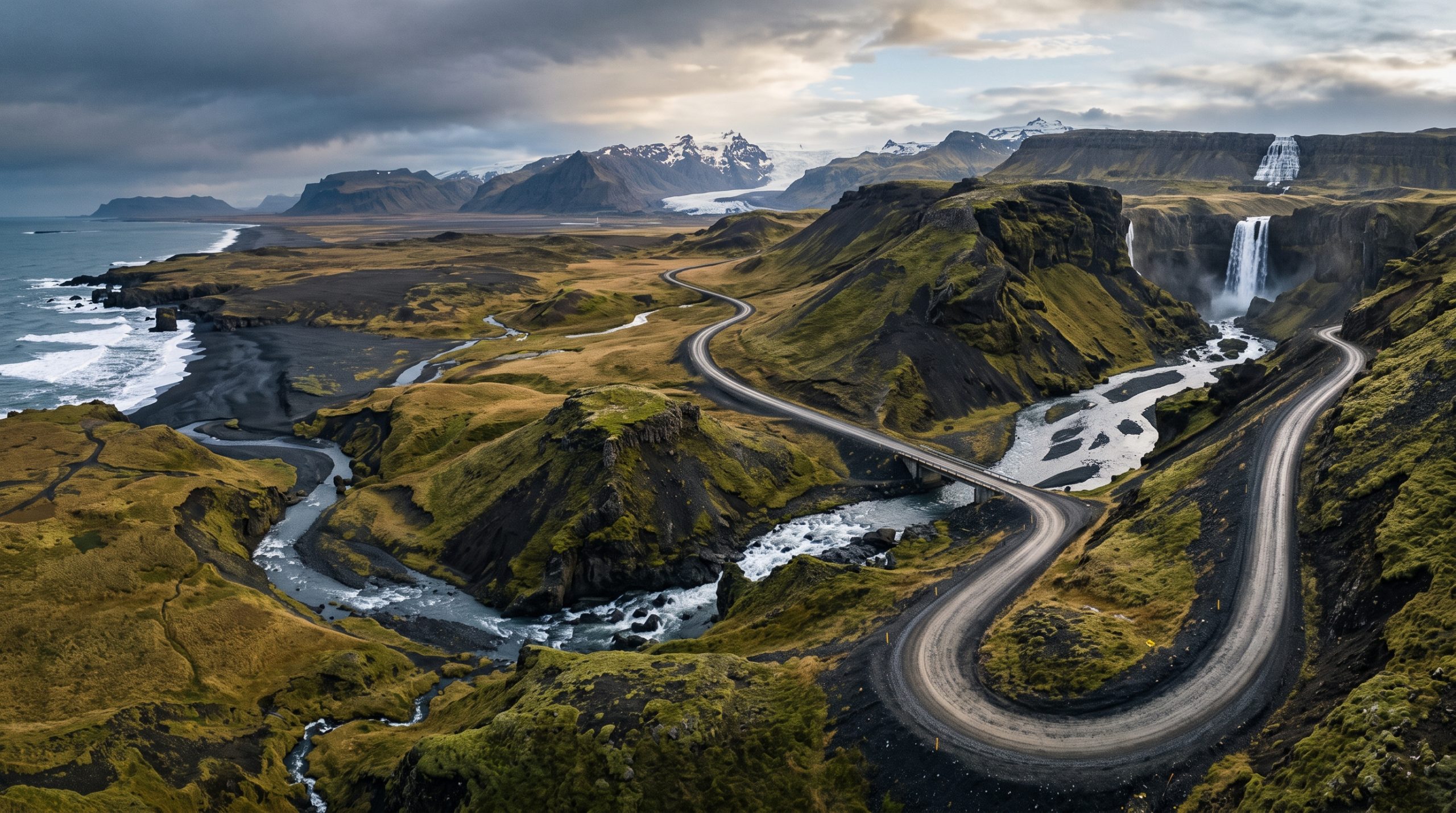
The most useful thing to know about marrying in Iceland has nothing to do with waterfalls. Your certificate of no impediment, the document that makes the marriage legal, sets a clock running: the ceremony has to take place within 30 days of the date on it. Every other decision, the flights, the region, the celebrant, the permit applications, hangs off that one window.
That is what planning an Icelandic elopement actually is. Not seating charts. A document list that US county offices often cannot fill exactly as written, three separate authorities issuing permits on three different timetables, and a road network where the honest drive time and the route planner’s drive time are two different numbers.
We are a team of eight, photographers and filmmakers, and planning is not something we hand to a third party. So this page is written from the inside: what the work is, who charges what in Icelandic krónur, and which parts of it genuinely need someone whose job it is to watch the dates.
Planner, coordinator, or the team that films the day
Most Iceland elopements do not need a separate wedding planner. They need one party who owns the legal paperwork, the permit lead times, the route and the light. When photography, film and planning come from the same team, that work already sits inside the coverage, and no one is waiting on anyone else to confirm a location.
The 30-day clock on your Icelandic paperwork
Iceland’s civil marriage process runs through the District Commissioner, the sýslumaður. Both of you must be at least 18 and legally competent to marry. You submit documentation showing there is no impediment to the marriage, and once that is accepted you receive the certificate that permits the ceremony. The ceremony must then happen within 30 days of the certificate’s date, which is why we plan the paperwork backwards from your chosen day rather than forwards from the day you decide to elope.
The document list itself is short. The difficulty is in the matching. A birth certificate, proof of your current marital status, and, if either of you has been married before, documentation that the earlier marriage is legally concluded. American couples frequently discover that their county or state issues something close to what Iceland names, but not the same thing, and the equivalent has to be accepted by the Icelandic authority before it counts. That single detail is where most self-planned timelines slip.
Officiants are also defined narrowly. District commissioners, priests of the national church, and the heads of registered religious and secular life-stance organisations can legally marry you in Iceland. Two witnesses are needed; for a ceremony held at the office, the commissioner’s staff can usually provide them if you ask. Afterwards, the officiant, not you, notifies Registers Iceland (Þjóðskrá) that the marriage took place. If a US authority later needs to recognise the Icelandic certificate, it may ask for an apostille, which is issued by Iceland’s Ministry for Foreign Affairs. Our elopement planning fundamentals cover the same sequence in a country-neutral way, and it is worth reading alongside this.
Permits: three authorities, three different lead times
There is no single Icelandic film and photography permit. Which office you deal with depends entirely on where you stand.
Most protected areas fall to the Nature Conservation Agency of Iceland, formerly the Environment Agency. Its processing time runs to 15 working days from the point all required documents are in, and up to 30 days inside the Mývatn and Laxá conservation area. Applications arriving within five working days of the project can attract an additional charge equivalent to two hours of expert work, and the project, including preparation, cannot begin before the permit is granted. Under the agency’s tariff, the processing fee is 83,200 ISK for cinematography and photography within protected areas, and 41,600 ISK for recreational drone use covering up to two of them. The fee does not change with the size or weight of the drone.
Two national parks sit outside that system and issue their own permissions. At Þingvellir, commercial photography and filming requires permission from the Þingvellir Committee, or from the park director acting on the committee’s behalf. Vatnajökull National Park runs its own service portal, charges according to the park’s published price list, and asks for filming applications at least 30 days in advance. Vatnajökull also publishes the clearest drone framework in the country: recreational flying is broadly allowed with regional exceptions, and in the mapped zone no special permit is needed between 15 July and 21 September if you fly before 09:00 or after 18:00. Anything commercial, which includes an elopement film, needs the permit regardless of the hour.
On top of the park rules, camera drones require operator registration with the Icelandic Transport Authority. What that means in practice is simple enough: we confirm the airspace, the permit and the time window for aerials before we build any part of the film around them, and if the answer is no in one valley we plan the aerial elsewhere. Our destination guides go region by region on where those windows tend to fall.
The one form nobody can file on your behalf
Protected-area applications have to be submitted by the applicant, not through a proxy. The person doing the filming is the person on the permit. A planner cannot lift that piece off a photography team, which is one reason we handle our own applications rather than routing them through anyone else. The paperwork mirrors it at the legal end: the officiant files the marriage with Registers Iceland, and that step is not yours either.
The króna costs that stay in your name
Planning fees and the fees charged by Icelandic authorities are two separate things, and the second list is yours whoever does the planning. The amounts are modest against the cost of the trip, but they carry deadlines, and a deadline missed is a date moved.
| What it is | Who charges it | What to plan on |
|---|---|---|
| Civil ceremony | District Commissioner (sýslumaður) | From 15,400 ISK at the office in office hours; outside the office or after hours by arrangement, with an additional fee |
| Filming and photography in a protected area | Nature Conservation Agency of Iceland | 83,200 ISK processing fee; 41,600 ISK for drone use in up to two areas; allow 15 working days |
| Commercial filming at Þingvellir | Þingvellir Committee or park director | Park’s own application and rules, separate from the national system |
| Filming in Vatnajökull National Park | Vatnajökull National Park | Park price list, applied for at least 30 days ahead |
| Parking at Þingvellir (P1 Hakið, P2 Efri-Vellir, P5 Valhöll) | Þingvellir National Park | One payment covers all main lots for that day, currently around 1,000 ISK for a car |
| Regional fees at Skaftafell and Jökulsárlón | Vatnajökull National Park | Collected at the parking lots, including online |
| Celebrant, accommodation, vendors, unusual transport | Each supplier | Booked in your name, on their terms |
From 15,400 ISK is a little over a hundred US dollars at recent exchange rates, so the legal side of an Icelandic elopement is not where the money goes. The permit fees are the ones worth diarising early. On our side, destination and location design, the timeline, permit research and logistics guidance, weather alternatives and team travel worldwide are all inside the coverage rather than added to it; the tiers are set out on our pricing page.
Where the map lies: 187 kilometres to Vík
Reykjavík to Vík is 187 km, and a route planner will tell you two and a half hours. It is not wrong, exactly. It is just describing a car with nothing in it, driven by someone who does not stop.
Put two people in wedding clothes in that car, add camera and lighting cases, a dress bag, a change of footwear and three stops on the way, and the same stretch of Route 1 becomes three and a half to four hours. The road narrows to single-lane bridges at several river crossings, where whoever arrives first goes first. Sheep stand on the tarmac all summer. Crosswinds on the open sections slow everyone down, and a headwind coming off the coast quietly rewrites your arrival time. We plan on the four-hour figure and are pleased when it comes in under.
Two more places the map misleads. The first is timing rather than distance: Þingvellir and the Golden Circle between roughly 10:00 and 16:00 in summer are coach hours, and the same rift valley that feels like the oldest place in Europe at 06:00 feels like a car park with scenery behind it at midday. We would rather drive an hour further than photograph a queue. The second is season. The paved network, Route 1, the Golden Circle loop and the south coast through Vík, carries no seasonal closures, but the mountain F-roads open in stages once the snow clears. Vegagerðin, the Icelandic Road Administration, opens each one only after physically inspecting it, and in a typical year F35 over Kjölur comes first, F208 to Landmannalaugar and F249 toward Þórsmörk follow through mid to late June, and the remote interior often waits until early July. A May date is not a highland date, and that is a planning fact rather than a disappointment: the coast and the peninsulas are at their emptiest then.
Building an Iceland day around 21 hours of June light
Icelandic light is the reason the timeline is worth so much attention. On 21 June in Reykjavík the sun rises at 02:55 and sets more than 21 hours later at 00:03, with roughly three further hours of twilight in which it sits just below the horizon. There is no golden hour. There is a golden evening that runs from about 21:00 until well past midnight, which is exactly when the coaches have gone.
So a June day often looks like this: a slow start, the drive out in flat afternoon light, a ceremony around 21:00, the walk and the long frames from 22:00, the coastal hour close to midnight, and back to the guesthouse at 01:30. Guests eat at 19:00 before the ceremony rather than after it. December is the mirror image, with Reykjavík getting 4 hours and 7 minutes of daylight at the solstice, which means one region, one base, a ceremony built around solar noon and headlights on both legs of the drive.
Wind decides the rest. We hold a second location in reserve for every coastal hour, chosen for a different aspect so a strong southerly does not cost you the ceremony, and we tell you both options the week before rather than on the morning. When the day spans real distance, two vehicles change what is possible: one of us can be at the next stop checking the light and the wind while the other stays with you, and there is a second full set of bodies and lenses on the ground rather than in a hotel two hours back. You can see how these hours translate into finished work in our elopement films and galleries, which is also where the delivery rhythm becomes clear: highlights within 5 days, the full gallery or film within 3 weeks.
If you already have a month in mind, or two months you are choosing between, that is enough for us to tell you which one gives you the light and the access you are picturing. Send Us a Message with the dates and the part of Iceland you keep coming back to, and we will map the day against the paperwork and the permits.
Common questions
Do we need to hire a wedding planner and a photographer separately in Iceland?
Not if your photography and film team plans as part of its work. Destination and location design, the timeline, permit research and logistics guidance sit inside every experience we run, so there is no separate planning hire and no handover between two companies. What stays with you is the paperwork you personally sign and the fees Icelandic authorities charge in your name.
How much does the civil ceremony itself cost in Iceland?
A civil marriage ceremony starts at 15,400 ISK at the District Commissioner’s office during office hours. Holding it outside the office or after hours is possible by arrangement, depending on the individual office, and carries an additional fee. That figure is separate from a celebrant’s own fee if you choose an independent officiant instead.
Who can legally marry us in Iceland?
District commissioners, priests of the national church, and the heads of registered religious and secular life-stance organisations. Two witnesses are required. For a ceremony at the commissioner’s office, staff can usually act as witnesses if you ask in advance, and afterwards the officiant files the marriage with Registers Iceland.
How far ahead do we need to sort the Icelandic marriage paperwork?
Earlier than most couples expect, because the certificate of no impediment is only valid for 30 days before the ceremony, and the documents feeding it come from your own state or county first. We work backwards from your date, so the certificate lands inside its window rather than months early or a week late.
Do we need a drone permit for our elopement film in Iceland?
It depends on the ground. Camera drones need operator registration with the Icelandic Transport Authority. Most protected areas are handled by the Nature Conservation Agency of Iceland, while Þingvellir and Vatnajökull issue their own permissions, and Vatnajökull wants filming applications at least 30 days out. We confirm the permit and the time window before planning aerials into a film.
Are the highland roads open if we elope in May?
Generally not. The paved network, including Route 1, the Golden Circle and the south coast through Vík, has no seasonal closures, but Vegagerðin opens each mountain F-road only after inspecting it, mostly through June and into early July for the interior. A May day is built on the coast, the peninsulas and low-level ground, and it is a quieter time to have them.
When do we get the photos and the film?
Highlights reach you within 5 days of the day itself, and the full gallery or film within 3 weeks. Because photography and film come from the same team, the two land together rather than at whatever pace two separate suppliers happen to work.
What to send us first
Dates, or the month you are circling. The region, or the one image of Iceland you cannot let go of. Roughly how many people, if anyone is coming. That is enough for us to answer with something specific rather than general, and everything runs in writing, by email, so you can read it twice and talk it over between yourselves. An inquiry gets a reply and an initial brochure within 24 hours, then a tailored proposal, and planning starts once the contract is signed and the 30% retainer is paid. We are booking 2027, 2028 and 2029 now.
Check Your Date and tell us what kind of morning, or midnight, you actually want.