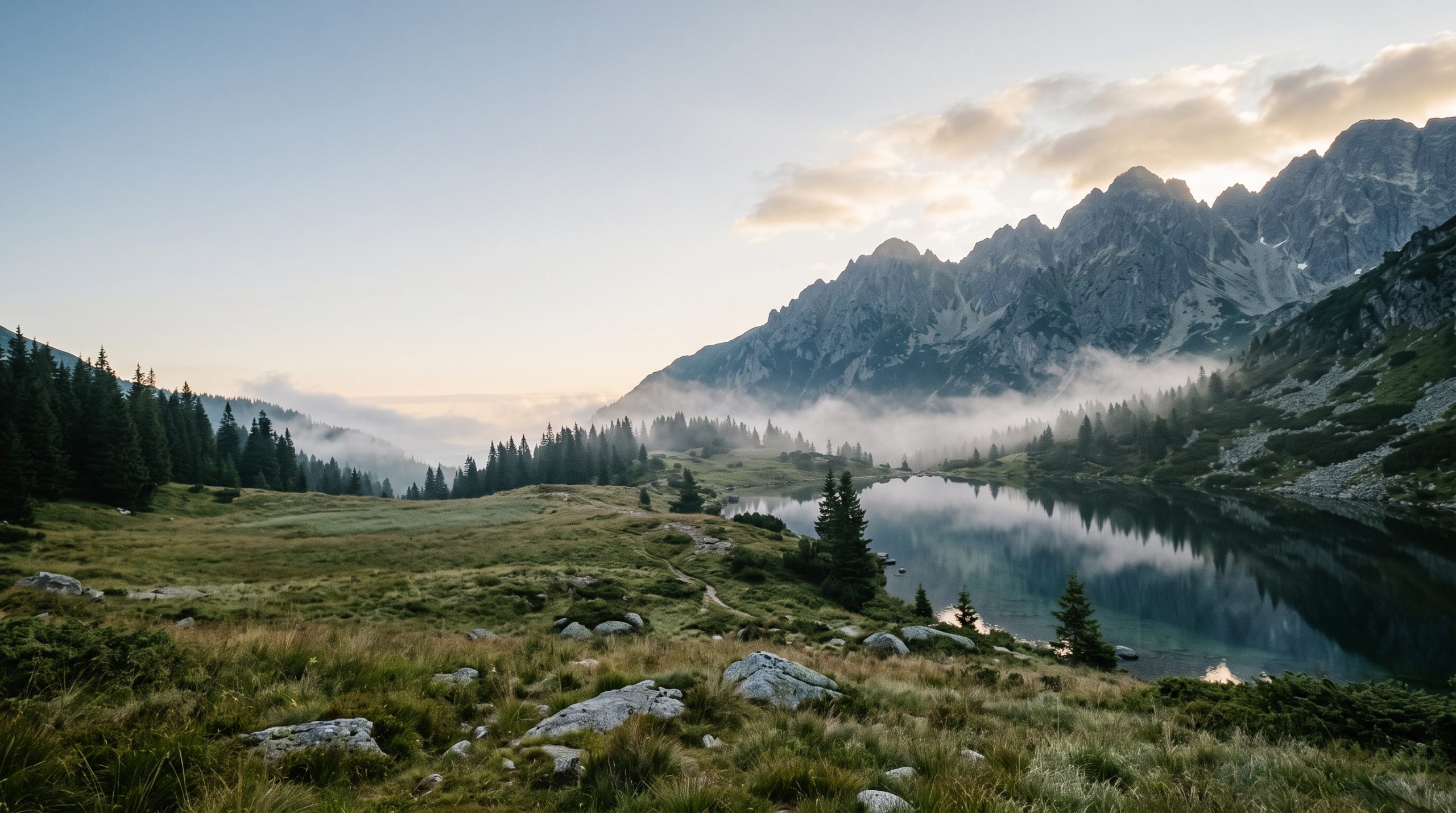
The asphalt road from the Palenica Białczańska car park up to Morskie Oko is a little over 9 km, closed to private cars, and by mid-morning in July it carries a steady file of walkers toward Poland’s most photographed lake. At 5am it carries almost nobody. That gap, three or four hours wide, is the whole reason a symbolic ceremony works so well in the Tatras.
A symbolic ceremony asks nothing of a registry office. There is no notice period to count backwards from, no birth certificate to have apostilled, no sworn translator to track down in Nowy Targ or Poprad. You handle the legal marriage at home, in your own county, in an afternoon. Then you fly out and plan the ceremony purely around the mountains: which side of the border, which month, which hour, and how high you want to be standing when you say the words you wrote.
What does exist is a set of park rules, tickets and paid permissions that differ on each side of the border, plus a seasonal calendar on the Slovak side that decides how high you can go before midsummer. None of it is difficult. All of it rewards knowing about it in February rather than in the week before. Here is how the Tatras actually work, what you pay and to whom, and how we build a day inside those rules.
Symbolic in the Tatras, legal at home
A symbolic ceremony in the Tatras carries no legal weight, which is exactly what makes it simple. Nobody files anything, no notice period applies, and no document needs translating or legalising. You marry legally at home, then choose your celebrant, your words, your hour and your ground here. Park entry tickets and camera permission are the only paperwork left.
Straightforward, with one honest caveat about height
On a scale that runs from straightforward to not realistically available to visiting couples, this sits at the easy end. There is no residency test to satisfy, no office to sit in, no queue number to take. Two people, a celebrant and a couple of friends can stand beside a lake at 1,395 m and nothing needs stamping afterwards.
The caveat is altitude rather than administration. The Tatras are a compact range with genuinely big mountains inside it, and the ground above the huts is governed by a season and a weather window rather than by anyone’s preference. A ceremony at Morskie Oko or on the Hrebienok plateau at 1,285 m is available in almost any month. A ceremony on a 2,000 m ridge is a late-June-to-October proposition with a real alternative held in reserve. If you have not settled which of those two you want, our guide to planning an elopement is the place to start, and telling us honestly how early you are willing to get up shapes more of the day than the location does.
The paperwork that does exist, in the order you need it
Nothing on this list is complicated. The order matters, because two of the items are locked to a date and one of them takes time to come back to you.
- Your legal marriage at home. The licence from your county clerk or local registrar, the ceremony, then a certified copy of the certificate. Order a spare certified copy while you are there. It costs very little and it saves weeks later if either of you is changing a name.
- Your date, tested against the season. Before anything gets booked, decide how high you intend to stand. That one choice decides whether the Slovak high-mountain trails, closed every year from 1 November to 15 June and reopening on 16 June, are open to you at all.
- Park entry tickets on the Polish side. Every entrance to Tatrzański Park Narodowy is ticketed, whichever valley you walk into. You can buy online through the park’s own system, at the entry point, or from the QR code posted at the gate. A standard day ticket is currently around 11 zł a person, reduced tickets are half that, and children under seven go free. Tickets are tied to a date, so they follow your plan rather than lead it.
- The Polish park’s permission for commercial photography and filming. Tatrzański Park Narodowy treats professional camera work as a chargeable activity and handles it separately from entry tickets, applied for and paid in advance through the park. The fee is the park’s, not ours. We research what the day requires, tell you exactly what to lodge and when, and build the timeline once the answer is in.
- Transport that is itself a reservation. The Morskie Oko road is closed to private cars, and the park sells parking and the shuttle in that valley separately from entry. Anything beyond ordinary driving, a 4×4 up a forest track, a private transfer from Kraków, a licensed guide for Gerlachovský štít at 2,655 m, is booked and paid by you with our logistics guidance behind it.
- The celebrant and the words. A symbolic ceremony has no required script, which is why this is the part couples spend longest on and get the most back from. The celebrant is your booking; the shaping of the ceremony hour is ours.
- Beds. Valley hotels in Zakopane, Starý Smokovec and Tatranská Lomnica are straightforward. Mountain hut beds are not, and they are what decides whether you can already be high when the light arrives.
Not one item on that list needs an apostille, a sworn translation or a stamp from your consulate. Nothing expires mid-plan. That is the practical case for the symbolic route, and it is why couples who want a wild hour rather than an appointment usually end up choosing it.
This guide helps you plan the the Tatras process; it is not legal advice. Rules can depend on nationality and circumstance, so confirm your own case with the responsible office.
Two parks, two rulebooks, one border crossing apart
Most couples arrive thinking of the Tatras as a single place. Administratively they are two, and the differences matter more to your morning than the scenery does. Tatrzański Park Narodowy governs the Polish side above Zakopane. TANAP governs the Slovak side above Poprad. Both ask you to stay on marked trails, and both are strict about it, which is a good thing for anyone who wants a photograph without a hundred bootprints across the meadow.
| Practicality | Polish side | Slovak side |
|---|---|---|
| Base villages | Zakopane and the Białka valley | Starý Smokovec, Tatranská Lomnica, Štrbské Pleso |
| Nearest useful airport | Kraków, roughly two hours by road | Poprad-Tatry, under half an hour |
| Money | Złoty | Euro |
| Trail entry | Ticketed per person per day, online or by QR code at the gate | No per-person trail ticket; you pay for parking and for lifts |
| Spring above the huts | No blanket closure; conditions decide | High-mountain trails closed 1 November to 15 June |
| Height without a long climb | Cable car to Kasprowy Wierch, 1,987 m | Funicular to Hrebienok, then cable car to Skalnaté pleso at 1,751 m and on to Lomnický štít at 2,634 m on timed tickets |
The crossing at Łysa Polana and Lysá Poľana is a drive over the Białka, both countries sitting inside Schengen, and on paper you could take first light in Poland and evening at Štrbské Pleso at 1,346 m. We rarely build a day that way. The driving eats the two hours you actually wanted for walking, and your Polish park ticket does not travel with you. If you are still weighing one side against the other, our destination guides are organised the way couples decide: light, season and access first, postcard views second.
Who charges what, and what sits inside our fee
A symbolic ceremony in the Tatras has no government fee attached to it, so the day’s third-party costs are small and easy to see. Here is who invoices what.
| What it is | Charged by | Who pays |
|---|---|---|
| Park entry, Polish side, around 11 zł a person a day | Tatrzański Park Narodowy | You |
| Permission and fee for commercial photography and filming | The park, venue or landowner | You |
| Parking and the shuttle in the Morskie Oko valley | The park | You |
| Cable car and funicular tickets | The lift operators | You |
| Celebrant, accommodation, flowers, dinner | Your vendors | You |
| Licensed mountain guide, 4×4, helicopter | The operator | You |
| Location design, permit research, timeline, weather alternatives | Us | Included |
| Our team’s flights, accommodation and travel in both countries | Us | Included |
Poland uses the złoty and Slovakia the euro. A złoty is worth roughly a quarter of a US dollar as we write, which puts that Polish day ticket at about three dollars a person, and it is the only fee in the whole plan that you can buy on your phone at the trailhead.
Our own coverage starts at $4,900 for a full day with a dedicated photographer or a dedicated filmmaker, and $7,900 for a photographer and filmmaker working the same day side by side, team travel included in both countries, with multi-day and multi-country work set out on the pricing page.
The figures in this the Tatras article are a point-in-time planning reference. Reconfirm prices and deadlines with the office responsible for your case.
The details that quietly reshape a Tatra morning
This is the part no ticket page tells you, and it is where the difference between a good Tatra day and a frustrating one actually lives.
Polish park tickets are tied to a date, and a refund has a deadline. A change has to be reported to the park’s e-ticket address by noon on the day before the reservation. In practice that means the weather decision gets made over lunch the day before, not at 4am in a car park with rain on the windscreen. We build the alternative into the timeline from the start so that call is a short one.
The last 9 km to Morskie Oko happen on foot or on a booked seat. Private cars stop at Palenica Białczańska. Whatever you are wearing for the vows travels in a pack and comes out at the lake, and the shuttle in that valley is a reservation rather than a whim, which means the hour you go up is decided days earlier.
Mid-morning at the famous places is genuinely disappointing. By eleven the Morskie Oko shore is a line of tripods and the light coming off the water is flat and white. The photograph that made you want to come here was almost certainly made before seven, and there is no clever way around that except to be standing there at six.
Movement on Polish trails is restricted between dusk and dawn. So a pre-dawn walk deep into a valley is not the plan it appears to be on a map. We shape first light either from ground you can properly reach at that hour, or by putting you high the night before, which is a hut booking and needs to be raised early.
Wind decides where the vows are said. A ridge at 2,000 m can be beautiful and completely unusable for recorded audio. On the Expedition we bring professional audio for vows where conditions allow, and we always hold a sheltered spot ten or fifteen minutes below the col, so the words are kept properly and the wide frames still happen up top.
Aerials run on permission and a window. Drone footage is part of what we deliver where it is legal, safe and appropriate, and in the Tatras that is decided in advance rather than on the morning. We confirm what is possible in your specific valley first, then build the film around the answer.
Tell us the date you are circling and which side of the border pulls at you, and we will come back with the honest shape of that day, including which hour we would protect and what we would hold in reserve. Check Your Date.
What we build around the Tatra day, and what remains yours
We plan the day around the constraints rather than in spite of them. That means location design across both sides of the range, a timeline built on real travel time and the actual hour of sunrise, permit research and logistics guidance, and a weather alternative that is a genuine second plan rather than a shrug. In late June the sun is up before five and still out at nearly nine, so a Tatra day has two entirely different ceremonies inside it. In October first light lands around seven, which is a far kinder morning and a shorter afternoon.
What stays with you: the legal marriage at home, the celebrant, the permit and landowner fees themselves, accommodation and anything unusual on wheels or rotors. We do not lodge documents on your behalf, and we would not want you to rely on us as though we could.
On the Expedition, a dedicated photographer and a dedicated filmmaker work the same day together. They are colleagues from the same team of eight rather than two freelancers introduced on the morning, which matters most in the ceremony hour: one holds the wide frame while the other is close enough to catch a voice breaking, and nobody is negotiating for position while you are speaking. You can see how that plays out in our published stories and films, mountain mornings included.
Delivery is quick by design, because you will want to send something home while you are still in the mountains. Highlights arrive in 5 days. The full gallery or film follows within 3 weeks.
Common questions
Is a symbolic ceremony in the Tatras legally binding?
No, and that is the point of it. Nothing is registered, so nothing has to be filed, translated or legalised. Couples marry legally at home first, usually months earlier, and then hold the ceremony that actually means something to them beside a lake or on a ridge, with their own words and no official timetable.
Do we need a permit for a symbolic ceremony in the Tatra mountains?
Not for the vows themselves as a small private group. What you do need on the Polish side is a park entry ticket for everyone walking in, and the park’s paid permission for commercial photography and filming. We research what your specific location requires and tell you what to lodge and when.
Can we have our ceremony at Morskie Oko?
Yes, with an early start. Private cars stop at Palenica Białczańska and the remaining stretch is a little over 9 km of closed asphalt, so you walk it or take a booked seat. The lake is quiet before seven and busy by eleven, so we set the ceremony hour accordingly.
Should we choose the Polish or the Slovak Tatras?
Poland gives you Zakopane, Kasprowy Wierch at 1,987 m and the Morskie Oko cirque, with tickets and a dusk-to-dawn trail restriction to plan around. Slovakia gives you lifts to real altitude, no per-person trail ticket, and a high-trail closure until 16 June. Tell us your month and we will tell you which side fits it.
When do the high Tatra trails open in spring?
On the Slovak side the high-mountain trails are closed from 1 November to 15 June and reopen on 16 June. For a May or early June date we build the day on lower ground: the lakes, the forest valleys, the plateaus reachable by funicular, all of which photograph beautifully with snow still sitting above you.
Do we need witnesses if the ceremony is symbolic?
Not legally, because there is no register to sign. Many couples bring two people anyway, or nobody at all. Guest numbers do not change our fee; they change access, permits, transport and how long each move up the valley takes, which is why we ask early.
Can our parents come, and does that make the day harder?
It makes it different rather than harder. Older guests usually mean a location reachable by lift or a short valley walk, an earlier finish, and transport arranged rather than improvised. We design the day around who is actually coming instead of asking them to keep up with a 2,000 m plan.
How far ahead should we book a Tatra elopement?
We are currently booking 2027, 2028 and 2029, and mountain hut beds and the best June and September dates go first. Booking is an inquiry, a reply and brochure within 24 hours, a tailored proposal, then a signed contract and a 30% retainer before planning starts.
Pick the month, then pick the peak
Almost every good Tatra day we have built started with a month rather than a place. Tell us the window you have, whether you are drawn to a lake at dawn or a lift to 2,634 m, and how much walking sounds like a good morning to you, and we will come back with the shape of the day, the hour we would protect, and what we would hold in reserve if the cloud sits low. All of it happens in writing, at your own pace, so you can read it twice and forward it to whoever needs to see it. Whichever side of the border you land on, the paperwork is the easy part, and we have done this in these mountains before. Tell Us Your Story.