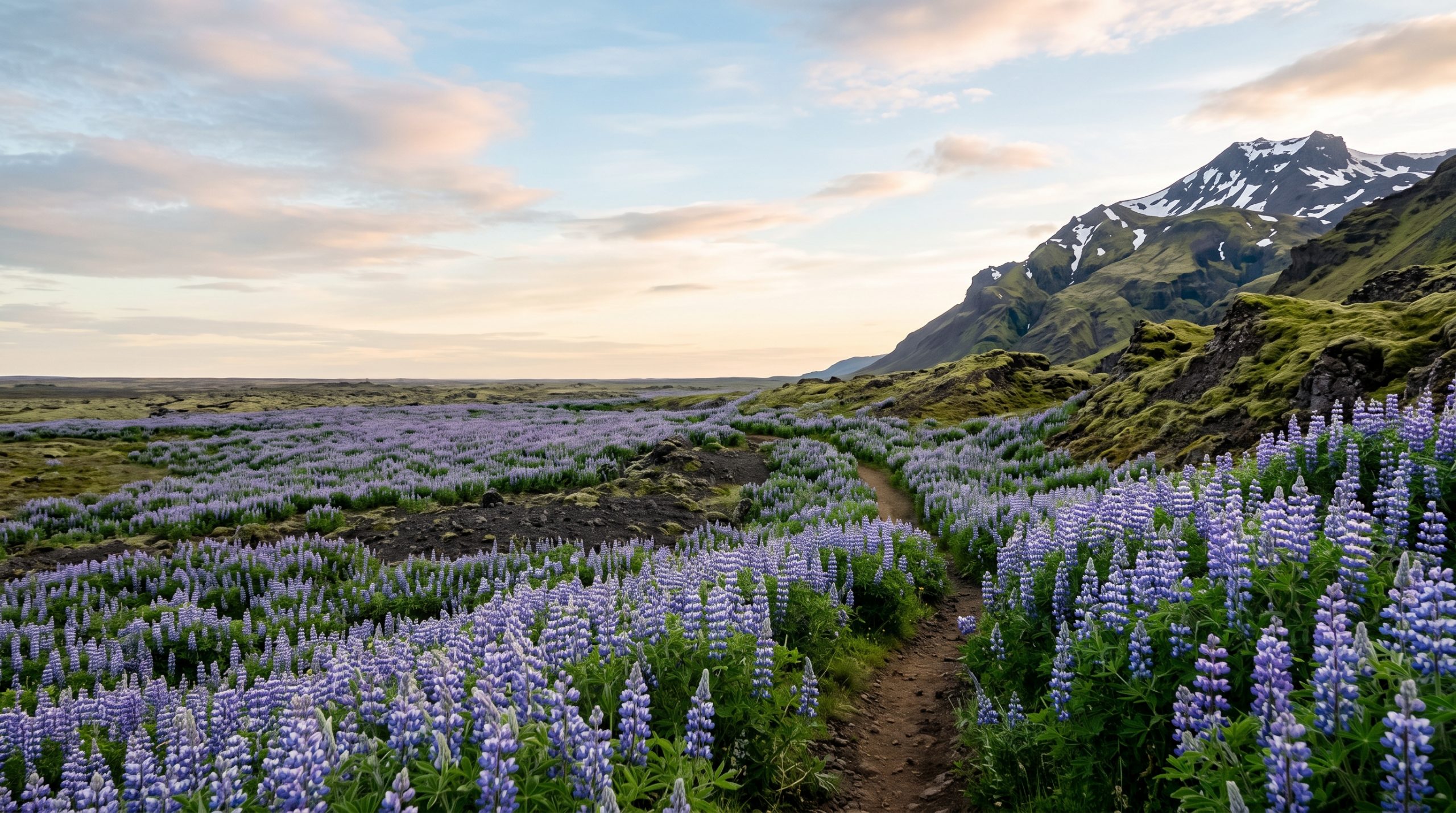
The lupine does not wait for anybody. In the last week of June the fields under Reynisfjall at Vík stand waist high and the purple runs right to the base of the mountain. Three weeks later the same ground has gone to seed, grey-green and finished, and no amount of good light brings the colour back.
That is the whole planning problem in one sentence. The flowers that made you search for Iceland in the first place hold their best form for about three weeks, and those three weeks sit at the exact hinge of the Icelandic summer: the sun rising around three in the morning, setting a few minutes either side of midnight, and the year’s visitor numbers climbing hard toward July.
We plan elopements around that window every year. Here is what the calendar actually gives you, month by month, with the light figures, the closure dates and the plan we write for the day the wind turns.
The lupine window, plus the days that still work around it
Book the last week of June into the first days of July. In South Iceland the Nootka lupine peaks between mid-June and mid-July, and that final week of June sits inside the colour while the sun still rises near three in the morning and sets close to midnight, and before July’s visitor numbers arrive on the coast.
Every month of the Icelandic year, judged on purple
Daylight figures below are for Reykjavík at mid-month. Iceland stays on GMT all year and does not move its clocks, so read every time below as the clock time you will actually see on the ground.
| Month | Lupine | Light, mid-month | Crowds | Our verdict |
|---|---|---|---|---|
| January | None | 5 hr 20 min, sunrise 10:56 | Low | Ice and dark, not fields |
| February | None | 8 hr 30 min | Low | Snow country, no colour |
| March | None | 11 hr 40 min | Rising | Good elopement month, wrong one for this |
| April | Green shoots on the coast | 15 hr exactly | Moderate | Too early by two months |
| May | Spears, colour only at the very end | 18 hr 20 min | Building | Beautiful, but do not promise purple |
| June 1 to 20 | Colour arrives, lowest coastal fields first | 21 hr, sunset near midnight | 234,000 for the month | Strong, choose the field late |
| June 21 to 30 | Peak in the south | Sunrise 03:00, sunset 00:02 | Still below July | The week we book |
| July 1 to 15 | Coast easing off, higher ground at its best | 19 hr 50 min | 302,000 for the month | Excellent inland, go up |
| July 16 to 31 | Fading fast, seed heads | 19 hr, sunset 23:04 | Peak | Plan around something else |
| August | Over | 16 hr 30 min | 312,964, the busiest month on record | Highlands, not lowland flowers |
| September | None | 13 hr, real darkness returns | Easing | Our other favourite month, for other reasons |
| October to December | None | 9 hr 55 min down to 4 hr 07 min | Low | A completely different film |
How far the peak slides, and what slides it
Altitude moves the bloom more than the calendar does. Visit South Iceland puts the southern coastal fields one to two weeks ahead of higher inland ground, which is why the last days of June belong to Vík and Skógar while the same week can still look early at Kirkjubæjarklaustur or up toward Þingvellir. The season opens in late May in the warmest coastal pockets and the colour is going by late July.
So we plan the week, then choose the field. Your date is fixed months out; the specific meadow is not confirmed until we are watching that spring’s growth, and we hold two fields at different elevations for the same hour.
25 June, 1 June, and the other dates set for us
Two public bodies quietly decide what a late-June day can include, and both publish their decisions.
The first is the Environment Agency of Iceland. At the Dyrhólaey nature reserve, fifteen minutes west of Vík, the Agency can restrict visits between 1 May and 25 June to protect nesting birds, with an ornithologist assessing the colony each year and the restriction reviewed on that basis. In a year when limits apply, the reserve is open on paths during the day and the area returns to round-the-clock access from 25 June. That single date is the reason a three in the morning start on the Dyrhólaey arch belongs to the very end of June rather than the middle of it.
The same Agency protects ground that needs a spring recovery. Fjaðrárgljúfur and Skógaheiði above Skógafoss have both been closed through the thaw and reopened on 1 June, so a canyon hour in May is never something we build a whole day around.
The second body is Vegagerðin, the road administration, which opens the highland F-roads in stages as it inspects them. The routes couples ask for by name, F208 into Landmannalaugar and the F249 approach to Þórsmörk, generally come open in the second half of June, and the deep interior often waits until early July. Permit research and the landowner conversations are part of what we do for every couple; the government, venue and landowner fees themselves are paid by you. Our destination guides go further into how the access side of an Icelandic day gets assembled.
Where the sun actually is at eleven at night
This is the part that changes the photographs, and almost nobody plans for it. Iceland keeps GMT year-round while sitting far out to the west, so solar noon in Reykjavík lands around half past one in the afternoon. Everything you know about golden hour shifts three hours later than your instinct says.
On the solstice, Reykjavík gets 21 hours and 8 minutes between a 02:55 sunrise and a 00:03 sunset, with roughly three hours of twilight in between where the sun sits just under the horizon and never lets go of the sky. At Vík, a little further south and considerably further east, late June gives you a sunset around 23:35 and a sunrise near 03:05.
What that buys you is the longest usable evening in Europe. The light goes low and warm somewhere around nine, and it stays low for four hours. There is no rush from a twenty-minute golden hour to a blue one. We put the ceremony at ten in the evening in that last week of June, because at ten the mountain behind Vík is still lit and the field is glowing rather than glaring.
Then there is the direction, which is the genuinely strange part. Near solar midnight the sun sits in the north. A north-facing slope, the one direction no one thinks to scout, is front-lit at one in the morning while everything else has gone flat. Purple is a difficult colour in hard light and a wonderful one in this light; it saturates instead of blowing out, and the film picks up a warmth in it that a mid-afternoon frame simply does not have. You can see how the fields and the low northern light read in finished work in our elopement stories and films.
A long evening is also the argument for two people working at once rather than one taking turns. Four hours of low sun means a photographer and a filmmaker can both work the same field properly: the photographer close in for vows while the filmmaker holds the wide, then swapping distances without anyone waiting. We are eight, so there is always a second camera on the ground and a colleague in reserve. How our one-day and multi-day experiences are built, and what team travel covers, is set out on the pricing page. Highlights reach you five days after the date, and the full gallery or film in three weeks.
When we would leave the lupine window and what we would choose instead
Mid-May through the first days of June is the honest trap. The fields look promising to a visitor and completely blank to a camera, all green spears and no colour, and it is also the stretch when protected ground is most likely to be recovering from the thaw. Mid-May does hand you 18 hours of light and roads that feel like yours alone. If your date is locked there, we stop selling purple and build a day out of water, black sand and the coastline instead.
The second half of July onward is the other one. The lowland colour is going, and August 2027 was the single busiest month Iceland has ever recorded, with 312,964 foreign departures through Keflavík according to the Icelandic Tourist Board. The answer for a late-summer date is to go up. Higher inland ground runs one to two weeks behind the coast, the highland roads are fully open by then, and the interior in August gives you a bigger, emptier film than a roadside field ever would.
We do not think of a fixed date in a hard month as a problem you have created. Tell us the date you are working with, and we will tell you which region still gives you colour that week, or exactly what we would build in its place. Send Us a Message with the week you are holding.
How we protect a lupine day from Icelandic wind
Reykjavík is overcast or mostly cloudy about 61 percent of June, daytime highs sit between 10 and 13 degrees Celsius, and the Met Office’s 1991 to 2020 June normal for the city is just under 10 degrees. Long-term averages give the capital 67 millimetres of rain across 17 days of the month. That is the reality behind the purple photographs you have been saving.
Cloud is not the problem. Overcast light is what makes lupine read as violet rather than washed lilac, and some of the best work we have made in these fields happened under a flat grey lid. Wind is the variable that actually decides the day. A hard onshore blow lays a lupine field over sideways and the flowers stop being a field and become a texture.
So the plan is written by direction, not by hope. Southerly and southeasterly weather hits the Vík coast first, so the alternatives sit inland and west: the Skógar fields 35 kilometres along the coast, the Kirkjubæjarklaustur side 70 kilometres east, or the lupine along the Þingvellir rift and the Hvalfjörður hillsides two to three hours away and often under a completely different band of weather. Every couple gets named alternatives per hour before they fly, chosen by wind direction rather than picked on the morning.
The 21-hour day is the safety net nobody talks about. When a squall is forecast to clear at nine in the evening, we move the ceremony hour to ten and lose nothing, because the sun is still four hours from setting. Weather alternatives and a written backup plan are part of every experience we run. If you are still working out the order of the pieces, our guide to how to plan an elopement covers the sequence.
Common questions
Will the lupines still be out in the second week of July?
On the coast they will be past their best, and higher inland they will often be right at peak, because that ground runs one to two weeks behind the sea-level fields. A second-week-of-July date is genuinely good, it just needs to be planned upward and inland rather than along the south coast.
Can we get married in a lupine field at sunrise?
Yes, and in the last week of June sunrise is around 03:00 in Reykjavík and near 03:05 at Vík. The three hours before it are twilight rather than darkness, so there is workable light the whole way through. It means a night without much sleep, which some couples love and others tell us honestly is not their idea of a good morning.
Do we need permission to use a lupine field?
Most of the good fields sit on private land, and several of the best-known ones sit inside protected areas with their own rules. We identify who governs each specific field, secure the permissions in writing and handle the logistics; any government, landowner or venue fees are paid by you.
What happens if it rains on our late June date?
We move the hour rather than the plan. With sunset near midnight there is room to shift a ceremony by several hours and still have low warm light, and each hour of the day already has named alternatives chosen by wind direction. Rain on the south coast very often means dry ground two hours inland.
Can we see the northern lights during lupine season?
No, and we would rather say so plainly than sell you a maybe. In late June the sun only dips below the horizon for about three hours and the sky never goes properly dark. The flowers and the aurora do not share a calendar, so those are two separate trips.
Are the highland roads open in time for a late June elopement?
Usually. Vegagerðin opens the F-roads in stages after inspection, and F208 into Landmannalaugar and the F249 approach to Þórsmörk generally open in the second half of June, with the remote interior often waiting until early July. For a date before the first of July we design the day so the highlands are a bonus rather than the spine of it.
How far ahead do couples book the last week of June?
Earlier than for any other week in the Icelandic year, simply because the window is narrow and everyone who wants purple wants the same fortnight. Our calendar is currently open across 2027, 2028 and 2029, and planning begins once the contract is signed and the 30 percent retainer is paid.
Choose the bloom week first; build the hours second
Give us the week and the shape of the day you actually want, whether that is a ten in the evening ceremony with the field lit gold or a three in the morning start at the coast, and we will build the timeline, the alternatives and the permit work around it. We keep the planning in one written thread, at whatever hour suits you, with a reply and our first brochure inside 24 hours.
If the last week of June is the one you have been circling, tell us and we will tell you honestly what that week looks like in the fields. Check Your Date and we will take it from there.