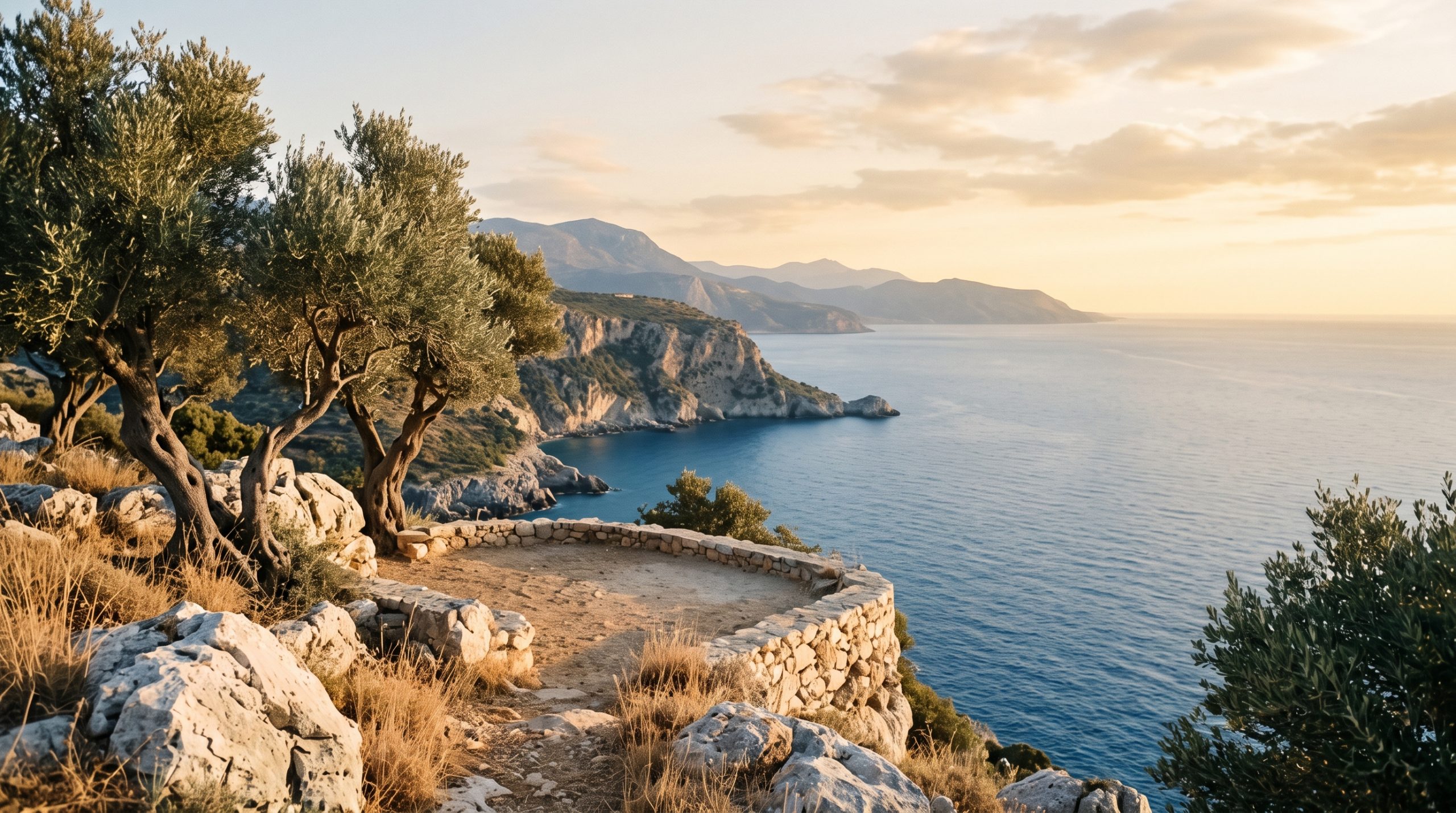
In the last week of September the sun is off the water on the west coast of Crete by about 19:20. Count back ninety minutes from that and you have the hour a ceremony should start: 17:50, the light already turning gold on the rock, the day boats gone from the sandbars, nobody standing behind you waiting for the space.
That is the real planning problem for a symbolic ceremony here, and it is not paperwork. Greece asks nothing of you for a ceremony that carries no legal weight. No licence, no municipal booking, no newspaper notice, no office to sit in on a Tuesday morning. The costs sit somewhere else entirely: the ground you stand on, the celebrant you choose, and a drive west that takes two hours in August rather than the fifty minutes the map promises.
We plan, photograph and film elopements across Crete, from the Venetian harbour in Chania to the ferry-only villages on the Libyan Sea. Here is how a symbolic day works on paper, what carries a fee and who collects it, and what changes if you decide you want the marriage itself signed in Greece instead.
What a symbolic ceremony in Crete actually is
A symbolic ceremony has no legal effect in Greece. No licence is issued, nothing is filed with a municipality, and no certificate exists afterwards. Couples marry legally at home, usually a few weeks earlier, then stand somewhere on Crete with a celebrant and say the words that matter to them. It is the most straightforward route on the island.
What carries a fee, and who collects it
Nothing about the ceremony itself is payable to the Greek state. What you pay for is access, people and, if you want your marriage recognised somewhere other than the country that issued the certificate, authentication at home.
| What | Who collects it | What to expect |
|---|---|---|
| The symbolic ceremony | Nobody | No state fee, no licence, no notice period |
| Celebrant or officiant | The celebrant, direct | Ask what a second language or a rehearsal adds before you book |
| Private ground: estate, olive grove, villa terrace | The owner | A fee for the location and a written hour, not a handshake |
| Anything built on a public beach | The municipality or the concession holder for that stretch | Permission is for a set hour, and everything you bring leaves with you |
| Your legal marriage at home | Your own county, state or register office | Fee, notice period and validity all set locally |
| Apostille on the certificate, if you need one | The authority in the issuing country | The US Embassy in Athens is explicit that an apostille on a US document is obtained in the United States |
| A legal civil marriage in Crete instead | The municipality | Heraklion currently publishes 100 euros for a Tuesday or Thursday ceremony at 12:00 and 150 euros for a Wednesday or Friday from 18:00, plus a 15 euro fee stamp |
Administrative prices and response times in Crete can move. Use the figures here for planning, then verify the current version with the authority handling your application.
Our own coverage is published rather than quoted: the Adventure starts at $4,900 for one full day with a dedicated photographer or filmmaker, the Expedition at $7,900 for a photographer and filmmaker working the same day, with team travel included worldwide, and the rest of the detail sits on our pricing page.
If the marriage itself is legal in Greece, this is the paper route
For a symbolic day, the chain runs entirely through your own country. Nothing in it is translated into Greek, nothing is apostilled for a Greek office, and nothing is lodged in Crete.
- Your marriage licence at home. Issued by your own county, state or register office, on their notice period and their validity window. If the licence expires before you use it, that is a home problem with a home solution, and no Greek deadline touches it.
- The legal ceremony at home, before you fly. Ten minutes in a county office, two witnesses if your state wants them, and the legal work is finished while your Crete plans stay untouched.
- Certified copies of the marriage certificate. Order at least two and leave one at home. A photograph of a certificate is not a certificate.
- An apostille, only if a certificate has to be recognised outside the country that issued it. A name change with a foreign authority or a spousal visa application can trigger this. For US documents, the US Embassy in Athens states plainly that the apostille is obtained in the United States, not in Greece.
- Passports that comfortably outlast the trip. The Embassy also notes that US citizens may stay in Greece up to three months without a residence permit, which covers any elopement timetable we have ever built.
- Written permission for the exact location, at the exact hour. This is the only Crete-side document in the chain, and it is the one couples leave until last. It should name the spot, the date and the time window.
We plan and document wedding days; we do not give legal advice. Rules change and circumstances differ, so confirm the detail with the relevant registry office or your own consulate before you book flights. If the legal side at home is still unshaped, our guide to how eloping works covers the sequence in general terms.
Build the symbolic Crete day around permission and light
Every Cretan day we build starts from the sun and works outwards. Sunset in Chania sits close to 20:40 in the last week of June, near 19:20 by late September, and closer to 18:45 by the third week of October. A ceremony an hour and a half before that puts the vows in warm light and the first drinks in dusk, and it also puts you on the coast after the tour boats have pulled off the sandbars.
The real minimum is short. If you are already legally married, the Crete side of a symbolic day can be assembled in a couple of months, because there is no waiting period to serve and no office queue to join. The comfortable minimum is nine months, and that is the one we work to, because the houses within twenty minutes of the west-coast light are few and the good hour on a Saturday in late September is a narrow target.
| Counting back | What happens | Who carries it |
|---|---|---|
| 12 to 9 months | Region and location shortlist set, ceremony hour fixed against sunset, accommodation held | Us, with you |
| 6 months | Location permissions opened with owners, estates or the municipality; celebrant booked | Research and drafting from us, signature and fee from you |
| 3 months | Your home licence timetable checked with the office that issues it | You |
| 4 to 6 weeks | Legal marriage at home, certified copies ordered | You |
| 2 weeks | Final timeline, drive times re-timed for the season, weather alternatives confirmed | Us |
| Ceremony day | Start hour set by the light rather than the venue | Us |
| Afterwards | Highlights in 5 days, the full gallery or film in 3 weeks | Us |
Photo and film sit in one team, which matters most in the fifteen minutes either side of sunset. One of us holds the wide frame while the other moves in close, and on an Expedition day the filmmaker is recording the vows as they are spoken, so nobody asks you to say them twice for a second camera. Our published galleries and films show what that hour on Crete looks like when it is worked properly.
Permission for the ground you stand on
A Cretan beach is public. You cannot reserve one, and nobody can sell you exclusivity on the sand. What Greek beach rules do govern is the equipment: concession holders operate inside marked boundaries, keep access clear, and clear their gear away and return the beach to its natural state at the end of the season. That is worth knowing because it sets the shape of what is possible. Two people, a celebrant and a small group standing on open sand need no infrastructure at all. An arch, seating and a sound system on public ground is a different request, and it goes to the municipality or to the operator holding that stretch.
The practical fix is usually private ground for the ceremony and public ground for everything else. An olive terrace above Kissamos, a family estate outside Rethymno or a villa headland gives you a written hour and a chair for whoever cannot stand for long. The coast then belongs to the walk afterwards.
Three location types need more lead time than couples expect. Monasteries and chapels answer to the church rather than the council, so permission comes from the abbot or the parish priest, and an Orthodox chapel is not somewhere to plan a symbolic ceremony inside without asking first. Archaeological sites sit under the Ministry of Culture rather than the municipality, which is why we plan places like Knossos or Aptera as visits rather than ceremony ground. And aerials run on the local rules and a time window, so we confirm both before we build any part of the film around a drone shot.
Access itself does half the work of choosing. Balos is reached by an unsealed track from Kaliviani and then a path down, or by boat from Kissamos, and the boats land mid-morning. Elafonissi is a genuine two hours west of Chania in season, and by eleven the shallow lagoon has a crowd standing in it. Loutro has no road at all: the ferry from Chora Sfakion is the only way in and the last sailing is the real end of your evening. None of that is a reason to avoid these places. It is a reason to be there at first light or in the last hour before sunset, which is the same conclusion the light gives you anyway. Our destination guides go deeper on how the island splits by coast and season.
If you want the marriage itself signed in Greece
This route is entirely open to visiting couples, and to same-sex couples: civil marriages in Greece are performed by the mayor, and same-sex marriage has been legal in the country since 2024. It is simply a longer chain, and every link runs through an office rather than a landscape.
For foreign nationals who do not live in Greece, the Municipality of Heraklion asks for a marriage licence from your own country translated into Greek, carrying an apostille where your country is a party to the Hague Convention, plus a birth certificate on the same terms. The national register of administrative public services is specific about the translation: documents from Hague states are accepted only with the apostille and a translation into Greek by a Greek translator. Greece’s Ministry of the Interior recognises a translation certified by a Greek consulate, made by the official translation service, or made by a qualified Greek lawyer. A notice of the marriage in a daily newspaper is part of the licence application, and the licence is not handed over on the day you apply: Chania’s citizen guide gives eight days from the moment the documents are lodged, and the national register puts it within one week of the application.
On the day, Heraklion holds civil ceremonies in the municipal council hall named for Eleftherios Venizelos, each spouse accompanied by an adult witness, and the municipality’s own page confirms that your photographer may be present. The ceremony is conducted in Greek. Afterwards the marriage has to be recorded at the local vital statistics office, the Lixiarcheio, in the city where it took place: the US Embassy in Athens is blunt that marriages are not legal in Greece until registered, and gives 40 days from the ceremony for it. US citizens using an embassy affidavit of marriage also need it authenticated by the Greek Ministry of Foreign Affairs, with a 30 euro e-paravolo for the authentication.
Both routes work. The choice is really about where you want to spend your attention in the fortnight before you fly. If you are weighing them, send us a message with your month and the coast you have in mind, and we will tell you which one shapes a better day on your dates.
Small things that catch couples out
- Your name in Greek letters. Heraklion’s page notes that names on the application and in the newspaper notice go in Greek characters. Choose one transliteration, write it down, and use exactly that spelling on every document that follows.
- The entry stamp. The US Embassy is direct about it: your passport needs a stamp showing the date and place of entry into Greece or another Schengen country before a marriage in Greece can go ahead. If you land in Athens after a Frankfurt connection, check what is actually in the passport before you leave the airport.
- Midweek slots. Heraklion’s published ceremony times are a Tuesday or Thursday midday and a Wednesday or Friday evening. A symbolic ceremony has no such constraint, which is why a Saturday at 19:15 on a west-facing beach is a symbolic-route privilege.
- Offices keep office hours. Municipal counters work weekdays, and Greek public holidays close them. Orthodox Easter moves several weeks year to year and takes ferry loads, room rates and counter hours with it, so we check the calendar for your specific date rather than for the month.
- The 40-day clock only exists on the legal route. If you married at home, there is nothing to register in Crete and no deadline running while you travel.
- One certificate is not enough. Banks, insurers and immigration offices all want an original. Two or three certified copies ordered at home cost very little and save a month of correspondence.
- The last ferry is a hard edge. On the south coast, timetables shift with the season and the wind, so we confirm the return sailing in the week of the ceremony and build the evening backwards from it.
Common questions
Is a symbolic ceremony in Crete legally binding?
No. It creates no legal record in Greece and no certificate. That is the point of it: the marriage is already legal from the day you signed at home, and the ceremony in Crete is the one you actually invite people to and the one you watch back.
Do we need any paperwork with Greek authorities for a symbolic ceremony?
None. There is no licence to apply for, no newspaper notice, no translation, no apostille for a Greek office and no registration afterwards. The only Crete-side permission you need is for the location itself, from the owner or the municipality.
How much does a symbolic ceremony in Crete cost?
There is no state fee at all. Your costs are the celebrant, any fee for private ground, accommodation and travel, and coverage. For comparison, the legal civil route adds municipal charges such as the 100 or 150 euros Heraklion currently publishes for the ceremony itself, plus translation.
Can we hold the ceremony on any beach in Crete?
Standing on open sand with a celebrant and a few people is straightforward, because Greek beaches are public. Setting up an arch, chairs or amplified sound changes it into a request to the municipality or the concession holder for that stretch, and that request needs weeks rather than days.
Do we need witnesses for a symbolic ceremony?
Legally, no, because nothing is being witnessed. Many couples still ask two people to stand with them, and some ask us. A Greek civil marriage is different: Heraklion requires each spouse to be accompanied by an adult witness.
Can two women or two men marry in Crete?
Yes. Same-sex marriage has been legal in Greece since 2024, so both routes are open, and a symbolic ceremony was always open. Civil marriages are performed by the mayor of the municipality.
Can we get legally married in Crete on a Saturday?
Each municipality sets its own ceremony times, and Heraklion currently publishes midweek slots only: Tuesday or Thursday at 12:00, Wednesday or Friday from 18:00. If a Saturday evening ceremony matters more to you than a Greek certificate, the symbolic route gives you the hour you want.
Will a symbolic ceremony work for a name change or a spousal visa?
Not on its own, because it produces no document. Those processes run on your home marriage certificate, which is why we suggest ordering extra certified copies and, where an authority abroad is involved, an apostille from the country that issued it.
What we can handle for the symbolic day, and what still belongs to you
We design the destination and the locations, build the timeline around light and honest travel times, research the permits and guide you through the logistics, and hold weather alternatives for every outdoor hour. Filing is yours: the licence at home, the signatures, the fees. That division is clean, and it is why nothing on your side of it is ever waiting on us.
Everything between us happens in writing, so you can read it twice and answer at your own hour. Send the inquiry form, and a reply with our initial brochure comes back within 24 hours, followed by a tailored proposal for your dates. A signed contract and a 30 percent retainer start the planning. We are currently taking elopement dates across 2027–2029, which is runway enough to put your date in the week where the light does what you want it to.
Tell us the month, the coast and the hour you imagine standing there, and we will tell you honestly whether that hour works in that month, or which fortnight fits it better. Check your date and we will take it from there.