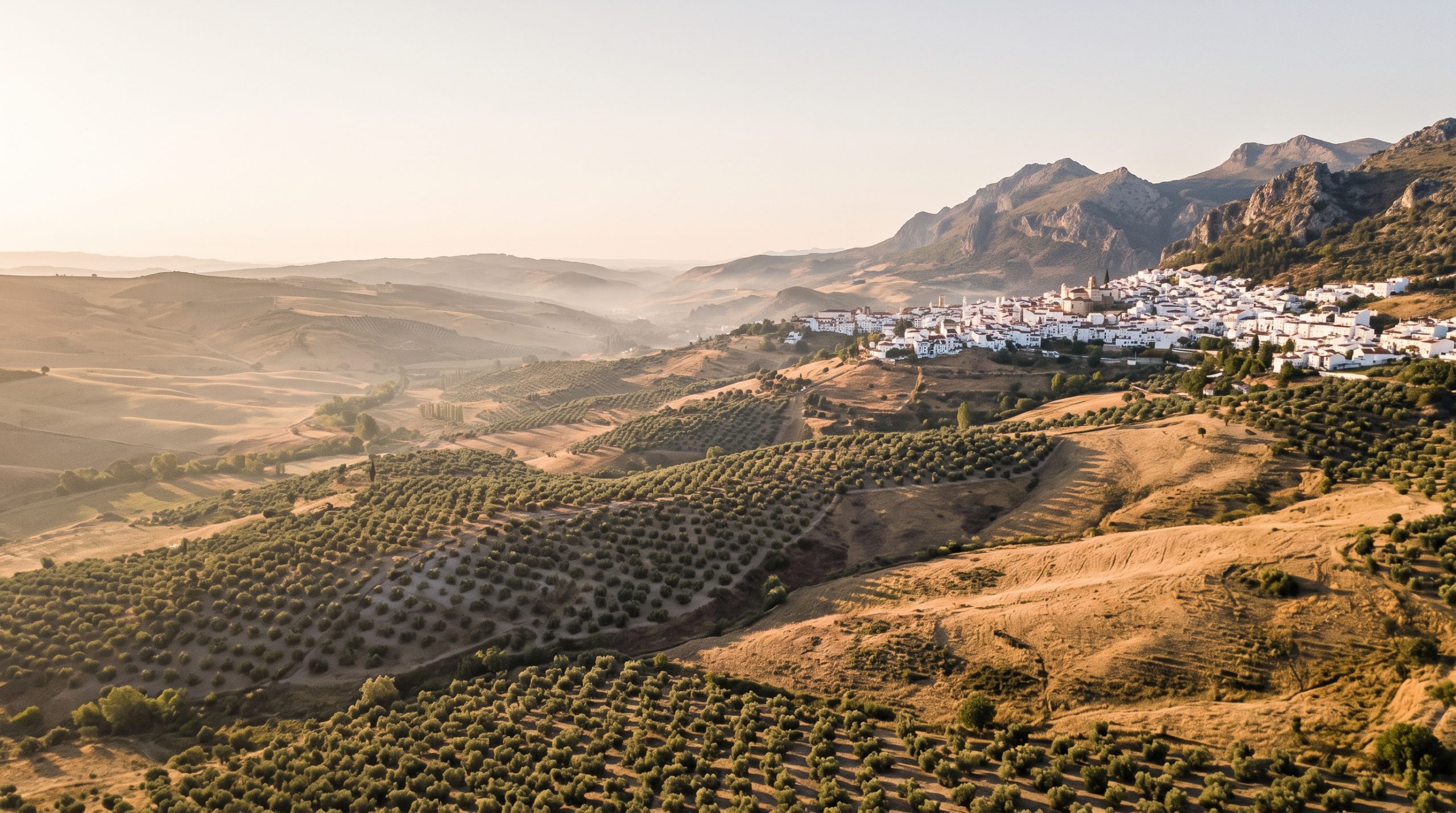
Seville sits about as far west as Dublin and runs on the same clock as Berlin. That one administrative fact shapes every elopement morning in Andalusia. On 21 March 2027 the sun comes up over Seville at 08:27. On 21 June it goes down at 21:48. Nobody is setting a 3am alarm here, and nobody is eating dinner in the dark.
The other thing to know is where the buses go. Ronda is a little over an hour from the Costa del Sol, so the Puente Nuevo belongs to day-trip coaches from mid-morning until late afternoon, and belongs to almost nobody at 08:15. Twenty minutes north, Setenil de las Bodegas has streets running underneath an overhanging rock shelf that hold soft light long after the open ridges have gone hard and contrasty. Most of a good Andalusian timeline is built on those two observations: take the famous thing early, then move to the places the coach circuit skips.
This page is about money, so here is the shape of it. Our side is a fixed figure you will see in the next paragraph, and it already includes flying our team to Spain. The Spanish side is smaller than most couples expect and arrives in specific pieces: a timed ticket here, an authorization there, a celebrant, a car. One 2027 date to hold before you book flights is Holy Week, which runs 21 to 28 March, with the Feria de Abril about two weeks behind it. Rooms in Seville, Granada and Málaga go early for both.
Andalusia elopement costs, answered in one paragraph
Our Andalusia elopements start at $4,900 for one full day with a dedicated photographer or filmmaker, and $7,900 for a photographer and filmmaker working together. Team travel to Spain is included. Everything else you pay locally is small and specific: monument tickets, any permit fees, a celebrant, accommodation and your own transport.
One day on the clock Andalusia actually keeps
This is a real mid-October day based in Ronda and the villages north of it. October is the month we suggest most often for this region, and the times below are the actual ones for that ridge, not rounded guesses.
07:15. You leave the hotel in the dark. It is a twenty-five minute drive to a mirador on the far side of the gorge, coffee in the car, nobody talking much. We have already driven this road the previous afternoon and know which gate is open.
08:02. First light. The gorge still holds cold air from overnight and often a shallow layer of mist below the bridge. The town goes grey, then apricot, then gold, in about eleven minutes.
08:28. Sunrise. The next forty minutes are the best light of the whole day: low, raking, coming along the Serranía rather than down onto it, so every terrace wall and olive row has an edge. This is when the wide frames happen, the ones where you are small and the country is enormous.
09:15. Vows. Symbolic, with a celebrant, because the legal marriage is registered at home. On a still morning the bells from town carry all the way up the valley, which is the sort of thing that ends up in the film and cannot be planned, only anticipated.
10:30. The first coaches reach Ronda’s car parks. We are already gone, twenty minutes north to Setenil de las Bodegas, where the rock roof over the street works as an enormous soft box and 11:00 light is still usable. Getting changed happens here, in a room we have arranged, not in a car park.
12:00 to 16:30. The gap. Andalusian midday is flat and white and no amount of skill makes it beautiful, so we do not pretend otherwise and we do not fill it with filler. You eat properly, sleep, swim. We scout the evening ground, check the wind, and drive the last kilometre of track once so there are no surprises later.
16:45. Second location. Often the limestone above Grazalema, sometimes the olive terraces toward Zahara de la Sierra, sometimes a single mountain road with nothing on it. Forty minutes of driving buys a completely different landscape in this part of Spain, which is why the day is built around one or two moves rather than five.
18:45. Golden hour, an hour before the 19:45 sunset, and the whole reason we kept you off the ridges at noon.
20:11. Last usable light. In Spain that is still early, so dinner at 21:00 is normal rather than heroic, and you are eating as a married couple rather than watching a clock.
Shift that same day into late June and it stretches unrecognisably: first light at 06:31, sunset at 21:41, useful colour until 22:09. We split June days in two, with a five hour break in the middle, because sixteen hours of daylight is not sixteen hours of working. Shift it into mid-December and it compresses instead: sunrise 08:29, sunset 18:08, low sun all day long and one continuous arc of good light. Winter is underrated here and the villages are yours.
If you already know which month you have, tell us and we will send back the real light times for it rather than a generic timeline. Check Your Date and we will build the hours around it.
Heat, crowds, and the hours that are actually worth having
The two things couples raise about Andalusia are the summer heat and the number of other people. Both are real and both are scheduling problems rather than reasons to look elsewhere.
Inland afternoons in July and August run into the high thirties Celsius around Seville and Córdoba. That does not rule out summer, it rules out 15:00. In mid-July the light at Ronda arrives at 06:43 and the sun does not set until 21:40, which gives two generous windows either side of a long, shaded, entirely pleasant nothing. The other lever is altitude: the Alpujarras villages sit above 1,200 metres, Mulhacén tops out at 3,479 metres as mainland Spain’s highest summit, and the Atlantic coast near Bolonia stays cooler than the Mediterranean side because the wind rarely stops there.
Crowds are a matter of hours, not places. Granada’s Mirador de San Nicolás is the honest example. The famous version of that photograph, warm light on the Alhambra walls, happens at sunset, which is precisely when the wall is three deep in people with buskers working the crowd. At 08:15 in October the same mirador is nearly empty and the Alhambra is a hard silhouette against a rising sun behind it. That is a different photograph, and we think a better one, but you should choose it knowingly.
Inside the monuments the constraint is paperwork rather than people. Alhambra day tickets are timed and sold through the Patronato’s own site, and any filming or photographic report inside the complex needs the Patronato’s prior authorization, arranged well ahead. So we treat monuments as a scene with rules and keep the private hours where they genuinely exist, which is early on the outside. Our month-by-month notes for this region live in the destination elopement guides.
| Around Ronda | First light | Sunrise | Sunset | Last light |
|---|---|---|---|---|
| Mid-April | 07:21 | 07:47 | 20:55 | 21:21 |
| Mid-May | 06:45 | 07:14 | 21:21 | 21:50 |
| Mid-June | 06:31 | 07:01 | 21:41 | 22:12 |
| Mid-September | 07:36 | 08:02 | 20:29 | 20:55 |
| Mid-October | 08:02 | 08:28 | 19:45 | 20:11 |
| Mid-November | 07:31 | 07:58 | 18:12 | 18:39 |
Two cameras working the same twenty minutes
Photography, film and planning come from one team here. That is not an arrangement where a photographer books a videographer they have never met and the two of you meet both of them at 07:00 on the morning. We are eight people, four photographers and four filmmakers, so there is always a second camera on the ground and a colleague in reserve.
In Andalusia that matters for a reason specific to the terrain. The good morning light on a ridge above Ronda lasts about forty minutes, and the vows sit inside twenty of them. One person cannot hold a still frame and record sound at the same time, so a single operator either photographs your vows and loses the audio, or films them and hands you frame grabs. With a photographer and filmmaker working together, one is close in at 24mm while the other is sixty metres back on a long lens, and the vows go to a lavalier because wind moves constantly on those ridges and a camera microphone would give you nothing but air.
The villages ask the opposite question. A lane in Setenil is about three metres wide with a rock ceiling, and two people who have not worked together will spend the morning in each other’s frames. Ours have done it in the same lanes before: photographer takes the near ground, filmmaker holds the far end, then they trade ends without a word being said. You notice none of it.
Aerials fit the same discipline. The Tajo, the terraces and the reservoir country above Ardales are made for one long drone move, and that move happens because the drone is registered with the Spanish aviation authority and the flight is planned into a window. Doñana and Sierra Nevada are national parks, so anything flown there needs the park authority’s authorization on top of that registration, which is why we build the ground film to stand alone and treat the aerial as an addition rather than the backbone. What limewashed walls do to skin tone, and what a 21:40 sunset does to the Serranía, are easier seen than described, and both are in our stories and films.
What travels with us, and what you pay in euros
Costs in this section are quoted in euros, which have lately traded a little above the dollar. We do not mark up anything local, and we do not add a travel fee for Spain.
Included in every Andalusia experience
- Destination and location design, and the planning that goes with it.
- A custom timeline built around real light times and real driving time between villages.
- Permit research and logistics guidance, including monument and protected-area authorizations.
- Weather alternatives and backup planning, so the levante on the Atlantic coast changes the plan rather than the day.
- Drone footage where it is legal, safe and appropriate.
- Team travel worldwide: flights, accommodation and ordinary travel for the assigned team, with no European or long-haul distinction.
- On the two-person experience, professional audio for vows and other meaningful moments where conditions allow.
- Highlights delivered in 5 days, and the full gallery or film in 3 weeks.
Paid locally, by you
- Government, venue and landowner permit fees. The research and the applications are ours; the fee itself is yours.
- Timed monument tickets. Alhambra day admission is per person and sold only through the Patronato, and it has risen most years.
- Ticketed walkways, if you want one. Caminito del Rey general entry is currently 10 euros a head, with the shuttle bus 2.50 euros and the municipal car park 2 euros, and weekend slots go weeks ahead.
- Accommodation, your celebrant, and any vendors such as flowers, hair or a private cook.
- Car hire, which in the Serranía is the difference between three locations and one.
- Unusual transport only if you want it: a 4×4 up a track, a private boat out of Tarifa, a helicopter.
Our own figures, and what separates the one-person day from the two-person day, are set out plainly on the coverage and pricing page. The number does not change with guest count. Six guests instead of none affects access, permits, transport and the shape of the timeline, not the fee.
How an Andalusia cost enquiry becomes a signed date
- You send the inquiry form with your dates, or the month you are circling, and the region you have in mind.
- We reply within 24 hours with an initial brochure and the first honest questions about your day.
- You tell us, in writing and at your own pace, what you actually want the day to feel like.
- We send a tailored proposal: locations, an hour-by-hour timeline, the permissions involved, and which of us would be with you.
- You sign the contract and pay a 30% retainer. The rest of the payment timetable is set out in the proposal.
- Planning begins. Permit research, weather alternatives and the final timeline are ours from that point on.
If you are earlier than that and still deciding on the whole shape of the thing, our guide to how to plan an elopement covers the order to do things in.
Early starts, cobbles, and a plan that can move
Andalusia rewards couples who are happy to be in a car at 07:15 with wet hair and no makeup done yet, which is a gentler ask than most mountain destinations make. It rewards people who can walk on uneven ground: Setenil’s cobbles, the limestone slabs above Grazalema, soft sand on the dune at Bolonia. And it rewards couples who can let a plan move on the morning, because the levante can blow along the Atlantic coast for days at a time, and when it does we take the coastal hour to the sheltered side or trade the beach for a river gorge inland.
If the monuments are the whole point for you, if Granada or Córdoba is the reason you chose Spain, say so in your first message. Those days are built differently, around ticket windows and authorizations, with the private hours sitting either side of them.
If your only window is late July or August, tell us that too. We will put the day at altitude in the Alpujarras or on the Atlantic side and start it before 07:00, or we will tell you honestly that mid-October in the Serranía would give you a calmer version of the same photographs. And if you want mountains and coast in one trip rather than one landscape in one day, ask us about the Odyssey, which runs from two to seven days across one or several destinations and comes as a custom proposal.
Common questions
Can we legally get married in Andalusia as Americans?
Spanish civil marriage runs through the municipality where one of you is legally resident, which is why couples flying in for a week hold a symbolic ceremony in Andalusia and register the marriage at home instead. Nothing about the day itself changes: same vows, same celebrant, same words out loud on the ridge. The order to handle the paperwork in is short, and we set it out in your proposal.
Is Andalusia too hot to elope in July or August?
Not if the day is built correctly. Inland afternoons reach the high thirties Celsius, so we work the two ends of the day, which in mid-July means light from 06:43 and sunset at 21:40, and we spend the middle at altitude, on the Atlantic coast, or indoors with the shutters closed.
How much do we need on top of your coverage?
Less than most couples budget for. The local costs are monument tickets, any permit fees, your celebrant, accommodation and a hire car, all of it in euros and all of it paid directly rather than through us. Our own figures sit on the pricing page.
Can you photograph and film inside the Alhambra?
Filming and photographic reports inside the Alhambra and Generalife require prior authorization from the Patronato, and day tickets are timed slots that cannot be moved once the hour is set. We ask about the Alhambra early for that reason, and we design the unhurried hours for the Albaicín lanes and the miradors outside the walls.
Do you fly a drone in Andalusia?
Where it is legal, safe and appropriate. Operators must be registered with the Spanish aviation authority, and flights inside the Doñana and Sierra Nevada national parks need the park authority’s authorization as well, so we confirm both before any part of the film depends on an aerial.
How far ahead should we book for 2027?
Our current Andalusia availability runs across 2027–2029, and the tighter constraint is usually accommodation rather than us. Holy Week falls on 21 to 28 March 2028, with the Feria de Abril roughly two weeks later, and the good rooms in Seville and Granada are taken a long way out for both.
When do we get the photos and the film?
Highlights reach you 5 days after the day itself. The full gallery, or the finished film, arrives within 3 weeks.
Does the price change if we bring our parents and two friends?
No. Guest numbers do not move the figure. They do affect access, permits, transport and the timeline, so tell us the count early and we will plan the ground and the cars around it.
Your 2027 date, and how we work from here
We handle the planning in writing so nothing depends on matching time zones, at whatever pace suits you. You send the form, we reply within 24 hours with the brochure, and the proposal, the timeline and the permit research all arrive as documents you can read twice and sit on for a week. Nothing has to happen live.
Tell us the month, the region if you have one, and what you want the morning to feel like. We will come back with the real sunrise time for your date and an honest opinion about where to stand when it happens. Tell Us Your Story.