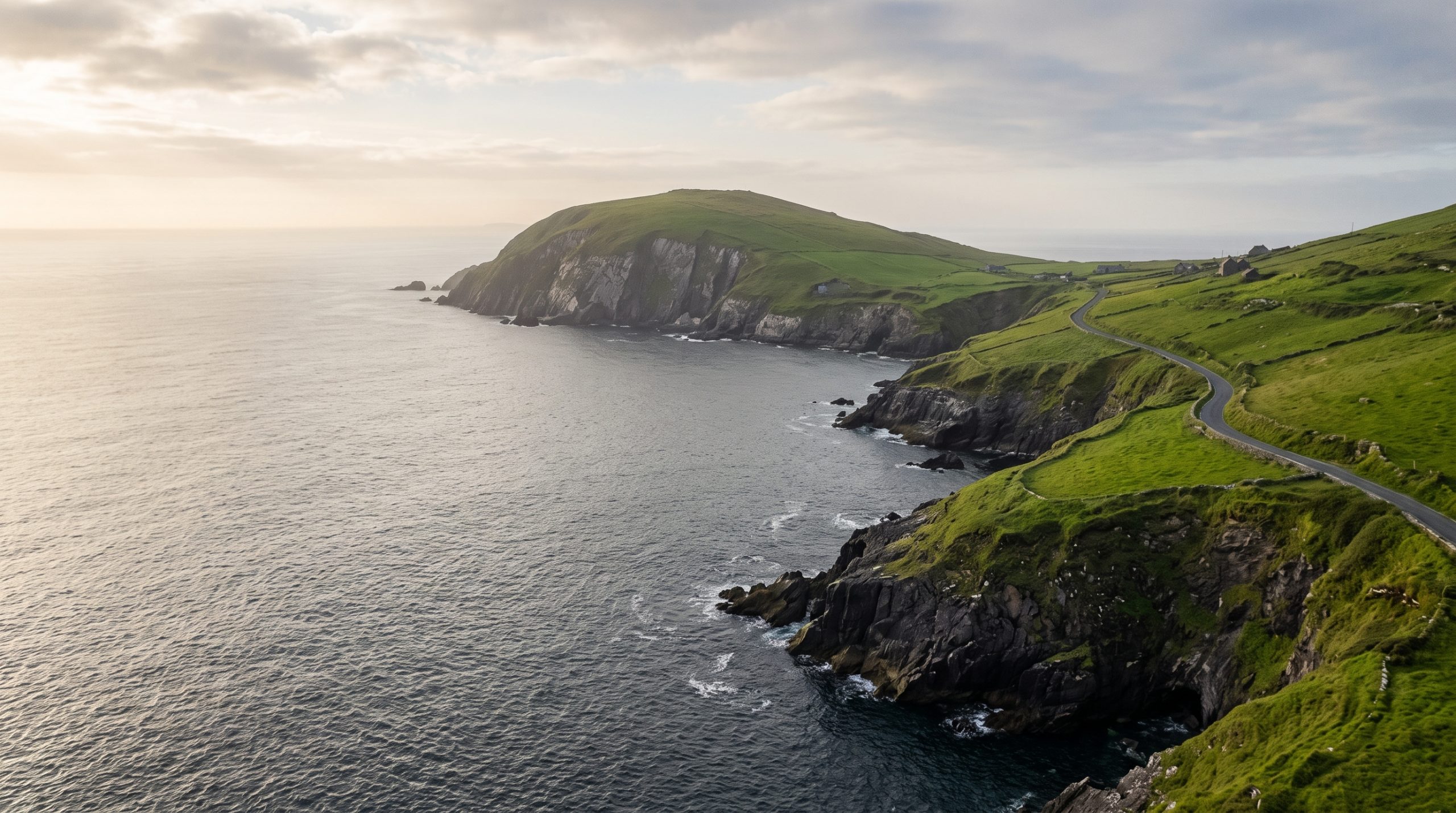
On 21 June 2027 the sun comes up over Slea Head at 5:21 in the morning and does not go down until 10:06 at night, with enough light to work by for another forty minutes after that. Close to seventeen hours, on one peninsula in west Kerry. Stand on the same headland on 21 December and you get sunrise at 8:48 and sunset at 4:32, and the whole thing becomes one careful loop instead of three.
Almost every honest question about what an Irish elopement costs comes back to that gap. Day length decides how many places one day can hold, whether you need a second day at all, and how hard the drive between two headlands has to be. The state’s share, by comparison, barely moves. You give three months of notice to the HSE Civil Registration Service, you pay a notification fee that currently stands at 200 euro, and that is the whole of what Ireland asks of you before you are legally married.
The rest is choices. Who marries you, and therefore whether you can stand on a cliff to do it. Which month you come, which changes both your light and your accommodation. How many people are on the ground with a camera when the weather gives you four good minutes.
The three numbers an Irish elopement actually breaks into
An Ireland elopement costs three things: the state’s fee, currently 200 euro for marriage notification; your own travel, accommodation and solemniser; and coverage. Ours is photography, film and planning from one team of eight, with team travel included worldwide, starting at $4,900 for one full day on the west coast.
Seventeen hours of light in June, eight in December
Ireland sits far enough north and far enough west in its time zone that summer evenings run absurdly long, and winter days do not. That single fact reshapes what your money buys, month to month, more than any other variable on the west coast.
| Date in 2027 | Sunrise at Slea Head | Sunset | What one day holds |
|---|---|---|---|
| 20 March | 6:45 am | 6:54 pm | Two locations, ceremony in the middle, home before dark |
| 15 May | 5:48 am | 9:29 pm | Three landscapes, a long break in the afternoon |
| 21 June | 5:21 am | 10:06 pm | Everything, with a real rest built in |
| 15 September | 7:16 am | 7:58 pm | A civilised alarm, still two clear light windows |
| 15 October | 8:06 am | 6:48 pm | One loop, low sun most of the day |
| 21 December | 8:48 am | 4:32 pm | Two locations, close together, lit the whole time |
Times are Irish clock time. The clocks go forward on the last Sunday in March, which is why the March figures look earlier than you expect.
Here is how we build the June version, because it is the one most couples picture and the one that goes wrong most often when nobody plans the middle of it.
4:40 am. Leaving the house. There is already grey light on the road, and the walk in to most west Kerry headlands takes fifteen to twenty-five minutes over ground that is wet whatever the forecast said. Boots on, shoes in the bag.
5:21 am. Sunrise. On an Atlantic coast the sun comes up behind you, over the land, so the first hour throws long light out along the cliff faces and turns the sea silver rather than gold. It is the quietest hour of the entire day. Nobody else is out. We work back from the edge on set ground with a long lens, which is where the better frame is anyway, because it lets the cliff line run away behind you.
7:15 am. Back to the car, coffee, and a change of clothes if you want one. This is a good hour for the small stuff, the boreens and the stone walls and the gate you passed on the way up.
10:00 am. The coaches reach the famous viewpoints. If the Cliffs of Moher are on your list, this is where planning does real work: admission there is booked by arrival time slot and includes the car park, and there are 800 metres of paved path, which makes it the one dependable option on a morning when every other surface is soft. We book the slot that suits the day, not the one that suits the coaches.
12:30 pm. Ceremony, usually. If a secular solemniser is marrying you, this can happen on a headland, on a beach, in a field. If you want a registrar from the civil registration service, the ceremony has to be indoors at an approved venue that is open to the public, Monday to Friday only, and never on a bank holiday. The two shapes of day are genuinely different, and it is worth deciding this before you fall in love with a clifftop.
2:00 pm. Nothing. Go back, eat, sleep for an hour. A seventeen-hour day is not a gift if you spend all of it upright, and the frames from a couple running on adrenaline at 8pm look exactly like what they are.
6:30 pm. Out again, usually somewhere completely different. Twenty-five minutes inland from the coast is a landscape nobody associates with Ireland, all bog and lake and empty road.
8:40 pm to 10:06 pm. The long one. This is the hour the whole day was built around, and in June it lasts closer to ninety minutes than sixty. If the wind sits under the limit, this is when the drone goes up.
10:30 pm. Still shooting. The west coast holds colour long after the sun has gone, and the last frames of a June day are regularly the ones couples end up printing.
Change the month and the shape changes completely. A mid-October day starts at a humane 8:06, runs low and warm the whole way through, and finishes in time for dinner. If you want to know how we fit a legal ceremony, a walk-in and two coasts into one timeline, Check Your Date and tell us roughly when you are thinking. We will send back the light times for your week.
What a second camera catches in four minutes of Irish weather
West of Ireland light does not arrive and stay. A shower crosses the Dingle Peninsula in about eight minutes, and the gap behind it is the good part: a few minutes of hard raking light under a black sky, with the wet rock throwing it back up at you. That window opens without warning and closes just as fast.
One person with one camera has to choose in that moment. Stills or motion. The wide or the close. Almost every compromise you see in elopement work from this coast is that choice being made under pressure by someone who wanted to make neither.
We do not hire a filmmaker in for the morning. There are eight of us, four photographers and four filmmakers, and the two people on your day have planned it together for months before they stand on the same piece of grass. When the sky breaks, one is already on the long lens from the set-back position and the other is thirty metres up the slope on the wide. You get both versions of the same four minutes, and you did not have to pay two travel bills to get them.
Wind is the other thing. An Atlantic headland in any month will eat spoken vows, which is why the Expedition includes professional audio for vows and the moments that matter, and why we scout the lee side of things: a wall, a dip in the ground, a boreen a hundred metres back from the edge where you can hear each other and the recording still holds. Aerials get the same treatment. Drone footage is included where it is legal, safe and appropriate, and at OPW national monument sites drone filming is not permitted at all, so we simply plan the aerial minutes into the coast road section of your day instead of the castle section. Our published galleries and films are the fastest way to see what that division of labour actually produces on ground like this.
What happens to your money if the morning is grey
This is the real question behind most emails we get about Ireland, and it deserves a straight answer rather than reassurance. Yes, it will probably rain at some point in your day. No, that is not what a grey elopement looks like.
Irish weather moves. A forecast showing rain from six until noon almost never means six hours of rain; it means three or four showers travelling through with bright gaps behind them, and the gaps are the reason this coast photographs the way it does. Flat grey all day is the harder hand, and it is also the one with the clearest answer: we go low. Ferns, beaches, water level, close work, interiors with the door open and the weather visible behind you. Nobody needs a blue sky to make that hour beautiful.
Practically, we build every Irish day with an alternative fifteen to twenty minutes away, facing a different direction. On the west coast you are frequently within an hour of two coastlines and a mountain pass, and cloud rarely sits on all three. We watch the models through the week before, we tell you on the morning if we want to swap the 6:30 pm block for the 8:30 pm one, and the fee does not move because the plan did. Rescheduling hours is normal. Rescheduling the date almost never is.
What sits inside the fee, and what you pay in euro on the ground
Every experience we run, in Ireland and everywhere else, includes the same core.
- Destination and location design, built around where the light actually falls in your month
- Planning and a custom timeline based on real travel time, not map distance
- Permit research and logistics guidance, including which sites need written permission and how far ahead they want it
- Weather alternatives and backup planning for every block of the day
- Drone footage where it is legal, safe and appropriate
- Team travel worldwide: flights, accommodation and ordinary travel for your assigned team, with no long-haul surcharge
- Highlights delivered in 5 days, and the full gallery or film in 3 weeks
The Adventure covers one full day with a dedicated photographer or a dedicated filmmaker. The Expedition puts both on the ground together for a full day and starts at $7,900. The Odyssey runs from two to seven days across one or several destinations, photography and film, quoted as a custom proposal. Guest count does not change any of those figures. Ten people affect access, permits and transport, not the fee. Full detail sits on the pricing page.
What you pay separately in Ireland is short, and mostly in euro.
| Cost | Paid to | What to know |
|---|---|---|
| Marriage notification fee, currently 200 euro | HSE Civil Registration Service | Non-refundable, paid at your notification appointment, at least three months before the date |
| Solemniser’s fee, commonly 400 to 700 euro | Your solemniser directly | Set independently by each solemniser, with travel often added for the far west |
| Registrar attending an approved venue | The local civil registration service | An additional fee applies away from the registrar’s own office, and the amount is confirmed to you at notification |
| Site admissions, parking and permit fees | The site or landowner | We do the research and the applications; the fees themselves are yours |
| Unusual transport | Operators | Boat charters, 4×4 transfers and mountain guides where a location needs one |
| Accommodation, celebrant, vendors, activities | Direct | Booked in your name so you keep control of the changes |
How an Ireland 2027 date moves from enquiry to hold
- Send the inquiry form with your rough dates and the shape of day you have in your head.
- We reply within 24 hours with an initial brochure.
- We build a tailored proposal around your dates, your region and your light.
- You sign the contract and pay a 30% retainer.
- Planning begins: locations, timeline, permits, the legal sequence, the alternatives.
- The remaining payment schedule is set out in your proposal, so there is nothing to guess at.
Our planning calendar for Ireland currently covers 2027, 2028 and 2029. If you are still working out the order of operations, our guide to planning an elopement covers the fundamentals we work from.
Couples this coast fits, and the month we would move you to
Ireland in June suits couples who genuinely do not mind a 4:40 am alarm, who will walk twenty-five minutes over wet ground in good boots, and who can hear “the wind has turned, we are doing the headland tonight instead of this morning” without it ruining anything. If that sounds like your idea of a good day, this is one of the best coastlines in Europe for it.
If it does not, the fix is a month, not a compromise. Mid-September gives you sunrise at 7:16 and full dark still hours away after dinner. Mid-October pushes first light back to 8:06 and keeps the sun low and side-on all day, which is flattering in a way that midsummer noon simply is not. Couples who want short walks and firm ground do better on the Clare and Connemara road networks than on the Kerry passes, and we will say so. Tell us what you actually want your morning to feel like, and we will either shape the day around it or point you at the month and the region that fit it better.
Common questions
How much should we budget for an Ireland elopement in 2027?
Build it from four lines: coverage, accommodation, the state fee of 200 euro, and your solemniser. Coverage is the fixed one, and our current figures are all on the pricing page. Because our team travel is included, the Irish flights and hotel nights on your spreadsheet are yours and your guests’, not ours.
Does the price change if we bring our parents and a couple of friends?
No. The fee is the same whether it is the two of you or twelve. Guest numbers affect access, parking, permits and how long the walk-in takes, which is planning work, and planning is already inside the price.
Do we have to be in Ireland three months before the wedding?
Not usually. Couples living abroad can ask a registrar for permission to give the three-month notification by post, then attend a registrar’s office in person at least five days before the ceremony to sign the declaration and collect the marriage registration form. Civil registration offices work Monday to Friday, so we build that visit into your travel week.
Can we legally get married on a cliff or a beach in Ireland?
Yes, if a secular or religious solemniser on the Register of Solemnisers marries you, because they can officiate outdoors. A registrar cannot: civil ceremonies must be held in a registry office or an approved venue that is open to the public. You will need two witnesses aged 18 or over either way, and we help you solve that if you are travelling alone.
Are your flights and hotels added to our invoice?
No. Team travel is included worldwide, Ireland included, with no European or long-haul distinction. What you pay separately are the third-party costs in the table above.
What if the forecast is bad the week of our date?
We move hours, not dates. Every Irish day we plan carries an alternative fifteen to twenty minutes away facing a different direction, and we will tell you the morning of if we want to flip your evening and morning blocks.
How quickly do we see the photographs and the film?
Highlights land in 5 days, while you are usually still travelling. The full gallery or film follows within 3 weeks.
Can you fly a drone at Irish castles and heritage sites?
Not at OPW national monument sites, where drone filming is not permitted, and filming or photography needs prior written permission arranged in advance. We plan aerial minutes into the parts of your day where they are legal and safe, which on the west coast is rarely a problem.
Your 2027 date on the Irish west coast
Everything on our side happens in writing, which suits a five-hour time difference: you send the form, and a reply and an initial brochure come back within 24 hours while you sleep. Send us the week you are thinking about, the two or three landscapes you keep coming back to, and whether 5am sounds like a good idea or a terrible one. We will tell you honestly what that week’s light will do and what your day could look like inside it. Tell Us Your Story.