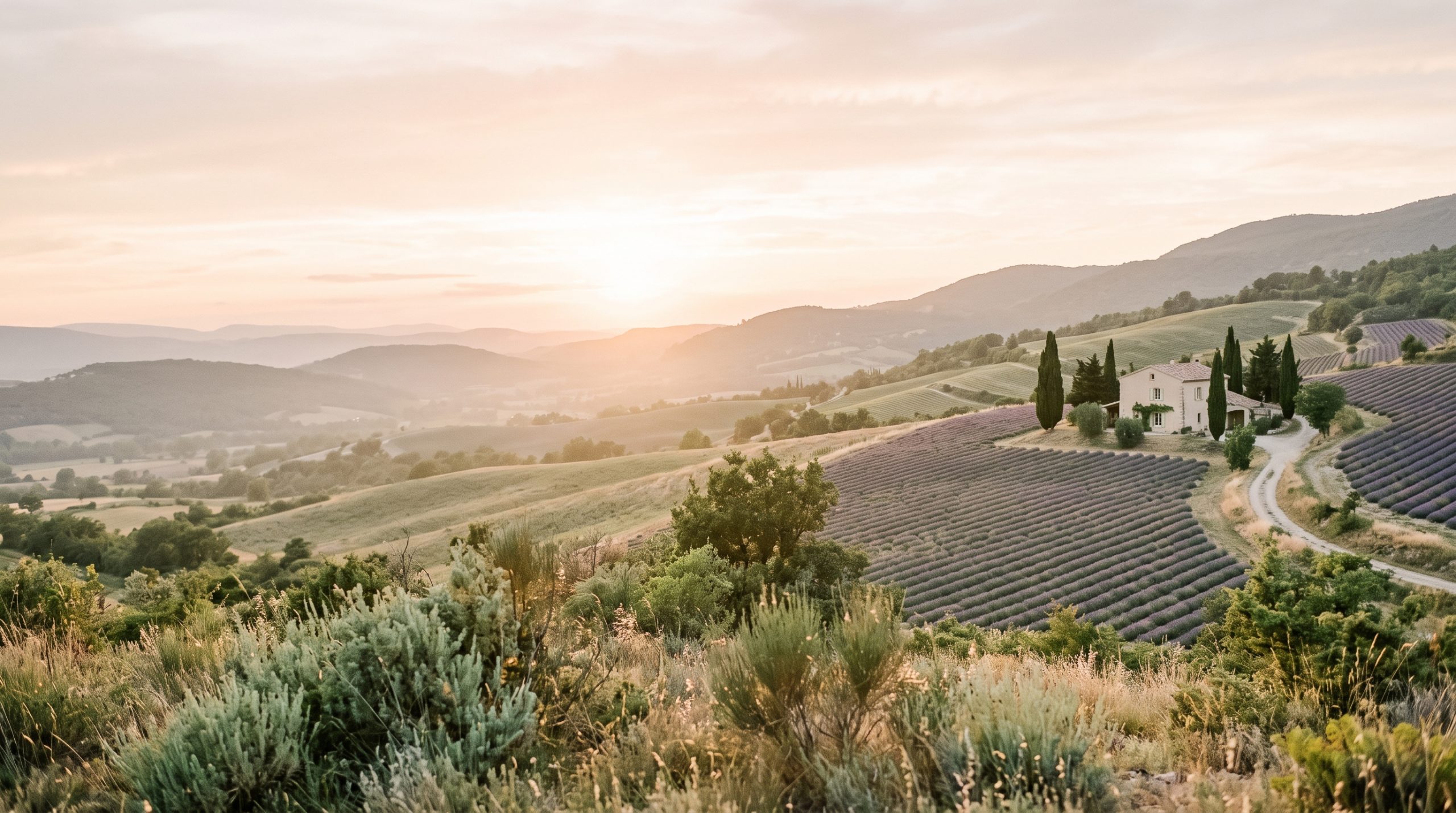
Lavender on the Valensole plateau starts to turn around mid-June and holds its colour for roughly a month before the cutters go through. That window, not the paperwork, is what most couples are really asking about when they write to us about Provence. The legal question arrives second, and the answer to it is shorter than people expect.
French law puts a legal marriage inside a mairie, in a commune where one of you has lived continuously for at least a month. For a couple flying in from Denver or Charleston, that is not a wedding plan, it is a relocation. So nearly everyone marries at home first, quietly, and brings the ceremony itself to Provence, where it can happen at six in the morning in a field, on a limestone terrace above Cassis, or in a courtyard around one long table.
This page covers what that route actually costs, what you sign and where, what the small number of couples who genuinely qualify for a French civil marriage have to collect, and how we build the day around the one hour of light worth having.
The one-month rule, and what it means for your budget
A symbolic ceremony has no legal standing in France, so it carries no residency requirement, no banns and no registry file. You marry legally at home, then hold the ceremony anywhere in Provence that will have you, at any hour you choose. Your money moves off the paperwork entirely and onto the celebrant, the location and the coverage.
Two routes into a Provence ceremony, and the one nearly everyone takes
Article 74 of the Code civil is the sentence that decides this. A marriage is celebrated in the commune where one of the spouses, or one of their parents, has a domicile or a residence established by at least one month of continuous habitation at the date the banns are published. Publication itself runs for ten days, and the ceremony cannot be held until that period has ended. Stack the two together and the French civil route asks for something close to six weeks anchored to a single commune, with a complete file accepted before the clock even starts.
Only the civil ceremony at the mairie, conducted by the maire or a municipal officer standing in for them, creates a marriage under French law. A ceremony in a lavender field, on a clifftop above Cassis or inside a chapel is not a legal marriage in France, whoever officiates it and however beautifully it is written. Marriage has been open to same-sex couples in France since the law of 17 May 2013, and the symbolic route has never had a gatekeeper at all: no licence, no registration, no minimum notice.
Here is the honest difficulty rating. The French civil marriage is not realistically available to a couple flying in for a week, and no mairie is going to bend Article 74 for a good story. Marrying at home first is straightforward, and it is the route we plan around most often. It is also, quietly, the better one. Nothing about the day in Provence changes. Same vows, same hour, same field, same friend reading the thing she wrote at two in the morning and rewrote on the plane. What changes is that you arrive with the legal part already behind you, and you spend the week being present instead of chasing a sworn translation across a departement. If you want the shape of that week mapped before you commit to anything, our guide to planning an elopement walks through how the pieces fit together.
If you choose the French legal route, collect the documents in this order
Most couples reading this need the first list and none of the second. Both are here, because the gap between them is the whole point of the page.
Marrying at home, celebrating in Provence
- Marriage licence from your county or state office, on whatever notice period that office sets.
- The civil marriage itself, at home, before you fly.
- Certified copies of the marriage certificate from the office that issued it. Order two.
- An apostille on one copy, from the Secretary of State of the state that issued the certificate, if you expect a French or other European administration to need it later.
- Passports. Nothing else.
Not one item on that list is ever filed with a French office. No mairie sees it, no sworn translator touches it, no French deadline applies to it. That is precisely why the route exists, and why it is the mainstream choice rather than a compromise.
The French civil marriage, for the few who qualify
- Residence. One month of continuous habitation in the commune, established by the date the banns go up. The residence of one of your parents in that commune also opens the door.
- Birth certificate in the full version showing parentage. Records issued abroad are generally accepted up to six months old. Validity window applies.
- Apostille on the birth certificate, issued by the Secretary of State of the state that produced it. Two people born in two states means two separate offices. Apostille required.
- Sworn translation into French by a traducteur assermenté registered with a French court of appeal. A translation produced in France by a sworn translator needs no apostille of its own, because the translator’s seal and signature carry it. Translation required, and not by you.
- Attestation tenant lieu de certificat de coutume et de célibat. American citizens sign this themselves, because marriage records in the United States are held by individual states and no federal authority can certify them. Self-signed.
- Photo identification and proof of address for both of you.
- Witnesses. Names and identity documents for two to four people, each aged 18 or over, who will sign the register on the day.
- The file, lodged at the mairie. The registrar can ask to see you both before accepting it. Banns are then posted for ten days, and your date sits on the far side of them.
We can build the day around the paperwork, but we do not decide the law. Check your specific Provence circumstances with the registry, municipality or consulate involved.
Build the Provence week backwards from the ceremony light
The real minimum for the symbolic route is very short. Marry at home, land in Marseille, drive an hour, walk up the hill. The comfortable minimum has nothing to do with paperwork. It is set by the fact that a lavender field is a crop with a harvest date, that a national park authorisation is granted at somebody’s discretion, and that the light you want happens once a day. We work nine to twelve months out, and we are currently holding dates in 2027, 2028 and 2029.
| Counting back | What happens | Why the timing is fixed |
|---|---|---|
| 12 to 9 months | The week is chosen, the locations are designed, the date is held | Lavender timing is set by the season and the harvest, not by your calendar |
| 9 to 6 months | Landowner and site permissions opened, any park authorisation requested | An authorisation in the Parc national des Calanques is granted case by case by the park director |
| 6 to 3 months | Home marriage licence researched, the civil marriage at home settled | Notice periods vary by state and none of them are ours to hurry |
| 3 months to 6 weeks | French route only: birth certificate ordered, apostilled, sworn-translated | The six-month window is measured at the counter, so ordering too early can cost you the document |
| 6 weeks | French route only: the complete file is lodged at the mairie | Banns cannot be posted until the file has been accepted |
| 10 days | French route only: banns are posted | The marriage cannot be celebrated before the ten days have run |
| Ceremony week | The timeline is finalised against the forecast and the wind | The mistral changes which side of a ridge is usable, sometimes overnight |
We work to the comfortable minimum rather than the real one, and the reason is the top row rather than the bottom. If you are choosing between the lavender weeks and the quieter, longer light of September, that decision belongs at the start of the process. Tell us which one you are drawn to and we will tell you honestly what each week gives you and what it takes away.
Six-month clocks, sworn seals and other small print
This is the section other pages skip. None of it is dramatic. All of it is the kind of detail that quietly moves a date by three weeks.
- The six-month clock is measured at the counter. A foreign birth certificate is generally accepted up to six months old, and those months are counted against the day the mairie takes the file, not the day you ordered the document. Order it, apostille it and translate it in one continuous run rather than across three seasons.
- There is an exception worth asking about. Where the issuing country does not update its birth records with marginal notes, no time limit is imposed, but the mairie will want an attestation from your embassy or another competent authority confirming exactly that. Ask which rule the office is applying before you order anything.
- Translations must be sworn, and the swearing happens in France. A translation made in France by a traducteur assermenté needs no apostille of its own, because the seal and the signature carry the weight. A translation made at home by a friend with excellent French carries none of it.
- No American is ever handed a certificat de coutume. Marriage records in the United States sit with individual states, so neither the Embassy nor any federal authority issues one. US citizens sign an attestation in its place, and the Embassy’s own guidance is that the form does not require consular notarization. Some mairies ask for it regardless. Notarial service is available in Paris, at the Consulate General in Marseille and in Strasbourg, at a consular fee of $50 per seal.
- Two states means two apostille offices. American apostilles come from the Secretary of State of the state that issued the document, so a couple born in different states runs two separate processes with two sets of processing times.
- The ten days start when the mairie says they start. Banns go up once the file has been accepted, not on the day you hand it over. Every day spent chasing an outstanding translation is a day added to the front of that period, not absorbed by it.
- The mairie ceremony runs in French. Worth planning for if you are taking the civil route with family who do not speak it.
Registry and permit costs in Provence can change between seasons. Before you commit travel, confirm the current fee and processing window with the authority involved.
Lavender, limestone and who has to say yes to your location
With the legal question off the table, the constraints that remain are agricultural, administrative and meteorological. Those are the ones we spend our planning hours on, and they are far more likely to shape your morning than anything in a registry.
Lavender first, because it is why most people write to us about Provence. On the Valensole plateau, between the Durance valley and the Verdon gorges, the bloom starts around mid-June and holds for roughly a month. Higher ground near Sault comes later and runs into August. The regional tourism board is blunt that the start of flowering shifts every year with rainfall and temperature, so treat any single date as a forecast rather than a promise. Harvest is the harder edge. Valensole’s lavender festival falls on the third Sunday in July and marks the beginning of the cut, which means a field that was deep purple on the Tuesday can be neat green stubble by the Friday. We hold two fields and choose late. We also say plainly that a lavender field is somebody’s crop, that access is a farmer’s decision rather than ours to assume, and that the difference between a row you were invited into and a row you were not shows in the pictures.
South of there, the limestone. The Parc national des Calanques covers the inlets around Marseille, Cassis and La Ciotat along with the Frioul islands, and photography or filming carried out in a professional or commercial capacity inside the park core is prohibited unless the park director grants an individual authorisation. Private snapshots taken with portable, handheld, non-aerial equipment for purely personal use are free of all that. Our work is not private snapshots. The same rule pointedly excludes aerial gear from the free-use exemption, so we never design a Calanques film around a drone before the authorisation is in hand. Elsewhere in Provence we fly where it is legal, safe and appropriate, and that gets written into the plan rather than decided on the morning.
All of that produces a specific look. Pale limestone holds warm light for a long stretch after the sun has dropped behind a ridge, and lavender rows read best with the camera low and the sun behind them, which is a different hour from the one the coaches keep. You can see how that resolves into finished work in our elopement stories, where the same day appears as both a gallery and a film. Our destination guides go region by region if you are still weighing Provence against somewhere else entirely.
Tell us the week you are drawn to and the kind of morning you keep imagining, and we will come back with locations, an hour, and an honest read on what the season will be doing. Send Us a Message.
Where our Provence planning ends and the French legal process begins
We design the destination and the locations, build a timeline around the light and real travel time, research the permits that apply to the ground you actually want to stand on, guide the logistics and hold weather alternatives for every part of the day. Team travel is included worldwide, so flights and accommodation for the assigned team are never a line you pay. Highlights reach you in 5 days and the full gallery or film in 3 weeks.
Photography and film come from one team, which matters most in the ten minutes that only happen once. A dedicated photographer and a dedicated filmmaker who already work together will set the ceremony hour with the light rather than against it, and there is always a second camera on the ground, because there are eight of us and someone is always in reserve. The Expedition adds professional audio for vows where conditions allow, which is the difference between remembering roughly what you said and hearing it again in your own voice.
What stays with you is the licence at home, the attestation if you take the French route, the registry file and anything a consulate or a mairie asks you to sign. We do not file paperwork and we are not agents for any office. We plan around the constraints, hold your date against them, and coordinate the ceremony hour with the light once the celebrant is confirmed.
The Adventure covers one full day with a dedicated photographer or a dedicated filmmaker from $4,900, the Expedition puts both on the ground together from $7,900, and the Odyssey runs from two to seven days across one or several destinations as a custom proposal, all of it set out on our pricing page.
Common questions
Is a symbolic ceremony in Provence legally binding?
No, and that is the point of it. A symbolic ceremony creates no marriage under French law, produces no certificate and is registered nowhere. Under French law only the civil ceremony at the mairie creates a marriage. Couples marry legally at home, then hold the ceremony they actually want in Provence, with no notice period and no file.
Do we have to live in France to get legally married in Provence?
For the French civil route, effectively yes. Article 74 of the Code civil requires the marriage to be celebrated in the commune where one of you, or one of your parents, has a domicile or residence established by at least one month of continuous habitation by the date the banns are published. A holiday rental for the week does not satisfy it.
How long do the banns have to be posted before a French civil wedding?
Ten days, and the marriage cannot be celebrated until that period has ended. The ten days only begin once the mairie has accepted your complete file, so any outstanding translation or expired certificate pushes the whole thing back rather than running alongside it.
Can we hold our ceremony in a lavender field at Valensole?
Often, with the farmer’s permission, which is the part that matters. The fields are working agricultural land, the crop is cut from around the third Sunday in July, and access is granted by the owner rather than by the commune. We approach the landowner as part of planning and hold a second field in reserve in case the cut comes early.
Do we need witnesses for a symbolic ceremony?
No. Witnesses belong to the legal marriage, where French law asks for two to four people aged 18 or over to sign the register. A symbolic ceremony has no register, so you can bring nobody, or two people, or your parents, and none of it changes anything except how the day feels.
Can the US Embassy in France give us a certificat de coutume?
It cannot. Marriage records in the United States are held by individual states, so no federal authority can certify your capacity to marry. American citizens sign an attestation that stands in place of the certificat de coutume and de célibat, and the Embassy’s guidance is that it does not require consular notarization, although some town halls ask for it anyway.
When is the lavender actually purple in Provence?
On the Valensole plateau the bloom generally starts in mid-June and holds for about a month, while the higher fields near Sault start in July and can run into August. The regional tourism board notes that flowering shifts each year with rainfall and temperature, so we plan a week rather than a day and confirm the field close to the date.
Does our guest count change what we pay?
No. The price is the same for the two of you as it is with twelve people watching. Guest numbers change access, permits, transport and the timeline, so they matter enormously to the planning, but they do not move the fee.
Choosing your week in Provence
Pick the season first and the location second. Mid-June to mid-July buys you the plateau in colour and a 6am start; September buys you longer, softer light, empty villages and a warm sea below Cassis. Both are good weeks. They are simply not the same week, and knowing which one you want makes every other decision easier.
Everything between us happens in writing. You send the inquiry form, we reply with an initial brochure within 24 hours, a tailored proposal follows, and when it is right the contract is signed with a 30% retainer and the planning begins. Bring us the week, the hour you keep picturing and the shape of the ceremony you have in mind. Start Your Story.