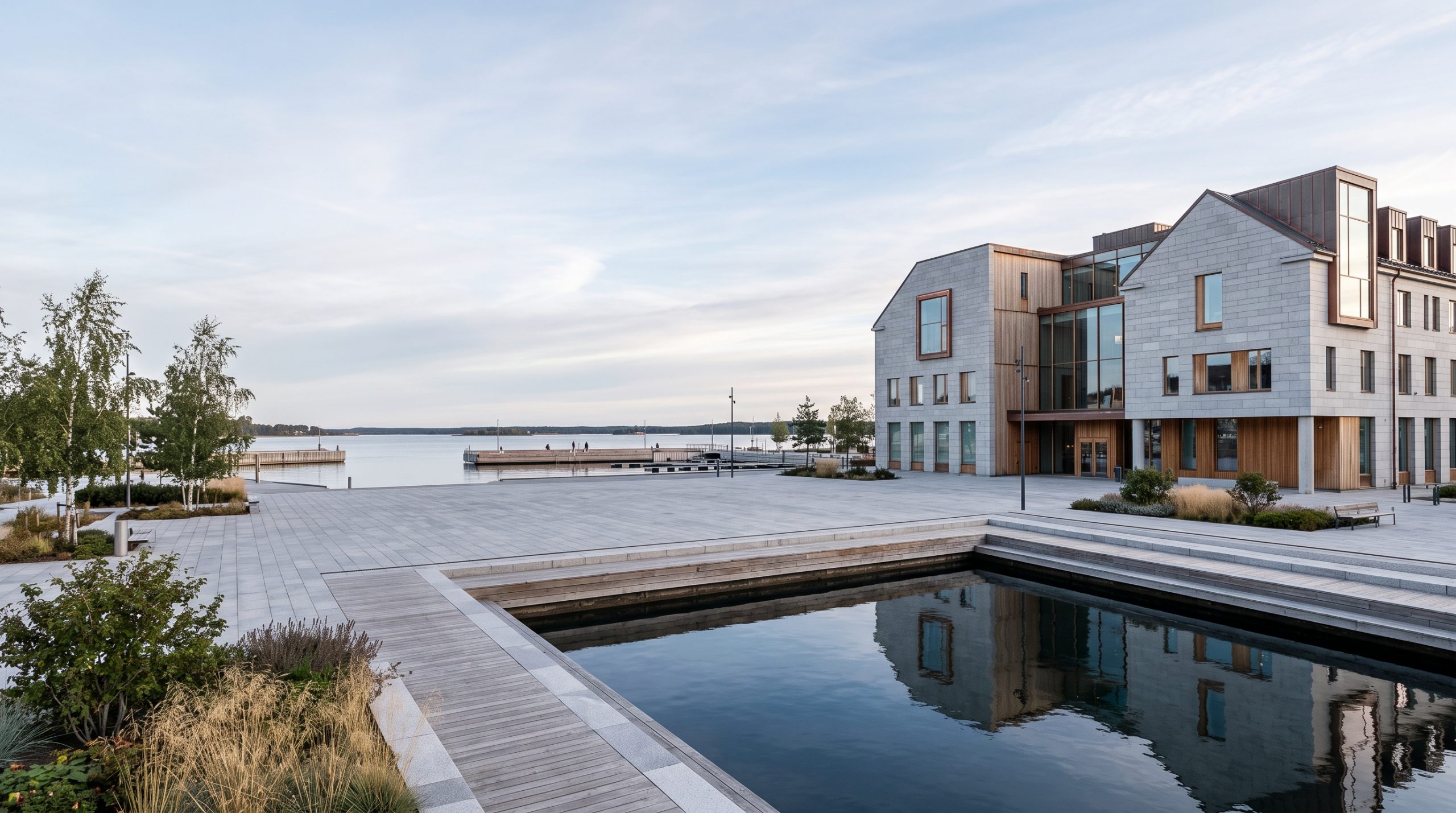
The legal part of a Swedish wedding is short. One northern municipality spells it out without any ceremony of its own: the exchange runs about five minutes, it can be held in Swedish or English, valid identification has to be on the table, two witnesses have to be standing there, and it is free of charge.
Everything else about marrying in Sweden as a visiting couple comes down to one certificate, the hindersprövning, and the four months it stays alive. Get that window right and the rest of the day belongs entirely to you and the landscape. Get it wrong by starting too early, and you do the paperwork twice.
We plan and shoot elopements across Sweden, from the birch forest above Abisko to the pink granite of the Bohuslän coast, and the questions we get most are not about locations. They are about which office issues what, in what order, and how long before the flight it all has to happen. Here is the chain as the governing offices describe it.
Sweden in one paragraph: free, four months, two witnesses
Two foreign visitors can legally marry in Sweden. You apply jointly to Skatteverket for a consideration of impediments to marriage, free of charge, with proof from home that you are over 18, unrelated and unmarried. The certificate that comes back is valid for four months, and two witnesses aged 18 or over must attend.
The difficulty sits in one document, and it is not a Swedish one
Sweden’s own side of this is unusually clean. The application to Skatteverket carries no fee at all. The civil ceremony carries no fee either: Boden’s municipal guidance states that the ceremony is free of charge and that the couple covers only the officiant’s travel expenses if it takes place away from the City Hall. The officiant is appointed by the County Administrative Board, which keeps a list of officiants for each municipality, and that authorisation is valid throughout Sweden.
The friction is on your side of the Atlantic. Skatteverket requires both of you to submit documentation issued by a public authority in your country of residence, proving there is no impediment to your marriage under Swedish law: that you are over 18, that you are not closely related to each other, and that you are not currently married. In the United States, no single national office produces that record. The US Embassy in Stockholm states that each state has its own set of rules on marriage and that the embassy cannot provide marriage information for individual states, so the document you need comes from your state or county, and its turnaround depends on which one you were born in and where you live now.
So the honest rating is this. Straightforward on the Swedish side, fiddly on yours, and completely doable once you know that one record is the pacing item. Couples who start with the state or county office and treat Skatteverket as the second step almost never run into trouble. Couples who start with Skatteverket wait.
We are photographers and filmmakers, not lawyers. Rules change and circumstances differ, so confirm the detail with Skatteverket or your own consulate before you book flights.
What you gather, in the order Skatteverket needs it
The order matters more than the length of the list. Municipalities such as Finspång tell couples to start with the officiant, agree a date and a place, and only then apply for the certificate. That sequence exists because the certificate has an expiry date and the officiant’s diary does not.
- An officiant and a date. The County Administrative Board maintains the list of appointed civil marriage officiants for each municipality. You contact the officiant directly to agree the hour and the place. Their authorisation covers the whole country, so a mountain shoulder and a council chamber are, in law, the same event.
- Passports. Skatteverket accepts a passport or an equivalent identity document stating your date of birth as proof that you are over 18.
- Your marital status record from home. Documentation issued by a public authority in your country of residence, showing that you are free to marry. This is the piece with the variable lead time and the one to request first.
- Proof that any earlier marriage has ended. If either of you has been married before, or was in a registered civil partnership, Skatteverket needs the official document that closed it. For most couples that is the divorce decree.
- Form SKV 7880. The application and affidavit for consideration of impediments to marriage. Skatteverket labels it as a Swedish-language form, and the online e-service is built for people who can sign with a Swedish e-ID, so visiting couples use the paper route: post it to Skatteverket, or hand documents in at a state service centre.
- The two documents that come back. Skatteverket returns a certificate of no impediment and a wedding certificate form for your officiant to complete. This is the four-month document. The window cannot be extended.
- Delivery to the officiant. Växjö asks couples to send both certificates in due time before the ceremony, preferably two weeks ahead, along with the names and addresses of the witnesses. Other municipalities set their own habits, and two weeks is a sensible floor to plan against.
- After the ceremony. The officiant records the details of the marriage in an official record immediately, and you keep the vigselbevis, the certificate from the ceremony itself. The US Embassy’s guidance is to take that document back to Skatteverket to have the marriage officially registered.
Two things about apostilles, because they catch people out at the wrong end of the process. Skatteverket does not issue apostille stamps or document legalisation; that is a notarius publicus. And Sweden does not produce an international marriage certificate in the way many countries do. If you want your Swedish marriage on record with a US state, the embassy’s route is a translation by an authorised translator plus an apostille from a notarius publicus, sent to the office of vital statistics for the relevant state.
Build the Swedish timeline from the ceremony date backwards
Swedish law puts one hard edge on this and it is the far one: four months, not extendable. Everything else is governed by how fast paper moves between offices, which is why we plan backwards from the hour we want the light rather than forwards from the day you decide to do it.
| Counting back | What has to be true | Who holds it |
|---|---|---|
| The hour itself | Officiant present, both of you present, two witnesses aged 18 or over, identification on the table. The legal exchange takes about five minutes. | Your officiant |
| Two weeks before | Both Skatteverket documents in the officiant’s or the municipality’s hands, witnesses named. | You |
| Within four months before | Certificate of no impediment issued and still inside its validity window on the ceremony date. | Skatteverket |
| Before you apply | Passports, your state or county marital status record, divorce decree where relevant, form SKV 7880 signed by both of you. | You |
| Six to eighteen months out | Date held, officiant agreed, ceremony hour matched to sunrise or sunset, weather alternatives mapped, travel built around real drive times. | Us |
The real minimum is genuinely short, and it is set almost entirely by your own state’s processing rather than by Sweden. The comfortable minimum, and the one we work to, looks like this: request the home record around five months out, send the Skatteverket application about three months out, have the certificate in your hands before you fly, and get both documents to the officiant a clear fortnight ahead. That leaves room for one thing to go slowly without touching the date.
The parts of the calendar that have nothing to do with paperwork matter just as much, and our guide to planning an elopement walks through those: guest logistics, travel days, and how much day you actually have once you subtract the drive.
Five details that decide whether the certificate is ready in time
None of these are difficult. All of them are the kind of thing you only learn by having done it a few times.
Applying too early is the most common misstep
The four-month validity cannot be extended, and if you do not marry inside it you apply again from scratch. A couple who send form SKV 7880 nine months out because they are organised will be re-doing it in the spring. Four months is a ceiling, not a target.
Check that your officiant’s appointment covers your date
Appointments made by the County Administrative Board can be time-limited, and the board states that ensuring the appointment is valid is the officiant’s own responsibility rather than something they are reminded about. One line in your first email to the officiant settles it for good.
You are on the paper route, and that is fine
The e-service assumes a Swedish e-ID. Form SKV 7880 is published in Swedish. Neither is an obstacle, but both mean you should allow post time in each direction and keep scans of everything you send.
Witnesses are named in advance, not found on the day
Some municipalities ask for the names and addresses of your two witnesses before the ceremony. If you are marrying without guests, decide early who they will be, because it is a question you will be asked in writing rather than at the ceremony.
The apostille belongs to the trip home
Nothing about registering the marriage in the United States happens in Sweden’s free, fee-less part of the process. Translation and the apostille from a notarius publicus are separate services you arrange yourself, and they are far easier to organise calmly after the trip than in the last week before it.
The prices and lead times here are a snapshot. Reconfirm them with the relevant authority before you build flights around them.
Marrying at home and holding the ceremony on a Swedish ridge
Plenty of the couples whose Swedish days we plan sign the legal paperwork at home, in a county office, weeks or months before they fly. Then they hold their real ceremony on granite or above the treeline with nobody watching. This is not a compromise and we do not treat it as one.
What changes: no application to Skatteverket, no four-month window to manage, no officiant list to work through, no statutory witnesses, and no requirement that any part of the day be conducted in Swedish or English or in five minutes. You write your own words. You can read them for twenty minutes if you want to.
What does not change: anything at all about the day itself. The hour is still chosen for the light. The ceremony still happens where you wanted it to happen. Our planning still covers destination and location design, a custom timeline built around real travel time, permit research where the ground needs it, and weather alternatives held in reserve. Highlights reach you within five days and the full gallery or film within three weeks, exactly the same either way. If you want to see how a Swedish day reads once it is finished rather than planned, our published stories and films are the honest version.
The only practical difference we notice is the mood. Couples who arrive already married are noticeably looser on the morning, because the last administrative thing in their lives was handled on another continent. Couples who are marrying legally in Sweden get a small, precise, oddly moving five minutes that the paperwork made possible. Both are good. Tell us which one you are planning and we will build the day accordingly. Tell Us Your Story.
What we plan around, and what stays in your name
We hold your date against the officiant’s availability rather than the other way round, and we set the ceremony hour where the light is actually good, which in the far north can mean an hour most people would call the middle of the night. We research the permits the ground requires, guide the logistics, and keep a sheltered alternative within reach of every coastal or high-level plan. Drone work runs where it is legal, safe and appropriate for that specific ground, confirmed before we build any of the film around it.
What stays with you: the application itself, the signatures, the certificate. We do not file paperwork with Skatteverket and we are not authorised to. What we do is make sure the paperwork and the light land on the same day.
Witnesses are where our shape of team occasionally becomes relevant. A Swedish civil ceremony needs two people aged 18 or over standing there, and some municipalities will supply them during office hours. On a fell at six in the morning they will not. If you are marrying with no guests at all, the two people already present are your photographer and your filmmaker, and it is worth raising that with us and your officiant early rather than on the day. We are eight people, so there is always a second camera on the ground and a colleague in reserve.
Photography, film and planning come from that one team, and the version with a dedicated photographer and filmmaker working together also brings professional audio for the vows where conditions allow, with both shapes and the multi-day option set out on our coverage and pricing page.
Common questions
Do we have to live in Sweden or be Swedish to get married there?
No. Residency and citizenship are not requirements. What changes for visiting couples is the evidence: if neither of you is registered as living in Sweden, you both submit documentation issued by a public authority in your country of residence proving there is no impediment to the marriage under Swedish law.
How much does the hindersprövning cost?
Nothing. Skatteverket states that the application for consideration of impediments to marriage is free of charge. A civil ceremony arranged through a municipality is also free of charge, and in Boden the only cost mentioned is the officiant’s travel expenses if you marry away from the City Hall.
How long is the Swedish certificate of no impediment valid?
Four months from issue, and that period cannot be extended. If the ceremony has not happened inside the window, you apply again. This is the single most important number in the process and the reason organised couples sometimes have to repeat a step.
Can we legally marry outdoors in Sweden, on a beach or a mountain?
Yes. Municipalities state that the ceremony can be held at your home or another venue if the officiant agrees, and an officiant appointed by the County Administrative Board is authorised throughout Sweden. Expect to cover their travel when the location is away from the municipal building.
Who can be our witnesses if we are eloping with no guests?
Two people aged 18 or over have to be present. Some municipalities will provide witnesses if the ceremony is held at the City Hall during office hours. For a ceremony out on the coast or in the mountains, agree the arrangement with your officiant in advance, and tell us early so the timeline accounts for it.
Will our Swedish marriage be recognised back in the United States?
Sweden does not issue an international marriage certificate. To put a Swedish marriage on record with a US state, the embassy’s guidance is to have the document translated by an authorised translator and apostilled by a notarius publicus, then sent to that state’s office of vital statistics. Skatteverket does not issue apostilles.
Can same-sex couples marry in Sweden as foreigners?
Marriage in Sweden is gender-neutral and has been since 2009. For visiting couples, Skatteverket notes that in certain situations the right to marry is assessed under the law of a country other than Sweden, which for couples resident in the United States is a test already met.
What documents do we need in Sweden if we marry at home first?
None. A ceremony that is not a legal marriage needs no certificate, no officiant from any list and no witnesses. You bring your marriage licence from home if you want it in the photographs, and nothing else.
Pick the light first, then start the clock
Choose the month before you choose the paperwork. North of the Arctic Circle the sun stays up for weeks around midsummer, and the dark half of the year turns the same fells into aurora ground. Down on the Bohuslän coast the granite goes warm and pink for a long stretch of evening in June. Our destination elopement guides are the place to work out which of those you actually want, and once you know, counting back four months is straightforward.
We keep every planning decision in writing so the process works across time zones. Send the inquiry form with your month and the region you are drawn to, and you will have a reply and our brochure within 24 hours, then a tailored proposal. A signed contract and a 30 percent retainer start the planning, and our Sweden dates are currently open across the 2027–2029 seasons. Check Your Date.