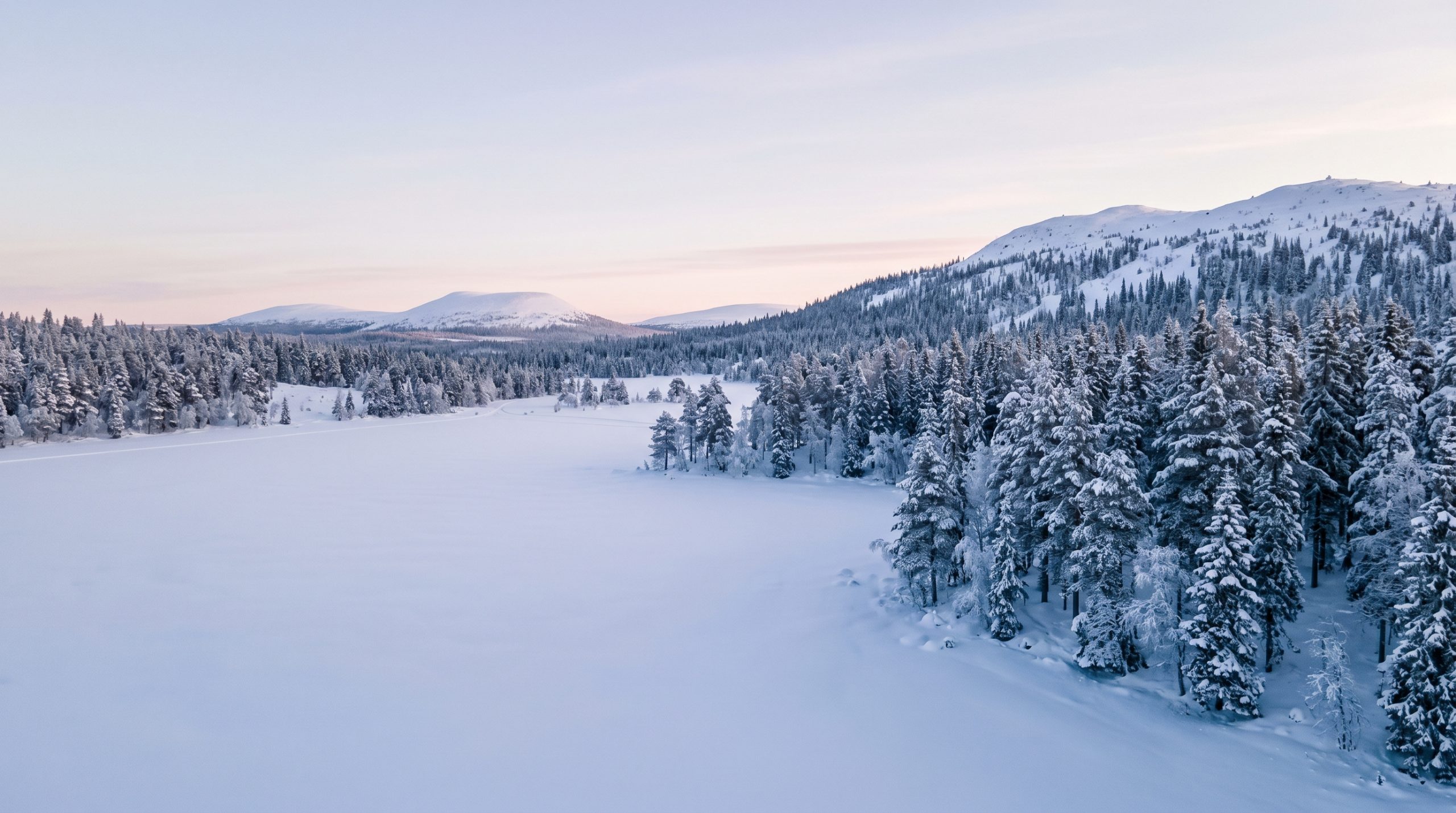
Stand on a fell above Levi on 1 February and the sun clears the horizon at 09:40, travels sideways for just under six hours, and drops again at 15:28. It never climbs higher than about five degrees. There is no harsh hour to work around, because there is no harsh hour. The whole day is the light other places get for forty minutes.
That is the part most cost breakdowns for a Lapland elopement leave out. You are not paying for a venue here. You are paying for access to a short, very specific stack of hours, and for people who know the order to spend them in. Two weeks later, on 15 February, the same fell gets a sunrise at 08:41 and a sunset at 16:29. Three weeks earlier, around the solstice, the sun does not come up at all and the entire day happens inside five and a half hours of blue.
The rest of the number is Finnish admin and Arctic logistics. There is a registrar’s fee if you want a legally binding ceremony somewhere other than an office. There is a Metsähallitus permit if your plan needs off-road transport inside a protected area. There is a husky team if you want one in the film. We do the research and the planning for all of it, and this page lays out every line, ours and yours.
The cost question, answered before anything else
We photograph, film and plan Lapland elopements as one team, and coverage starts at $4,900 for a full day with a dedicated photographer or a dedicated filmmaker. Our travel to Finland is included. Alongside it sit Finnish costs you pay directly: lodging, activity charters, any permit fees, and 250 euros if a registrar marries you outside office hours.
Timing a day when the sun never gets above five degrees
Every Lapland month is a different job. The fells do not change much between December and March, but the light budget changes completely, and the budget is what we plan against. These are the numbers for the Levi and Ylläs area, at roughly 67.8 degrees north.
| Date | Sun above the horizon | Highest the sun gets | How we use it |
|---|---|---|---|
| 21 December | Does not clear the horizon | Below the horizon all day | Five and a half hours of civil twilight, 09:37 to 15:01. Everything is blue and slow. |
| 15 January | 10:53 to 14:06 | About 1 degree | Three hours of horizontal light. One location, no driving between frames. |
| 1 February | 09:40 to 15:28 | About 5 degrees | Just under six hours, all of it low. Two locations is realistic. |
| 15 March | 06:46 to 18:15 | About 20 degrees | Eleven and a half hours, and still dark enough for aurora by nine. |
Here is how a 1 February day actually runs.
We start indoors and in the dark, around 07:30. Coffee, layers, and the part nobody thinks to plan: getting two people dressed for six hours outside in a way that still looks like them. Base layers under the dress, boot warmers, gloves that come off fast and go back on faster. Civil twilight opens at 08:27 and the snow turns a flat, even blue no reflector can imitate.
By 09:40 the sun is on the horizon and coming in sideways through the spruce. This is the hour we want you in forest rather than on top of anything. The trees up here carry crown snow load, tykky in Finnish, and it turns ordinary spruce into shapes that hold light hard on one side and go black on the other. Twenty minutes walking through that is worth an hour on an exposed summit.
Between 11:00 and 13:30 we move up. Solar noon is 12:34 and the sun sits at five degrees, which means every ridge throws a shadow the length of a football pitch and the fell tops read as texture rather than white nothing. This is the drone window, where the permits and the conditions allow one. It is also the coldest-feeling part of the day, because you are exposed to whatever the wind is doing.
A legally binding ceremony changes the shape of the afternoon. Finland’s Digital and Population Data Services Agency marries couples free of charge at its own offices during office hours, or at a place of your choosing outside them. The second option carries a 250 euro fee plus the officiator’s travel, and it is the one that puts you on a frozen lake instead of under a strip light. In early February, outside office hours lands almost exactly on sunset. We are not going to pretend that is inconvenient.
Sunset at 15:28 is not an ending here. Twilight at this latitude is long and it turns over slowly, from amber on the snow to a deep even blue that holds for the best part of an hour. Then we stop. Two hours indoors, hot food, dry gloves, batteries somewhere warm. From about 21:00 we are back out for the aurora window, and we hold it open until one in the morning if the sky is worth it.
One thing we will say plainly. The Arctic Circle marker at Santa Claus Village outside Rovaniemi is a decent forty minutes if you want the certificate, and after dark it is lit like a retail park. We do not build ceremonies there. Twenty minutes further out, the same latitude gets you a lake with nothing on it at all.
Why the aurora hour takes two cameras
An aurora substorm does not hold still and wait. A quiet green arc can brighten, split and start moving directly overhead inside three minutes, then flatten out again for an hour. Those three minutes are the whole reason we put a photographer and a filmmaker on the ground together.
The two mediums want opposite things from that sky. Stills want a tripod, a fast wide lens and an exposure measured in seconds, with the two of you holding reasonably still inside it. Film wants continuous capture at a very different sensitivity, a slow deliberate move, and nobody standing frozen in place like a statue. One person cannot switch between those two setups inside a substorm. They can shoot one of them and tell you about the other afterwards.
Cold sharpens the same problem. At minus fifteen a battery that read full in the cabin gives you a fraction of its usual life, and somebody has to be cycling spares against their own body heat while somebody else keeps working. With one camera on the ground, every battery change is a gap in the record. With two, it is not.
Daylight has its own version. Drone footage runs where it is legal, safe and appropriate, which in Lapland means daylight or blue hour, well clear of reindeer, and inside whatever a protected area allows. A drone in the air is a pair of hands not holding a camera. With two of us, the aerial does not cost you the frame on the ground.
The Expedition adds professional audio for vows where conditions allow, and on an open fell in February that matters more than it does anywhere warm. Wind across a microphone is the one thing that reliably ruins Arctic vows, and a filmmaker who has already set the mic and chosen the lee side of a boulder gets you words you can actually hear a decade later. You can watch how the pairing resolves in our published films and galleries, where the same day shows up twice, once as stills and once in motion.
There are eight of us, four photographers and four filmmakers. That is why there is always a second camera on the ground in Lapland and a colleague in reserve at home.
When the sky stays quiet, the day still works
Visit Finland puts the odds plainly: in Lapland, auroras appear on roughly every other clear night between August and April, and the season runs from late August to early April. Visit Rovaniemi counts around 150 nights a year across Finnish Lapland. The variable that decides your particular night is almost never the aurora itself. It is cloud.
So we plan cloud. That means we want more than one night wherever the trip allows it, which is what the Odyssey exists for: two to seven days, photography and film, one destination or several. It also means we use the size of the place. A two hour drive northeast toward Sodankylä or Inari can put you under a completely different sky, and we will make that call in the afternoon rather than at nine at night, so you are eating dinner in the right place.
The last piece is the one couples underrate. The daylight is not a gamble. Low sun, blue twilight and snow are there every single day of a Lapland winter, aurora or no aurora, and they are the reason the pictures work. The northern lights are the encore, not the show. Visit Finland also rates September to October and February to March as statistically strong aurora periods with more manageable temperatures, which is a large part of why we push couples toward late winter rather than Christmas week.
If you already have dates in mind, or a week you cannot move, send them over and we will tell you honestly what that week’s light and sky usually do. Check Your Date.
Our side of the invoice, and yours
What every Lapland day includes
- Destination and location design, built for the month you are coming, not a generic list of viewpoints.
- Full planning and a custom timeline built around the actual light and real Arctic travel times, which in winter are not the times a map app gives you.
- Permit research and logistics guidance, including what Metsähallitus requires for protected and wilderness areas.
- Weather alternatives and backup planning, worked out before you land rather than on the morning.
- Drone footage where it is legal, safe and appropriate.
- Professional audio for vows and other meaningful moments on the Expedition, where conditions allow.
- Team travel worldwide, flights and accommodation included, with no long-haul distinction and no Finland surcharge.
- Highlights delivered in 5 days, and the full gallery or film in 3 weeks.
Where coverage starts
A full day with one dedicated photographer or one dedicated filmmaker starts at the figure above. A full day with a dedicated photographer and a dedicated filmmaker working side by side is $7,900, and that is the one we recommend for an aurora night. Two to seven days across one or several destinations is the Odyssey, quoted as a custom proposal. Everything sits on the pricing page in full. The fee does not move with guest count. Guests change access, permits, transport and the timeline, not the number.
The Finnish costs that sit outside our fee
| Line | Who pays | What to expect in Lapland |
|---|---|---|
| Civil ceremony at a registry office, office hours | You | No fee |
| Registrar at a place of your choosing, outside office hours | You | 250 euros plus the officiator’s travel to the venue |
| Metsähallitus permit, where the plan needs off-road transport or any temporary structure in a protected or wilderness area | You pay the fee, we do the research and the application | Case by case, and often not needed at all if we keep the day on foot |
| Lodging | You | Usually the largest single line if you want a glass roof or a lake-shore cabin |
| Husky team, reindeer sleigh or snowmobile charter | You | Optional. A short husky park ride is currently around 50 euros a head, a private team on the trail runs into the hundreds |
| Thermal outer layers and boots | You | Most safari operators rent them by the day, which is cheaper than buying kit you will wear once |
| Our flights, accommodation and ordinary travel | Us | Included, everywhere, always |
One conversion and then we will stop: at the rates of the last few years, that 250 euro registrar fee lands under three hundred US dollars. Every other Finnish figure on this page stays in euros, because that is what you will be quoted and charged.
From first message to a planned Lapland day
- You send the inquiry form with your dates, or the month you are circling.
- We reply within 24 hours with an initial brochure and our first read on that month’s light.
- We build a tailored proposal around what you have described, including which part of Lapland fits it.
- You sign the contract.
- You pay a 30% retainer, with the remaining schedule set out in the proposal.
- Planning begins, and the location design, timeline and permit research start properly.
We currently have Lapland elopement dates available through 2027–2029. Finnish paperwork is the one thing that genuinely rewards being early, since the examination of impediments to marriage takes at least seven days, the certificate is valid for four months, and foreign applicants are asked to allow several weeks. If you are new to the mechanics of all this, our guide to how to plan an elopement covers the fundamentals in order.
The couples Lapland is built for
This place rewards a particular temperament. You will be outside in blocks of twenty to forty minutes at temperatures that sit around minus twelve in Rovaniemi through January, colder inland and colder still on the clearest aurora nights. Nobody is asking you to suffer, but you do need to be the kind of person who finds that funny rather than grim.
It also rewards couples who are relaxed about a plan that moves. We will sometimes swap the whole afternoon at eleven in the morning because a cloud deck is coming off the Norwegian border, and the couples who get the best days are the ones who say yes to that without a wobble.
If deep cold is genuinely not for you, say so in your first message rather than talking yourself out of Lapland. The same fells run under a midnight sun that does not set at all around 21 June, which is a completely different film and a very good one. If you want the aurora but less of the dark, mid-March gives you eleven and a half hours of daylight and a properly dark sky by nine at night. Tell us which of those you actually want and we will build the version that fits, or tell you honestly which month suits it better. Our destination guides are a good place to compare Lapland against the other northern options before you commit.
Common questions
Can we legally get married in Finnish Lapland if we are American?
There are two routes and both work. Finland’s registry can examine impediments to marriage for couples where neither party is a Finnish citizen or resident, provided you supply a certificate showing you are free to enter into that marriage in Finland. Alternatively, many couples complete the legal registration at home and treat the Lapland day as the ceremony itself. The timeline on the ground barely changes either way.
How far ahead do we need to file the Finnish paperwork?
The examination of impediments takes at least seven days and the resulting certificate is valid for four months, but the registry asks foreign applicants to allow several weeks. We plan on documents being lodged around two months out, which leaves room for a translation or a certified copy to be re-issued without touching your dates.
Does a Lapland elopement cost more because you have to fly to Finland?
No. Team travel is included worldwide, flights and accommodation for the assigned team, with no European or long-haul distinction and no Arctic surcharge. The fee also stays the same whether it is the two of you or the two of you plus twelve people in a cabin.
Do we need a permit to have our ceremony in a national park?
Usually not for the ceremony itself, because Finland’s freedom to roam covers walking and standing in most nature. Metsähallitus does require a permit for off-road transport of equipment and for any temporary structure inside protected and wilderness areas, and Lapland has twelve extensive wilderness areas alone. We research it and handle the application, and any fee is yours.
Is December or February better for a Lapland elopement?
February, for almost everyone. Around 21 December the sun does not clear the horizon at Levi at all and the day runs on five and a half hours of civil twilight between 09:37 and 15:01. By 1 February the sun is up from 09:40 to 15:28, and by mid-March you get eleven and a half hours of it and a sky still dark enough for aurora by nine. December has the atmosphere, late winter has the working hours.
Can you fly a drone over the northern lights?
Not usefully. Aurora needs long exposures from a stable platform, and a drone at night gives you noise instead of a sky. Drone work here belongs to daylight and blue hour, it runs under EU open category rules with a registered operator, and inside protected areas it runs on whatever Metsähallitus permits. We confirm both before we plan a single aerial into the film.
How long can we actually stand outside in that cold?
Longer than you think, in blocks. We build outdoor runs of twenty to forty minutes with a warm base between them, and we sequence the day so the exposed fell work happens in the middle when the sun is at its highest and the wind is usually most predictable. Thermal layers under the dress do the rest.
How soon do we see the photos and the film?
Highlights land within 5 days, while you are probably still travelling. The full gallery or film follows within 3 weeks.
Before you write to us
We keep every planning decision in writing, at whatever hour suits your time zone. Send us the month you are circling, whether you want the legal ceremony in Finland or at home, and one sentence about the kind of morning you enjoy. We will come back within 24 hours with a first read on that week’s light and a brochure, and if the month is wrong for what you have described we will say so before you have booked a flight. Start Your Story.