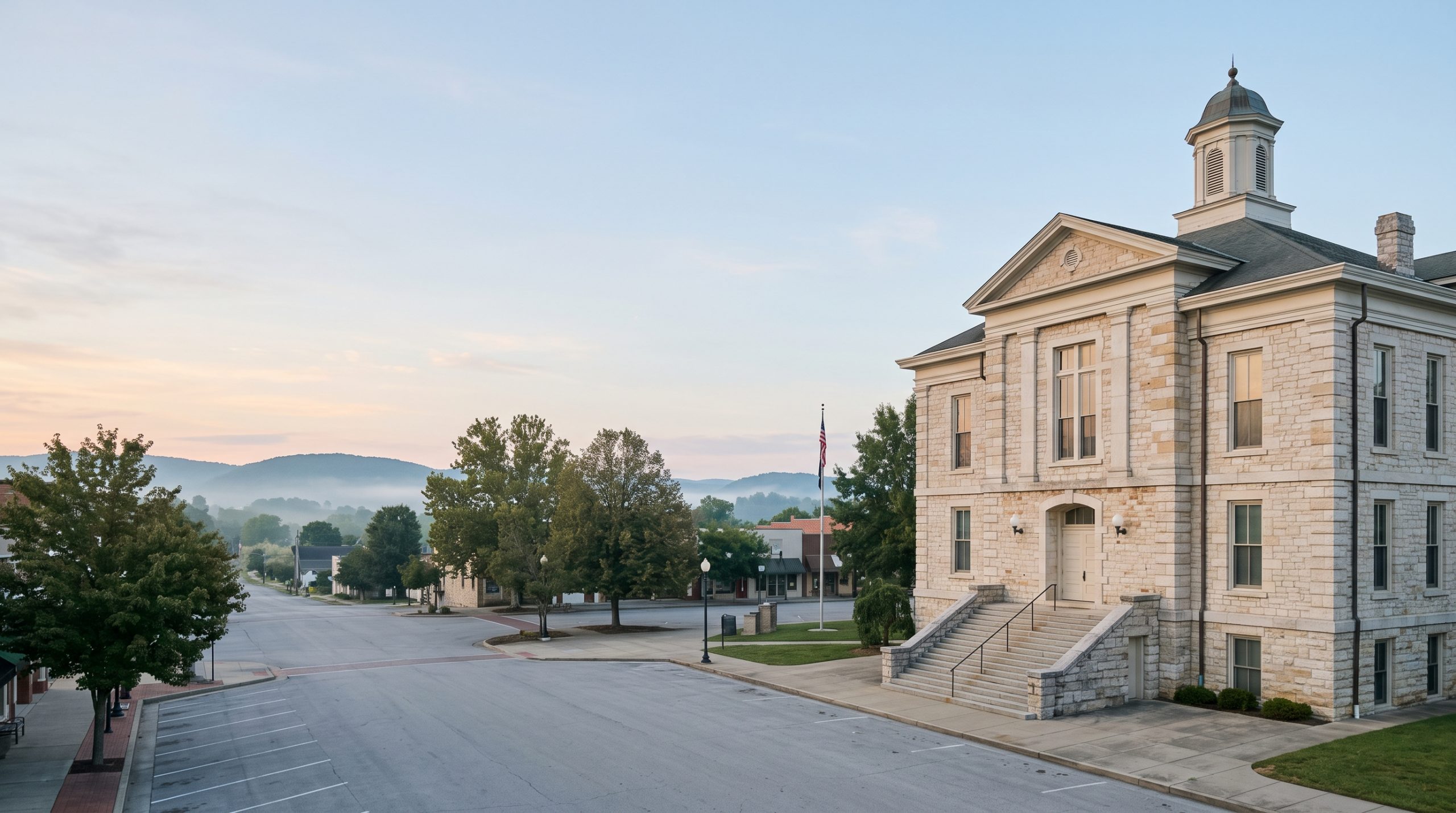
The Marriage License Bureau in Clark County, Nevada is open from 8 a.m. until midnight, every day of the year. Your own county clerk almost certainly closes mid-afternoon and does not open on Saturday. Both offices issue the same kind of document, and both documents stop working the moment you cross a state line.
That is the part American couples are usually surprised by. A marriage license is not a passport for your marriage. It is permission from one state to hold one ceremony inside that state, and no celebrant standing on a ridge in the Dolomites or a black sand beach in Iceland has any authority to sign it.
The route that does work is unglamorous and takes about an afternoon. You complete the legal marriage at a county clerk’s office at home, then you fly out and have the ceremony you actually wanted, with nothing to file and nobody’s office hours to work around. We plan a great many days shaped exactly this way, and almost nobody describes the courthouse part as the compromise afterwards.
The license does not travel
A US marriage license is valid only for a ceremony held inside the state that issued it, so it cannot be signed abroad. Couples marry at their county clerk’s office first, usually in a single appointment, then hold the ceremony overseas as a private vow exchange with no foreign paperwork attached to it.
Utah County is the one desk that reaches you overseas
There is a single exception worth knowing about, and it sits in a county clerk’s office in Utah. In 2019 the Utah County Clerk and Auditor’s office set out with its IT department to build a completely digital, end-to-end marriage license process. From January 2020, couples have been able to receive a license, hold the ceremony and have the officiant submit the information for the marriage certificate entirely over the web, with no need to visit the office in person at all.
The county’s own guidance is clear about what the ceremony still requires: an authorized officiant as listed in Utah Code 30-1-6, two witnesses over the age of 18 under Utah Code 30-1-11, and a real opportunity for both of you to affirm your willingness to enter into a marriage commitment. All of that can happen over video conference.
What it does not do is turn your ceremony abroad into the legal event. A Utah web conference marriage is a Utah marriage, recorded in Utah, whichever apartment or hotel room you join from. Couples who use it tend to do so because the timing suits them, and they still treat the day overseas as the ceremony proper, with no paperwork anywhere in the frame.
Four counties, four different clocks
The difficulty rating on the whole exercise is low. Two photo IDs, one counter, one signature, and for most couples the only genuinely awkward part is that both of you have to be standing there at the same time. What varies from state to state is not the difficulty. It is the clock: how long you wait before you can use the license, and how long it lasts once it is in your hand.
| Where you sign | License fee | Waiting period | License valid for |
|---|---|---|---|
| El Paso County, Colorado | $30 | None, valid on issue | 35 days |
| New York City | $35 | 24 hours | 60 calendar days |
| California county clerks | Set by each county | None | 90 days |
| Clark County, Nevada | $102 | None | One year |
Registry fees and response times are not permanent; verify the current version with the office responsible for your case.
The pattern repeats nationally. Florida issues through any county clerk and lets you marry anywhere in the state on a 60 day license, but only inside Florida. Nevada says the same thing in different words: per the Clark County Clerk’s guidance, the ceremony must be performed in Nevada by an officiant licensed in Nevada, and someone other than that officiant has to witness you saying your vows. Not one state license in the country authorizes a ceremony held on foreign ground.
The chain of paper, in order
This is the sequence front to back. Only two items carry a hard deadline, and the last one matters only if a foreign government will ever want to see the record.
- Photo ID for both of you. California’s public health department describes what counts as valid picture identification: a document showing a photograph, a date of birth, and an issue and expiration date. A state ID card, a driver’s license, a passport or military ID all qualify. Some counties also ask for a copy of your birth certificate.
- The end date of any previous marriage. If either of you has been married before, you need to know the exact date that marriage ended and the way it ended. Some counties want the final judgment on paper as well, so ask before you go rather than at the counter.
- Both of you, in person, at the same time. California requires both parties to appear together at the county clerk’s office. Texas is the useful exception: under Texas Family Code 2.006, an absent applicant can be represented by the other party or another adult with a notarized affidavit, proof of identity and proof of age.
- The license itself, issued over the counter. This is the moment the clock in the table above starts running. Nothing warns you when it lapses; it simply stops being usable after its last day.
- The ceremony that executes it. An officiant your state recognizes, plus witnesses where the state asks for them. Colorado is the outlier that many couples like: the state allows you to solemnize your own marriage, and the license comes back signed by the two people named on it and nobody else.
- The signed license returned to the clerk, inside a deadline. Whoever performed the ceremony is responsible for getting it back. Orange County, Florida asks for it within 10 days. El Paso County, Colorado allows 63 days. This is not housekeeping: the Florida clerk states plainly that a marriage is not considered valid until the license is returned.
- Certified copies, ordered afterwards. These come from the county clerk and recorder or the state vital records office that holds the record. The handsome certificate someone gives you at the end of a ceremony is a keepsake, not this document.
- An apostille, only if you will genuinely need one. A US marriage record is authenticated by the Secretary of State of the state that holds it, not by the federal government. New York’s Department of State, for instance, authenticates only public documents signed by a New York State official or a county clerk. You do not need an apostille to stand on a glacier and read your vows. You may need one years later if you apply for residency somewhere.
Work back from the flight, not the destination ceremony
The real minimum is the same day. In Clark County there is no waiting period and no blood test, the Bureau is open until midnight, and a couple can walk in and be married within a few hours. New York inserts 24 hours between issue and ceremony, and that clock runs from the hour printed on the license rather than from the calendar date, which catches out anyone who books an evening ceremony and a morning appointment.
The comfortable minimum is a different animal, and it is the one we plan to. Work back from the ceremony date: the day abroad, the flights a few days before that, and before all of it the courthouse visit, filed and finished. Your officiant at home has a legal window to return the license, 10 days in one county and 63 in another, but there is no reason to use it. Ask for it to go back that week, because until it is back with the clerk, there is nothing to certify and nothing to copy.
Then check the license window against your calendar rather than the other way round. Colorado’s 35 days is the tightest number in the table, so a Colorado couple planning a June ceremony cannot apply in April. Nevada’s year is the loosest. Our own rule does not change with the state: the paperwork should be signed, filed and forgotten before anyone gets on a plane, and we build the timeline back from your validity window instead of from your flights. The rest of the sequence, the part that has nothing to do with clerks, is laid out in our guide to planning an elopement.
The details that catch people out
None of these are hard. They are simply the things nobody tells you until the person behind the counter does.
- The office may not take the card in your wallet. El Paso County, Colorado takes cash, debit or credit only. Clark County does not accept checks at all and adds a fee on top of the $102 for card payments. New York City wants a credit card or a money order made payable to the City Clerk. Arriving with the wrong instrument costs you the appointment.
- An expired license is money spent. Orange County, California puts it flatly: there are no refunds for expired marriage licenses and none for a change of plans. If the trip moves past the window, you buy another license.
- Your names go on exactly as your ID spells them. Check the middle name, the hyphen and the accent before you sign. If you plan to change your name, do it after the trip, because the name on your ticket has to match the passport you are traveling on.
- Nevada records are public. Clark County notes that Nevada marriage records are public documents and cannot be made confidential or sealed. Couples who want the legal marriage quiet until a family announcement sometimes choose a different state for that reason alone.
- Florida asks you to swear you have done the reading. Both applicants must make a sworn affidavit that they have read the Family Law Handbook prepared by the Family Law Section of the Florida Bar.
- Counter hours are not what you assume. Las Vegas at midnight is the outlier. Most clerks keep weekday hours, and several now require the application to be completed online first, as Orange County, California does. Book the counter visit before you book the flights.
The ceremony you have once nobody has to file anything
The ceremony-only route buys more than convenience, and it deserves better than being described as a fallback. The State Department’s guidance for citizens marrying overseas lists what foreign jurisdictions commonly ask of you before they will marry you: residence in the country for a specified time, blood tests, age requirements, parental consent, proof that a previous relationship has formally ended, documents translated into the local language and authenticated, and an affidavit of eligibility to marry. Every one of those attaches to a legal marriage. None of them attaches to a ceremony.
Nor is there a shortcut through your own embassy. US diplomatic and consular officers are not permitted to perform marriages under Title 22 of the Code of Federal Regulations, and marriages abroad are performed by local civil or religious officials under local law. A consular officer can notarize your signature on a statement about your own eligibility to marry, which satisfies most countries that ask for one, and that is the extent of it.
What changes when the signing is already done is nothing you will feel and everything about the schedule. No registrar’s diary. No notice period, no minimum stay, no interpreter in the frame, no document that has to be back at an office by Tuesday afternoon. You choose the hour, the place, and the person who speaks. Tell your celebrant abroad that you are already legally married, though, so the wording of the ceremony sits right; good ones write it differently and better once they know.
What that buys, practically, is light. A registrar works office hours. Alpenglow does not. With the legal marriage behind you, vows can sit at 5:40 in the morning on a ridge or forty minutes before the sun drops behind one, because nothing administrative has to be scheduled around them. That single freedom shapes the pictures more than any other decision in the planning, and you can see what it produces across our published galleries and films.
It changes the film as much as the photographs. Photography and film come from one team here, so the photographer and the filmmaker have agreed on the shape of that hour days before it happens, and neither one is negotiating for position while you are speaking. There is always a second camera on the ground, which matters most in the ten minutes that only happen once.
If the destination is still open, our destination guides are organized around what each place asks of you season by season, which is usually the fastest way to narrow a shortlist. When you have a date circling, or two, Send Us a Message and we will tell you what that week looks like on the ground.
Common questions
Can we use our county marriage license for a ceremony in another country?
No. The license authorizes a ceremony inside the issuing state only. A Florida license can be used in any Florida county but nowhere outside Florida, and a Nevada license requires a ceremony performed in Nevada by an officiant licensed there. Sign at home first, then travel.
Can the US embassy or consulate marry us while we are overseas?
No. US diplomatic and consular officers are not permitted to perform marriages under Title 22 of the Code of Federal Regulations, and marriages are not performed on embassy premises. A consular officer can notarize your signature on a statement about your eligibility to marry, which is a notarial service rather than a wedding.
Do we need an apostille on our marriage certificate before we travel?
Not for a ceremony. An apostille authenticates a US record for use by a foreign government, and it is issued by the Secretary of State of the state that holds the record. You would want one if you later apply for residency, a spousal visa or a name change abroad, not to read vows on a mountain.
How far before the flight should we sign at the courthouse?
Legally it can be the same day in a state with no waiting period. Practically, we plan for the license to be signed and back with the clerk before anyone flies, which usually means a courthouse visit a few weeks out. If your state runs a short window, like Colorado’s 35 days, that number sets the earliest date you can apply.
Can we get legally married online while we are already abroad?
Utah County runs a fully digital license and ceremony process, so the license, the web conference ceremony and the certificate submission can all happen without visiting the office. It still needs an officiant authorized under Utah law and two witnesses over 18, and what it produces is a Utah marriage rather than a marriage in the country you are standing in.
Will our US marriage be recognized in the country where we hold the ceremony?
Most countries recognize a marriage performed in the United States, and the Clark County Clerk says as much on its own guidance while advising couples to check with their own government first. Recognition is decided by each country, so if immigration or residency is in play, confirm it with that country’s authorities well ahead of time.
Do we need witnesses at the ceremony abroad if we are already married?
No, because nothing is being registered. Witness rules apply to the legal act, which happened at home, where Nevada asks for one person other than the officiant and Colorado asks for nobody at all. Overseas you can bring two friends, your parents, or nobody.
Does signing the paperwork first make the ceremony abroad feel less like a wedding?
Not in our experience. Couples treat the county clerk visit as an errand, in ordinary clothes, and save the vows for the place they traveled to. The ceremony that matters to them is the one with the wind in it, and no document changes what is said out loud.
What we plan around the legal signing
Our side is the day itself: destination and location design, a timeline built around light and real travel time, permit research and logistics guidance, weather alternatives held in reserve, and your date held while the courthouse part gets done. Team travel is included wherever in the world the day happens, and what each experience covers is set out on our pricing page.
Your side is short: two IDs, one counter, one signature, and the certified copies afterwards. We are photographers and filmmakers, not lawyers. Rules change and circumstances differ, so confirm the detail with the county clerk who will issue your license, or with your own consulate, before you book flights.
We are booking 2027, 2028 and 2029, and everything on our end happens in writing. Send the week you are circling and the two or three places you keep coming back to, and you will have a reply and our brochure inside 24 hours. Check Your Date