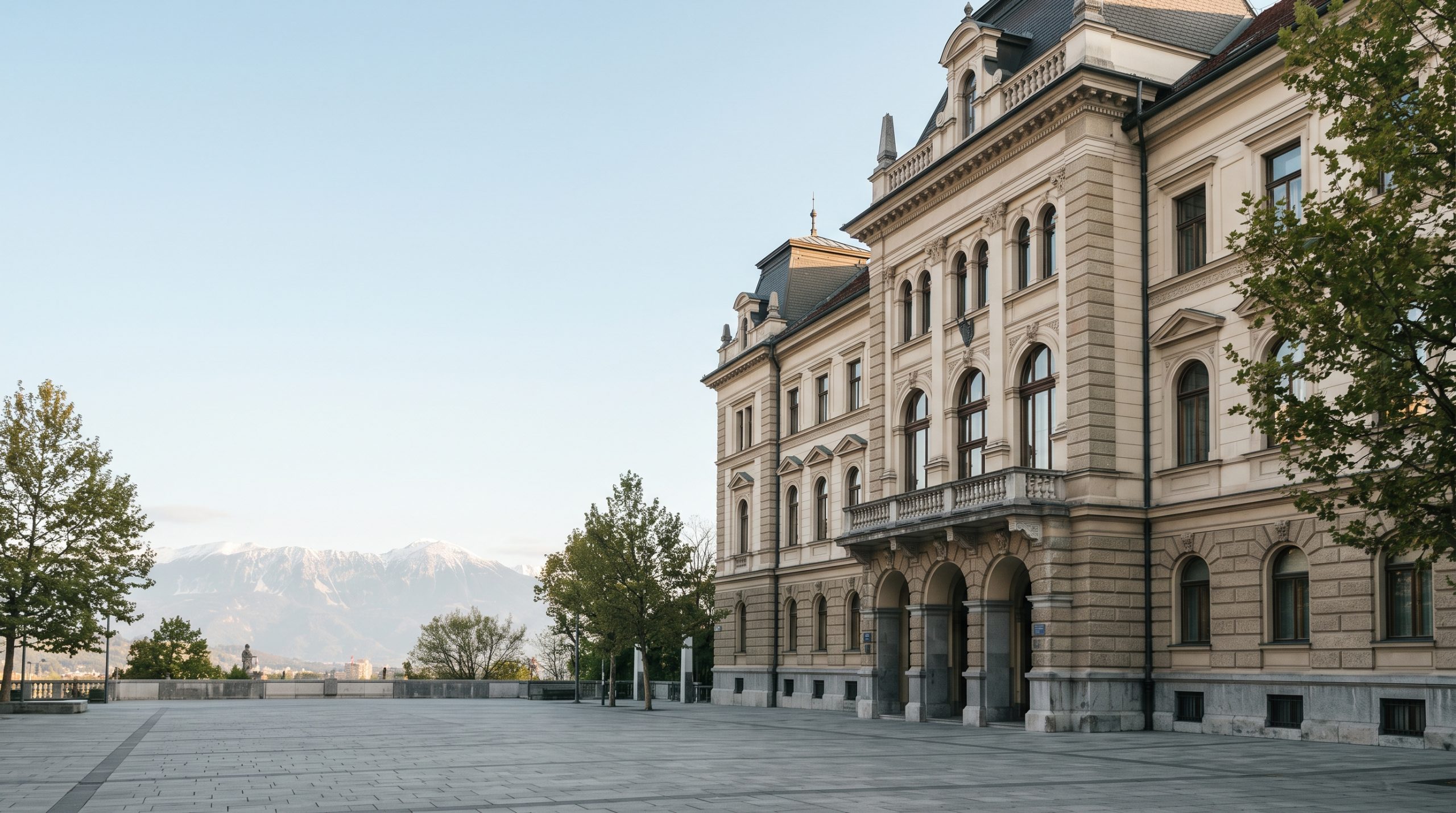
Slovenia will marry you. Two foreign passports, a birth record with an apostille attached, a registrar assigned to your date, and the marriage is as valid in Colorado as it is in Ljubljana. What most planning guides skip is that several links in that chain are done standing in a room in Slovenia, and one of those rooms shuts at 2pm on a Friday.
We photograph and film elopements across the Julian Alps, the Soča valley and the Kamnik Savinja high country, and this question arrives in almost every first message we get about Bled and Bohinj. So here is the chain as the offices themselves set it out, in the order you collect it, with the deadlines counted backwards from the hour you actually want to be standing above the water.
The paperwork itself is manageable. What complicates it is geography, and plenty of couples who fly in for a week end up completing the legal marriage at home and holding the ceremony here instead, and that is a good plan rather than a consolation prize. Both routes are below, along with what changes and what does not.
Legal for foreign couples, with a few errands inside Slovenia
Yes, foreign nationals marry in Slovenia. You need a valid passport, a birth record certified for use abroad, and a certificate that nothing bars the marriage. Both of you register in person at the administrative unit covering your location, at least 30 days ahead for a ceremony outside official premises, which carries a flat cost of 170 euros.
The Slovenian route is manageable if the stay is long enough
Nothing in Slovenia’s document list is unusual. The friction is geographic. Three of the steps happen at counters inside the country, and they happen on office hours rather than on elopement hours.
Both of you register the marriage in person at the administrative unit whose area covers the place you want to marry, and at that registration you state that you are marrying freely and that all the conditions for validity are met. For a ceremony anywhere other than the unit’s official rooms, the application has to be with them at least 30 days before the date. American citizens also swear their free to marry affidavit at the embassy in Ljubljana, because no equivalent certificate exists at home, and that affidavit then has to be certified by the Slovenian Ministry of Foreign Affairs at a separate counter across the city.
Add those up and the legal route suits couples who are in Slovenia for a while, or who are willing to run the paperwork over two trips. For a six-day trip built around one sunrise and one alpine pass, the arithmetic usually points the other way. Neither answer is better photographically, and the day we build does not change shape. Tell us which one you want and we will plan around it, or tell us your dates and we will say honestly which route fits them.
From a county records office to a counter in Slovenia
Collect the chain in this order. The first two items are slow because they travel by mail, and everything after them depends on those two being finished.
- Both passports, valid. Originals get shown at the counter, and every other name on every other document has to match what is printed in them.
- A certified copy of each birth record, with an apostille attached. The apostille comes from the Secretary of State of the US state that issued the certificate. The embassy in Ljubljana cannot issue one. Slovenia and the United States are both party to the Hague convention, so the apostille is the whole authentication step and no further consular legalisation is needed.
- A sworn translation of each birth record into Slovenian. Slovenia works through court-appointed interpreters, the sodni tolmači, appointed under Slovenian rules. A translation certified by a translator at home is a different animal. Birth records issued on the international multilingual form can generally be read as issued, which is why European documents skip this step and American ones do not.
- Evidence that an earlier marriage has ended, if that applies to either of you, apostilled and translated the same way. A divorce decree is the usual document, and the administrative unit will tell you what it wants if a previous marriage ended some other way.
- A free to marry certificate for each of you, which the offices also call a certificate of no legal impediment. Since the United States issues no such thing, American citizens attend the embassy in Ljubljana and swear an affidavit that they are single and free to marry. Bring your passport.
- Certification of that affidavit by the Ministry of Foreign Affairs consular service at Šubičeva 10 in Ljubljana, which keeps short opening windows and charges a nominal 3 euros.
- Written consent from whoever owns the ground you want to stand on, for any ceremony outside the unit’s official rooms. It goes in with the application, and the unit then tells you whether the marriage can be concluded at that location at all.
- The registration itself, in person, both of you, at the administrative unit for that area. You give the dates and hours you would like, and the registrar comes back with what is actually open.
Two of those items have a shelf life worth watching. The certificate of single status and the no impediment confirmation are the ones offices expect to be recent, and the two can often be combined into a single document, so we sequence them late rather than early. The apostilled birth record and the sworn translation go first because they are the slow ones.
Once an off-premises ceremony is approved, the permission arrives as a formal decision, and that decision is where the 170 euro cost is set out. It goes to the administrative unit’s account, and it has its own deadline, which is the next section.
Ceremonies are conducted by a registrar together with the head of the administrative unit or a person that office authorises, or by a registrar together with the mayor of the municipality. Both of you have to be physically present, which sounds obvious until someone suggests a proxy.
Work back from the Slovenian ceremony date
Published guidance on timing varies, and it is worth knowing why. The embassy in Ljubljana describes marriage registration as possible from six months out to about two weeks before the date, which is true of a straightforward ceremony in the unit’s own rooms. For a ceremony anywhere else, the office that grants permission wants the application at least 30 days ahead. That 30-day figure is the one that governs an elopement, so it is the one we plan to.
| Step | What the offices allow | What we build to |
|---|---|---|
| Apostille on each birth record | No deadline, but it travels by mail twice | Started five to six months out |
| Sworn translation into Slovenian | Any time before you hand documents in | Booked the week the apostille comes back |
| Registration at the administrative unit | From six months before, in person, both of you | Filed around four months out |
| Application for a ceremony outside official rooms | At least 30 days before the date | 60 days, with the landowner consent attached |
| The 170 euro off-premises cost | At least five days before the ceremony | Paid the day the decision lands |
So the real minimum is roughly a month of Slovenian process sitting on top of however long your home state takes to certify a birth record and put an apostille on it. The comfortable minimum is four to six months, and that is the shape we work to, because it leaves room for a mailed document to go astray without touching your date. One more calendar item: marriages are not performed on Slovenia’s public holidays that fall on non-working days, so a date that looks quiet on paper is occasionally the one date the registrar cannot take. If you are still at the stage of choosing a month rather than a day, our guide to planning an elopement works through that order of decisions.
Six things that catch couples out at the counter
None of these are hard once you know about them. All six have rearranged somebody’s week.
- The counter is where the ceremony is, not where you are staying. Administrative units are organised by area, and the seat is often a town away from the lake you have in mind. The unit that covers Bled sits in Radovljica. A ceremony at Ljubljana Castle is registered at the civil registry counter on the ground floor at Tobačna ulica 5, open Monday, Tuesday and Thursday from 8am to 6pm, Wednesday until 7pm, and Friday only until 2pm.
- The apostille is a state errand, not an embassy one. It comes from the Secretary of State where your birth certificate was issued, which means posting an original and waiting. Start here, not with the venue.
- The free to marry affidavit needs two stops in Ljubljana. Swear it at the embassy, then walk it to the consular service at Šubičeva 10 for certification. That counter opens in short windows, currently Monday, Wednesday and Friday mornings plus a Wednesday afternoon, takes no appointments and charges 3 euros.
- The 170 euros has a deadline of its own. It is due at least five days before the ceremony, and the rule is unambiguous: unpaid, the marriage is not performed. It is written into the decision that grants your location, so read that document the day it arrives.
- Your translator has to be theirs, not yours. Documents in a foreign language are translated by a Slovenian court-appointed interpreter. Budget a few working days for it, and get the translation done once, properly, rather than twice.
- An outdoor ceremony goes ahead in whatever weather turns up. Ljubljana Castle spells this out for its vineyard and bridge locations: choose a covered alternative when you book, because the ceremony is not moved for rain. Administrative units can also decline a location they judge too difficult to carry out, so the sensible application arrives with a second option already named.
Registry fees and response times are not permanent; verify the current version with the office responsible for your case.
Married at home, ceremony above the lake
This is the route most of the couples we work with in Slovenia take, and it deserves better framing than it usually gets. You complete the legal marriage in your own county, weeks or months before you fly, in twenty minutes and with no apostille anywhere. Then you come to Slovenia and hold the ceremony you actually pictured.
What changes is almost entirely administrative. No 30-day application, no 170 euros, no decision to wait on, no registrar’s diary to work around, no public holiday problem, no translation of anything. What that buys you is the hour. A ceremony at first light on the Bohinj shore, or vows on a ridge in the Soča valley that takes ninety minutes to reach on foot, are simply not shapes that fit inside an office’s official hours. Read your own words to each other, sign whatever keepsake you like, and let a friend or one of us hold the ring box.
What does not change is everything else. The same planning, the same timeline written around sunrise and real driving times, the same landowner permissions where a location needs them, the same care about which month puts water in the waterfalls and snow off the passes. The higher roads open later in the season than most planners assume, so spring dates get built on low ground and the high country waits for summer. Our published galleries and films are the honest test of that, and they are worth ten minutes before you write to anyone. Highlights reach you five days after the day itself, and the full gallery or film lands within three weeks.
If you have read this far and you know which version you want, Send Us a Message with your dates and the region you keep coming back to. If you are still torn between Bled, Bohinj and the Soča, our destination guides compare them on light, crowds and driving time.
What we can plan around your registry appointment
We are photographers and filmmakers, not lawyers. Rules change and circumstances differ, so confirm the detail with the relevant administrative unit or your own consulate before you book flights. We do not file your paperwork or lodge applications on your behalf.
What we do is everything around it. We design the location and the timeline, research which permits and landowner permissions your specific spots need, hold your date against the registrar or venue availability where a civil ceremony is involved, and set the ceremony hour so the light is doing something rather than just existing. We build the weather alternative before you ask for it, because Slovenia’s mountain weather has opinions. Drone footage goes in where it is legal, safe and appropriate, on the permissions that apply to that ground. Team travel is included worldwide, so flights and accommodation for your assigned team are not a line item you discover later.
Witnesses are the one place our shape matters legally. Slovenia asks for two, and the official guidance on who qualifies is simply that each has legal capacity, with no further conditions. Couples eloping without guests often ask the people who are already there. On an Expedition day a photographer and a filmmaker are both on the ground, so there are two of us who can sign if your registrar is happy with that, and two cameras on the vows rather than one covering both jobs.
Coverage and what each experience includes is set out plainly on our pricing page, including the multi-day option for couples pairing Slovenia with the Dolomites or the Adriatic coast.
Common questions
Do we have to live in Slovenia to get married there?
The document list for foreign nationals does not ask for residence. What the process does ask for is presence: both of you register in person at the administrative unit for the area, and American citizens swear the free to marry affidavit at the embassy in Ljubljana. Those are the steps that shape a travel plan, not a residency rule.
Can we get married outdoors at Lake Bled instead of in an office?
A marriage outside the unit’s official rooms is possible where the unit can staff it. You apply at least 30 days ahead with written consent from whoever owns the ground, the unit decides whether the ceremony can be held there, and a flat cost of 170 euros applies to any ceremony outside official premises or outside official marriage hours.
How far ahead do we have to file the paperwork?
For a ceremony in the unit’s own rooms, registration is generally possible from six months out until roughly two weeks before. For anywhere else, the application is due at least 30 days before the date. We work to four to six months, because the slow part is your home state issuing and apostilling a birth record.
Do our documents need to be translated into Slovenian?
Yes, anything in a foreign language is translated by a Slovenian court-appointed interpreter rather than by a translator you find at home. Documents issued on the international multilingual form are generally readable as they stand, which is why couples arriving with US certificates need the translation and couples arriving with some European ones do not.
Is same-sex marriage legal in Slovenia?
Yes. Marriage has been open to same-sex couples since July 2022, when the constitutional court ruled the previous restriction unconstitutional, and parliament amended the law that October. Some older English-language pages still carry the pre-2022 wording, so the current Slovenian guidance is the one to trust.
Can our photographer and filmmaker be our witnesses?
Often, yes. Slovenia asks for two witnesses and the published condition is legal capacity, with nothing further specified. On a day with both a photographer and a filmmaker there are two of us present who can sign, and we confirm it with the registrar in advance rather than on the morning.
Will a Slovenian marriage certificate be recognised in the United States?
Marriage is handled at state level in the United States, and a state will generally recognise a marriage that was legal where it was performed. Both countries are party to the Hague convention on legalisation, so the administrative unit’s marriage certificate can be authenticated with an apostille for use at home.
What does it cost to marry outside a Slovenian registry office?
The administrative unit charges a flat 170 euros for a ceremony outside official premises or hours, payable at least five days before. Any venue rental is separate and goes to whoever owns the site, which at Ljubljana Castle means the fee to the administrative unit and the room or garden to the castle.
Pick the hour first, then the paperwork
Most Slovenian elopements are decided by one thing: what time you want to be standing somewhere, and whether the calendar can be built backwards from there. Send us the month you are looking at and the version of the day you keep imagining, and we will tell you which route gets you there with the fewest counters involved. We are currently taking Slovenia elopement dates for 2027–2029.
From the first message onward, the planning stays in writing rather than depending on calls. You write, we reply with our brochure inside 24 hours, and a tailored proposal follows. When you are ready, a signed contract and a 30 percent retainer open the planning, and the remaining payment dates are set out in the proposal. Check Your Date and tell us what you are picturing.