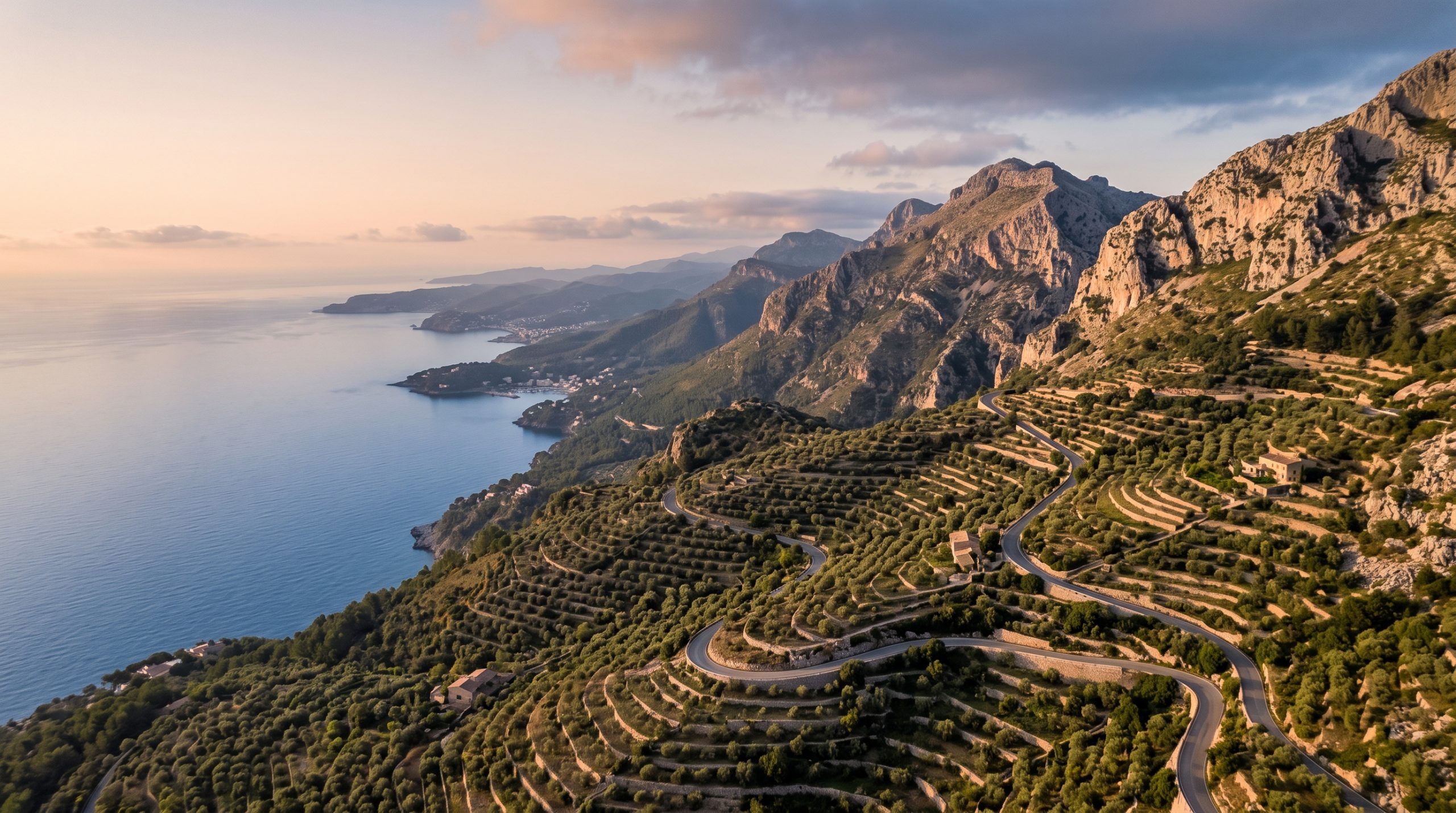
The Formentor road decides what a Mallorca elopement morning looks like. Through the high season, private cars are kept off the Ma-2210 between 10am and 10pm, and the stretch from Formentor beach out to the lighthouse is closed to them completely in those hours. Which means the cape belongs to whoever is willing to be standing on it at first light.
In late June, sunrise on that coast arrives a little after 6.20am, and the first usable light about half an hour before it. So the alarm goes at 4.45am, the pine road is yours, and by 9.30am we are driving back down past cyclists grinding up the last rise. By ten, the restriction is doing its work, we are eating breakfast in Pollença, and three hours of the day are already made.
Mallorca is not a quiet island in August, and we would rather say so than pretend otherwise. What it is, though, is an island with an east-facing dawn coast, a west-facing sunset coast an hour and a half of mountain road away, and a UNESCO-listed range between them that still smells of goats and wet limestone at six in the morning. The island gives its best hours to people who start early and finish late, and that happens to be exactly how an elopement day is built.
Mallorca elopement coverage, in one paragraph
We are eight people, four photographers and four filmmakers, and we cover Mallorca as one team: photography, film and planning together, across a single day or several. Coverage begins with one full day and one dedicated photographer or filmmaker, and our travel to the island is included. Your highlights reach you five days later.
One day, two coasts: dawn at Formentor, last light over Sa Foradada
This is the shape we build most often between May and September. It works because the island is generous at both ends of the day and close to useless in the middle.
4.45am. Coffee somewhere in Port de Pollença with nobody else awake. The drive out along the Ma-2210 takes about twenty minutes to the high pull-offs, and at that hour the road is free of both coaches and barriers.
5.55am. First light at the Mirador Es Colomer, or on the track up to the Talaia d’Albercutx watchtower above it. Be honest about Es Colomer: by mid-morning it is a coach stop with a view, flat and full. At six it is a knife-edge of rock with the sea going pink underneath it, and there is nobody there but us.
6.30am. Vows. This coast faces east, so the sun comes straight off the water and the light hardens fast, roughly forty minutes after it clears the horizon. We put the ceremony in that window rather than after breakfast, and we choose the exact ledge for wind rather than for the view, which is a decision worth a section of its own further down.
9.30am. Off the peninsula before the restriction starts, breakfast in Pollença or Alcúdia, and a change of clothes.
11am. Inland and up. The Ma-10 climbs to the Cúber and Gorg Blau reservoirs under Puig Major, where the ground is dry-stone walls, holm oak and sheep, and the sea is a thin blue line two valleys away.
1pm to 4pm. The gap. Mallorcan midday in July is white and flat and does no favours to anybody on an open ridge. We use it for lunch in Fornalutx, the drive, an interior in a stone finca, or a swim.
5pm. The Ma-2141 down to Sa Calobra: around twelve kilometres of hairpins losing some 800 metres of height, including the 270-degree loop known as the Nus de sa Corbata, built in 1932 by the engineer Antonio Paretti. About half an hour of driving from Sóller, and a different road in the evening than at eleven in the morning.
8.15pm. The west coast for the end of the day. The terraces at Deià, the path down to Cala Deià, or Son Marroig looking out at Sa Foradada, the pierced rock that sits exactly where the sun goes down. In late June the sun does not leave the water until after 9pm, and the olive terraces hold colour for another half hour after that.
Sa Calobra at eleven in the morning
The worry we hear most about Mallorca is crowds, and it is a fair one. At mid-morning the Sa Calobra car park is full, the excursion boats have unloaded, and the walk through the two road tunnels to the mouth of the Torrent de Pareis moves in single file. That is not a place to say anything to each other you want to remember. The same gorge at seven in the evening, after the last boat has gone back to Port de Sóller, is quiet enough to hear the pebbles move.
The answer to crowds here is never a secret location, because on an island this well travelled there aren’t any left. The answer is a start time and an order of operations. The small southern coves near Santanyí, Caló des Moro and Cala s’Almunia among them, are a set of steep steps down and busy from mid-morning onward, so we use them at first light or not at all. Every location in your timeline gets a sheltered alternative within about fifteen minutes’ drive, chosen before you arrive, and we tell you which places we would skip and why. Our destination guides go further into how each region of the island behaves through the year.
| Month | First usable light | Sun down | Formentor road | What it gives you |
|---|---|---|---|---|
| Late June | around 5.50am | after 9.20pm | Private cars kept off 10am to 10pm | The longest day on the island and a genuinely empty cape at dawn |
| Early September | around 6.50am | around 8.10pm | Private cars kept off 10am to 10pm | Warm sea, humane alarm, still summer light |
| Mid-October | around 7.35am | around 7pm | Restriction lifts in the second half of the month | Green returning to the terraces, and the lighthouse road open at any hour once it does |
| February | around 7.15am | around 6.15pm | Open all day | Almond blossom inland, low soft light, a short day that suits one region |
Two full days changes the arithmetic completely: one for the Tramuntana, one for the south and east, with no driving between them that eats a golden hour. That is what the multi-region shape exists for, and it is the version we suggest for couples who want both coasts without watching either through a windscreen. If you already have a date in mind, Check Your Date and tell us which coast you cannot leave out.
Wind, sound and two cameras on a two-metre terrace
Mallorca has two winds that matter on a wedding morning. The tramuntana comes over the range from the north and lands hard on the Formentor cliffs. The embat, the sea breeze, builds through late morning on the south and east coasts and is the reason an eleven o’clock ceremony by the water sounds like a hairdryer on film.
For a photographer, wind is a gift. It does to a veil and a linen jacket what no amount of direction can. For a filmmaker recording vows, it is the entire problem of the day. Those two facts pull in opposite directions, and the difference between one team and two separately hired vendors is where that argument happens. Ours happens a week out, in writing, and again at 5am when we look at the forecast together.
In practice, on the Formentor ridge, it means we drop you thirty metres down the path onto the leeward side, where a microphone can actually hear you, while the photographer works from the rock above into the same low sun. On a dry-stone terrace above Deià, where the usable ground is two metres wide between one wall and the next, one camera takes the wall above the path and the other the olive line below. Two people who met that morning would spend the day standing in each other’s frame. On the Ma-2141 there is nowhere to pull over and negotiate it.
The Expedition adds professional audio for the vows and the moments around them, which is what turns a beautiful silent film into your voices, plus goat bells across the valley and cicadas in the carob trees. Aerials run under Spain’s AESA framework: operator registration, pilot certification, insurance. Individual sites add their own permissions on top, so we confirm the exact spot and the time window before we design any sequence around a drone. You can see how the stills and the film sit together in our published elopement stories and films, which is the most useful hour of research you can do before writing to anybody.
Included in the day, and what lands afterwards
Every experience we run in Mallorca, from a single day to a week across several regions, includes the following.
- Destination and location design for this island specifically, built from what each place does at a given hour rather than from a map.
- Full planning support, and a custom timeline built around light and real travel time on the Ma-10, not optimistic map estimates.
- Permit research and logistics guidance for every location in your day.
- Weather alternatives and backup planning, including a sheltered option near each coastal stop.
- Drone footage where it is legal, safe and appropriate.
- Professional audio for vows and meaningful moments on the Expedition, where conditions allow it.
- Team travel worldwide, which for Mallorca means our flights, accommodation and ordinary travel are already in the figure you are quoted.
- Highlights delivered in five days, and the full gallery or film in three weeks.
Guest count does not change the fee. It changes access, permits, transport and the timeline, so tell us early if your parents are coming down the steps to Cala Deià with you, but it does not change what we charge. Our Mallorca calendar is currently open across 2027, 2028 and 2029, and Mallorca’s June and September dates go first.
Where coverage starts, and the euros that go elsewhere
The Adventure covers one full day with one dedicated photographer or one dedicated filmmaker, and starts at $4,900. The Expedition covers one full day with a dedicated photographer and filmmaker working alongside each other, and starts at $7,900. The Odyssey runs from two to seven days across one or several destinations, with photography and film throughout, and comes to you as a custom proposal because two days split between the Tramuntana and the south coast and a week that finishes on a second island are not the same piece of work. Full detail sits on our coverage and pricing page.
Separate from us, and paid in euros directly to whoever provides them, Mallorca adds a predictable short list: your accommodation, a celebrant for the ceremony, hire car and fuel, any permit fee a town hall or landowner charges for the location you choose, florals, hair and makeup, and the 300-space beach car park at Formentor when it is open to cars. Unusual transport sits here too, and on this island that usually means a boat. A skippered charter along the Tramuntana coast out of Port de Sóller or Port d’Andratx is priced by the hour in euros, and it is the one extra we suggest most often, because the cliffs between Sa Foradada and Sa Calobra only make sense from the water.
How a Mallorca package moves from first message to hold
- You send the inquiry form with your dates, your rough idea of the island, and how many people will be there.
- We reply within 24 hours with our initial brochure and first thoughts on what your dates make possible.
- We build a tailored proposal: the shape of the day, which of the eight of us would be with you, and the coverage that fits.
- You sign the contract.
- You pay a 30% retainer, and planning starts properly from that day.
- The rest of the payment schedule is set out in your proposal, and then we get to work on locations, permits and the timeline.
If you are earlier than that and still working out the shape of the whole thing, our guide to how to plan an elopement covers the fundamentals before destination comes into it.
The couples Mallorca rewards
This island is generous to couples who will get up in the dark. A June dawn at Formentor means a 4.45am alarm and being in bed by nine the night before, and it buys you a headland that will be shoulder to shoulder by lunchtime. It also suits people who are comfortable on uneven ground: dry-stone steps worn smooth, a twenty-minute descent to a cove, boulders instead of sand at Cala Deià. And it suits couples who can hear at 5am that the wind has swung north and say fine, show us the other plan.
If a pre-dawn start is not your idea of a good morning, that is worth telling us in your first message, because the fix is a month rather than a compromise. Mid-October to early November puts first light closer to 7.30am than to 5.50am, opens the Formentor road at any hour, and hands you a quieter island. February brings almond blossom to the inland orchards and a soft, short day that suits one region done properly. The high stretch of the Ma-10 can shut for a morning after snow on Puig Major, so we build winter days on lower ground and treat the mountain road as a bonus rather than a dependency. Tell us what you actually want from the morning and we will either shape the day around it or tell you honestly which month fits it better.
Common questions
Can we legally get married in Mallorca as Americans?
Spain’s civil marriage route is built around residency: in practice one partner needs to be Spanish or to have held legal residency in Spain for two years. So nearly every couple we take to Mallorca signs the legal paperwork at home and holds the ceremony here with a celebrant. Nothing about the day itself changes.
Do we need a permit for a ceremony at Cap de Formentor?
Permission and access are two separate questions on that peninsula. We research what your chosen location requires and guide you through it, and you pay any fee the authority or landowner charges. The bigger constraint is the road: private cars are kept off the Ma-2210 from 10am to 10pm in high season, which is why we plan the cape for sunrise.
Can you fly a drone in the Serra de Tramuntana?
In some places and at some times, yes. Spain works under the AESA framework, which means operator registration, pilot certification and insurance, and individual sites layer their own permissions on top. We confirm the specific location and window first, then build the film so the aerial adds to it rather than carries it.
How early do we actually have to get up in June?
Around 4.45am for a Formentor dawn. Sunrise on that coast is a little after 6.20am in late June, the first usable light comes about half an hour earlier, and the drive out from Port de Pollença takes roughly twenty minutes.
Can we do the Tramuntana and the south coast in one day?
You can, with one honest caveat: the Ma-10 is slow. Port de Pollença to Deià is about an hour and a half, and Sóller down to Sa Calobra is around thirty minutes. We would rather give you two places properly than four seen through a windscreen, which is why two days is our usual suggestion for both coasts.
How long before we see our photos and film?
Highlights land five days after your day, and the full gallery or film three weeks after. Those windows are the same whichever coverage you choose, and they do not stretch in high season.
Does the price change if we bring six guests?
No. Guest count affects access, permits, transport and how the timeline is built, not the fee. What we do ask is that you tell us early, because six people on a narrow terrace above Deià changes where we stand and how long each move takes.
What happens after your first Mallorca message
All of this happens in writing. You send the form, we reply within 24 hours with the brochure and our first read on your dates, and you never have to get on a call to find out what a Mallorca elopement with us would cost or look like. Tell us the month, the hour you would rather be awake for, and who is coming with you. We will come back with a shape for the day, the hours it hinges on, and the honest version of what each location is like at the hour we are suggesting. Tell Us Your Story and we will start there.