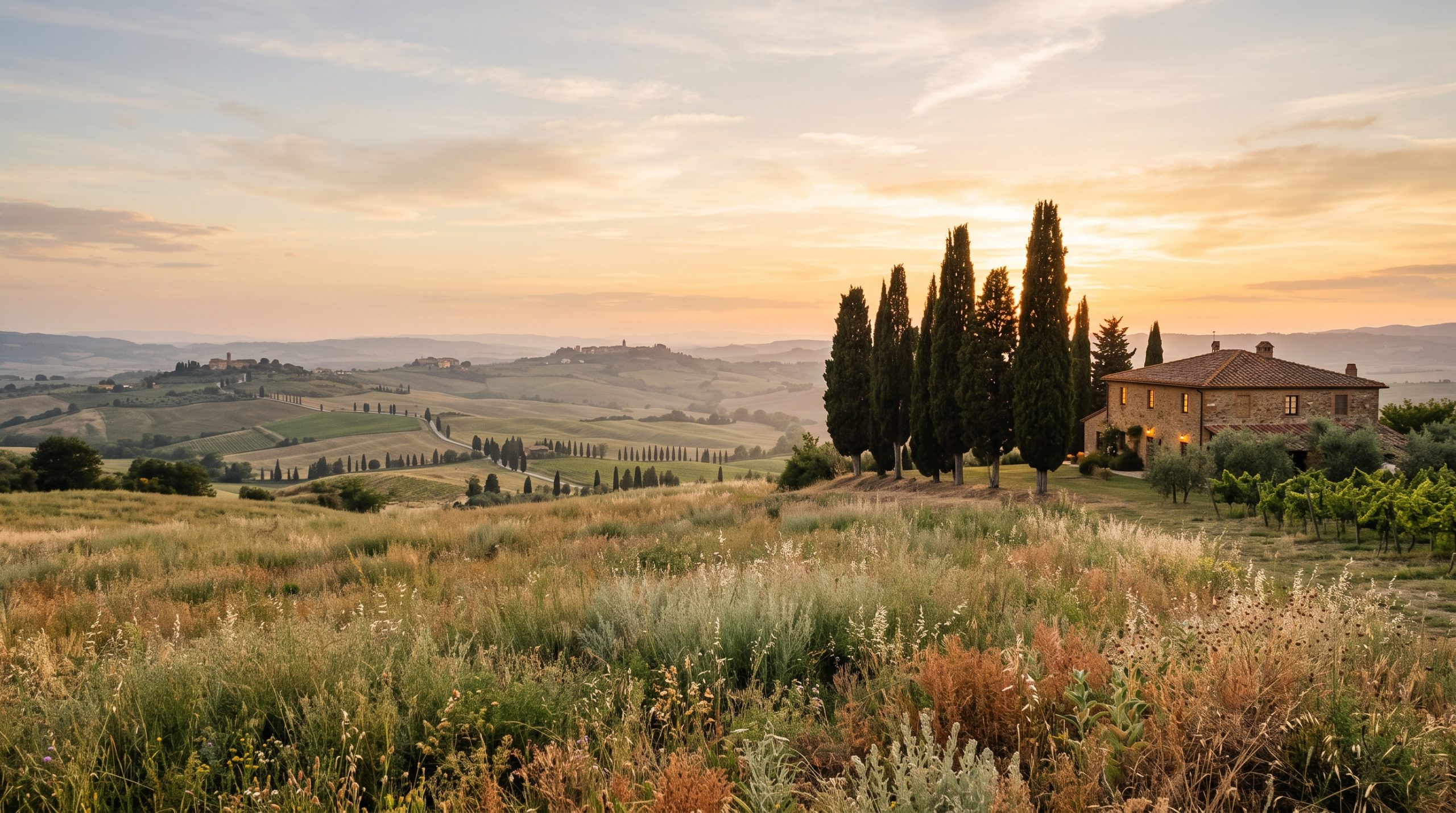
Mid-September in the Val d’Orcia, the sun goes behind the hills at around 19:25. Start a ceremony at 18:40 and you get all of that last light, the ridges below Pienza holding it long after the valley floor has gone soft and blue. Nobody standing there is holding a document. Nothing is signed, stamped, translated or filed.
That is a symbolic ceremony. It has no standing in Italian law, which sounds like a limitation and is in fact the reason so many couples choose it. Your legal marriage happens at home, on an ordinary weekday, at the office that issues licenses where you live. Then you fly to Tuscany and hold the ceremony that carries the meaning, in a place a registrar could not reach and at an hour no public office works.
The paperwork question arrives in the first email almost every time, so here is the whole of it. What you collect at home, what the ground itself requires, and what changes if you want the legal marriage to happen in Italy as well.
Which country your marriage certificate comes from
A symbolic ceremony in Tuscany creates no legal marriage, so it needs no Italian paperwork at all. No nulla osta, no sworn affidavit, no appointment at a town hall. Couples marry legally at home first, then hold the ceremony here. The certificate comes from your own county or state, and Italy never sees it.
The difficulty rating: pleasantly boring
On a scale that runs from straightforward to not realistically available, this sits at the easy end, and it stays there. There is no notice period, no residency rule, no translation to commission, no office whose opening hours dictate your date. The only real constraints on a symbolic ceremony in Tuscany are access to the ground you want to stand on and the hour the light works. A Tuesday in October is as available to you as a Saturday in June. Those are our constraints, not a registrar’s, and they are where our planning goes.
Our role is to plan and document the elopement, not to interpret the law for your individual case. Confirm the final requirements for your circumstances with the relevant registry office or consulate before travel is fixed.
The paperwork, in the order you collect it
All of this happens before you leave home, and none of it travels with you except as a memory and, if you like, a photograph of a courthouse corridor.
- Your marriage license, from the office that issues them where you live. License rules are set state by state. Several states run a short waiting period between issue and ceremony, and every license carries an expiry, so this one sits inside a validity window and is worth reading twice.
- The legal ceremony at home. A clerk’s office or a judge’s chambers, whoever your state authorizes, with whatever witnesses your state requires. Many couples do this quietly with two people, months before Tuscany, and treat it as an errand rather than an event.
- Certified copies of your marriage certificate. Order more than one. You will want them for name changes, insurance and banks long before you want them for anything to do with travel.
- An apostille on that certificate, only if something later asks for it. In the United States the apostille comes from the Secretary of State of the state that issued the certificate. Nothing about a symbolic ceremony in Italy requires it. It matters only if a foreign authority ever needs to accept your marriage, and it is cheap peace of mind if you already know you will move abroad.
- Nothing filed in Italy. No declaration of intention to marry, no consular affidavit, no comune appointment, no sworn translator. This is the step people keep looking for and it genuinely is not there.
- Written permission for the place you will stand. This is the only document the Tuscan day actually needs, and it is not a government form. It is an email or a contract from the estate, the farm or the comune that controls the ground, naming your date, your hours and how many people are coming.
If you are working out the shape of the whole trip rather than just the legal side, our guide to how to plan an elopement covers the sequencing: date, place, coverage, then the practical layer.
Permission belongs to the land, not to the ceremony
Here is the part that surprises couples. Removing the legal machinery does not remove permissions, it just moves them. In Tuscany, permission attaches to the ground.
Almost everything that looks like open countryside between Pienza, San Quirico d’Orcia and Montalcino is a working farm with a name, a gate and an owner. The cypress rows are planted on somebody’s land. The white gravel strade bianche are public where they are roads and private where they turn into farm tracks. The farmhouse on the rise that you have seen a thousand times online is a house, with people asleep in it at 06:50 when the light is at its best. Standing on the verge of a public road with a camera is one thing. Setting up a ceremony in the field behind it is another, and it needs a yes from the person who farms it.
Private estates are the straightforward route, which is why we build most Tuscan ceremonies on them. A podere, an agriturismo or a vineyard estate can host a ceremony anywhere on its property, at any hour, in any format, because the owner decides. What you are buying there is a written slot, and the written slot is what makes an 06:00 ceremony in an olive terrace possible at all.
Public ground works differently. Town squares, municipal gardens and belvederes belong to the comune, and every comune sets its own rules about who may occupy them, when and for how long. Some will happily authorize a small gathering with an application in advance. Some will not authorize ceremonies in their squares at any price. There is no single Tuscan answer, only the answer from the comune that owns that particular patch of paving, in writing, before it goes in your timeline. We do that research and hand you the request that needs to be signed.
Three smaller permissions ride along with the day. Live or amplified music at an Italian venue usually involves a music licence handled through SIAE, the Italian authors’ and publishers’ society, and any established estate will tell you who files it. Aerials fly only where the airspace and the landowner both allow it, so we confirm both before we build any of the film around a drone. And if you want clergy involved in a blessing, ask early what your officiant’s own church requires, because a religious ceremony in Italy performed by non-Roman Catholic clergy sits on top of a civil ceremony rather than replacing it. Guest numbers change none of our fee and quite a lot of the access question: twelve people on a hilltop chapel terrace is a different conversation with a landowner than two. What each experience includes is set out on our pricing page.
Build the Tuscany day around the light, not a registrar
Everything in a symbolic day hangs off one number, and that number is the sunset time for your specific date. In the Val d’Orcia the sun sets at about 20:30 in mid-May, just before 21:00 at the solstice, 19:25 in mid-September and 18:40 by the middle of October. Ceremony hour goes roughly forty minutes before that, so the vows land in warm light and the walk afterwards uses the last of it. On a June date, that puts your ceremony after 20:00 and dinner very late, which is either the best part of the plan or a reason to look at September.
| What has to be in place | Real minimum | What we would work to |
|---|---|---|
| Date held with us and with the site | Whenever both are still open | 9 to 18 months out |
| Written site access naming date, hours and headcount | A few weeks, for a small estate in a quiet month | 6 months out |
| Legal marriage completed at home | Any time before or after the Tuscan ceremony | 4 to 8 weeks before you fly |
| Celebrant booked and the script written with you | 3 to 4 weeks | 3 months out |
| Ceremony hour fixed against the sunset time for the date | 2 weeks | Set in the proposal, confirmed 3 weeks out |
| Road access, drivers, town-centre vehicle permissions | Days | 2 weeks out |
The honest minimum for the legal side is close to nothing, because it is finished at home before Tuscany is involved. The real lead time is the estate and the calendar. We are currently booking 2027, 2028 and 2029, and the Saturdays in late May, June and September go first.
The ceremony hour is also the one place our own structure matters. Good light in the Val d’Orcia lasts about twenty-five minutes, and a symbolic ceremony is short by nature. With a dedicated photographer and a dedicated filmmaker both working that single window, you say your vows once, at the right hour, and neither of you is asked to repeat a moment for a second camera. You can see how that reads in our published films and galleries, where the ceremony light and the walk afterwards are usually the same twenty minutes.
Where couples get caught out in Tuscany
None of these are hard. They are simply the things that are easier to fix nine months out than nine days out.
- A venue saying it is licensed for weddings. That authorization is granted by the comune to the site, and it is the comune’s registry office that confirms whether it still stands. If you have chosen the symbolic route, this stops mattering entirely, which is a quiet argument in the symbolic route’s favor.
- Trusting the almanac over the ridge. Published sunset times assume a flat horizon. West of Pienza the sun disappears behind higher ground well before the official minute, and the difference between a ceremony at 18:40 and one at 19:10 is the difference between gold and grey. We scout the actual sightline for your date.
- Planning a first look in a field that belongs to somebody. Ask, and Tuscan farmers are frequently generous. Arrive with a dress and a tripod and no conversation, and you are the third group that week.
- Mid-August. The 15th of August is a national holiday in Italy, and the days around it are the quietest week of the year for offices and the busiest for family-run estates. Nothing to be afraid of, just not the week to stack anything that needs a stranger to answer an email.
- The historic centres. Florence and Siena both restrict vehicle access to their old cores. If your day involves a car anywhere near the middle of either, the plate needs registering in advance, and hotels and licensed drivers do this as routine when they are asked in good time.
- Assuming the legal route has the same flexibility. It does not, and if you are considering it, the windows and office hours below are the whole game.
Send us the date and the corner of Tuscany you have in mind, and we will tell you what the light does that week and what the ground will allow. Check Your Date.
If you want the legal marriage in Italy as well
Some couples want the certificate to say Italy, and it is entirely doable. It is also the fiddly option, and it runs on windows and opening hours rather than on your calendar. For U.S. citizens marrying in the Florence consular district, the chain published by the U.S. Consulate General in Florence and by the Italian consulates in the United States runs in this order.
- Long-form birth certificates, apostilled and translated. The Italian consular guidance for U.S. citizens asks for certified long-form birth certificates legalized with an apostille and translated into Italian, plus evidence that any previous marriage has ended. The translation is not a job for a friend who speaks Italian; ask the office that will receive it who it accepts.
- The Atto Notorio. Taken at the Italian consulate with jurisdiction over where you live, it is sworn by four witnesses who must be over 18, unrelated to either of you and to each other, and present in person with valid passports. It must be executed within three months of the wedding, so this is the deadline you count backwards from. It can also be done in Italy at the Ufficio Atti Notori of a court, and the Florence tribunale runs that office only on Monday, Wednesday and Friday from 12:00 to 13:00, by appointment. If any party or witness does not speak Italian, an interpreter is required.
- The Dichiarazione Giurata. A sworn statement made at a notarial appointment at the U.S. Consulate General in Florence, Lungarno Vespucci 38.
- Legalization of that statement at the Prefettura. The Florence legalization office sits at Via Antonio Giacomini 8, second floor, room 27, and opens weekday mornings from 9:00. It is a separate errand on a separate day from the consulate.
- The Declaration of Intention to Marry. Made in person before a civil registrar at the marriage office of the comune where you will marry, with the full file in hand.
- The apostille on your Italian marriage certificate. Done after the wedding, and it is what makes the Italian certificate usable at home.
Two practical notes on top of the chain. Each comune sets its own tariff for non-residents and its own list of rooms and outdoor sites where its registrar will officiate, so ask that specific comune for the current figure and the current list in writing rather than taking a venue’s word for either. And for same-sex couples the equivalent legal route in Italy is a civil union rather than a marriage; the U.S. Consulate in Florence publishes that document chain separately, and it has the same shape. A symbolic ceremony draws no distinction of any kind and needs none of it.
Administrative prices and deadlines can shift between seasons. Re-check the current amount and deadline with the issuing office before you lock in flights or appointments for symbolic ceremony in tuscany.
Common questions
Is a symbolic ceremony in Tuscany legally binding?
No. It creates no marriage under Italian law and no record anywhere. That is why it needs no documents. Couples who want to be legally married complete that at home, usually well before they fly, and the Tuscan ceremony is the one they invite people to and remember.
Do we need a permit for a symbolic ceremony in the Val d’Orcia?
Not from any government office, but you do need permission from whoever controls the ground. On a private podere or vineyard estate that is the owner’s written yes. In a town square or municipal garden it is an authorization from that comune, applied for in advance, and some comuni say no to ceremonies in their squares regardless of the fee.
Can we marry legally at home and still have our real ceremony in Italy?
Yes, and it is the most common route for American couples in Tuscany. The two events are unconnected in law. Nobody in Italy needs to see your certificate, and nothing about being already married limits what the ceremony can be, where it is held or who officiates it.
Who can officiate a symbolic ceremony in Tuscany?
Anyone you choose, because no legal authority is involved. Most couples book an English-speaking celebrant who writes the script with them over several months. Others ask a friend or a sibling. If you want clergy for a blessing, check what their own church requires of a couple already married.
Do we need witnesses for a symbolic ceremony?
No. Witnesses are a legal requirement, and there is no legal act here to witness. Plenty of couples do it entirely alone, which changes the timeline and the access questions but not the fee. If you do bring two people, they can stand wherever they like.
Do our documents need translating into Italian?
Not for a symbolic ceremony, because no Italian office receives them. Translation and apostille requirements belong to the legal route, where the Italian consular guidance asks for apostilled long-form birth certificates translated into Italian and accepted by the office that receives the file.
Can two women or two men have a symbolic ceremony in Tuscany?
Yes, with no additional steps and no different treatment. Because the ceremony has no legal effect, it sits outside the distinction Italian law draws between marriage and civil union. Celebrants, estates and our own team plan it exactly as any other day.
How far ahead should we book a Tuscany elopement?
Nine to eighteen months is comfortable, and the constraint is the estate and our calendar rather than any legal notice period. We are booking 2027, 2028 and 2029 now, and late May, June and September Saturdays are the first to go. Shorter notice is worth asking about, especially midweek and outside high summer.
What we can hold for the day and what remains yours
Ours is the planning layer. Destination and location design, permit research and the logistics guidance around it, a timeline built backwards from the sunset time for your date, weather alternatives held ready, and the date held against site availability while the details settle. Then photography and film from one team, with highlights in 5 days and the full gallery or film in 3 weeks. Yours is the legal marriage at home, any permit fees the comune or landowner charges, your celebrant, your accommodation and your vendors. We do not file documents on anyone’s behalf, and nobody should promise you otherwise. If you want more of the region before you decide, our destination elopement guides go deeper on where and when.
Everything with us happens in writing. Send the inquiry form, and you get a reply and our first brochure within 24 hours, then a proposal built around your date, your place and the hour the light works there. A signed contract and a 30% retainer start the planning. Tell us the week you are thinking about and what you want the ceremony to feel like, and we will tell you honestly whether that corner of Tuscany gives it to you in that month or whether another one does it better. Tell Us Your Story.