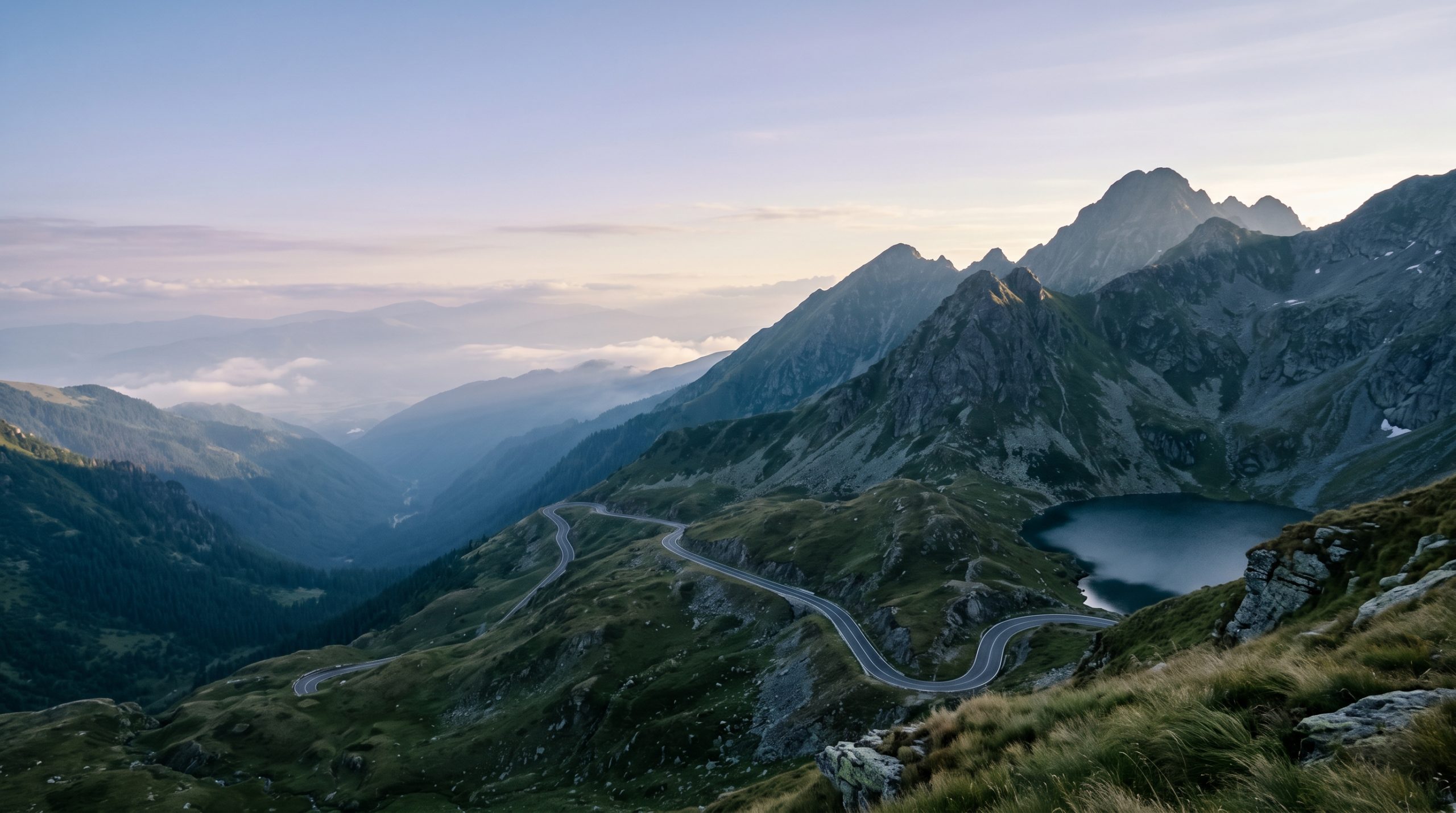
The high stretch of the Transfăgărășan opens at seven in the morning. Not seven-ish. Romania’s road administrator allows traffic between Bâlea Cascadă and Piscul Negru daily from 07:00 to 21:00, and in the last week of June the sun is up by about half past five. The best ninety minutes of light in the whole day happen behind a closed gate.
That one piece of arithmetic shapes more Carpathian elopement days than anything else about Romania. It is why couples who want Bâlea Lake at first light in July sleep at 2,034 meters, in a chalet resupplied by the cable car, and why the same day in late September starts with coffee in a valley guesthouse: sunrise then falls at about 07:11, roughly ten minutes after the gate lifts.
The Carpathians arc through several countries. Ours are the Romanian ones. The Făgăraș above the lake, the limestone ridge of Piatra Craiului and the hay meadows of Măgura and Peștera below it, the Parâng where the Transalpina crosses Urdele Pass at 2,145 meters. This page covers what photography and film here costs, and how the day around it gets built.
What we cover between Sibiu and Brașov
We plan, photograph and film elopements across the Romanian Carpathians, from Bâlea Lake in the Făgăraș to the meadow villages under Piatra Craiului. Photography, film and planning come from one eight-person team, not a photographer plus a separately hired videographer. A full day of coverage starts at $4,900, and team travel to Romania is included.
From the seven o’clock gate to the last light
Take the last week of September, the window we suggest most often in the Făgăraș. Sunrise at the lake lands at about 07:11, sunset at about 19:13, and there is workable light for another half hour past that. Twelve hours, beginning at the moment the barrier goes up.
06:20. Dressed in a village on the northern approach, then up to the cable car station at Bâlea Cascadă, 1,234 meters. Rings, vows, shoes in a bag, one flask of something warm. Nobody is at the gate yet except two motorcyclists warming their engines.
07:00. The barrier lifts and the road climbs 800 meters of vertical in switchbacks to the lake. The cable car covers the same rise in 3.7 kilometers of cable and does not start running until mid-morning, which is precisely why this hour belongs to whoever drove it.
07:15 to 08:15. Light hits the cirque wall above the water before it reaches the shore, so we work the ridge line first and bring you into the sun as it comes down the scree. The lake is silent at this hour. The terrace is shut and the first coaches are still two hours below.
08:30. Vows on the far shore, in the lee of the moraine where the wind drops enough to record them properly. This is a decision made the day before, on the spot, with a hand held up to feel which way the air is moving through the saddle.
09:40. We leave while the road is still ours. The frame everyone knows, the hairpins seen from above the tunnel, is flat and crowded by eleven o’clock and worth about four minutes of your day at that hour. At 07:20 the same view has shadow in the folds and one car on it.
10:30. Breakfast, and a change of world on the way down. At 900 meters there is grass, spruce, sheep bells and warmth. In July we treat the middle of the day as a rest deliberately, because cloud builds over the Făgăraș ridge through the afternoon and the low ground is where the pictures are.
15:30 to 17:30. Piatra Craiului. The limestone crest runs more than 25 kilometers and stands above 2,000 meters, and the villages under it, Măgura, Peștera, Șirnea, still cut hay by hand into wooden barns. This is the part of the day couples do not expect to love most, and often do. A walk into the gorge below Zărnești puts vertical rock on both sides of you within twenty minutes of the car.
18:40 to 19:45. Back up onto open ground for the last of the sun on the ridge, then the half hour after sunset when the meadows go blue and the barns go black. Dinner in a guesthouse afterwards, which is usually where the film finds its quiet ending.
| Window | Sunrise at the lake | The high road | What it gives you |
|---|---|---|---|
| Mid to late June | About 05:30 | Usually reopens this month, then 07:00 to 21:00 | Long days, light until nearly 22:00, first light at the lake only if you sleep up there |
| July and August | 05:45 to 06:20 | Open, 07:00 to 21:00 | Warmest ground, busiest lake by mid-morning, afternoon cloud over the ridge |
| Late September | About 07:11 | Open | Gate and sunrise line up, clear air, first color on the beech |
| October | About 07:30 | Open until winter shuts the high stretch, sometimes by around the twentieth | Larch and beech color, short crisp days, empty roads |
| November to May | Later, and lower light | High stretch closed for the season | Snow at 2,034 meters reached by cable car, and valley villages at their most Carpathian |
When the lake is inside a cloud
This is the thing couples write to us about most often, and it deserves a straight answer. At 2,034 meters the Făgăraș makes its own weather. Some mornings the lake is a white room with a shoreline in it, and no amount of planning changes that.
What planning does change is what else is available to you that morning. The meadows under Piatra Craiului sit near 1,000 meters and are frequently clear while the pass is not, and they are a genuine second act rather than a consolation. Some of the strongest mornings we have had here were inversions, where the cloud sat below the waterfall station and the lake stood in sun above a white floor. We build every Carpathian day with two altitudes in it and a sheltered alternative inside a short drive, so the decision on the morning is a choice between two good options rather than a scramble.
We watch the pattern for several days before, not just the night before, and we will flip the order of your day if that is what the sky is doing. You are not the one making that decision at five in the morning. That is what the planning half of this work is for, and it is the same thinking we apply in our destination guides before a date is ever held.
Two cameras above the hairpins
Here is what a compressed morning does to a two-vendor booking. You have one hour of first light at the lake and it opens at 07:00 sharp. A photographer needs you moving, turning, stopping where the light is. A filmmaker needs twenty unbroken seconds of the same thing, from a different distance, with sound. When those two people have never worked together, that hour becomes a negotiation conducted in front of you, in the wind, at 2,034 meters.
We do it as one team with one timeline. The photographer and filmmaker on your day know which of them takes the first pass at the shoreline and which waits at the moraine, because they planned the hour together weeks earlier and have run it in worse weather than yours. There are eight of us, so there is always a second camera on the ground and a colleague in reserve.
The specific gains in this landscape are concrete. Wind through the saddle above Bâlea is the enemy of vow audio, so on an Expedition day we bring professional audio and choose the ceremony spot for shelter first and view second, which only works if the person recording it helped pick the place. Aerials over the hairpins are the one moving image that says Transfăgărășan and nothing else, and they run under EU drone rules with Romanian operator registration and, in the open category, in daylight, so we confirm the window before the film is designed around them. Cloud moving through the cirque changes the whole scene in four minutes, and having two people already in position means one of them is filming the reveal while the other is making the frame you will print.
Our published galleries and films are the honest version of this. Look at how the ridge light behaves early, how much of the day is grass and barns rather than granite, and how the audio sits under a wide shot when it was recorded properly. That is the work, not a mood board of it.
If a Carpathian date is somewhere in your head for 2027, tell us the month and we will tell you what the light and the road are doing in it. Send Us a Message and you will have a reply and our brochure inside a day.
What travels into the Carpathians with us, and where coverage begins
Every experience we run, in Romania and everywhere else, includes the following.
- Destination and location design, from the region down to which shore of which lake at which hour.
- A custom timeline built around real light and real travel time, including gate hours, cable car hours and the drive between altitudes.
- Permit research and logistics guidance for parks, landowners and protected ground.
- Weather alternatives and backup planning, with a second altitude built into the day.
- Drone footage where it is legal, safe and appropriate.
- Professional audio for vows and meaningful moments on an Expedition day, where conditions allow.
- Team travel worldwide, which here means flights, accommodation and ordinary travel for the assigned team into Romania, with no long-haul surcharge.
- Highlights delivered in 5 days, and the full gallery or film in 3 weeks.
The price does not move with your guest count. Six people on the shore instead of two changes access, permits, transport and the shape of the timeline, and all of that is our problem to solve, but it does not change the fee.
The Adventure is one full day with one dedicated photographer or one dedicated filmmaker. The Expedition is one full day with a dedicated photographer and filmmaker working the same timeline together, from $7,900. The Odyssey runs two to seven days across one or several destinations, photography and film, and is quoted as a custom proposal. There is no half-day version of any of them, in the Carpathians least of all, because the day starts at a gate and ends after dusk. Full figures sit on the pricing page.
What you pay locally, on top of coverage, is short and specific here.
- The cable car at Bâlea Cascadă, currently around 50 lei per person each way, cash in lei being the safe assumption at the station. That is a little over ten dollars at recent rates.
- Accommodation, including a night at the lake at 2,034 meters if you want first light there in high summer.
- Your celebrant or officiant, and any vendors for flowers, hair or dinner.
- Government, venue and landowner permit fees where a location carries them. Peleș, for instance, publishes its own professional photography charge and treats interior images as personal use only, which is why we build castle hours around the terraces and forecourt and keep the vows in the mountains.
- Unusual transport, if you want it: a 4×4 up a shepherd track, horses in the meadows, a private transfer over the pass.
How a Carpathian film enquiry becomes a held date
- You send the inquiry form with your month, your rough idea and how many people are coming.
- We reply within 24 hours with an initial brochure and our first read on whether that month works in the Carpathians.
- We build a tailored proposal around the day you actually want, with the coverage that fits it.
- You sign the contract and pay a 30% retainer, and the date is yours. The remaining payments are set out in the proposal.
- Planning starts: locations, the hour-by-hour timeline, permit research, accommodation logic, the weather alternative.
- We photograph and film the day, then deliver highlights in 5 days and the full gallery or film in 3 weeks.
Who these mountains reward
Couples who are content to be awake at half past five and standing at a barrier at ten to seven. Couples who are steady on wet limestone and tussock grass, since almost nothing here is a paved viewpoint. Couples who can hear at breakfast that the plan has inverted and treat that as part of the adventure rather than a failure.
If a pre-dawn start is not your idea of a good morning, say so and we will move the date into late September or October, when sunrise arrives after seven and the day is gentler by the calendar rather than by compromise. If hairpins and altitude do not appeal at all, the Piatra Craiului meadows and the Bucegi plateau give you the Carpathians at a walking pace, with the ridge as a backdrop instead of a summit. If you want deep snow and a cable car ride rather than a mountain road, that is a winter day and it is a different, quieter film. Tell us which of those you are, and we will shape the day around it or tell you honestly which month fits it better. Our notes on how to plan an elopement cover the groundwork either way.
Common questions
When does the Transfăgărășan actually open, and can we plan a June date?
The high stretch between Bâlea Cascadă and Piscul Negru is a seasonal road. It has reopened in the first and the second week of June in recent years, and it has closed again for winter as early as around the twentieth of October. We plan early June and late October days from below, using the cable car for anything at the lake, and only build a driving day over the pass once the road is confirmed open.
Can we legally get married in the Carpathians, or is it a vow ceremony?
Romania recognizes civil marriage performed by a registrar at a town hall, with translated and authenticated documents, so the mountain itself is not where the paperwork happens. Most couples we work with sign at home or in a town hall in Sibiu or Brașov and hold the real ceremony on the ridge or in the meadows, with a celebrant and their own words.
Can you fly a drone over Bâlea Lake?
Aerials in Romania run under EU drone rules with Romanian operator registration, and open category flights are daylight operations. Protected ground and some viewpoints carry their own permissions. We check what applies to your specific locations while the timeline is being built, and design the film so it is complete whether or not the aerials happen on the day.
What happens if the pass is closed by weather on our date?
We move down. Every Carpathian day we plan has a second altitude in it, usually the meadow villages under Piatra Craiului near 1,000 meters, reachable in well under an hour from the north side of the range. Your timeline is written so that switching to it costs you nothing except the order of the day.
Which airport should we fly into?
Sibiu is the closest to the northern approach of the Transfăgărășan. Brașov-Ghimbav opened in June 2023 and now handles well over 300,000 passengers a year, which makes the Piatra Craiului and Bucegi side much simpler than it used to be. Bucharest and Cluj give you the widest choice of long-haul connections.
How many days should we spend in Romania?
Four nights is the shape that works: arrive, one spare day for jet lag and a scout, the elopement day, then a buffer in case the sky says to swap. If you want two or three shooting days across the Făgăraș, Piatra Craiului and the Transalpina, that is an Odyssey and we build it as one route.
How much walking is involved?
Less than couples expect. The lake is a short walk from where the road ends, and the gorge below Zărnești puts you between limestone walls twenty minutes from the car. If you want a genuine ridge day above 2,000 meters, we plan it with a mountain guide and a longer window.
Do guests change what we pay?
No. Coverage is priced by the day and the team working it, not by headcount, and the same figures hold whether it is the two of you or a dozen people. Guests do change access, permit paperwork, transport and how long each move takes, and we plan all of that in.
Start with the month, then the mountain
Tell us the season you have in mind and we will tell you what the gate, the light and the ridge are doing in it, before you commit to anything. We keep every planning decision in writing, at whatever hour suits you on your side of the Atlantic: your message, our reply and brochure within 24 hours, then a proposal you can read twice. Dates are currently open across our 2027, 2028 and 2029 Carpathians seasons, and most Făgăraș dates get planned a good year out. Check Your Date and we will start with the month.